
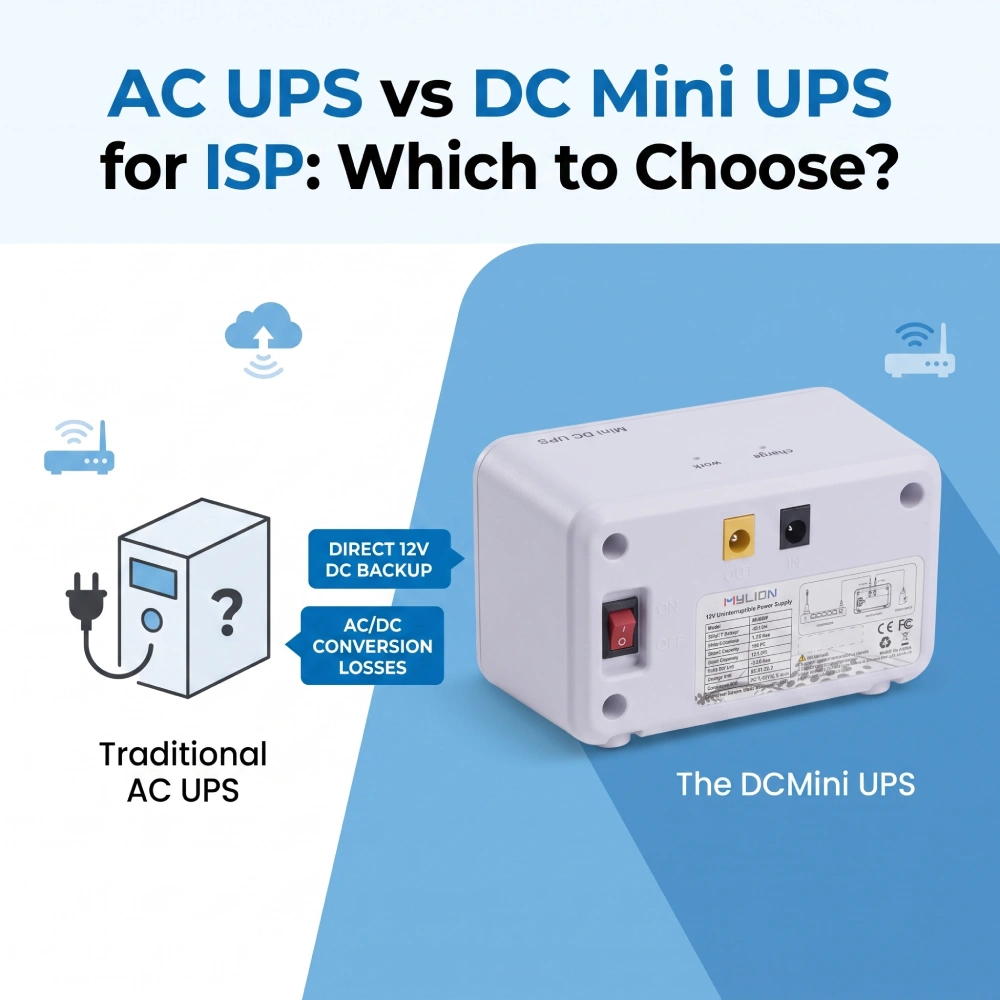
Para los ISP, el tiempo de actividad de la red no es solo una métrica técnica; es la base de la retención de clientes y la reputación de la marca. Para combatir las fluctuaciones de energía y los cortes de la red, los ISP implementan Sistemas UPS en toda su infraestructura.
Sin embargo, los arquitectos de redes se enfrentan a una elección crítica: implementar tecnologías tradicionales. UPS de CA para ISP infraestructura básica versus moderna Sistemas mini UPS de CC en el borde de la red. Si bien los sistemas UPS de CA siguen siendo el estándar para el respaldo a nivel macro, la rápida expansión de las redes FTTH y de borde ha desplazado los requisitos de energía hacia los sistemas UPS de CC para las implementaciones de módems y enrutadores de banda ancha.
Esta guía desglosa las variables técnicas y financieras del diseño de energía de telecomunicaciones, destacando exactamente cuándo un ISP debería confiar en un UPS de CA y por qué las redes de borde modernas están haciendo una rápida transición a Soluciones mini UPS de CC como el Mylion Mini UPS.
Comprender los fundamentos: Impulsando la infraestructura de los proveedores de servicios de Internet (ISP)
Para tomar decisiones estratégicas de despliegue, es crucial comprender cómo fluye la energía a través de la infraestructura de telecomunicaciones. La red eléctrica comercial suministra energía en corriente alterna (CA), que periódicamente invierte su dirección. Sin embargo, casi todos los equipos modernos de telecomunicaciones y redes, desde los enormes enrutadores centrales hasta las pequeñas ONT en la sala de estar de un cliente, funcionan de forma nativa con corriente continua (CC).
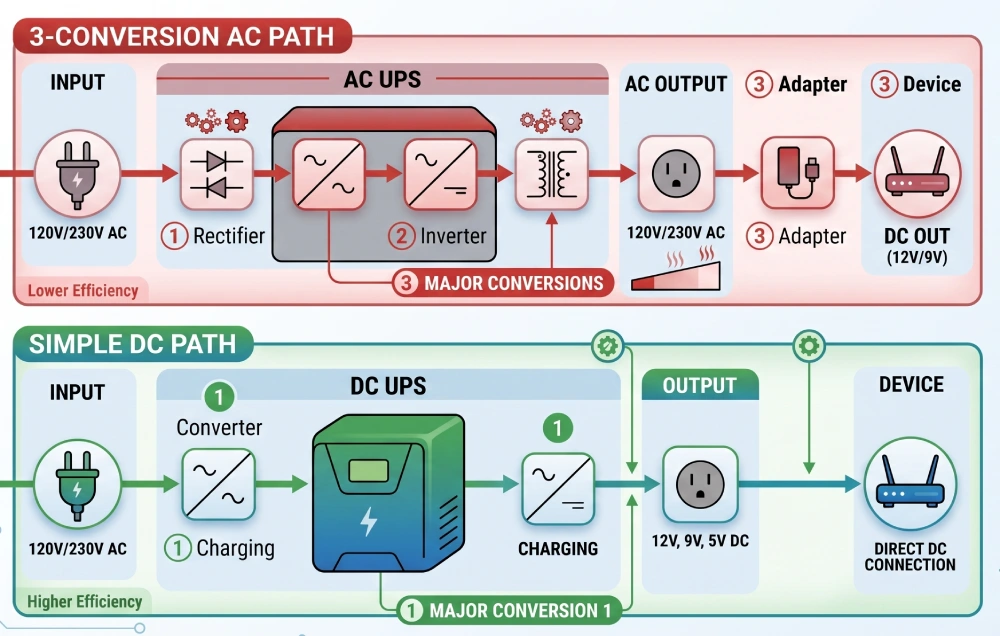
Un SAI de CA Toma corriente alterna de la red eléctrica, la convierte en corriente continua para cargar su batería interna y luego la invierte de nuevo a corriente alterna para suministrarla a los dispositivos conectados.
Un mini SAI de CCPor otro lado, toma la corriente alterna de la red eléctrica, la convierte en corriente continua para cargar su batería y suministra corriente continua directamente al dispositivo de red. Esto elimina por completo la etapa final de inversión, creando una solución de respaldo de energía optimizada y altamente eficiente para las redes perimetrales de los proveedores de servicios de Internet.
3 escenarios en los que los proveedores de servicios de Internet deberían elegir un SAI de CA
A pesar de la creciente popularidad de los sistemas de microalimentación de CC en el extremo de la red, los sistemas UPS de CA tradicionales siguen siendo insustituibles en varios escenarios de infraestructura crítica. Los arquitectos de red deben especificar implementaciones de UPS de CA bajo las siguientes condiciones:
Infraestructura central de alta potencia
En el corazón de la red de cualquier proveedor de servicios de Internet (ISP) se encuentran los centros de datos, las centrales telefónicas y los puntos de presencia (PoP) principales. Estos entornos albergan enormes enrutadores centrales, conmutadores de red de alto rendimiento y densos racks de servidores que requieren miles de vatios de potencia.
Los sistemas UPS de CA a gran escala, que a menudo funcionan en paralelo y están respaldados por generadores diésel, son las únicas soluciones capaces de gestionar los enormes requisitos de carga, las necesidades de disipación térmica y la distribución de energía trifásica que exige la infraestructura central de telecomunicaciones.
Compatibilidad con equipos heredados
Muchos proveedores de servicios de Internet (ISP) aún utilizan hardware obsoleto en sus centros de distribución. Los gateways de telecomunicaciones más antiguos, los multiplexores de acceso DSL (DSLAM) de línea de cobre heredados y los equipos de diagnóstico especializados suelen tener fuentes de alimentación integradas solo de CA, sin opciones de entrada de CC.
Cuando un nodo de infraestructura contiene hardware altamente especializado o antiguo que requiere estrictamente un voltaje de CA estándar de 110 V/220 V, un SAI de CA es obligatorio para garantizar la compatibilidad sin anular las garantías ni requerir adaptaciones electrónicas personalizadas.
Entornos con dispositivos mixtos
Muchas oficinas de campo, puntos de presencia (POP) y centros regionales de los proveedores de servicios de Internet (ISP) contienen una combinación de tipos de equipos: ordenadores de sobremesa, monitores, conmutadores de red y equipos de enrutamiento junto con equipos de telecomunicaciones.
En estos entornos, un único SAI de CA puede dar respaldo a varios tipos de dispositivos simultáneamente. Funciona como una red de seguridad eléctrica universal que puede mantener en funcionamiento todo el entorno físico durante un fallo de la red eléctrica, no solo los paquetes de datos.
UPS de CA frente a mini UPS de CC para ISP: Matriz de implementación por nivel de red
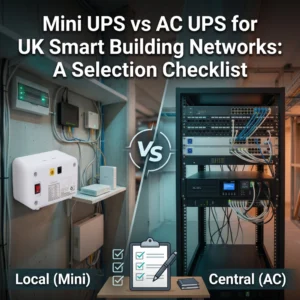
Para optimizar la planificación de la infraestructura, los arquitectos de red pueden consultar esta matriz de despliegue optimizada. Alinea el método de suministro de energía correcto con niveles de red específicos, asegurando que los sistemas de CA de servicio pesado permanezcan en el núcleo, mientras que las soluciones ágiles y de conversión cero, como Mini SAI Mylion dominar el borde.
Escenario de despliegue | Solución recomendada | Justificación principal |
Centros de datos y oficinas centrales | UPS de CA | Alta potencia, necesidades de alimentación trifásica, cargas informáticas complejas. |
Concentradores de hardware heredados | UPS de CA | Requisito estricto para entradas estándar de 110V/220V. |
Instalaciones de uso mixto | UPS de CA | Es necesario suministrar energía tanto a los equipos informáticos como a los electrodomésticos estándar de las instalaciones. |
Equipo de las instalaciones del cliente (CPE) | Mini UPS de CC | Tamaño compacto, elimina la pérdida de conversión, alimentación directa del router. |
Terminales de red óptica FTTH | Mini UPS de CC | Se adapta a armarios de cableado, alta eficiencia, escalabilidad rentable. |
Puntos de acceso PoE remotos | Mini UPS de CC | Suministro nativo de CC, capacidades de inyección PoE integradas. |
¿Por qué el mini SAI de CC está dominando las redes perimetrales de los proveedores de servicios de Internet?
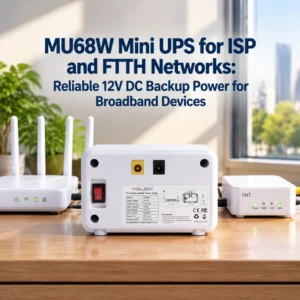
Para resolver el problema de la alimentación en el borde de la red, los proveedores de servicios de Internet (ISP) con visión de futuro están abandonando las voluminosas unidades de CA en favor de soluciones específicas. micropotencia de CC soluciones. Al suministrar energía de CC directamente a los dispositivos de borde alimentados por CC, incluidos enrutadores, ONT, y CPE—Los proveedores de servicios de Internet (ISP) eliminan las pérdidas por conversión, reducen la infraestructura de equipos y mejoran la experiencia del usuario final.
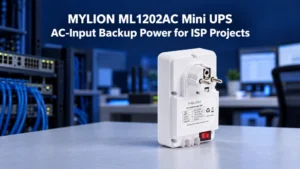
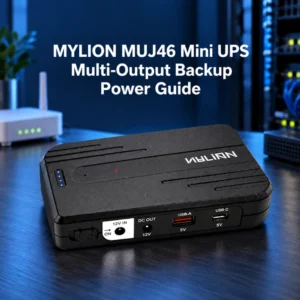
Aquí es donde el Mini SAI Mylion se ha convertido en un activo estratégico para los operadores de telecomunicaciones. Diseñado específicamente para resiliencia de la red del ISP, el Mylion Mini UPS se integra directamente entre la toma de pared y el CPE (como un enrutador, módem o ONT), ofreciendo varias ventajas distintivas:
- Eficiencia de potencia directa:Al proporcionar voltajes de CC exactos (comúnmente 5V, 9V o 12V), Mylion elimina la penalización de la doble conversión. Mini UPS de CC para router Suministra energía de forma eficiente desde la batería directamente a la placa base del router.
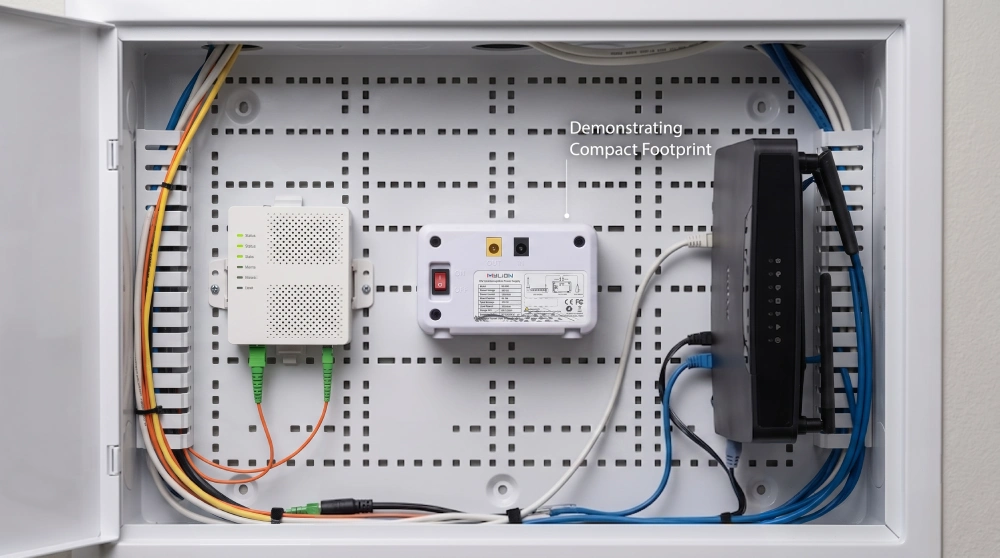
- Diseño compacto y escalabilidad:Con unas dimensiones que representan una fracción del tamaño de las unidades de aire acondicionado tradicionales, Mini UPS para ISP Los dispositivos se pueden instalar fácilmente dentro de gabinetes de cableado estructurado.
- Tecnología avanzada de litio:A diferencia de las baterías SLA tradicionales que se estropean después de dos años, Mylion utiliza Batería de LiFePO₄ tecnología, proporcionando más tiempo Alimentación de respaldo para FTTH
- Capacidades PoE:Algunos modelos de Mylion incluyen soporte PoE integrado, lo que permite a los proveedores de servicios de Internet alimentar antenas exteriores remotas, puntos de acceso inalámbricos o teléfonos VoIP.
Al garantizar que la conexión Wi-Fi y de fibra óptica local permanezca activa incluso cuando se produce un corte de energía en el vecindario, los proveedores de servicios de Internet (ISP) aprovechan los productos de Mylion para mantener los acuerdos de nivel de servicio (SLA) y mantener a los clientes conectados durante emergencias críticas.
Preguntas frecuentes
P1: ¿Puedo usar un mini SAI de CC para alimentar equipos de CA?
P2: ¿Puedo usar un SAI de CA para alimentar routers y ONT de CC?
P3: ¿Qué autonomía de respaldo puedo esperar de un SAI Mylion Mini DC?
P4: ¿Las unidades Mylion Mini UPS admiten múltiples salidas de voltaje?
P5: ¿Qué tecnología de baterías utilizan las unidades UPS Mylion Mini?
P6: ¿Es importante el tiempo de transferencia cero para los equipos de los proveedores de servicios de Internet?
Conclusión
La arquitectura de la entrega de Internet moderna se está acercando al consumidor, lo que hace que fiabilidad de la red perimetral más crítico que nunca. Si bien robusto UPS de CA Si bien estos sistemas siempre tendrán una presencia obligatoria en centros de datos, oficinas centrales y entornos de servicios mixtos, no son adecuados para el borde de la red.
Para CPE, FTTH nodos y hardware de enrutamiento localizado que los ISP deben adoptar Suministro de energía CC a CC, que ofrece una eficiencia sin igual, un tamaño físico menor y una mayor duración de la batería. Al implementar Soluciones mini UPS de CCLos proveedores de servicios de Internet (ISP) pueden garantizar que sus puntos finales de red más vulnerables sigan siendo resilientes, manteniendo a los clientes conectados sin interrupciones, independientemente de la estabilidad de la red local.
 Español
  English
  简体中文
简体中文  Deutsch
  Français
  Italiano