
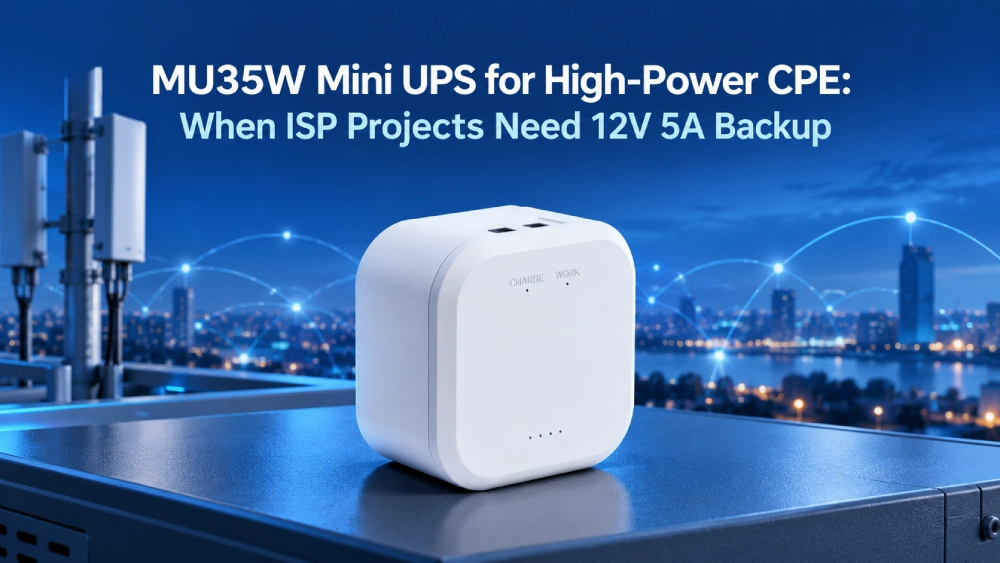
Power outages can interrupt broadband service even when the network infrastructure remains operational. For ISPs and broadband operators, one common challenge is keeping customer-premises equipment (CPE), routers, and gateways powered during local electricity interruptions.
A standard Mini UPS may work well for a low-power ONT or basic router. However, some broadband devices require higher current, making backup power selection more challenging.
El MYLION MU35W Mini UPS provides a 12V DC output rated at up to 5A. It is designed as a backup power option for compatible higher-power routers, CPE devices, and broadband network equipment.
This guide explains where the MU35W fits, how it differs from lower-current Mini UPS solutions, and what ISP buyers should consider before selecting it for a project.
Why Some Broadband Devices Need More Than a Standard Mini UPS
Not all network devices have the same power requirements.
Basic ONTs and routers often operate with relatively modest power demands. Higher-performance broadband gateways, advanced routers, and certain CPE devices may require a greater current supply.
For example, a device rated at 12V 4A requires a power supply capable of supporting up to 48W at its rated input. A Mini UPS limited to 12V 3A would not meet that nameplate requirement.
This can create several challenges for ISP projects:
- Insufficient output current:The backup unit may not support the connected device under higher-load conditions.
- Router restarts:An unsuitable power supply can cause interruptions when equipment demand exceeds the available output.
- Limited deployment flexibility:One Mini UPS specification may not suit every CPE model used across the network.
- Incorrect backup expectations:Higher output current does not automatically mean longer backup time.
For these applications, a 12V 5A Mini UPS provides a higher-current option worth evaluating.
What Makes the MYLION MU35W Mini UPS Different?
El MYLION MU35W Mini UPS combines a higher-current 12V output with lithium-ion battery backup in a compact unit.
It is particularly relevant to broadband projects where standard lower-current backup products do not meet the connected equipment’s power requirements.
1. 12V 5A Output for Higher-Power Network Devices
The MU35W is rated for a maximum output of 12V 5A.
This makes it a candidate for compatible networking devices that require more current than a 12V 3A Mini UPS can supply.
Typical application categories include:
- Higher-power Wi-Fi routers
- Puertas de enlace de banda ancha
- Compatible fixed-voltage CPE devices
- Selected 12V network equipment
The important requirement is matching the output voltage, current capability, connector, and operating conditions to the actual device.
A 5A output rating does not mean every router requires 5A. It means the UPS has a higher maximum current rating for applications that need it.
2. 75.6Wh Lithium Battery for Backup Applications
The MU35W uses a lithium-ion battery with a stated capacity of 75,6 Wh.
Battery capacity is an important consideration for backup applications, but it should not be confused with maximum output power.
Actual backup time depends on the connected device’s power consumption, the battery’s usable energy, temperature, battery condition, and other operating factors.
For ISP procurement, runtime should therefore be evaluated using the intended device and load rather than relying on battery capacity alone.
3. Practical Features for Network Installations
MU35W Feature | Published Specification |
Producción | 12V DC, 5A maximum |
Batería | 75.6Wh lithium-ion |
DC input | 12V DC, 6A maximum |
Battery indication | Four LED indicators |
Alojamiento | ABS enclosure |
Dimensiones | 100 × 100 × 60 mm |
These features provide a useful starting point when evaluating the product for subscriber-side network installations.
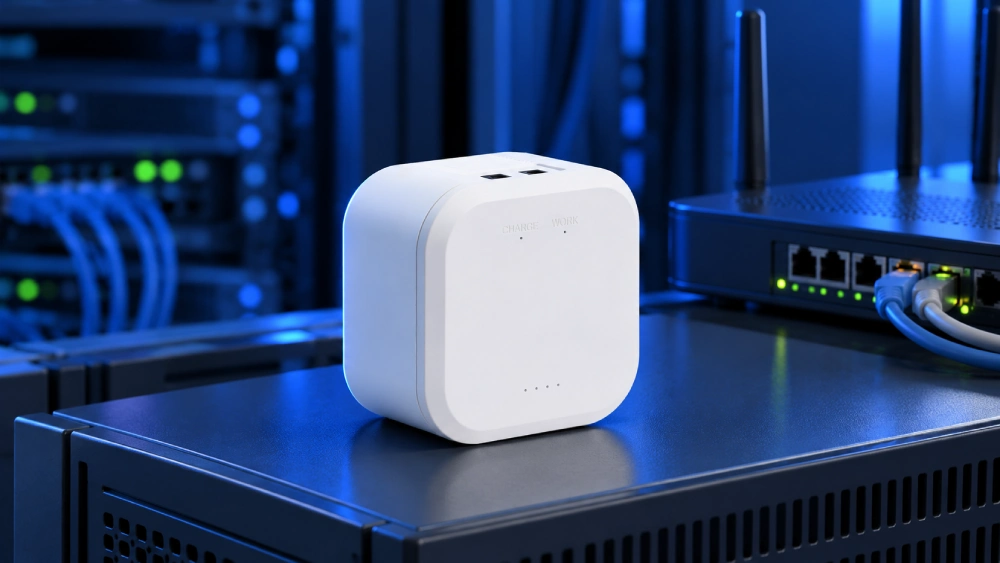
The LED indicators allow technicians to check battery status, while the compact enclosure offers an option for installations where space is limited.
12V 3A vs 12V 5A Mini UPS: Which Fits Your Network?
Choosing between 12V 3A and 12V 5A backup power is not simply about selecting the larger specification.
For a router rated at 12V 2A, a suitable 12V 3A model may already provide adequate current capability. A higher-current UPS is not automatically necessary.
For a broadband gateway rated at 12V 4A, however, the MYLION MU35W becomes a more relevant option because its stated output current limit is higher.
ISP buyers can also explore MYLION’s Mini UPS range to compare solutions for different device requirements.
Where Can MU35W Mini UPS Be Used?
The MU35W is primarily relevant to broadband and communication equipment that requires fixed 12V DC backup power.
1. High-Power Routers and Broadband Gateways
Broadband gateways are increasingly used to combine routing, Wi-Fi, and other network functions.
Some of these devices have higher current requirements than basic routers.
For compatible 12V gateways, the MU35W offers a higher-current backup option that can be considered when designing a subscriber-side power solution.
It is important to verify the gateway’s input voltage, maximum current, connector, and actual power demand before installation.
2. ISP Customer-Premises Equipment Backup
ISPs often manage different CPE models across residential, business, and broadband access projects.
Using the same backup specification for every device can lead to unsuitable power matching.
The MU35W can be evaluated for customer-premises equipment with higher 12V current requirements, particularly where an ISP wants to maintain a defined backup solution for a specific group of devices.
For a larger rollout, model selection should be based on the actual CPE inventory and installation requirements.
3. ONT and Router Backup Configurations
Some broadband installations use a separate ONT and router.
If only the ONT receives backup power, the customer may still lose local Wi-Fi and routing functions when the router shuts down.
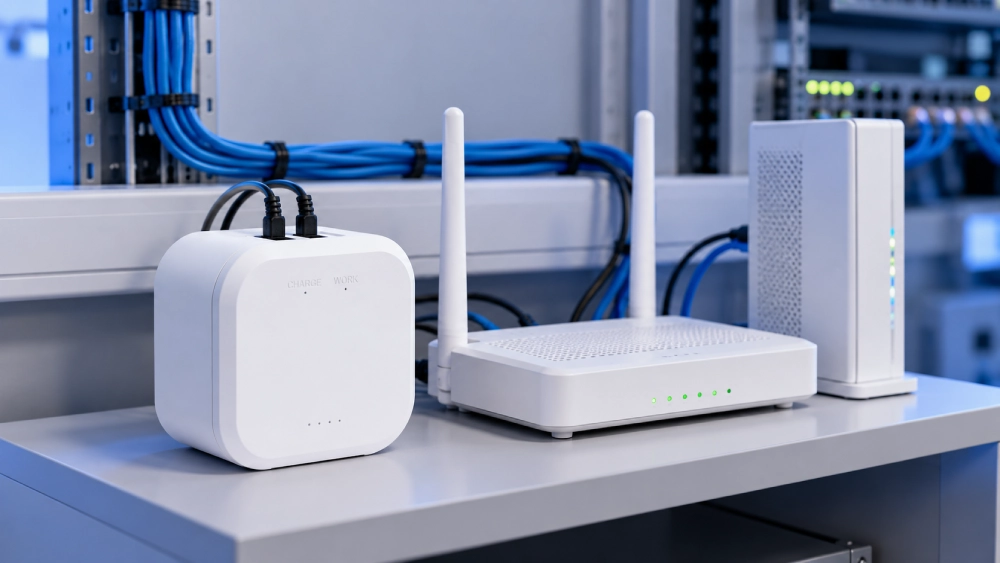
A higher-current Mini UPS such as the MU35W may be considered for a combined 12V backup configuration when both devices have compatible power requirements.
However, using one UPS for multiple devices requires checking the combined current demand, suitable power distribution cables, connector polarity, and operating behavior.
Multiple-device backup should be validated as a complete configuration rather than assumed from the 5A rating alone.
For additional options, explore MYLION’s high-power network backup solutions.
What Should ISPs Check Before Using MU35W?
For procurement managers and technical teams, a suitable Mini UPS must match more than the voltage printed on a device label.
Three practical considerations are especially important.
1. Match the Actual Device Requirements
Start with the equipment manufacturer’s rated input voltage and current.
Check whether the equipment uses fixed 12V DC, a different voltage, or a USB-C PD power supply.
The MU35W should be considered for compatible fixed-12V applications, not automatically for every router, Wi-Fi 7 gateway, or CPE model.
2. Confirm Connectors and Installation Conditions
Confirm the DC connector dimensions, polarity, input power adapter, and cable arrangement.
A suitable voltage and current rating alone does not guarantee that the device can be connected correctly.
Installation space and ventilation also matter, especially for higher-current equipment operating in enclosed areas.
3. Validate Runtime with the Intended Load
A Mini UPS may provide very different backup durations depending on whether it is connected to a low-power ONT or a higher-power broadband gateway.
For ISP projects, the most useful verification is a backup test using the actual equipment under representative operating conditions.
The test should check whether the connected device continues operating during a power interruption and whether the achieved backup duration meets the project target.
These checks help establish an appropriate configuration before wider deployment.
Why Consider MYLION for Mini UPS Projects?
MYLION focuses on Mini UPS and DC backup solutions for telecom, ISP, broadband, and network equipment applications.
Its product range includes lower-current backup options, higher-current models such as the MU35W, and solutions for different output and installation requirements.
For business customers, MYLION provides support in several areas:
Product Selection Support
MYLION can review the connected device requirements and help identify an appropriate Mini UPS model.
Project-Based Backup Solutions
For ISPs, distributors, and system integrators, the selection process can consider actual network equipment, backup targets, connectors, and deployment conditions.
OEM and B2B Cooperation
MYLION also supports project discussions involving branding, packaging, and selected configuration requirements, subject to technical and commercial confirmation.
The objective is to match the backup product to the application rather than assume that one Mini UPS works for every network device.
Preguntas frecuentes
Q1: Is MU35W suitable for high-power Wi-Fi routers?
Q2: Can MU35W power both an ONT and a router?
Q3: How long can MU35W Mini UPS provide backup power?
Q4: Is a 12V 5A Mini UPS always better than a 12V 3A model?
Q5: Can MU35W replace a traditional AC UPS?
Conclusión
Choosing the right Mini UPS for an ISP project starts with understanding the actual network equipment.
For basic ONTs and low-power routers, a standard Mini UPS may be sufficient. For higher-current broadband gateways, CPE, and selected multi-device configurations, the MYLION MU35W Mini UPS provides a 12V 5A backup option with a 75.6Wh lithium-ion battery.

 Español
 English
 简体中文
 Deutsch
 Français
 Italiano