
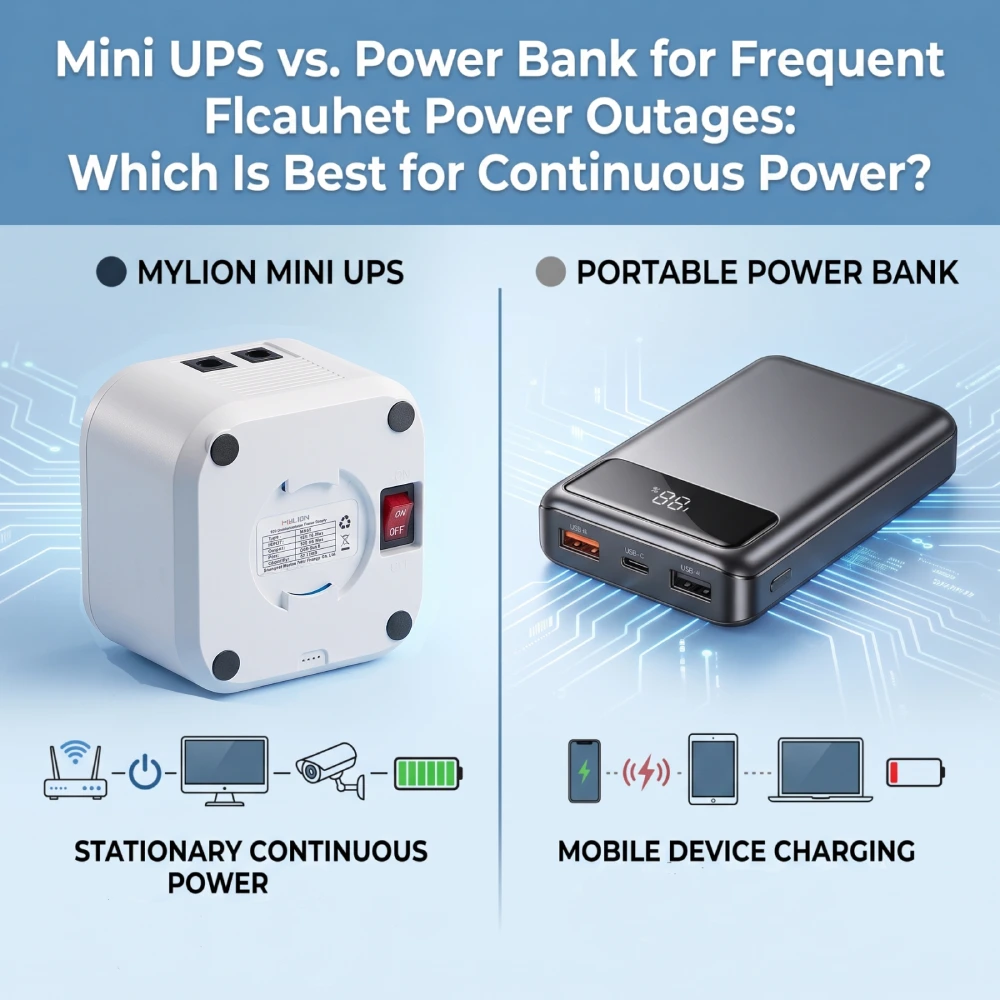
Le Mini-onduleur vs batterie externe Cette décision revêt une importance particulière dans les pays où les coupures de courant, les délestages et l'instabilité de l'approvisionnement en électricité interrompent régulièrement l'accès à Internet.
Pour un utilisateur particulier, une batterie externe peut sembler un moyen simple d'alimenter un appareil. En revanche, pour un fournisseur d'accès Internet, une entreprise du secteur des télécommunications, un distributeur d'équipements réseau ou un intégrateur de systèmes, l'alimentation de secours doit offrir bien plus qu'un simple stockage d'énergie.
Un routeur, ONT, ONU, modem ou CPE Il peut être nécessaire de rester connecté à une source d'alimentation externe 24 heures sur 24 et de continuer à fonctionner automatiquement en cas de panne de courant. C'est là la différence fondamentale. Mini-onduleur Comparaison avec une batterie externe.
Pour les projets régionaux sujets à des coupures de courant fréquentes, il est important de choisir le bon système d'alimentation de secours.
Pourquoi les pannes de courant deviennent un problème de connectivité
Une panne de courant locale ne signifie pas toujours que le réseau haut débit ou de télécommunications en amont a cessé de fonctionner.
Dans de nombreux cas, le réseau fibre optique, le réseau sans fil ou l'infrastructure du FAI restent disponibles, mais le client perd l'accès à Internet car le routeur local, l'ONT ou le CPE ne dispose pas d'alimentation de secours.
Ce problème d'alimentation électrique du dernier kilomètre peut entraîner :
- Redémarrages répétés des routeurs et des ONT ;
- Les abonnés au haut débit perdront leur accès à Internet ;
- Les employés travaillant à distance doivent se déconnecter des VPN et des réunions en ligne ;
- Les magasins de détail perdront l'accès aux systèmes basés sur le cloud ;
- Les équipements de vidéosurveillance et de contrôle d'accès seront mis hors service ;
- Les passerelles IoT et les terminaux de surveillance deviendront indisponibles ;
- Les équipes d'assistance des fournisseurs d'accès Internet recevront davantage de plaintes liées aux pannes ;
- Des techniciens se rendront sur les sites où le réseau est toujours fonctionnel mais où les équipements locaux sont hors tension.
Une coupure de courant de quelques secondes seulement peut entraîner une interruption de service de plusieurs minutes, le temps que le périphérique réseau redémarre et se reconnecte.
C'est pourquoi Mini-onduleur vs batterie externe La question ne se résume pas à savoir quel produit possède une batterie plus grande. Il s'agit de savoir quelle solution permet de maintenir la connexion réseau locale complète en cas de coupure de courant et de rétablissement du courant.
Comparaison directe : Mini-onduleur vs. batterie externe
Une batterie externe Il est principalement conçu pour recharger des appareils électroniques portables ou fournir une alimentation temporaire via des sorties USB ou USB-C.
Un mini onduleur est conçu pour assurer une gestion continue de l'alimentation externe et une alimentation de secours par batterie pour les équipements basse tension compatibles.
Caractéristique / Métrique | Mini-onduleur CC | Banque d'alimentation portable |
Cas d'utilisation principal | Alimentation CC continue et de secours | recharge d'appareil portable |
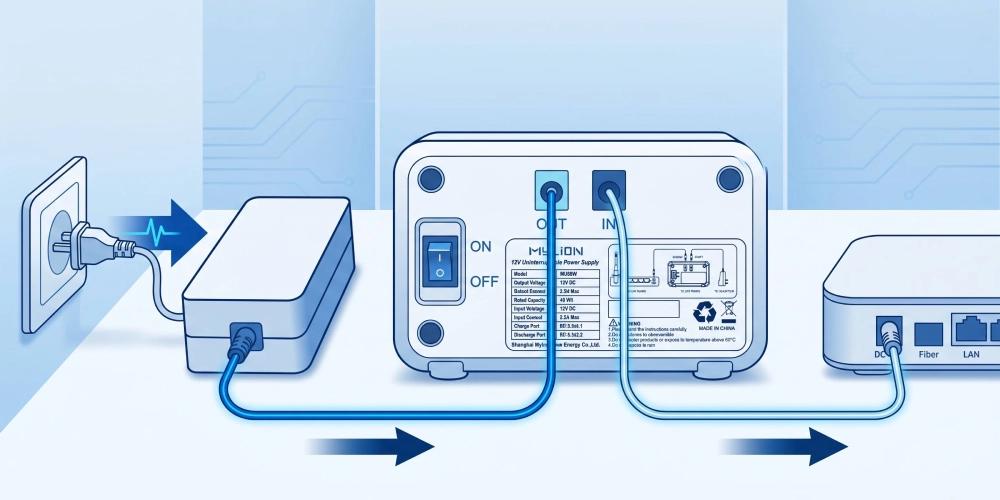
Installation normale | Connecté entre l'alimentation externe et l'appareil | Connecté lorsque l'alimentation portable est nécessaire |
Temps de transfert | 0 ms (transfert nul) | Le comportement de la sortie varie et peut inclure des interruptions. |
Tension de sortie native | 5 V, 9 V, 12 V, 15 V, 24 V, PoE | 5V (Nécessite des câbles élévateurs de tension peu efficaces) |
Réponse à une panne de courant | Conçu pour passer automatiquement en mode batterie. | Le comportement varie selon le modèle |
Principales applications | Routeur, ONT, ONU, modem, passerelle, CPE, CCTV et IoT | Téléphone, tablette et appareils portables |
Fonctionnement multi-appareils | Disponible sur les modèles compatibles dans les limites de puissance totale | Cela varie considérablement |
Comparer un mini-onduleur à une batterie externe n'est pas une science exacte. Une batterie externe peut alimenter un routeur spécifique, tandis qu'un mini-onduleur mal choisi peut s'avérer inadapté à un autre appareil.
Pourquoi une batterie externe peut ne pas convenir comme onduleur pour routeur
1. La charge en mode transit n'est pas identique au fonctionnement d'un onduleur.
Certaines batteries externes permettent de charger et de décharger simultanément. On parle alors de charge en mode pass-through.
Toutefois, la facturation par transfert ne prouve pas que :
- La sortie reste active même lorsque l'alimentation d'entrée disparaît ;
- La tension reste stable pendant la modification ;
- Le profil USB-C sélectionné reste disponible ;
- Le routeur ne redémarrera pas ;
- La sortie reste active lorsque le courant du réseau est rétabli ;
- Ce produit est conçu pour un fonctionnement continu ;
- La charge de la batterie et l'alimentation peuvent être maintenues en toute sécurité sur de longues périodes.
Une batterie externe peut interrompre brièvement son alimentation lorsque celle-ci est débranchée ou rétablie. Cette interruption peut suffire à redémarrer un routeur ou un ONT.
Pour une installation d'urgence à commande manuelle, cela peut convenir. En revanche, pour un équipement haut débit sans surveillance, une succursale ou un déploiement chez un fournisseur d'accès Internet, cela peut ne pas convenir.
2. De nombreuses batteries externes sont conçues pour les appareils portables.
La batterie externe classique est optimisée pour les téléphones, les tablettes et les appareils électroniques portables.
Les périphériques réseau peuvent nécessiter :
- Sortie CC fixe de 9 V, 12 V, 24 V ou 48 V ;
- Un profil spécifique d'alimentation USB-C ;
- Courant continu stable ;
- Support du courant de démarrage ou de pointe ;
- Une taille de connecteur particulière ;
- Polarité correcte du connecteur ;
- Fonctionnement continu pendant de nombreuses heures ;
- Sortie simultanée vers deux appareils.
La présence d'un port USB ou d'une étiquette de tension correspondante ne prouve pas que toutes ces conditions sont remplies.
3. L'arrêt en cas de faible charge peut poser problème
Certaines batteries externes coupent leur alimentation lorsque la charge connectée est inférieure à un seuil prédéfini.
Un routeur ou un terminal réseau basse consommation peut ne pas toujours consommer suffisamment de courant pour maintenir une telle batterie externe active.
Il peut en résulter un arrêt inattendu, même lorsqu'il reste de l'énergie dans la batterie.
4. Une récupération manuelle peut être nécessaire.
Certaines batteries externes nécessitent d'appuyer sur un bouton ou de reconnecter un câble avant que l'alimentation ne reprenne.
Cela peut convenir à un utilisateur individuel, mais ce n'est pas adapté à :
- Installations à distance ;
- Déploiements FAI côté abonné ;
- Équipement de sécurité ;
- Dispositifs IoT sans surveillance ;
- Succursales;
- Projets de réseaux distribués.
5. La constance du produit peut être difficile à contrôler
Une batterie externe grand public peut changer de cellule, de contrôleur, de profil de charge, de boîtier ou d'électronique interne sans pour autant être conçue pour un déploiement dans le secteur des télécommunications.
Pour un projet B2B, l'acheteur a généralement besoin d'une configuration contrôlée qui puisse être testée, approuvée et fournie de manière constante.
Quelles sont les régions qui ont le plus besoin de solutions de mini-onduleurs ?
Demande de Solutions Mini UPS Elle est généralement plus performante dans les régions où l'instabilité de l'électricité, la gestion programmée de la charge, les défaillances de la distribution locale ou les coupures de courant brèves et répétées affectent les équipements du réseau chez le client.
Asie du Sud : Routeurs, ONT et connectivité des petites entreprises
Dans certaines régions d'Asie du Sud, des coupures fréquentes et une instabilité de la tension peuvent perturber l'accès Internet haut débit à domicile, les réseaux des petits bureaux, les systèmes de vente au détail et les équipements des abonnés des fournisseurs d'accès Internet.
Les applications typiques comprennent :
- Routeurs 12V ;
- ONT et ONU ;
- Modems ;
- Appareils CPE standard ;
- Équipement réseau pour petites entreprises ;
- Terminal de vidéosurveillance et de contrôle d'accès.
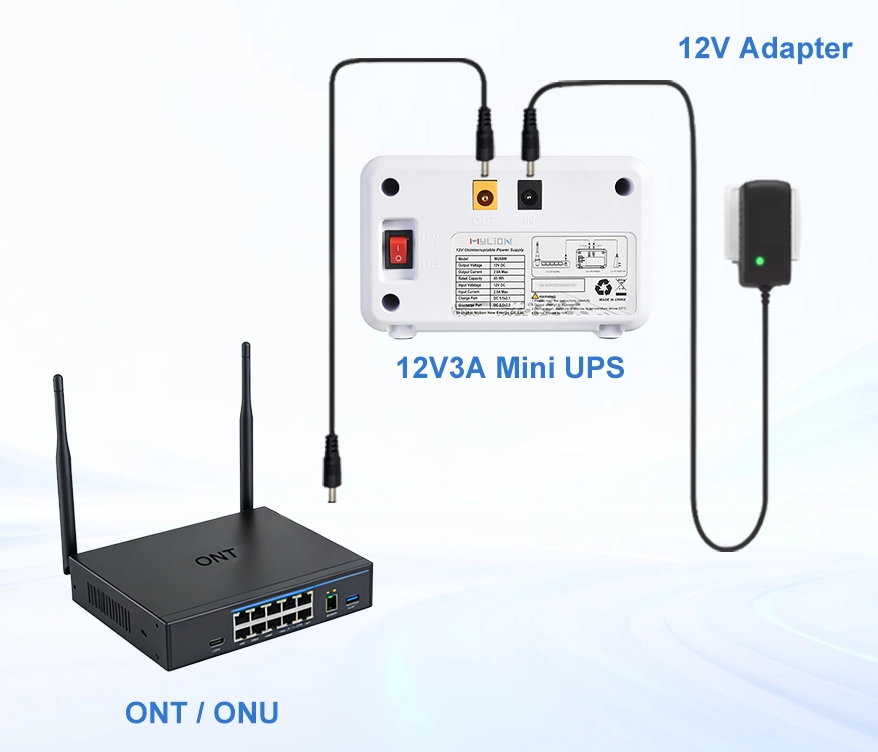
Pour appareils compatibles standard 12VMYLION peut évaluer les orientations des produits, notamment :
Ces produits appartiennent à la gamme standard de mini-onduleurs 12V de MYLION pour routeurs, ONT, modems et équipements CPE standard compatibles.
Afrique de l'Ouest : Projets de fournisseurs d'accès Internet, de distribution et de solutions multi-appareils
Les marchés ouest-africains pourraient connaître une forte demande de la part de :
- FAI ;
- Entreprises liées aux télécommunications ;
- Distributeurs d'équipements réseau ;
- Intégrateurs de systèmes de vidéosurveillance et de sécurité ;
- Distributeurs d'alimentation de secours ;
- Opérateurs de réseaux de succursales.
Pour routeurs plus puissants, passerelles, modems avancés et équipements CPE, les directives relatives aux produits MYLION comprennent :
Ces modèles appartiennent à la gamme Mini UPS 12 V haute puissance de MYLION. Ils sont recommandés lorsque la charge continue réelle dépasse la plage de puissance admissible d'une solution standard.
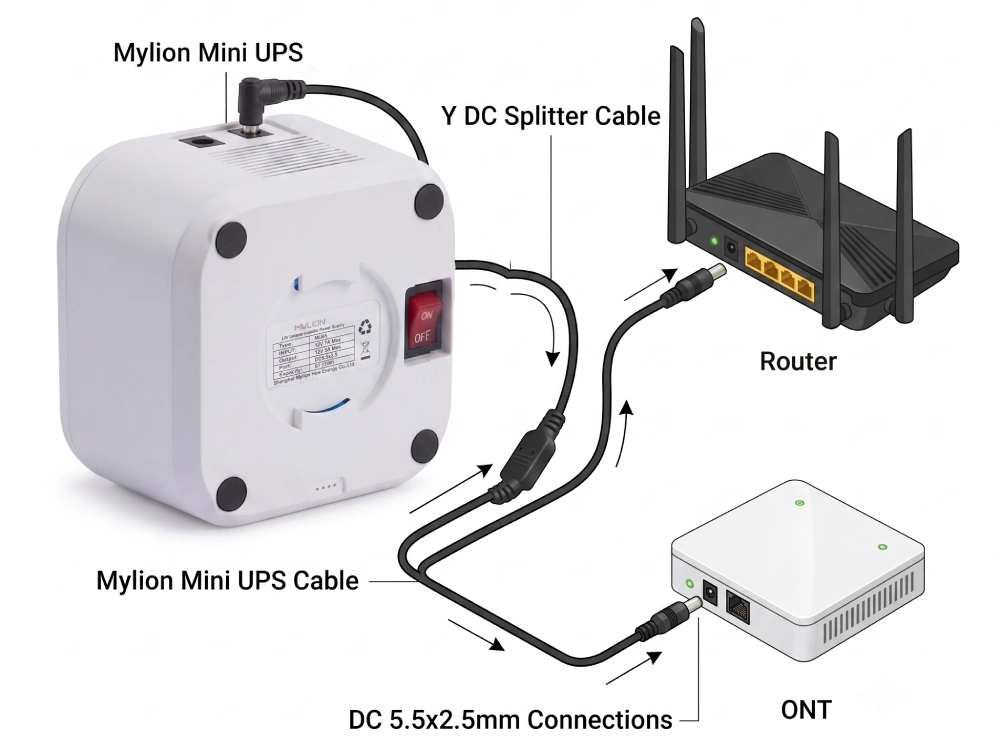
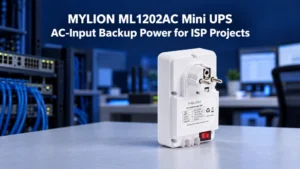
Pour les installations nécessitant le maintien en ligne simultané d'un ONT ou d'un ONU et d'un routeur, MYLION peut également évaluer des solutions à double périphérique telles que… ML1202AC.
Chaque appareil doit être vérifié individuellement et en charge combinée. Les puissances nominales des ports de sortie individuels ne doivent pas être additionnées, sauf si la limite de puissance totale approuvée du système le permet.
Afrique de l'Est : Sorties mixtes et équipements réseau USB-C
Sur les marchés d'Afrique de l'Est, les coupures de courant peuvent affecter les cybercafés, les commerces de détail, les succursales, les systèmes de sécurité, les sites distants et les utilisateurs d'accès à Internet haut débit. La solution d'alimentation sans coupure (ASI) requise peut varier en raison de la diversité croissante des interfaces d'alimentation utilisées par les périphériques réseau.
Pour les routeurs et ONT 12V classiques, MYLION peut évaluer sa gamme standard de mini-onduleurs 12V.
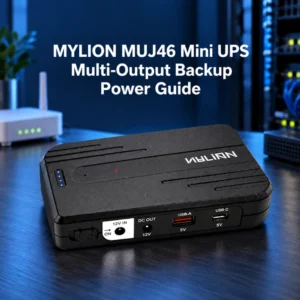
Pour les applications nécessitant un appareil 12 V et un appareil alimenté par USB, les instructions relatives aux produits à sortie mixte comprennent :
- MUJ46-2A;
- MUJ435-2A.
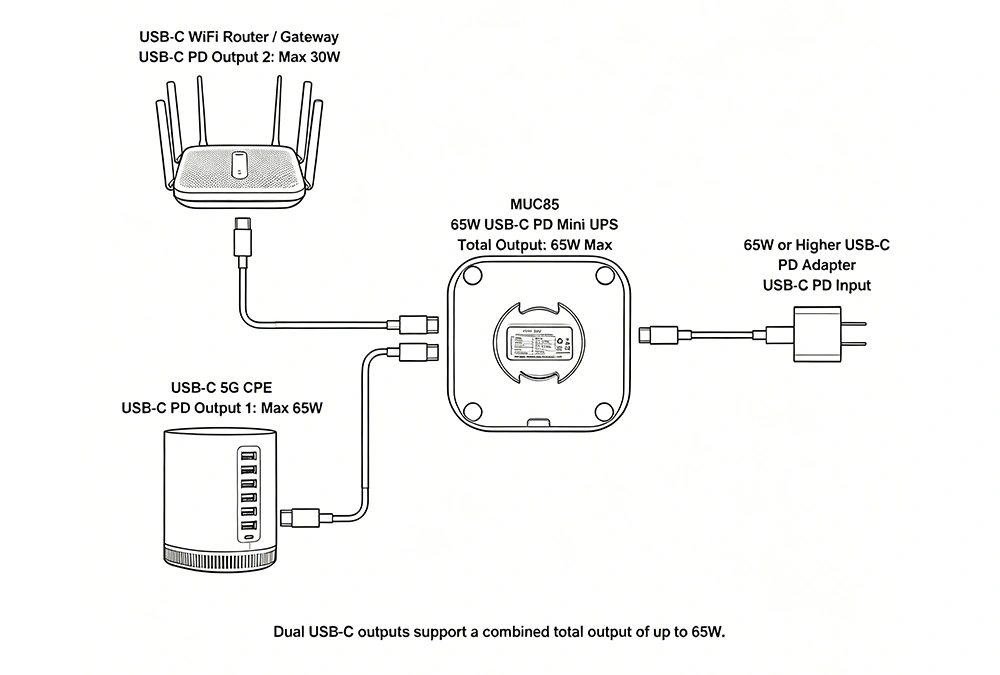
Pour les routeurs, passerelles et équipements Wi-Fi plus récents alimentés par USB-C Power Delivery, MYLION peut évaluer Mini-onduleur USB-C PD MUC85 direction.
Un connecteur USB-C à lui seul ne prouve pas qu'une batterie externe puisse fournir une alimentation de secours automatique fiable.
Moyen-Orient : Équipements de communication haute puissance, 24 V et 48 V
Certains projets au Moyen-Orient impliquent des solutions plus complexes que les routeurs domestiques classiques. Parmi les applications concernées, on peut citer :
- CPE sans fil ;
- Ponts de réseau ;
- Équipement radio ;
- Appareils de communication professionnels ;
- Terminaux réseau distants ;
- Équipements de télécommunications de plus grande puissance.
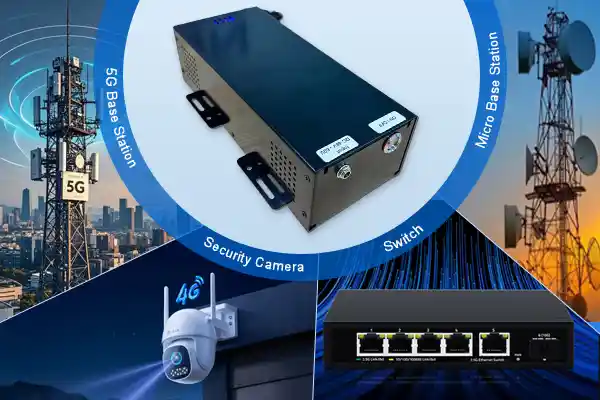
Pour les applications de communication compatibles 24 V ou 48 V, MYLION peut évaluer Mini-onduleur basé sur le projet MU248 direction.
Pour l'Irak et les marchés similaires du Moyen-Orient, une batterie externe standard destinée au grand public ne pourra probablement pas répondre aux besoins d'une sortie de 24 V ou 48 V, d'une puissance continue plus élevée, d'un câblage contrôlé ou de plusieurs appareils de communication.
Guide d'achat pratique : Choisir l'alimentation de secours adaptée à votre équipement
Si vous avez décidé qu'un mini-onduleur est la solution idéale pour vos besoins en alimentation continue, comment choisir le modèle qui vous convient ?
- Vérifiez la tension et l'ampérage de votre appareil :Regardez sous votre routeur et votre modem. Vous y trouverez des indications comme 12 V, 1,5 A ou 9 V, 1 A. Votre mini-onduleur doit correspondre exactement à cette tension.
- Calculer la puissance totale en watts :Multipliez la tension par l'intensité (ex. : 12 V x 1,5 A = 18 watts). Assurez-vous que la puissance de sortie maximale du mini-onduleur est supérieure à la puissance totale de votre charge.
- Besoins en sorties multiples :Si vous utilisez des appareils distincts pour votre ONT fibre et votre routeur Wi-Fi, recherchez un mini-onduleur avec deux sorties 12 V ou des commutateurs 9 V/12 V sélectionnables.
- Exigences PoE :Si vous utilisez un onduleur pour alimenter des caméras IP extérieures ou des points d'accès sans fil, recherchez un Mini UPS doté de ports Power over Ethernet (PoE) (15V/24V) pour envoyer l'alimentation et les données via un seul câble LAN.
Solutions MYLION Mini UPS : Fiabilité d’alimentation adaptée aux coupures fréquentes
Pour les acheteurs B2B, les distributeurs, les fournisseurs d'accès Internet et les entreprises de sécurité à la recherche d'une alimentation de secours hautement fiable et de qualité commerciale, MYLION Mini-onduleur se distingue comme la solution de premier choix.
Contrairement aux gadgets grand public disponibles dans le commerce, MYLION conçoit ses produits Mini UPS spécifiquement pour lutter contre les fortes instabilités du réseau électrique.
- UNcommutation de secours automatique:MYLION garantit une commutation en 0 ms, réduisant ainsi le risque de redémarrage pour vos routeurs d'entreprise, vos hubs domotiques et vos systèmes de contrôle d'accès biométriques.
- Sorties multi-tensions polyvalentes :Les mini-onduleurs MYLION sont équipés de sorties CC sélectionnables (5 V/9 V/12 V), vous permettant d'alimenter simultanément un modem fibre optique, un routeur Wi-Fi 6 et une caméra de vidéosurveillance à partir d'un seul onduleur.
- Système de gestion de batterie avancé (BMS) :La sécurité est primordiale. MYLION intègre un système de gestion de batterie intelligent qui protège contre la surcharge, la décharge excessive, les courts-circuits et les anomalies thermiques.
- Prêt pour les équipementiers/fabricants d'équipement d'origine (OEM/ODM) :MYLION propose des solutions sur mesure pour les distributeurs du monde entier. Que vous ayez besoin d'une personnalisation de marque, de capacités de batterie spécifiques ou de configurations de tension particulières, MYLION vous garantit une qualité évolutive.
FAQ
Q1 : Une batterie externe peut-elle être utilisée comme onduleur pour un routeur ?
Q2 : La charge en mode pass-through est-elle identique à la fonctionnalité UPS ?
Q3 : Un mini-onduleur peut-il alimenter à la fois un ONT et un routeur ?
Q4 : Un mini-onduleur permet-il de maintenir la connexion Internet pendant toutes les coupures de courant ?
Q5 : Quels appareils les solutions MYLION Mini UPS peuvent-elles prendre en charge ?
Q6 : De quelles informations MYLION a-t-il besoin avant de recommander un modèle ?
Conclusion
Sur les marchés sujets à des coupures de courant fréquentes, le choix d'une alimentation de secours adaptée est crucial. Les batteries externes sont avant tout des chargeurs portables. Elles ne sont pas conçues pour assurer une alimentation continue et ininterrompue des infrastructures critiques.
MYLION Mini-onduleur solutions Conçus spécifiquement pour répondre aux exigences d'une connectivité réseau 24h/24 et 7j/7, les mini-onduleurs offrent des temps de transfert nuls (0 milliseconde), des sorties de tension continue, une architecture de charge sécurisée et une durée de vie prolongée des batteries. Ils constituent ainsi la solution idéale pour protéger les routeurs, les ONT et les systèmes de sécurité.
 Français
  English
  简体中文
简体中文  Deutsch
  Italiano
  Español