
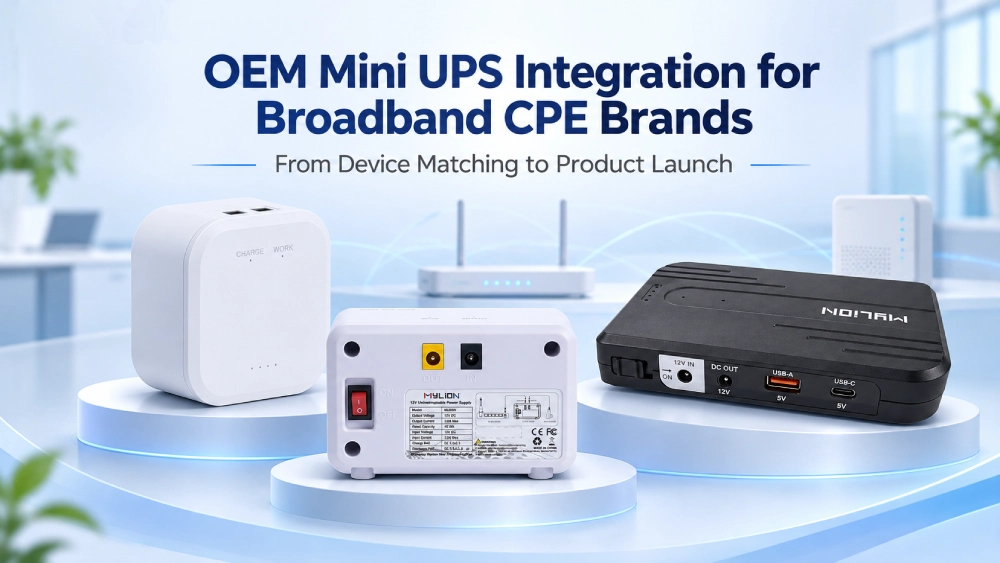
For broadband CPE brands, developing a reliable networking product is not only about connectivity and performance. Power continuity also matters, especially when routers, ONTs, and broadband gateways are installed at customer premises.
A power outage can interrupt these devices even when the broadband network itself remains operational.
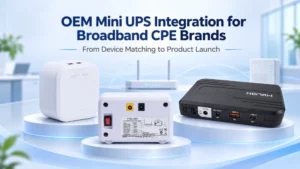
This creates an opportunity for CPE manufacturers and broadband equipment brands to include an OEM Mini UPS as part of their product offering.
However, successful integration requires more than selecting a battery capacity or adding a company logo. The Mini UPS must match the device’s power requirements, installation design, and product development schedule.
This guide explains how broadband CPE brands can move from device matching to sample validation and product launch.
Why Broadband CPE Brands Need an Integrated Backup Power Strategy
Broadband equipment brands often supply routers, ONTs, and gateways to ISPs, distributors, and system integrators.
These customers may also need backup power for subscriber-side installations.
Offering a compatible Mini UPS alongside CPE equipment can help brands:
- Provide a more complete broadband equipment solution.
- Simplify backup power selection for ISP customers.
- Reduce uncertainty around device and power supply compatibility.
- Offer consistent accessories and installation instructions.
- Support project-specific branding and packaging requirements.
For example, a CPE brand supplying routers to multiple broadband operators may want a Mini UPS that matches its existing device power interface and can be included in a standard equipment package.
Instead of asking each ISP to select a separate backup power product, the brand can evaluate a suitable solution during product development.
The first step is understanding the equipment’s actual power requirements.
Start with Device Matching, Not Battery Capacity
One of the most common mistakes in Mini UPS selection is focusing on battery capacity before confirming compatibility.
A larger battery does not automatically make a Mini UPS suitable for a particular router or broadband gateway.
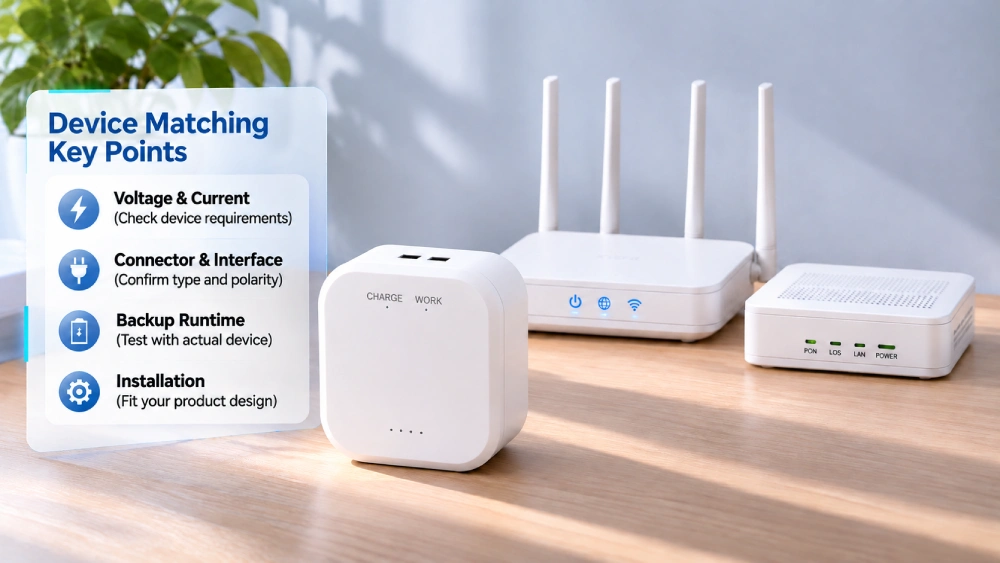
For OEM integration, several factors need to be checked.
1. Voltage and Current Requirements
Different CPE devices may use different power configurations.
The Mini UPS output must match the device’s specified input voltage and support its operating and startup current requirements.
These values should be confirmed using the actual CPE specifications and measured operating conditions.
2. Connector and Power Interface
A compatible voltage is not enough if the connector does not fit.
CPE brands should confirm connector dimensions, polarity, cable arrangement, and whether the device uses standard DC input or USB-C Power Delivery.
For USB-C PD equipment, the supported power profiles and power negotiation behavior also need to be validated.
3. Backup Runtime
Backup time depends on the actual equipment load, battery performance, conversion losses, and operating conditions.
Rather than relying only on a theoretical calculation, OEM projects should verify runtime using the intended CPE device.
4. Installation Design
The Mini UPS should also fit the intended installation environment.
A compact router installation may require simple cable routing, while an ISP equipment bundle may need a standardized mounting arrangement and installation instructions.
Addressing these details early can help avoid unnecessary changes later in the product development process.
MYLION Mini UPS Options for Different Broadband CPE Designs
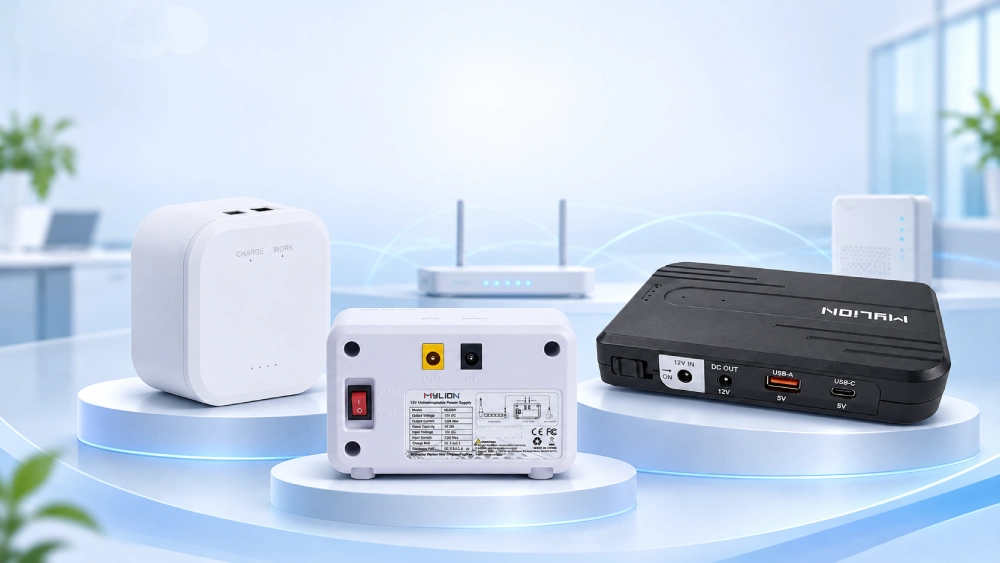
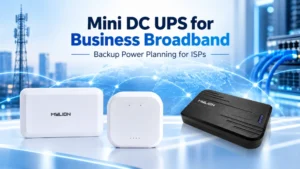
MYLION offers Mini UPS solutions for different broadband equipment power requirements.
For CPE brands developing an integrated backup power offering, the following product families provide potential starting points for evaluation.
Modèle MYLION | Orientation produit | Potential OEM Application |
12V DC Mini UPS | Routers, ONTs, and compatible 12V CPE devices | |
12V DC Mini UPS for higher-current requirements | Broadband routers and CPE equipment requiring a compatible 12V power supply | |
DC and USB output options | Broadband equipment requiring compatible DC and USB power arrangements | |
Onduleur mini USB-C PD | CPE devices using supported USB-C PD power configurations |
These models serve different power architectures rather than being interchangeable.
For example, a CPE brand developing a conventional 12V router package may start by evaluating the MU68W. A brand developing a USB-C-powered gateway may need to consider the MUC85 instead.
The final model should be selected after confirming device compatibility, output requirements, and the intended installation environment.
CPE brands can also compare MYLION Mini UPS models to identify suitable candidates for further testing.
What Can Be Customized for an OEM Mini UPS Project?
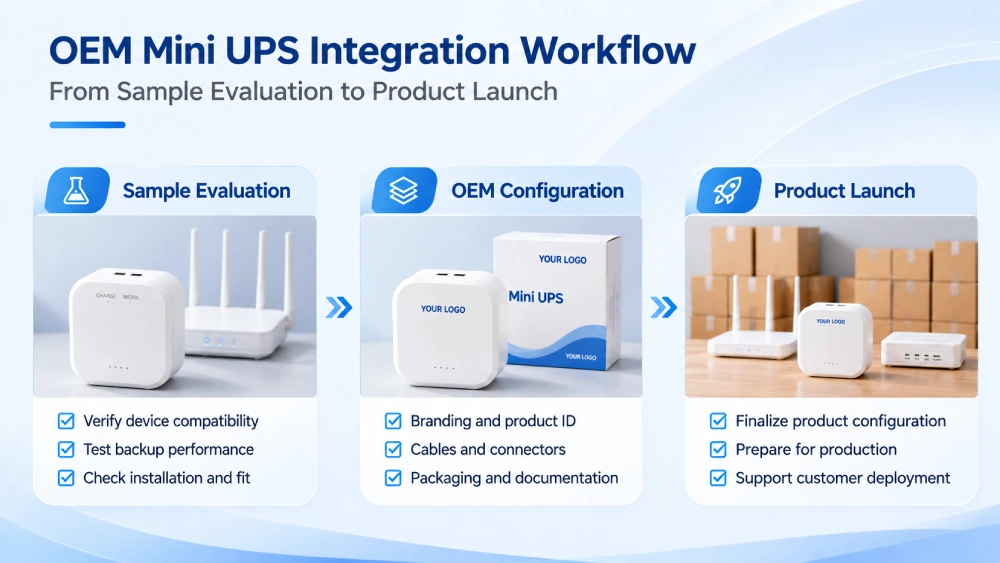
For broadband equipment brands, OEM integration often involves aligning the Mini UPS with an existing product portfolio.
This may include both technical and branding requirements.
Branding and Product Identification
OEM projects may require company logos, product labels, model identification, and packaging that match the brand’s existing equipment range.
A consistent appearance helps the Mini UPS fit into the overall CPE product offering.
Cables and Connectors
Different routers and gateways may require specific power connectors or cable arrangements.
CPE brands should review these requirements with the supplier before approving an OEM configuration.
Packaging and Documentation
A Mini UPS supplied with a broadband equipment bundle may need coordinated packaging, product identification, and installation instructions.
These details are especially important when the same product package is distributed through multiple ISP customers or regional markets.
MYLION supports OEM/ODM discussions for Mini UPS projects, including branding, packaging, and selected technical configurations.
Confirm availability and customization scope for the selected model before project approval.
Validate the Mini UPS Before Product Launch
A working sample is an important step, but it does not automatically mean the Mini UPS is ready for commercial deployment.
CPE brands should validate the proposed configuration with their actual equipment.
A practical evaluation should cover the following areas:
Evaluation Item | What the CPE Brand Should Confirm |
Compatibilité des appareils | Correct voltage, current, connector, and polarity |
Power continuity | CPE behavior during mains power interruption and restoration |
Backup runtime | Measured performance with the intended equipment load |
Installation | Cable arrangement, mounting, accessibility, and space |
Operating conditions | Performance under the project’s specified environment |
Documentation | Product identification, instructions, and applicable compliance evidence |
Testing should reflect how the product will actually be used.
From Approved Samples to Product Launch
Once sample evaluation is complete, the next step is preparing the OEM Mini UPS for production and commercial introduction.
For CPE brands, this stage should focus on keeping the approved product configuration consistent.
Step 1: Confirm the Final Product Configuration
Record the approved electrical specifications, connector arrangement, cable requirements, product appearance, and packaging details.
Any later changes should be reviewed before implementation.
Step 2: Finalize Branding and Documentation
Confirm product labels, packaging artwork, model identification, user instructions, and any market-specific documentation.
Applicable compliance requirements should also be reviewed for the final product configuration and target market.
Step 3: Review Production and Quality Requirements
Agree on the inspection criteria, product acceptance requirements, change-control process, and handling of nonconforming units.
For an OEM product, consistency between approved samples and production units is essential.
Step 4: Prepare for Customer Deployment
Before launch, confirm that the product package and installation instructions match the intended CPE equipment.
If the Mini UPS will be supplied through an ISP or distribution partner, installation teams should have clear guidance on supported device configurations.
A controlled transition from sample approval to production helps CPE brands introduce a more consistent backup power offering.
Working with MYLION on OEM Mini UPS Integration
MYLION se concentre sur Mini UPS and backup power solutions for broadband, ISP, telecom, and network equipment applications.
For CPE brands, the integration process begins with understanding the intended equipment and project requirements.
MYLION’s Mini UPS product range provides options for standard DC-powered devices, mixed-output arrangements, and selected USB-C PD applications.
Depending on the project, the evaluation may cover product selection, connector matching, OEM identification, packaging, and sample requirements.
FAQ
Q1. Can an OEM Mini UPS work with existing broadband routers?
Q2. What is the difference between a standard Mini UPS and an OEM Mini UPS?
Q3. Should CPE brands test Mini UPS samples before bulk production?
Q4. What information is needed for an OEM Mini UPS project?
Q5. Can MYLION support bulk orders for broadband CPE projects?
Conclusion
Integrating an OEM Mini UPS into a broadband CPE product line requires careful planning, from initial device matching to sample validation and launch preparation.
For CPE brands, the priority is to select a backup power solution that fits the equipment’s actual requirements and can be consistently supplied as part of the final product offering.
MYLION fournit Mini UPS options for broadband and telecom applications, supporting brands evaluating standard and selected OEM backup power configurations.

 Français
 English
 简体中文
 Deutsch
 Italiano
 Español