
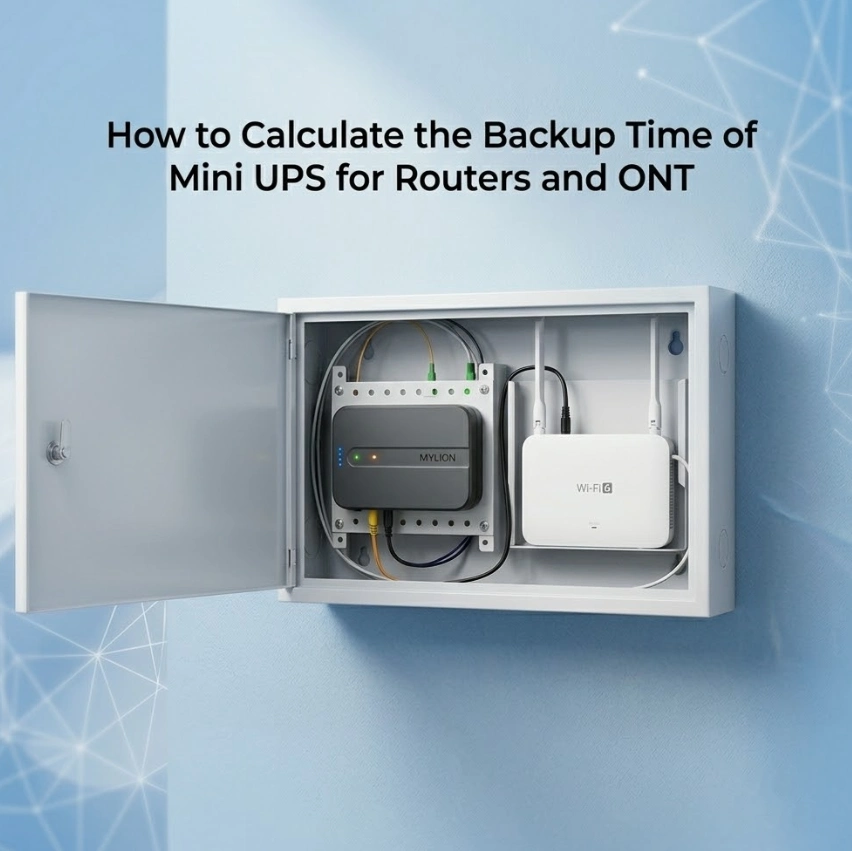
In a world where remote work, streaming, and smart home devices depend on an always-on internet connection, a power outage becomes more than an inconvenience—it becomes a disruption. Your fiber modem (ONT) and Wi-Fi router are useless without electricity. A Mini UPS solves this, but only if you know how long it will keep your network alive. This guide walks you through the exact method to calculate backup time for a router and ONT Mini UPS, using real-world examples including the Mylion Mini-USV.
Why backup time matters for routers and ONT devices
Unlike computers or monitors, routers and ONTs run 24/7 but draw relatively little power—typically between 5W and 15W combined. However, they are also highly sensitive to voltage drops. A brownout or sudden blackout can interrupt VoIP calls, disconnect VPN sessions, and reset smart home hubs.
Knowing your actual backup time helps you:
- Determine if a Mini UPS can survive a typical 1–2 hour local outage.
- Avoid overpaying for oversized battery units.
- Plan for extended outages by pairing with a generator or larger power station.
Without a calculation, you are guessing. And guessing often leads to a dead network in 15 minutes when you expected two hours.
Key electrical terms you need to know (Voltage, Current, Power, Capacity)
To calculate backup time accurately, you must understand four basic electrical metrics:
Spannung (V) – Electrical pressure. Routers and ONTs commonly run on 5V, 9V, or 12V DC. Mini UPS units output a matching voltage.
Current (A or mA) – Flow rate of electrons. Measured in amperes (A) or milliamperes (mA). Most router power adapters label output current (e.g., “12V ⎓ 1A”).
Power (W) – Real energy consumption. Formula: Watts = Volts × Amps. This is the single most important number for runtime calculation.
Capacity (Ah or Wh) – Total energy stored in a battery.
Ah (Amp-hour) common for lead-acid or lithium at a nominal voltage.
Wh (Watt-hour) more universal: 1 Wh = 1 watt for 1 hour.
Remember: Wh is the true energy measure because it removes voltage from the equation. A 12V 7Ah battery holds 84Wh (12×7). A 5V 20Ah power bank holds 100Wh (5×20).
Step-by-step method to calculate backup time for your router and ONT
Step 1 – Determine the total power consumption of your router and ONT
Do not rely on the power adapter’s maximum rating (e.g., “12V 2A” = 24W). That number is the adapter’s capability, not actual draw. Instead:
- Option A (accurate):Use a plug-in power meter (like Kill-A-Watt) between the wall and your devices. Read active watts.
- Option B (good enough):Look for the device’s input rating on its label (not the adapter). Many routers specify “12V ⎓ 0.5A” – that’s 6W.
- Option C (conservative):Measure DC current with a multimeter in series.
Beispiel:
ONT = 12V × 0.4A = 4.8W
Router = 9V × 0.6A = 5.4W
Total load = 10.2W
Step 2 – Find the battery capacity (Wh or Ah) of your Mini UPS
Check the specification label on your Mini UPS. For instance, the Mini UPS for router models typically list:
- Battery type: Lithium-ion or LiFePO₄
- Capacity in mAh or Ah (e.g., 10,000mAh / 10Ah)
- Nominal voltage (e.g., 12V)
Mylion offers several models for different use cases:
Modell | Batteriekapazität | Ausgabe | Typische Anwendung |
19,24 Wh | 12V 2A max | Single router/ONT, 1–2 hours backup | |
44,4 Wh | 12 V 3 A | Standard router/ONT, 4–8 hours backup | |
77,7 Wh | 12 V 5 A | High-load routers/gateways, 8–12+ hours backup | |
38,48 Wh | 12 V Gleichstrom | Compact hidden installation for ONT/router | |
92 Wh | USB-C PD (20V/3.25A) | Modern USB-C/PD powered devices |
For a typical home network, the MU68 (45Wh) is the most widely applicable model.
Step 3 – Convert battery capacity to watt-hours (if needed)
If your Mini UPS specifies amp-hours (Ah), multiply by nominal voltage:
Wh = V_battery × Ah_battery
Example: A 12V battery rated at 5Ah provides 12V × 5Ah = 60Wh.
If capacity is in mAh, divide by 1000 first: 10,000mAh = 10Ah.
For Mylion units that list only Wh (e.g., MU26: 19.24Wh), you can skip this step.
Step 4 – Apply the backup time formula: (Battery Capacity × Inverter Efficiency) / Load Power
Most Mini UPS units for routers are DC-to-DC (no inverter) or have a small inverter if they also power AC devices. For pure DC output (e.g., 12V to 12V), efficiency is high: 90–95%. For AC output (120V/230V), efficiency drops to 80–85%.
Basic formula (DC output, no inverter loss):
Backup time (hours) = Battery capacity (Wh) / Load power (W)
With efficiency factor:
Backup time = (Battery Wh × Efficiency) / Load W
Example (using MU68 DC Mini UPS):
Battery = 44.4Wh, Load = 10.2W, Efficiency = 0.93
→ (44.4 × 0.93) / 10.2 = 4.05 hours (theoretical)
Step 5 – Real-world adjustment for battery discharge depth
Lithium batteries can safely discharge 90–100% of rated capacity without damage. Mylion also offers LiFePO₄-based solutions for customers who need safer chemistry and longer cycle life (2000+ cycles).
For lithium (standard Mylion models), multiply result by 0.95 usable depth. For LiFePO₄ (e.g., ML1202AC), the usable depth is similar due to advanced BMS protection.
For high-load applications like Wi-Fi 6/7 routers or combined ONT+router setups, the MU35 (12V 5A) provides higher output capacity and longer runtime—up to 10–13 hours depending on load
Example calculation using Mylion Mini UPS for a typical home network setup
Let‘s walk through three real scenarios with actual Mylion models:
Scenario 1: Standard home router + ONT (10W total)
Devices:
- ONT: 12V 0.35A → 4.2W
- Router: 9V 0.55A → 4.95W
- Total load = 9.15W
Mylion MU68:
- Capacity = 44.4Wh (12V 12000mAh Li-ion)
- Efficiency (DC output) = 92%
- Battery type = Li-ion (DoD = 95%)
Calculation:
(44.4Wh × 0.92) / 9.15W = 40.85 / 9.15 = 4.46 hours (theoretical)
× 0.95 DoD = 4.24 hours actual backup time
Scenario 2: FTTH inline deployment (limited space)
For clean, hidden installation in structured wiring boxes or FTTH cabinets, the MUJ46 is specifically designed for inline deployment.
Devices: ONT + router (8W total)
Mylion MUJ46:
- Compact inline form factor
- Estimated capacity: ~30–40Wh (varies by configuration)
- Runtime: approximately 3–5 hours under moderate load
Scenario 3: High-performance Wi-Fi 6/7 router (15W load)
Mylion MU35 (12V 5A high-output model):
- Designed for higher-load 12V network devices
- High-capacity Li-ion battery
- Output: 12V 5A maximum
Calculation:
Assuming ~75Wh capacity (typical for MU35 class):
(75Wh × 0.92) / 15W = 69 / 15 = 4.6 hours (theoretical)
× 0.95 DoD = 4.37 hours actual backup time
Ergebnis: The MU35 keeps even a power-hungry Wi-Fi 6 router online for over 4 hours during an outage.
For USB-C/PD powered modern network devices, the MUC85 (92Wh, 65W PD) provides flexible modern power architecture support.
Factors that can shorten or extend actual backup time
Your calculated backup time may differ from reality due to:
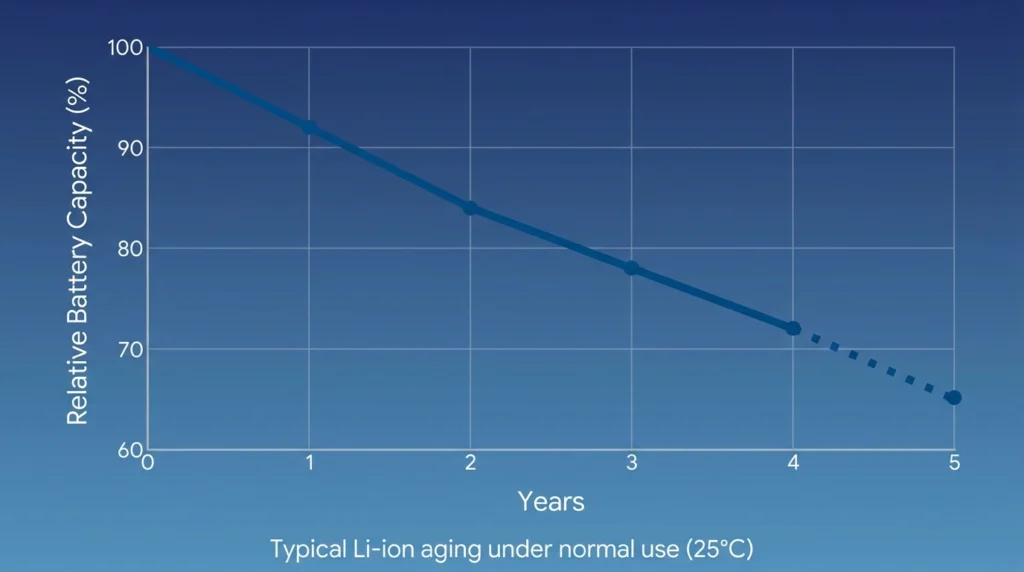
Aging battery – Lithium batteries lose 20–30% capacity after 2–3 years.
Temperatur – Cold (below 0°C) reduces effective capacity; heat accelerates degradation.
Load fluctuations – Router power consumption varies with Wi-Fi traffic, USB devices, or CPU load.
Cable losses – Thin or long DC cables drop voltage, forcing the UPS to deliver more current.
Standby vs. active – Some ONTs consume 2x power during data transfer vs. idle.
To maximize runtime:
Use short, thick-gauge DC cables.
Keep the Mini UPS in a cool, dry place.
Recalculate every 12–18 months.
How to choose the right Mini UPS capacity for your required backup time
Use the reverse formula: Required Wh = (Target hours × Load W) / (Efficiency × DoD)
Example: You want 4 hours for a 10W load with DC output (92% eff, 95% DoD):
Required Wh = (4 × 10) / (0.92 × 0.95) = 40 / 0.874 ≈ 45.8Wh
That means you need a Mini UPS with at least 46Wh usable capacity.
Mylion model recommendations by backup need:
Erforderliche Backup-Zeit | Load Type | Recommended Mylion Model |
1–2 Stunden | Single router/ONT | MU26 series (19.24Wh) |
3–5 hours | Standard router + ONT | MU68 series (44.4Wh) |
4–6 Stunden | FTTH hidden installation | MUJ46 (38.48Wh) |
6–10+ hours | High-load router or multiple devices | MU35 series (77.7Wh) |
3–6 Stunden | USB-C/PD modern devices | MUC85 (92Wh, 65W PD) |
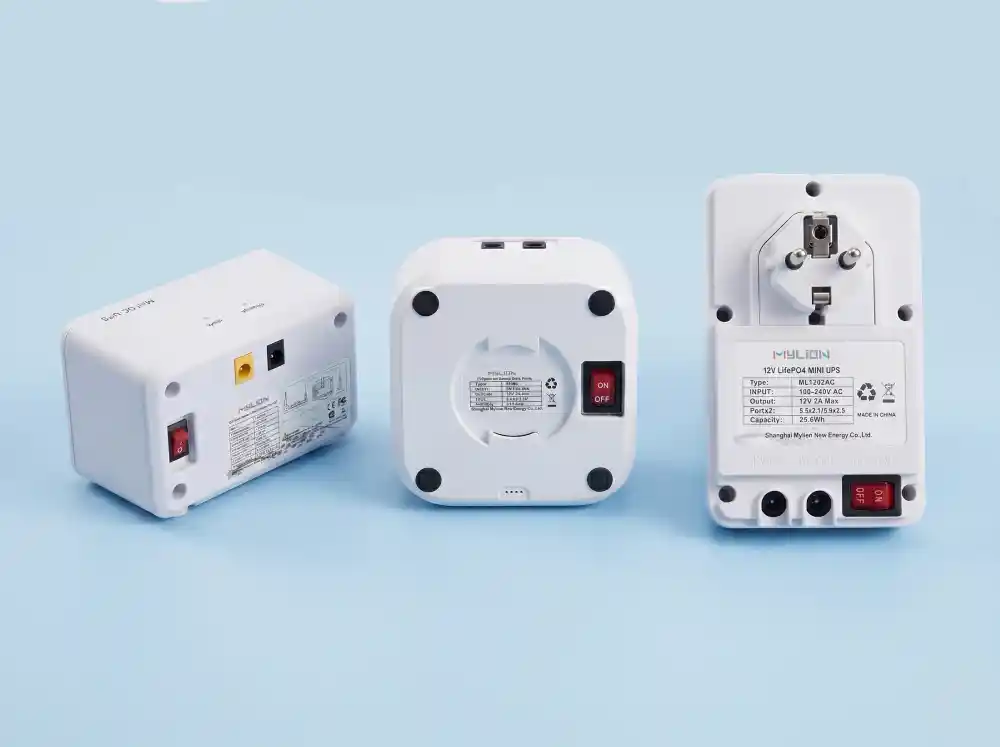
2–4,5 Stunden | Low-power router (AC input convenience) | ML1202AC (25.6Wh LiFePO₄) |
Always add 20% safety margin to account for battery aging and unexpected load spikes.
For complex deployments or custom requirements, Mylion provides engineering-based model matching support to help avoid unsuitable selections.
Häufig gestellte Fragen
Q1: How to Calculate Mini UPS Backup Time for Routers and ONTs
Q2: What is the typical backup time of a Mylion Mini UPS for routers?
Q3: Does the battery capacity decrease over time?
Q4: Why does my Mini UPS show less backup time than calculated?
Can I use the Mini UPS to connect two devices simultaneously?
Abschluss
Calculating backup time for a router and ONT Mini UPS is not guesswork. It requires measuring your actual load, understanding battery capacity in watt-hours, and applying efficiency and depth-of-discharge factors. A Mylion Mini-USV offers reliable lithium battery performance with clear specifications, making it easy to plug into the formula.



 Deutsch
  English
  简体中文
简体中文  Français
  Italiano
  Español