
Introducción
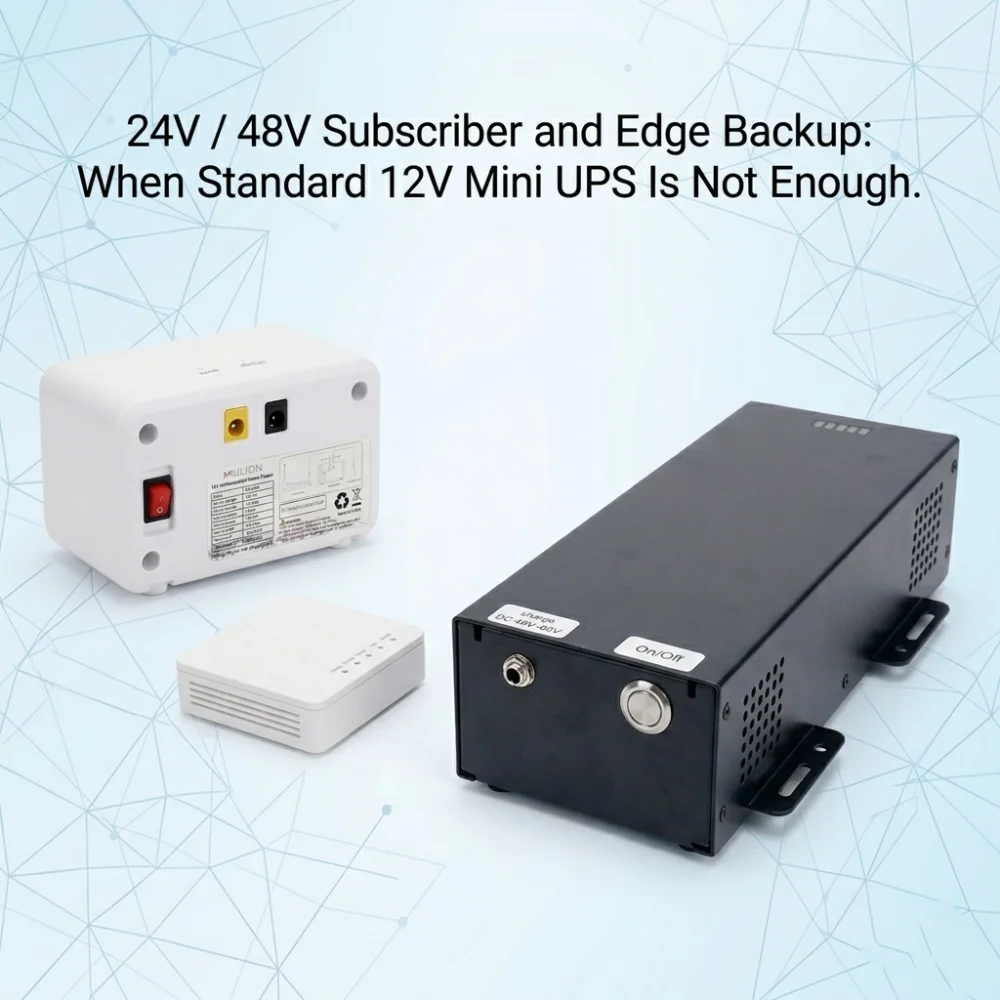
Muchas discusiones sobre mini UPS comienzan con 12V porque una gran cantidad de Dispositivos ONT, ONU, enrutadores y puertas de enlace Funcionan con una entrada de 12 V CC. Pero no todas las aplicaciones de telecomunicaciones o de redes perimetrales se ajustan a esa lógica.
Algunos dispositivos de abonado y de borde funcionan con rieles de voltaje más altos, como 24 V o 48 V. En estos casos, forzar un estándar Mini SAI de 12 V en el proyecto puede crear complejidad innecesaria, arquitectura débil o mala adaptación de implementación. El enfoque más inteligente es identificar temprano cuándo la aplicación debe salir de la categoría de 12V y entrar en una UPS de 24 V / 48 V diseño.
Por qué 12V es común, pero no universal.
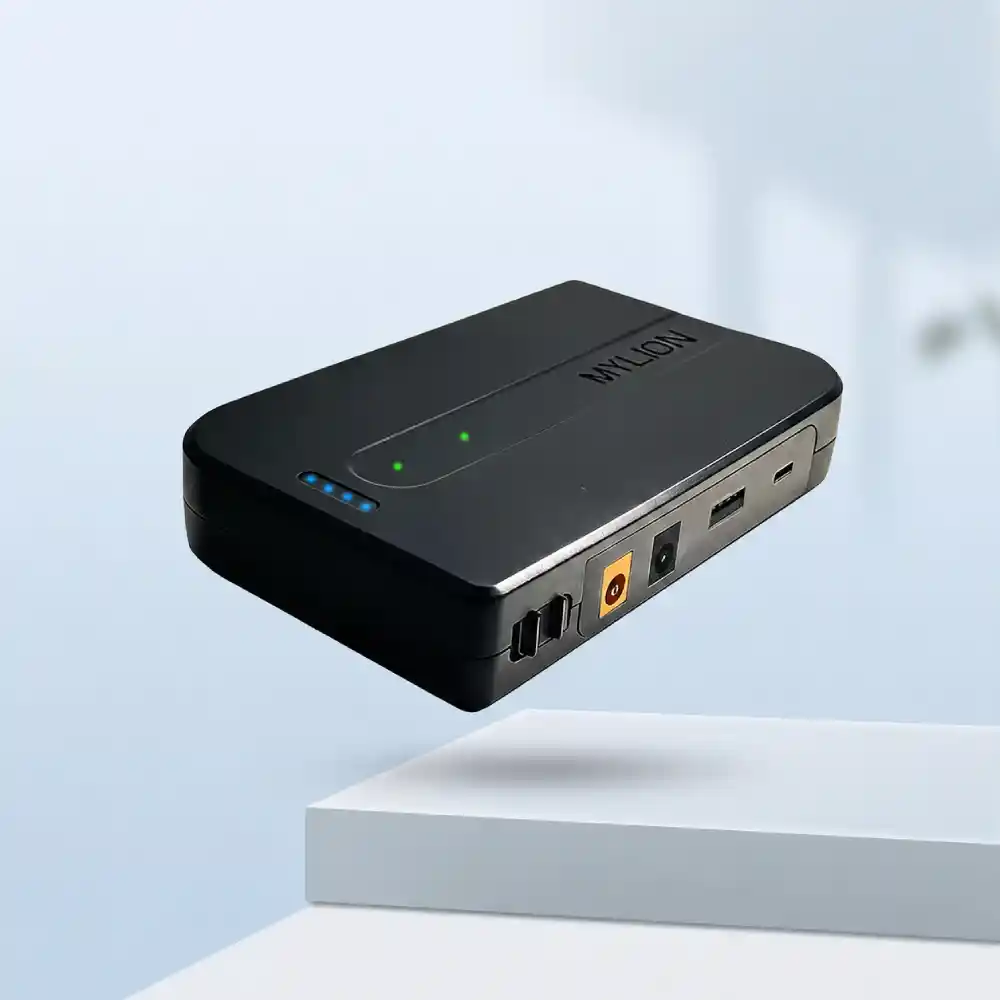
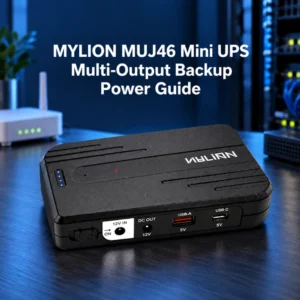
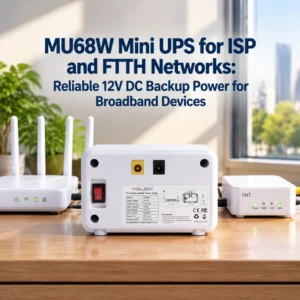
Las soluciones Mini UPS de 12 V son comunes en equipos de banda ancha y de borde de abonado porque se adaptan a muchos dispositivos compactos. Por eso, la gama de Mini UPS de 12 V de MYLION, que incluye MU68 (estándar 12V 3A), MU35 (superior)–carga 12V 5A), y MUJ46 (despliegue FTTH en línea)—es ampliamente adoptada por los proveedores de servicios de Internet para proyectos de fibra óptica hasta el hogar (FTTH) y de respaldo de redes pequeñas.
Sin embargo, las aplicaciones de mayor voltaje son comunes en:
- Equipos de borde de telecomunicaciones
- Hardware de red inalámbrica
- Unidades de comunicación para exteriores
- Sistemas de acceso empresarial o de borde de suscriptor seleccionados
- Dispositivos donde la eficiencia actual o la arquitectura de alimentación existente favorecen los 24 V o los 48 V.
La existencia de una sólida línea de productos de 12 V no significa que 12 V sea siempre la opción de diseño correcta.
Comparación: Mini UPS de 12 V frente a UPS de 24 V/48 V
La siguiente tabla ayuda a los equipos de proyectos de ISP y telecomunicaciones a identificar rápidamente la arquitectura de respaldo adecuada:
Dimensión de comparación | Mini SAI de 12 V | UPS de 24 V / 48 V |
Aplicaciones típicas | Banda ancha FTTH, ONT/ONU, routers, gateways | CPE inalámbrico, equipos de telecomunicaciones para exteriores, nodos de borde |
Voltaje nativo del dispositivo | 12 V CC | 24 V o 48 V CC |
Ejemplos de dispositivos | Huawei ONT, puerta de enlace Nokia, enrutador MikroTik, terminal GPON | Unidades de radio Ericsson, CPE para exteriores Huawei, dispositivos de acceso ZTE, conmutadores industriales |
Corriente y eficiencia | Carga de 3A a 5A; una corriente mayor produce pérdidas de línea notables en distancias más largas. | Corriente reducida a la mitad (24 V) o a la cuarta parte (48 V) con la misma potencia; más eficiente para tramos de cable largos. |
Entorno de despliegue | Interior, escritorio, caja de herramientas: entorno benigno | Gabinetes para exteriores, tipo torre, semi-exteriores, con requisitos de temperatura más amplios. |
Modelos MYLION | MU26 (26,4 Wh), MU68 (68 Wh), MU35 (12 V 5 A), MUJ46 (Salida mixta) | MU248 (salida de 24V/48V) |
Nota: La tabla no indica que 24 V/48 V sea siempre superior. Ayuda a los equipos de ingeniería a elegir la categoría de producto adecuada según el voltaje nativo del dispositivo y el entorno de implementación.
Para dispositivos nativos de 12 V, el MYLION 12V Mini UPS es la opción más directa y económica; para dispositivos nativos de 24 V/48 V o implementaciones en el borde de la red, un UPS de 24 V/48 V es la opción arquitectónicamente correcta. Más comparaciones de productos.
Cuando la alimentación de respaldo estándar de 12 V ya no es la adecuada
Un proyecto debe evaluar un UPS de 24 V / 48 V cuando:
- La entrada del dispositivo es de 24 V o 48 V.
- La arquitectura de potencia ya está diseñada para funcionar con voltajes más altos.
- El nivel de carga hace que el consumo de corriente de 12 V sea menos eficiente o menos práctico.
- El entorno de instalación está más cerca del borde de la red de telecomunicaciones que de la copia de seguridad básica para abonados domésticos.
- El proyecto necesita una ruta de alimentación más limpia sin capas de conversión innecesarias.
Intentar “adaptar todo a 12 V” puede generar más complejidad que soluciones. Una vez que la arquitectura de voltaje diverge, la solución de respaldo debe adaptarse a la aplicación, no a la conveniencia del catálogo existente.
Por qué un sistema de respaldo de mayor voltaje puede ser mejor para algunos proyectos.
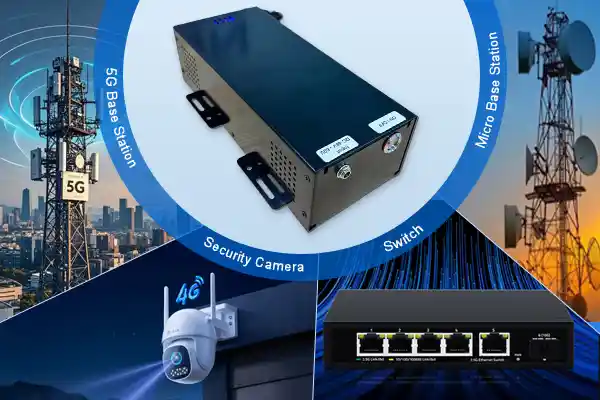
A UPS de 24 V / 48 V Este enfoque puede ser más adecuado porque puede ofrecer:
- Mejor alineación con la entrada del dispositivo nativo
- Menor necesidad de conversión de soluciones alternativas
- Arquitectura de proyecto más limpia
- Soporte más práctico para determinadas aplicaciones de telecomunicaciones e inalámbricas.
- Se adapta mejor a equipos de red perimetral fuera de la clase estándar de ONT/enrutador.
Para los ISP que implementan CPE inalámbricos, equipos de puente para exteriores o radios de telecomunicaciones, MYLION admite determinados UPS de 24 V / 48 V proyectos a través de modelos como MU248, que está diseñado para arquitecturas de voltaje no estándar.
Esto no significa que un voltaje más alto sea siempre superior. Significa que es más adecuado cuando el equipo objetivo y el entorno de implementación lo requieren.
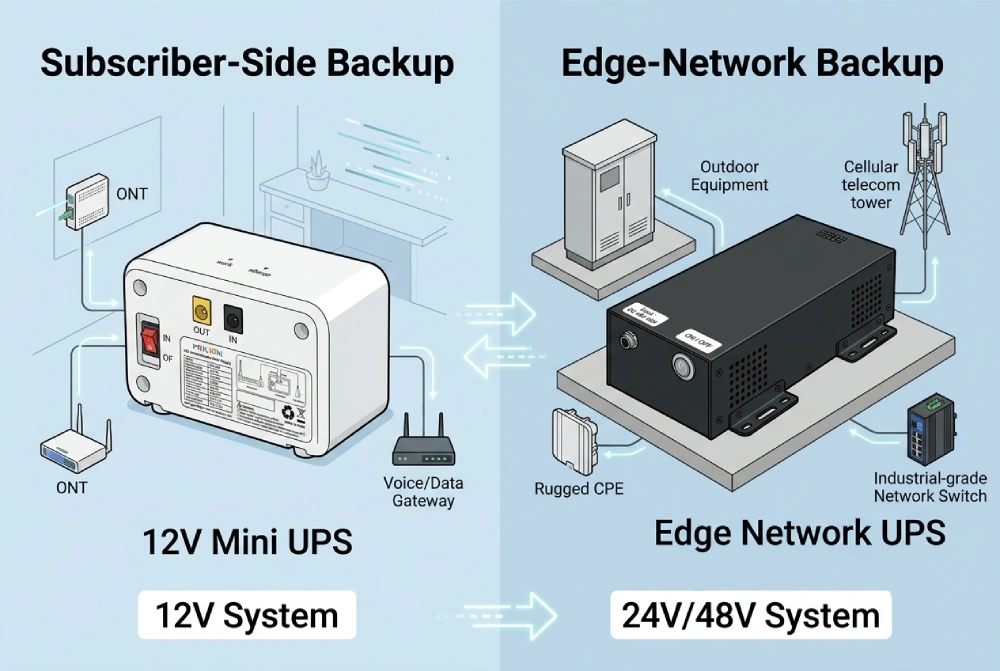
Uso de la red del lado del suscriptor frente al uso de la red perimetral
Ayuda a separar dos categorías amplias.
La copia de seguridad estándar del lado del suscriptor suele incluir:
- ONT/ONU de 12 V
- Router de 12 V
- puerta de enlace de 12 V
- Kits de respaldo compactos para interiores
Las redes perimetrales o las soluciones de respaldo de telecomunicaciones especializadas pueden incluir:
- Dispositivos de comunicación de alto voltaje
- Equipos para exteriores o armarios
- Hardware de red inalámbrica
- Dispositivos ubicados más allá del entorno interior básico del suscriptor.
Comprender en qué punto de este espectro se sitúa el proyecto ayuda a determinar si la lógica estándar de los mini SAI de 12 V sigue siendo adecuada o si, en su lugar, debería evaluarse una solución SAI de 24 V/48 V.
Qué deben comprobar los compradores antes de pasarse a 24V / 48V
Antes de seleccionar una solución de respaldo de mayor voltaje, los compradores deben revisar:
- Voltaje de entrada del dispositivo y tolerancia
- Requisito de carga real
- Objetivo de tiempo de ejecución
- Entorno de instalación
- Lógica de conectores e interfaces
- Ya sea que la aplicación sea del lado del suscriptor, del lado del borde o mixta.
- Si está disponible un modelo estándar de mayor voltaje o si se necesita un ajuste del proyecto.
Esto permite que el proyecto se base en los requisitos reales de los dispositivos, en lugar de en suposiciones generales sobre la arquitectura de alimentación de las telecomunicaciones.
Un error común: Tratar el alto voltaje como un tema puramente industrial.
Algunos compradores suponen que los sistemas UPS de 24 V/48 V solo son relevantes para grandes sistemas industriales. Esa visión es demasiado limitada.
En realidad, muchos proyectos de telecomunicaciones y comunicaciones se sitúan entre el respaldo compacto para abonados y la gran infraestructura industrial. Estos proyectos pueden ser lo suficientemente pequeños como para necesitar un producto de respaldo compacto, pero operan con lógica de mayor voltaje. Un proveedor que solo entiende los productos Mini UPS de 12 V a menudo ignora por completo este segmento del mercado.
Para los profesionales de ISP y telecomunicaciones que evalúan implementaciones de computación de borde, MILION admite todo desde lo estándar Mini SAI de 12 V para FTTH a UPS de 24V/48V para equipos de borde especializados.
Cómo se deben abordar el tiempo de ejecución y la clase de salida
Al igual que con los sistemas de 12 V, los sistemas de respaldo de mayor voltaje requieren la misma revisión rigurosa:
- Carga real, no una suposición.
- Tiempo de ejecución por objetivo de servicio
- Identificación del dispositivo, no etiquetado genérico.
- Adecuación para el despliegue, no solo capacidad teórica.
La diferencia radica en que el análisis de la arquitectura parte del rol del sistema de alto voltaje. Los compradores deben resistir la tentación de simplificar la conversación a "mayor voltaje significa un producto más grande". En realidad, se trata de la correcta adaptación del sistema.
Para los ISP que buscan un enfoque sistemático para el respaldo de última milla, MYLION proporciona soluciones listas para proyectos. Modelos de mini UPS de 12 V como el MU68 (68 Wh, tiempo de transferencia de 0 ms) con certificaciones completas para su uso a gran escala.

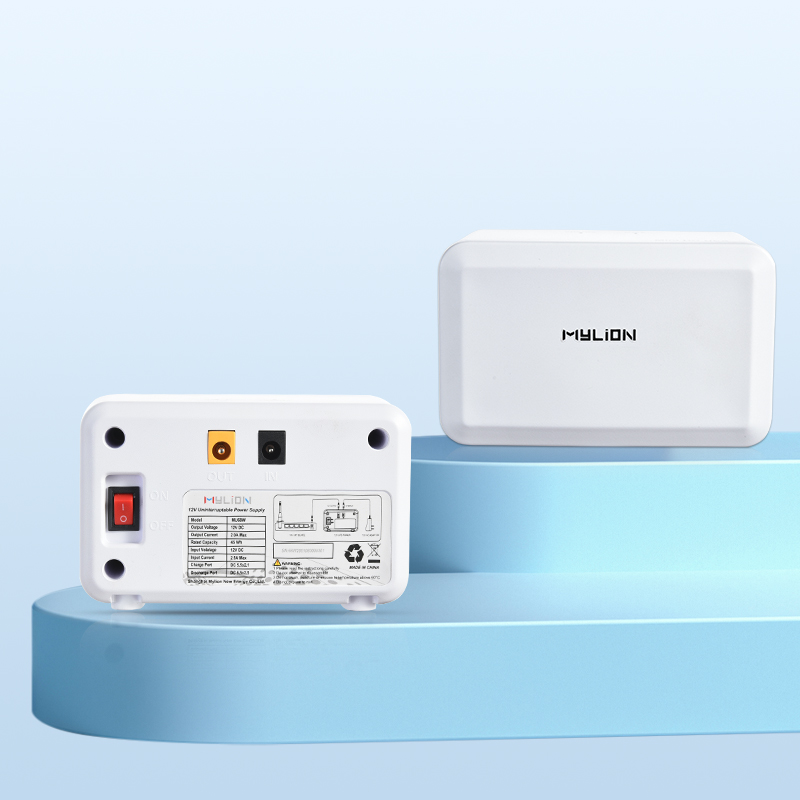
Mini SAI MUC85
Mini SAI MU68
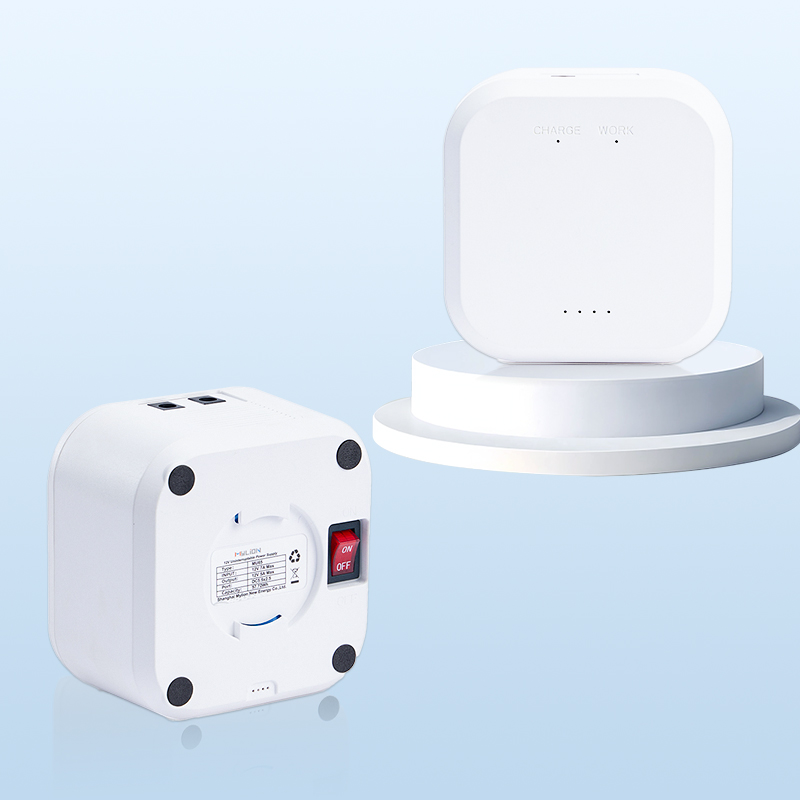
Mini UPS MUJ46
Mini SAI MU35
Cómo MYLION satisface las necesidades de respaldo de telecomunicaciones de 24 V / 48 V
MYLION ofrece soporte para determinados requisitos de respaldo de energía de 24 V/48 V para telecomunicaciones y redes perimetrales, donde los mini SAI estándar de 12 V no son adecuados. Esto ayuda a los clientes a cubrir la brecha entre el respaldo compacto de banda ancha y las necesidades de alimentación de comunicaciones más especializadas.
Para proyectos de mayor voltaje, MYLION puede brindar soporte para:
- Evaluación de los requisitos de los dispositivos de 24 V / 48 V
- Discusión sobre el objetivo de tiempo de ejecución y el rol de la aplicación.
- Posicionamiento del producto para su uso en redes perimetrales y telecomunicaciones.
- Recomendación del modelo estándar cuando corresponda
- Cooperación selectiva basada en proyectos cuando sea necesario
Explorar Catálogo completo de mini UPS de MYLION, incluyendo soluciones de SAI Mini de 12 V y SAI de 24 V/48 V.
Preguntas frecuentes
P1: ¿Cuándo es mejor una solución de respaldo de 24V o 48V que una de 12V?
P2: ¿Los sistemas de 24V/48V son solo para grandes sistemas industriales?
P3: ¿Se puede adaptar un mini SAI de 12 V a cualquier dispositivo de telecomunicaciones?
P4: ¿Qué deberían revisar primero los compradores?
P5: ¿Un voltaje más alto implica automáticamente una mejor copia de seguridad?
Conclusión
Para los profesionales de ISP y telecomunicaciones, la alimentación de respaldo no es una decisión que se adapte a todos los casos. Estándar Soluciones mini UPS de 12 V Siguen siendo la columna vertebral del respaldo para los suscriptores de FTTH. La línea de productos de 12 V de MYLION, que incluye los modelos MU26, MU68, MU35 y MUJ46, ofrece una fiabilidad comprobada para estas aplicaciones de uso general.
Sin embargo, una selección adecuada UPS de 24 V / 48 V Se adapta a su arquitectura de alimentación, elimina las pérdidas de conversión innecesarias y proporciona una base más sólida para la resiliencia de la red.
Al evaluar las especificaciones del dispositivo, los requisitos de carga y los objetivos de tiempo de funcionamiento antes de seleccionar entre un mini SAI de 12 V y un SAI de 24 V/48 V, los operadores de telecomunicaciones pueden reducir el tiempo de inactividad, mejorar la continuidad del servicio y disminuir los costes de mantenimiento a largo plazo.
 Español
  English
  简体中文
简体中文  Deutsch
  Français
  Italiano