
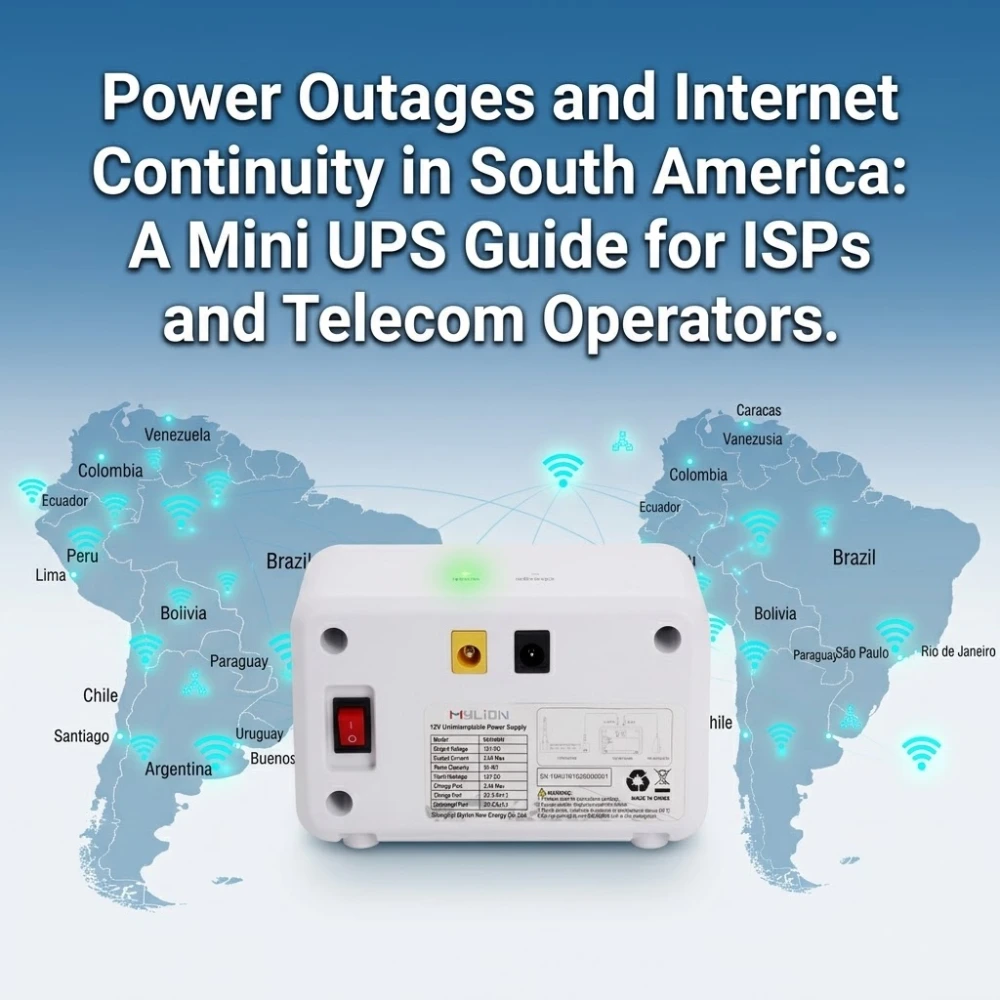
Los cortes de energía en Sudamérica varían significativamente según el país, la ciudad y la red de distribución. Sin embargo, el resultado para el cliente suele ser el mismo: cuando falla la electricidad local, el abonado enrutador, ONT, ONU, módem, puerta de enlace o CPE inalámbrico La conexión a Internet se interrumpe y desaparece incluso cuando parte de la red de subida del operador sigue disponible.
Para los proveedores de servicios de Internet y los operadores de telecomunicaciones, esto crea un problema de continuidad del servicio en las instalaciones del cliente.
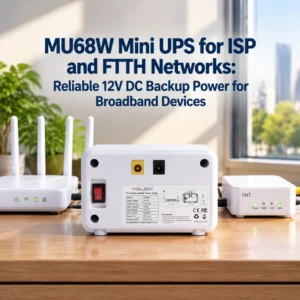
Una coincidencia correcta Mini UPS Puede proporcionar respaldo automático de batería para equipos de red de CC de bajo voltaje compatibles. Solución MYLION Mini DC UPS Puede ayudar a que los dispositivos del abonado sigan funcionando durante las interrupciones locales del suministro eléctrico, reducir los reinicios innecesarios de los dispositivos y ofrecer una experiencia de cliente más resiliente.
Por qué un corte de energía se convierte en un problema de continuidad de Internet.
Una conexión de banda ancha fija depende de varios elementos alimentados por energía.
El proveedor de servicios de Internet (ISP) o el operador de telecomunicaciones debe mantener en funcionamiento los equipos centrales, los gabinetes de campo, los nodos de fibra, las torres o la infraestructura inalámbrica. Al mismo tiempo, el abonado debe mantener encendidos los equipos locales, como el ONT, el enrutador, el módem o la puerta de enlace.
Un fallo en cualquiera de los dos niveles puede interrumpir el servicio.
Cuando la red principal permanece operativa, pero el equipo del abonado sufre un corte de energía, un Mini UPS compatible puede permitir que la conexión local continúe. Si el nodo, la torre, el armario o la red de transporte principal también están fuera de servicio, la alimentación de respaldo en las instalaciones del cliente no puede restablecer el servicio de red interrumpido.
Esta distinción es importante tanto para la planificación técnica como para la comunicación con el cliente.
Los apagados repetidos de los dispositivos de los suscriptores pueden provocar:
- Más llamadas de soporte técnico.
- Quejas que parecen ser fallos de la red.
- Tiempos de reconexión más prolongados mientras los dispositivos se reinician.
- Interrupciones en la gestión remota.
- Presión adicional sobre los equipos de servicio de campo.
- Menor satisfacción del cliente durante las interrupciones recurrentes del servicio.
Por lo tanto, para los operadores con una gran base instalada, el respaldo en las instalaciones del cliente debe evaluarse como parte de la continuidad del servicio, y no simplemente como una venta de accesorios.
El creciente desafío de la inestabilidad de la red eléctrica en Sudamérica
América del Sur se enfrenta a una serie de desafíos infraestructurales y ambientales únicos que hacen que los cortes de energía sean una realidad frecuente para millones de hogares y empresas.
Muchos países de la región latinoamericana dependen en gran medida de la energía hidroeléctrica. Si bien esta es una fuente formidable de energía renovable, hace que la red eléctrica sea altamente vulnerable a las anomalías climáticas.
Las sequías severas, exacerbadas por el fenómeno meteorológico de El Niño, suelen provocar niveles peligrosamente bajos en los embalses. Países como Ecuador, Colombia, Brasil y Argentina han enfrentado históricamente períodos en los que se implementaron racionamiento de energía y cortes de luz rotativos para evitar el colapso total de la red eléctrica.
Además, el envejecimiento de la infraestructura de distribución eléctrica y la falta de inversión en la modernización de la red implican que incluso fenómenos meteorológicos extremos localizados, como las fuertes tormentas tropicales, pueden provocar cortes de energía repentinos e impredecibles.
Para un proveedor de servicios de internet (ISP), la fiabilidad de su red de fibra óptica depende totalmente de la fiabilidad de la red eléctrica local. Puede tener la red central más resistente del mundo, pero si se interrumpe el suministro eléctrico en el domicilio del usuario, su servicio se percibirá como poco fiable.
Implementación de un mini SAI para routers y ONT en redes de proveedores de servicios de Internet (ISP)
Un mini SAI (Sistema de Alimentación Ininterrumpida) resulta especialmente útil cuando la interrupción del servicio comienza en las instalaciones del cliente.
Las aplicaciones típicas incluyen:
- Alimentación de respaldo para el router.
- Alimentación de respaldo para ONT u ONU.
- Módem y puerta de enlace de respaldo.
- Copia de seguridad inalámbrica del CPE.
- Equipos Wi-Fi.
- Equipos seleccionados de videovigilancia o control de acceso.
- Una combinación de ONT más enrutador.
- Terminales de comunicación o monitorización remota.
Los equipos conectados deben utilizar una entrada de alimentación de CC compatible o USB-C homologada, y deben conocerse los requisitos de voltaje, corriente, conector y potencia total.
Un mini SAI puede ser adecuado cuando:
- Se prevé que la red de distribución principal permanezca disponible al menos durante parte de la interrupción del servicio.
- El equipo del abonado dispone de una entrada de alimentación compatible.
- La duración de la copia de seguridad requerida es técnicamente realista.
- El entorno de instalación se encuentra dentro de las condiciones de funcionamiento aprobadas.
- El operador está preparado para validar la solución con su equipo real.
La categoría del dispositivo por sí sola no es suficiente para la selección del producto.
Dos routers pueden estar etiquetados como "12V", pero pueden tener diferentes requerimientos de corriente, comportamiento de arranque, dimensiones del conector, polaridad y requisitos de adaptador de corriente.
Cómo las familias de productos MYLION Mini UPS son compatibles con las aplicaciones comunes de los proveedores de servicios de Internet (ISP).
MYLION proporciona Soluciones mini UPS para diferentes cargas de dispositivos, interfaces y escenarios de implementación. La familia de productos correcta debe seleccionarse solo después de haber revisado el equipo conectado y los requisitos del proyecto.
MILION dirección del producto | Aplicación típica | Llave modelo |
Serie Mini UPS estándar de 12 V | Enrutador, ONT, ONU, módem y CPE estándar | |
Serie de mini UPS de alta potencia de 12 V | Routers, gateways, módems y CPE de mayor potencia | |
Serie de salidas múltiples de 12 V más USB | Un dispositivo de 12 V más un dispositivo alimentado por USB. | |
Serie de doble entrada de CA de 12 V | Dos dispositivos de 12 V de baja potencia, como un ONT y un enrutador. | |
Serie de mini UPS USB-C PD | Routers alimentados por USB-C, equipos Wi-Fi 6/7 y CPE seleccionados. | |
Serie de comunicación de 24 V/48 V | Equipos inalámbricos CPE, de radio, de puente y de comunicación profesional. |
La disponibilidad del producto, las especificaciones y la documentación pueden variar según el modelo, la configuración y el mercado objetivo.
MYLION no selecciona un Mini UPS únicamente por la capacidad de la batería. La evaluación considera el equipo, el adaptador, la carga, la interfaz, el tiempo de respaldo deseado, el entorno de instalación y el plan de implementación.
Validación de muestras antes de un programa piloto de ISP
En el caso de una implementación de un proveedor de servicios de Internet (ISP), la decisión final debe basarse en una muestra probada con el enrutador, ONT, ONU, módem o CPE previsto.
Un plan práctico de validación de muestras debe incluir los siguientes pasos:
- Confirme la configuración, el adaptador y los cables del Mini UPS aprobados.
- Registre los modelos de los equipos conectados.
- Medir o confirmar la carga operativa.
- Verifique el funcionamiento normal mientras haya alimentación externa.
- Desconecte la alimentación externa.
- Compruebe si el equipo conectado sigue funcionando.
- Compruebe que la sesión de internet y el estado del dispositivo se mantengan estables.
- Mida el tiempo de ejecución bajo la carga prevista.
- Restablecer la alimentación externa.
- Confirme la recuperación normal y la carga de la batería.
- Repita la prueba de interrupción.
- Registre cualquier reinicio, alarma, sobrecalentamiento, problema con el conector o el cable.
Las pruebas deben reflejar el escenario de implementación real.
Por ejemplo, una prueba de ONT y enrutador debe utilizar ambos dispositivos simultáneamente. Probar el Mini UPS con un solo dispositivo no valida la configuración de doble dispositivo.
Una prueba de muestra exitosa no aprueba automáticamente un lanzamiento a gran escala. Antes de un proyecto piloto o un despliegue en producción, el cliente y el proveedor también deben confirmar lo siguiente:
- Versión del producto.
- Configuración del adaptador y del cable.
- Embalaje y etiquetado.
- Instrucciones de instalación.
- Documentos aplicables.
- Cantidad piloto.
- Requisitos de control de calidad.
- Expectativas de control de cambios.
- Plan de despliegue y reabastecimiento.
MYLION Mini UPS: El socio estratégico de hardware para telecomunicaciones
Los proveedores de servicios de Internet (ISP) requieren un socio de hardware robusto y de nivel empresarial, capaz de ofrecer soluciones de respaldo confiables, escalables y versátiles.
MYLION proporciona Soluciones mini UPS y apoyo a proyectos para operadores de telecomunicaciones en Sudamérica.
He aquí por qué MYLION está diseñado para su implementación por parte de proveedores de servicios de Internet (ISP):
- Tecnología de baterías de litio de primera calidad: MYLION utiliza celdas de batería de iones de litio o LiFePO4 de alta calidad. Esto garantiza una larga duración de la batería (a menudo de 4 a 8 horas, dependiendo de la carga, lo que cubre el apagón promedio en Latinoamérica).
- Salida multivoltaje y amplia compatibilidad: Las configuraciones en las instalaciones del cliente varían. Algunos ONT requieren 12 V, mientras que ciertos routers pueden usar 9 V o 5 V. Los modelos MYLIONMini UPS cuentan con salidas multivoltaje (5 V/9 V/12 V) y puertos USB, lo que permite que una sola unidad alimente simultáneamente un ONT y un router.
- Tiempo de transferencia cero: Diseñadas con tecnología de circuitos avanzada, las unidades MYLION garantizan un tiempo de transferencia de 0 ms. Los routers no se reiniciarán ni perderán paquetes cuando falle la red eléctrica.
- Sistemas de seguridad integrados: El despliegue masivo de hardware requiere estándares de seguridad rigurosos. Las unidades MYLION están equipadas con protocolos de protección contra sobrecarga, sobredescarga, cortocircuito y sobrecalentamiento.
- Escalabilidad B2B y personalización OEM: MYLION ofrece precios competitivos al por mayor, capacidades de fabricación escalables y Fabricante de equipos originales (OEM)/fabricante de diseños originales (ODM)
Preguntas frecuentes
P1: ¿Funcionará la conexión a internet por fibra óptica durante un apagón?
P2: ¿Puede un Mini UPS alimentar tanto un ONT como un enrutador?
P3: ¿Qué mini SAI de MYLION es el más adecuado para un proyecto de ISP?
P4: ¿Cuántas horas de respaldo debe especificar un proveedor de servicios de Internet (ISP)?
P5: ¿Puede una batería externa reemplazar un mini SAI?
P6: ¿Una batería de mayor capacidad siempre ofrece una mejor solución?
P7: ¿Se puede utilizar el tiempo de ejecución impreso en un catálogo para todos los enrutadores?
Conclusión
cortes de energía En Sudamérica, los distintos mercados presentan diferentes desafíos operativos, pero el problema de las instalaciones del cliente es constante: los routers, ONT, ONU, módems, gateways y dispositivos CPE dejan de funcionar cuando se interrumpe el suministro eléctrico local.
Un emparejamiento adecuado Mini UPS puede ayudar a mantener la energía a los equipos de red compatibles cuando la red ascendente permanece disponible. Mini UPS de CC solución Debe seleccionarse en función de la carga real del dispositivo, el conector, la configuración de salida, el entorno de ejecución de destino y el entorno de implementación.
 Español
  English
  简体中文
简体中文  Deutsch
  Français
  Italiano