
Introducción
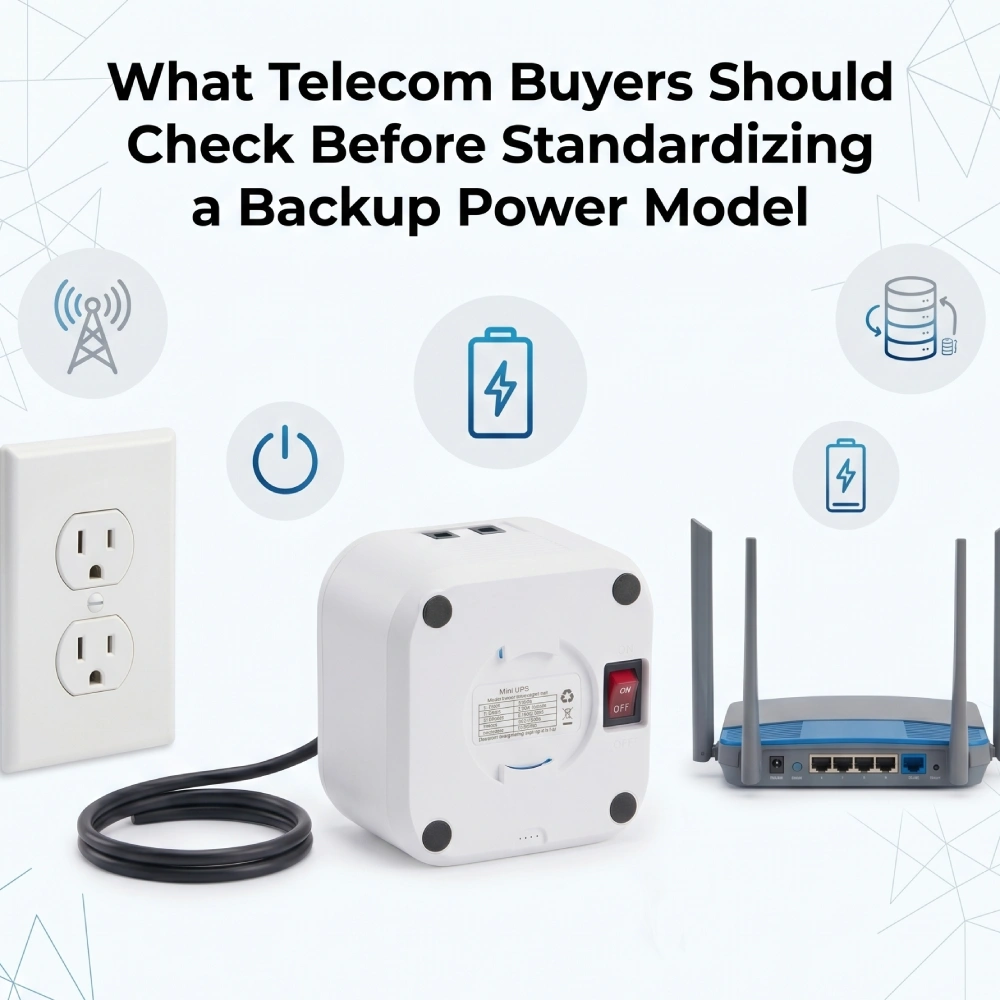
La estandarización suena eficiente, y en los programas de respaldo de telecomunicaciones, a menudo lo es. Sin embargo, estandarizar demasiado pronto o sobre una base técnica incorrecta convierte la eficiencia operativa en un riesgo de implementación, lo que aumenta el costo total de propiedad y genera penalizaciones por incumplimiento de los acuerdos de nivel de servicio.
Muchos equipos de compras esperan seleccionar un único y universal Modelo Mini UPS para una amplia gama de CPE. Si bien esto es posible, forzar una única arquitectura de alimentación sin validación suele generar desajustes de voltaje, un rendimiento inestable en el campo o una carga innecesaria para el soporte al cliente.
Para los directores de tecnología y los directores de compras, la pregunta clave es: "¿Qué parámetros técnicos debemos verificar antes de estandarizar un modelo de Mini UPS en varios dispositivos CPE?"
¿Por qué los compradores presionan para que se estandarice la energía?
La lógica financiera y operativa que respalda la implementación de un Mini UPS estandarizado para redes de enrutadores Wi-Fi y ONT es sólida:
- Adquisiciones más sencillas: El poder adquisitivo de las compras al por mayor reduce los costes unitarios.
- Menos referencias: Reduce la complejidad del inventario y el almacenamiento.
- Capacitación simplificada para instaladores: Los técnicos dominan un único protocolo de implementación.
- Gestión predecible de repuestos: Optimiza los procesos de garantía y reemplazo.
- Distribución de productos más limpios: Elimina los errores de preparación de kits en todos los canales.
- Apalancamiento de precios a largo plazo: Maximiza el poder de negociación de los proveedores.
Estas ventajas solo se mantienen si el modelo estandarizado Mini UPS es realmente compatible con la diversa flota de hardware que admite. Si la compatibilidad falla, el costo de los reemplazos en campo y la pérdida de suscriptores anulan rápidamente el ahorro inicial en la adquisición.
Comience con una revisión de la cartera de dispositivos.
Antes de estandarizar cualquier modelo de alimentación de respaldo, los compradores de telecomunicaciones deberían revisar la cartera actual de equipos del cliente (CPE).
Como mínimo, esta revisión debería incluir:
- Familia de modelos de dispositivos
- Voltaje de entrada
- Corriente de funcionamiento normal
- Corriente máxima o de arranque, si se conoce.
- Tipo de conector
- Requisito de configuración de un solo dispositivo o combinado
- Objetivo de tiempo de ejecución por escenario de servicio
Esto ofrece una visión realista de la distribución del hardware. Sin ello, la estandarización podría basarse en suposiciones en lugar de evidencias.
Primero, verifique el mapa de voltaje.
El voltaje es la primera barrera infranqueable en la ingeniería eléctrica.
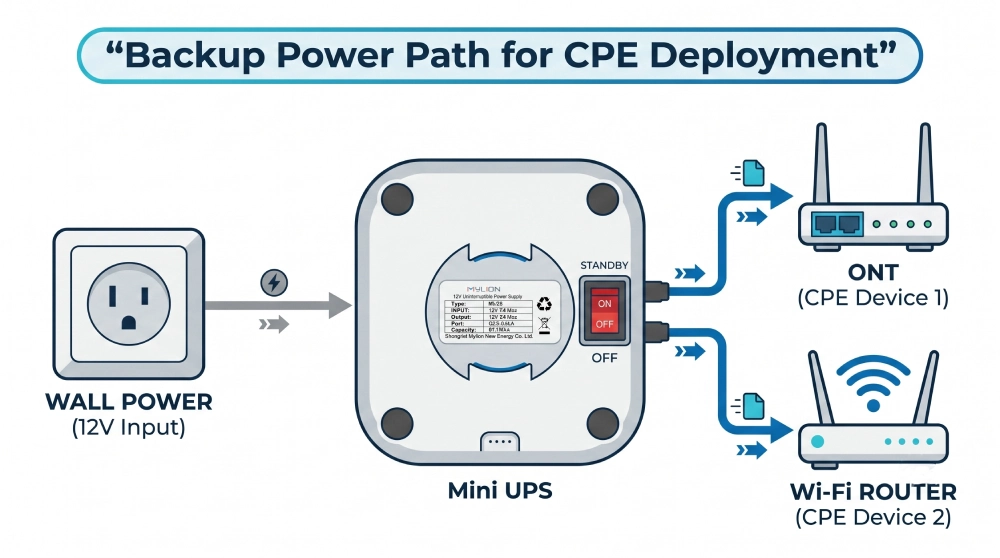
Si su cartera de productos incluye únicamente dispositivos de 12 V, estandarizar el uso de un Mini UPS de alta eficiencia es relativamente sencillo.
Sin embargo, si su infraestructura de red combina equipos de 9 V, 12 V, 24 V o de 48 V alimentados por PoE, un único modelo de respaldo universal resulta poco práctico.
Nota sobre riesgos críticos: La discrepancia de voltaje no se soluciona con accesorios ni cables de conexión. Suministrar un voltaje incorrecto a una puerta de enlace de alta gama provoca fallos inmediatos en los componentes o una grave degradación de la batería. Si existe variación de voltaje en su flota, deberá reestructurar su plan de estandarización.
Comprenda el rango actual, no solo la carga promedio.
Los programas de estandarización suelen fracasar porque los equipos de ingeniería diseñan teniendo en cuenta el consumo energético típico, sin considerar la distribución real de la carga.
- ONT/ONU estándar:Requieren una corriente continua de baja a moderada. Los routers Wi-Fi 6/7 de alto rendimiento requieren márgenes de salida significativamente mayores, especialmente con un alto flujo de datos.
- Pasarelas integradas: Presentan un comportamiento de corriente de arranque transitoria exigente y de alta intensidad durante las secuencias de arranque en frío.
- Implementaciones en dos dispositivos: Al conectar un ONT y un enrutador independiente a una sola fuente de alimentación, el perfil de carga cambia por completo.
A Mini UPS Diseñados exclusivamente para dispositivos de gama media, los sistemas de protección contra sobrecorriente sufrirán fallos al conectarse con sus gateways de más alta gama. Los compradores deben revisar toda la gama de corriente, no solo un dispositivo de referencia, para garantizar que los dispositivos de gama alta sean compatibles.
Revisión Conector Familiar Distribución
La variación en los conectores es uno de los mayores riesgos para la estandarización.
Aunque el voltaje y la corriente sean aceptables, las distintas familias de dispositivos CPE pueden utilizar diferentes tamaños de enchufes o lógica de cableado. Si se ignora este detalle, el plan de estandarización podría fracasar durante la instalación.
Antes de estandarizar, los compradores deben confirmar:
- ¿Cuántos tipos de conectores están incluidos en el alcance?
- Si los kits de cables pueden estandarizarse
- Si la polaridad es uniforme
- Si una estrategia de adaptadores puede respaldar la cartera
- Si la implementación de dispositivos duales modifica los requisitos de cableado
Esta revisión suele determinar si un producto puede escalar de forma realmente eficiente.
Separar la estandarización de un modelo de la estrategia de un programa.
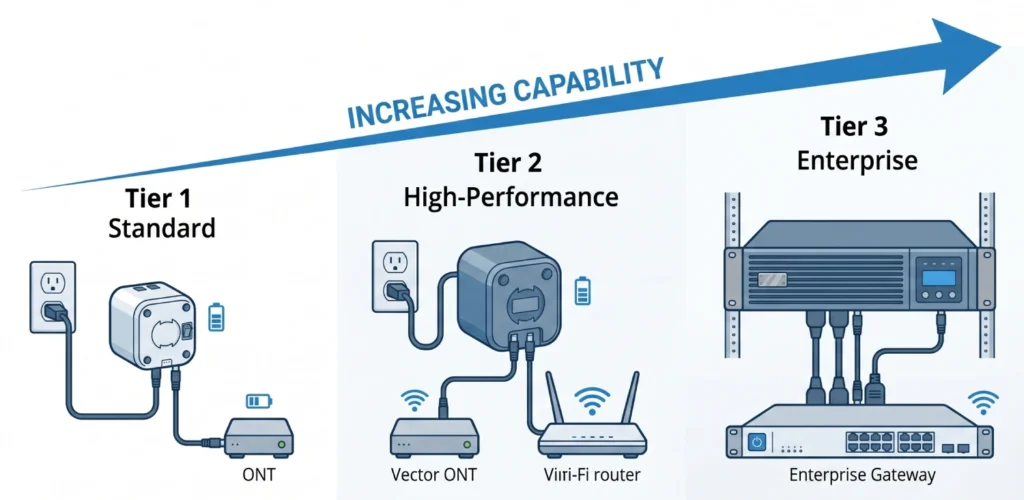
Obligar a utilizar un único modelo de hardware para cubrir todos los escenarios de implementación genera gastos de capital innecesarios o deja los servicios de alta gama desprotegidos. Los operadores de telecomunicaciones más sofisticados implementan una estrategia de programa único que utiliza una selección escalonada de modelos Mini UPS:
- Nivel estándar: Un mini SAI compacto y económico, optimizado para puntos de terminación de fibra óptica ONT/ONU independientes.
- Nivel de alto rendimiento: Un mini SAI robusto y de alta capacidad, diseñado para configuraciones de dos dispositivos o routers y gateways Wi-Fi de alto consumo energético.
- Nivel empresarial: Un modelo especializado de mayor voltaje, reservado para aplicaciones avanzadas en el borde de la red.
Este enfoque estructurado preserva el poder de negociación en las adquisiciones y simplifica los flujos de trabajo de los instaladores, al tiempo que garantiza que cada aplicación cumpla con su estricto acuerdo de nivel de servicio (SLA) de tiempo de actividad sin necesidad de especificaciones excesivas y costosas.
Definir el entorno de ejecución por nivel de servicio
Las expectativas de tiempo de ejecución deben revisarse antes de la estandarización.
Si una familia de dispositivos solo necesita cobertura ante interrupciones breves, mientras que otra requiere mayor continuidad, un único nivel de respaldo puede generar costos innecesarios o un rendimiento deficiente. El tiempo de ejecución debe agruparse según el objetivo del servicio y las necesidades del mercado, no solo por conveniencia.
Esto ayuda a los compradores a evitar una trampa común: estandarizar una batería grande para todas las aplicaciones, cuando diferentes niveles crearían un programa más eficiente.
Aplique la lógica de estandarización, no solo el producto.
Un buen piloto hace más que simplemente comprobar si una muestra funciona.
Debería comprobarse si la lógica de estandarización propuesta funciona:
- En modelos de dispositivos representativos
- En todas las familias de conectores
- En todas las expectativas de tiempo de ejecución
- En todos los escenarios de instalación
- En los casos de un solo dispositivo y de dos dispositivos, cuando sea pertinente.
En otras palabras, el piloto debe validar la estructura del programa, no solo la unidad de hardware.
Cómo MYLION respalda la estandarización estructurada
Mylion es un fabricante profesional especializado en Soluciones mini UPS de CC Para aplicaciones de telecomunicaciones y proveedores de servicios de Internet (ISP). La serie Mylion Mini UPS incluye modelos que van desde 12 V 2 A hasta 12 V 5 A, con opciones de configuración con PD tipo C, resistente al agua, compatible con energía solar y con baterías LiFePO4 para satisfacer las diversas necesidades de respaldo de los equipos del cliente (CPE).
MYLION puede brindar soporte para:
- Recomendación de modelo basada en dispositivos
- Comparación de clases de salida para roles de ONT, enrutador y puerta de enlace
- Discusión sobre la variación de conectores y cables
- Recomendación de nivel de tiempo de ejecución
- Soporte seleccionado para la estructuración basada en proyectos y las necesidades de OEM/ODM.
Preguntas frecuentes
P1: ¿Un solo modelo de Mini UPS puede cubrir todos los dispositivos CPE?
P2: ¿Qué deben revisar los compradores antes de estandarizar un Mini UPS?
P3: ¿Por qué la carga media del dispositivo no es suficiente?
P4: ¿Es mejor una estrategia de un solo programa que una estrategia de un solo modelo?
P5: ¿Por qué deberían los pilotos incluir varios tipos de dispositivos?
Conclusión
Estandarizar un Mini UPS en varias familias de dispositivos CPE es una estrategia muy rentable, pero solo si se validan rigurosamente los requisitos de voltaje, corriente, compatibilidad de conectores y tiempo de funcionamiento. Un enfoque de modelo único solo funciona para flotas homogéneas; la mayoría de los operadores de telecomunicaciones se benefician más de un programa de Mini UPS por niveles.
Soluciones Mylion Mini UPS Ofrecemos la flexibilidad de ingeniería, la compatibilidad con conectores y el rango de clases de salida necesarios para que esta estrategia por niveles sea práctica y rentable. Antes de comprometerse con cualquier plan de estandarización, audite su cartera de dispositivos, analice su distribución de voltaje y realice pruebas piloto en escenarios reales.
 Español
  English
  简体中文
简体中文  Deutsch
  Français
  Italiano