
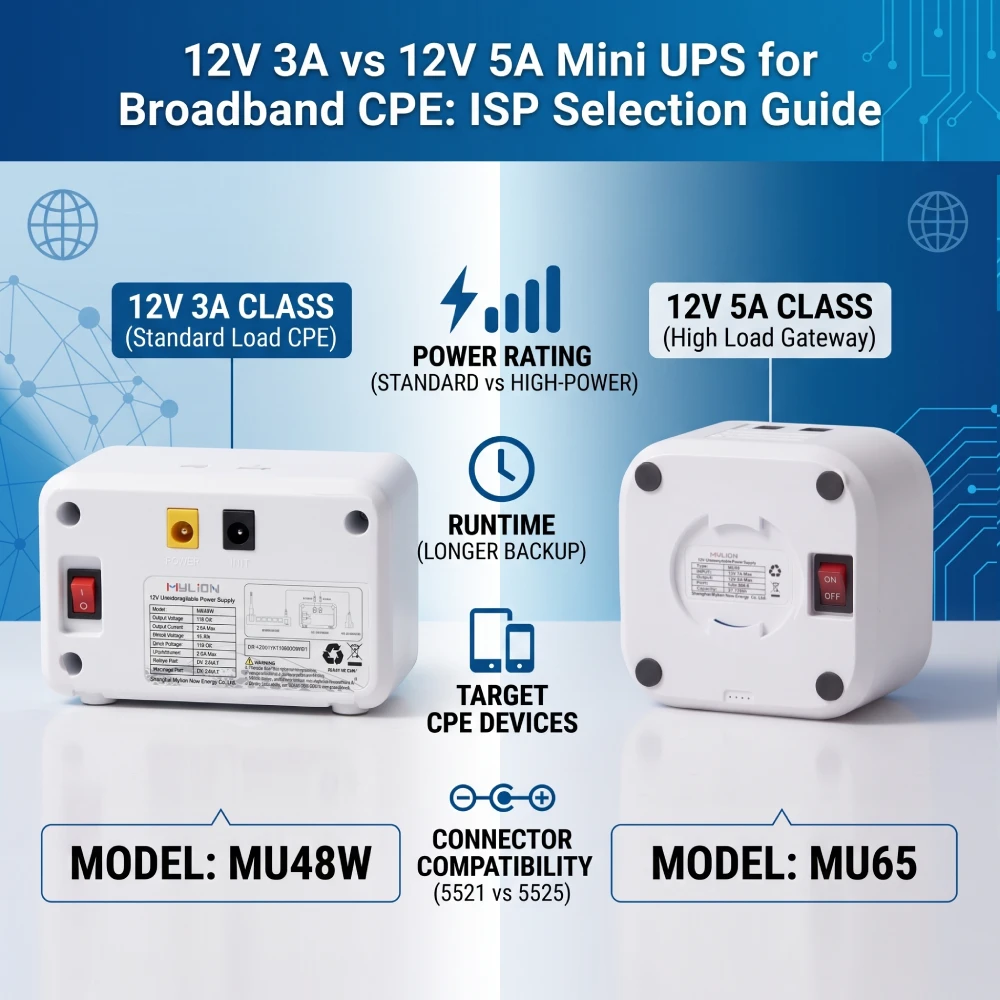
Pour les CPE haut débit, les routeurs, les ONT, les ONU et les passerelles, le choix d'un mini-onduleur adapté ne se limite pas à choisir entre « 12 V 3 A » et « 12 V 5 A ». Un choix fiable repose sur la charge réelle de l'appareil, son comportement au démarrage, le connecteur, la polarité, le temps de secours requis et l'environnement de déploiement.
Pour de nombreux appareils haut débit standard 12 V, un mini-onduleur 12 V 3 A peut s'avérer judicieux. Pour les routeurs, passerelles ou équipements CPE à forte consommation, un mini-onduleur 12 V 5 A peut offrir une marge de puissance supérieure.
Pour les projets des fournisseurs d'accès Internet et des télécommunications, le point clé est le suivant : le courant maximal n'est pas la même chose que le courant continu. Avant un déploiement à grande échelle, Mini-onduleur doit être adaptée à la charge de travail continue de l'appareil et vérifiée par une évaluation par échantillonnage.
Pourquoi le choix d'une solution de secours pour votre équipement client haut débit est important
Dans un réseau d'accès haut débit, les équipements chez le client peuvent constituer le maillon faible lors de coupures de courant locales. Même si le réseau fibre optique reste opérationnel, l'utilisateur final peut interrompre son service en cas de redémarrage de son ONT, ONU, routeur, modem ou CPE.
Pour les fournisseurs d'accès Internet, les opérateurs télécoms, les intégrateurs de systèmes et les partenaires CPE, un mauvais choix d'alimentation de secours peut engendrer plusieurs problèmes :
- Les appareils des abonnés se déconnectent lors de brèves coupures de courant.
- Les routeurs ou passerelles redémarrent après une chute de tension.
- Un mini-onduleur sélectionné uniquement en fonction de la tension ne peut pas supporter la charge réelle.
- Une seule unité de secours devrait alimenter plusieurs appareils sans calcul de charge totale.
- L'autonomie est estimée uniquement à partir de la capacité de la batterie.
- Un connecteur, une polarité ou un câble incorrects peuvent entraîner un échec d'installation.
Pour un foyer, cela peut paraître un détail. Mais lors du déploiement d'un réseau haut débit, ce même problème d'incompatibilité peut se reproduire sur de nombreuses installations. C'est pourquoi le choix d'un mini-onduleur doit être considéré comme une décision technique de déploiement, et non comme un simple achat d'accessoire de batterie.
Que signifient réellement « 12V 3A » et « 12V 5A » ?
Sur le marché, les appellations « Mini-onduleur 12 V 3 A » et « Mini-onduleur 12 V 5 A » sont souvent utilisées à tort comme simples étiquettes de produits. Pour le choix d'un onduleur, il convient toutefois de les examiner attentivement.
Une sortie de 12 V confirme le sens de la tension. L'intensité nominale donne une indication de la capacité de sortie, mais les acheteurs doivent tout de même faire la distinction suivante :
- Production continue : niveau de production à long terme approuvé dans des conditions définies.
- Production maximale : limite de production plus élevée qui ne doit pas être considérée comme une production continue à long terme.
- Charge de pointe ou charge de démarrage : une augmentation de charge de courte durée lors du démarrage de l’appareil ou lors de changements de fonctionnement.
- Puissance de sortie totale : limite du système lorsqu’un ou plusieurs appareils sont connectés.
Un adaptateur CPE marqué 12 V 3 A ne signifie pas automatiquement que l'appareil consomme 3 A en continu. Cela signifie généralement que l'adaptateur peut fournir jusqu'à ce courant nominal. Pour les projets B2B, il est recommandé de vérifier la charge de travail réelle dans la mesure du possible.
Quand un mini-onduleur 12 V 3 A peut convenir
Un mini-onduleur 12V 3A est généralement envisagé en premier lieu lorsque le projet implique des appareils haut débit standard de 12V avec des exigences de charge modérées.
Les applications typiques peuvent inclure :
- Sauvegarde ONT
- ONU de secours
- Sauvegarde standard du routeur
- Sauvegarde du modem
- Sauvegarde CPE standard
- Sauvegarde côté abonné FTTH
- continuité de l'accès Internet haut débit à domicile ou au petit bureau
Dans la gamme actuelle de mini-onduleurs MYLION, MU48W et MU68W Ces deux modèles fonctionnent selon la norme 12 V. Ils prennent en charge une sortie CC de 12 V avec un courant continu de 2,5 A / un courant maximal de 3 A et une puissance de sortie maximale de 36 W.
Le modèle MU48W convient lorsque la charge de l'appareil est compatible avec cette norme de sortie et que le projet nécessite une alimentation de secours compacte de 12 V. Le modèle MU68W est à privilégier lorsque la même classe de sortie est adaptée, mais que le projet requiert une capacité de batterie supérieure à celle du MU48W.
Quand un mini-onduleur 12V 5A peut être nécessaire
Il convient d'envisager l'utilisation d'un mini-onduleur 12V 5A lorsque le périphérique haut débit nécessite une marge de charge plus importante ou lorsque l'équipement est plus exigeant.
Les cas typiques comprennent :
- routeur de secours plus puissant
- Sauvegarde de la passerelle
- Sauvegarde CPE haute charge
- Dispositifs haut débit en périphérie avec une demande de démarrage plus élevée
- Applications où la charge peut fluctuer
- Projets nécessitant une marge de production plus importante avant les tests d'échantillonnage
Dans la gamme de produits actuelle de MYLION, MU35W Il appartient à la catégorie des alimentations 12 V haute puissance à longue autonomie. Il prend en charge une sortie CC de 12 V avec un courant continu de 4 A / un courant maximal de 5 A et une puissance de sortie maximale de 60 W.
Cela rend le MU35W plus adapté aux routeurs, passerelles, modems et équipements CPE à charge élevée lorsque les exigences du projet correspondent aux conditions de produit approuvées.
Pour plus de détails sur les équipements haut débit à forte charge, consultez Comment choisir un mini-onduleur pour les équipements clients haute puissance et les passerelles haut débit.
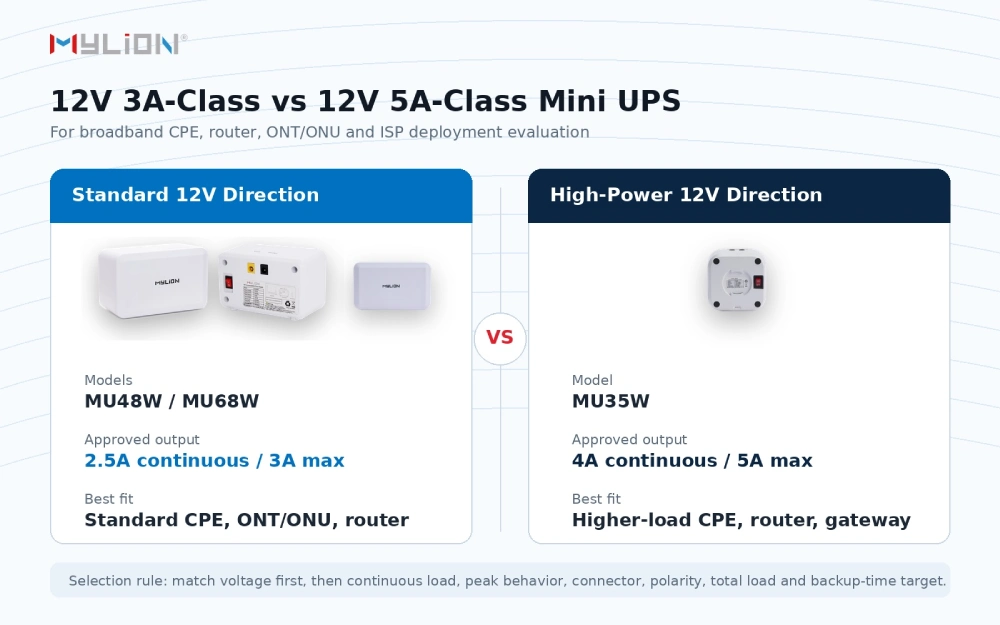
Comparaison des mini-onduleurs 12V 3A et 12V 5A
Facteur de sélection | 12V 3A Mini-onduleur | 12V 5A Mini-onduleur |
Objectif principal | Sauvegarde standard pour appareils haut débit 12 V | Sauvegarde des périphériques réseau 12 V à charge élevée |
Type d'appareil typique | ONT, ONU, routeur standard, modem, CPE standard | Routeur, passerelle, modem et CPE haute puissance |
Marge actuelle | Convient lorsque la charge réelle se situe dans la plage de débit continu approuvée | Meilleur lorsque des marges de charge plus élevées sont requises |
Orientation du modèle MYLION | MU48W, MU68W | MU35W |
Exemple de sortie approuvée | 12 V CC, 2,5 A en continu / 3 A maximum | 12 V CC, 4 A en continu / 5 A maximum |
Puissance de sortie maximale | MU48W / MU68W : 36W | MU35W : 60 W |
énergie de la batterie | MU48W : 29,6 Wh ; MU68W : 44,4 Wh | MU35W : 75,6 Wh |
Cas d'utilisation le plus adapté | Sauvegarde standard CPE, ONT, ONU, routeur ou modem | Sauvegarde CPE, routeur ou passerelle à charge élevée |
Solution MYLION : MU48W, MU68W et MU35W
MYLION propose aux entreprises une gamme de mini-onduleurs adaptés à leurs besoins, notamment pour les applications haut débit, télécommunications, FAI et continuité de réseau. Les principaux modèles disponibles sont les MU48W, MU68W et MU35W.
MU48W : Alimentation de secours standard 12 V
Le MU48W est un mini-onduleur standard 12V destiné aux équipements haut débit courants tels que les ONT, les ONU, les routeurs, les modems et les appareils CPE standard.
Informations produit confirmées :
- Sortie 12 V CC
- Courant de sortie continu de 5 A / courant de sortie maximal de 3 A
- Puissance de sortie maximale de 36 W
- Énergie de la batterie de 6 Wh
- Entrée DC5521 et sortie DC5525
- Batterie lithium-ion
- Boîtier en ABS ignifugé
MU68W : Mini-onduleur 12 V grand public pour alimentation de secours des FAI et des réseaux FTTH
Le MU68W est un mini-onduleur 12 V standard destiné aux applications de secours pour le haut débit et les télécommunications. Il convient aux appareils nécessitant un courant continu de 2,5 A et un courant maximal de 3 A, et dont l'autonomie est supérieure à celle du MU48W.
Informations produit confirmées :
- Sortie 12 V CC
- Courant de sortie continu de 5 A / courant de sortie maximal de 3 A
- Puissance de sortie maximale de 36 W
- Énergie de la batterie de 4 Wh
- Entrée DC5521 et sortie DC5525
- Batterie lithium-ion
- Boîtier en ABS ignifugé
Pour les applications standard 12V ONT, ONU, routeur, modem et CPE de secours, le MU68W peut constituer un point de départ pratique pour l'évaluation d'un projet.
MU35W : Alimentation haute puissance et longue autonomie pour CPE à charge élevée
Le MU35W est conçu pour les appareils réseau 12V à charge élevée, pour lesquels la classe de sortie standard peut ne pas offrir une marge suffisante.
Informations produit confirmées :
- Sortie 12 V CC
- Courant de sortie continu de 4 A / courant de sortie maximal de 5 A
- Puissance de sortie maximale de 60 W
- Énergie de la batterie de 6 Wh
- Entrée et sortie du DC5525
- Batterie lithium-ion
- Boîtier en ABS ignifugé
Le MU35W peut être évalué pour les routeurs, passerelles, modems et applications CPE à forte puissance, en particulier lorsque la marge de sortie et une direction de secours plus longue sont toutes deux importantes.
Comment les fournisseurs d'accès Internet doivent choisir entre 12 V 3 A et 12 V 5 A
1. Vérifiez la tension de l'appareil
Si le CPE ou le routeur nécessite une alimentation de 12 V CC, un mini-onduleur 12 V peut être envisagé. Si l'appareil utilise une alimentation de 24 V, 48 V, PoE ou USB-C PD, il ne faut pas se fier aux spécifications habituelles d'une alimentation 12 V.
2. Vérifier la charge de travail continue
L'onduleur Mini UPS doit supporter le courant de fonctionnement réel de l'appareil en conditions normales. Si seule l'étiquette de l'adaptateur est disponible, utilisez-la comme indication et non comme valeur de charge précise.
Pour les projets importants de fournisseurs d'accès Internet ou de télécommunications, demandez les spécifications des appareils, mesurez la charge de travail réelle ou organisez des tests par échantillonnage.
3. Vérifier le comportement au démarrage et en période de pointe
Certains routeurs, passerelles et équipements CPE peuvent consommer davantage de courant au démarrage, lors d'activités Wi-Fi, de variations de trafic ou de mises à jour du micrologiciel. Un produit dont la consommation semble suffisante en charge moyenne peut néanmoins tomber en panne si le courant de démarrage déclenche une protection ou une chute de tension.
4. Calculer la charge totale pour la sauvegarde multi-appareils
Si un seul mini-onduleur est destiné à alimenter à la fois un ONT et un routeur, calculez la charge continue totale des deux appareils. Vérifiez également si les pics de consommation au démarrage risquent de se chevaucher.
Ne présumez pas qu'une configuration à deux appareils convient uniquement parce que les deux appareils fonctionnent en 12V.
5. Vérifiez le connecteur, la polarité et la capacité du câble.
La taille des connecteurs, la polarité et l'intensité nominale des câbles font partie intégrante de la solution de secours. Un connecteur ou un câble inadapté peut entraîner une défaillance de l'installation, une chute de tension, une surchauffe ou un fonctionnement instable.
6. Estimer le temps de sauvegarde en fonction de la charge de travail
Le temps de sauvegarde doit être estimé à l'aide de :
Énergie de la batterie en Wh / puissance de travail en W
Il s'agit d'une estimation basée sur une formule, et non d'une durée d'autonomie testée ou garantie. La durée réelle de l'autonomie peut varier en fonction du rendement de conversion, de la consommation électrique du système, de la température, de l'état de la batterie, des pertes de câble et des variations de charge des appareils.
À titre de référence estimée par une formule sous une charge de 12 W :
- MU48W : environ 3 heures
- MU68W : environ 4 heures
- MU35W : environ 7 heures
Il s'agit d'estimations basées sur des formules calculées dans les conditions de charge spécifiées. Elles ne doivent pas être présentées comme des garanties d'exécution universelles.
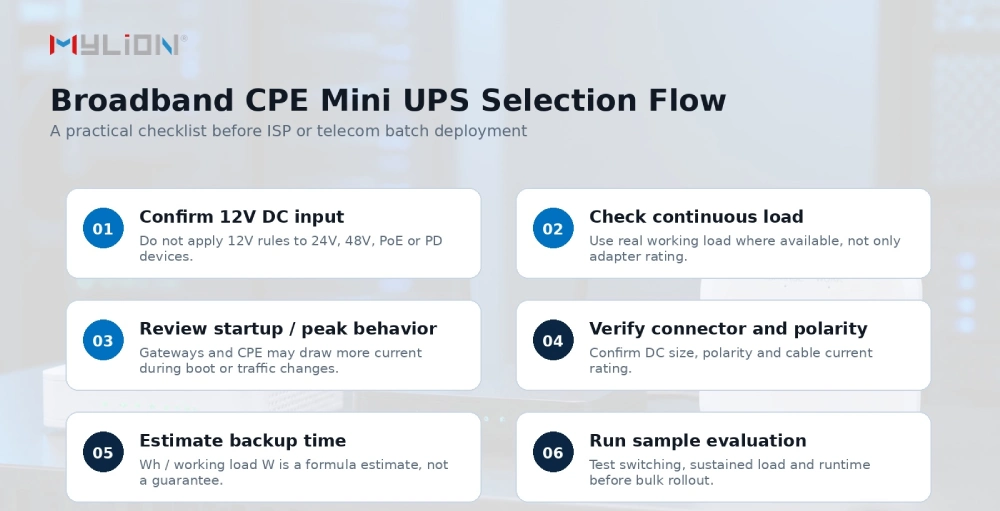
Scénarios d'application
Sauvegarde ONT et ONU
Pour l'alimentation de secours standard 12 V d'un ONT ou d'un ONU, les modèles MU48W ou MU68W peuvent être envisagés si la charge, le connecteur et la polarité de l'appareil correspondent aux spécifications du produit. Le modèle MU68W est souvent plus adapté aux applications nécessitant une autonomie supérieure à celle du MU48W.
Sauvegarde du routeur et du modem
Pour les routeurs et modems 12 V standard, l'alimentation 12 V 3 A peut convenir si la charge réelle reste inférieure à la limite de puissance continue. Pour les routeurs plus puissants, il est recommandé d'utiliser l'alimentation MU35W.
Sauvegarde du CPE haut débit
Les équipements CPE sont très variés. Certains sont des appareils basse consommation destinés à une utilisation intérieure, tandis que d'autres sont des passerelles à forte charge ou des terminaux haut débit sans fil. Le choix doit se baser sur le modèle précis de l'appareil, la charge réelle, le comportement au démarrage, le connecteur et l'autonomie souhaitée.
Pour des vérifications plus approfondies concernant l'approvisionnement en routeurs et en équipements CPE, consultez la section suivante : Onduleur 12 V pour routeur et CPE : ce que les acheteurs doivent vérifier avant de commander.
Sauvegarde de la passerelle
Les passerelles peuvent nécessiter plus d'énergie que les ONT de base ou les routeurs simples. En cas de charge élevée ou fluctuante liée au trafic, une alimentation 12 V 5 A peut s'avérer plus adaptée.
Déploiement des FAI et des télécommunications
Pour les déploiements par lots, MYLION recommande une évaluation par échantillon avant tout achat en grande quantité. Ce test doit vérifier le comportement au démarrage, la stabilité en charge continue, la commutation en cas de panne, l'autonomie en conditions réelles de charge, la compatibilité des connecteurs et l'environnement d'installation.
Pour une planification de projet plus globale, consultez la section Fournisseur de mini-onduleurs pour les projets d'alimentation de secours ISP et haut débit.
FAQ
Q1 : Un mini-onduleur 12V 5A est-il toujours meilleur qu'un mini-onduleur 12V 3A ?
Q2 : Puis-je choisir un mini-onduleur en me basant uniquement sur l'étiquette de l'adaptateur d'origine ?
Q3 : Quel modèle MYLION doit être évalué pour une sauvegarde CPE standard ?
Q4 : Quel modèle MYLION doit être évalué pour un CPE à charge élevée ?
Q5 : Un seul mini-onduleur peut-il alimenter à la fois un ONT et un routeur ?
Conclusion
Choisir entre une alimentation 12V 3A et une alimentation 12V 5A Mini-onduleur pour CPE haut débit Il ne s'agit pas de choisir le plus grand nombre, mais de répondre aux besoins réels de l'appareil.
Pour l'alimentation de secours des ONT, ONU, routeurs, modems et CPE standard 12 V, les modèles MYLION MU48W et MU68W offrent une puissance de sortie continue de 2,5 A et maximale de 3 A. Pour les routeurs, passerelles et CPE à charge plus élevée, le modèle MU35W fournit une puissance supérieure avec une sortie continue de 4 A et maximale de 5 A.
Pour les projets de fournisseurs d'accès Internet, de télécommunications et d'intégration de systèmes, MYLION aide ses clients à examiner la tension, la charge continue, le comportement au démarrage, le connecteur, la polarité, le temps de secours cible et les conditions de déploiement avant la sélection en masse.

 Français
  English
  简体中文
简体中文  Deutsch
  Italiano
  Español