
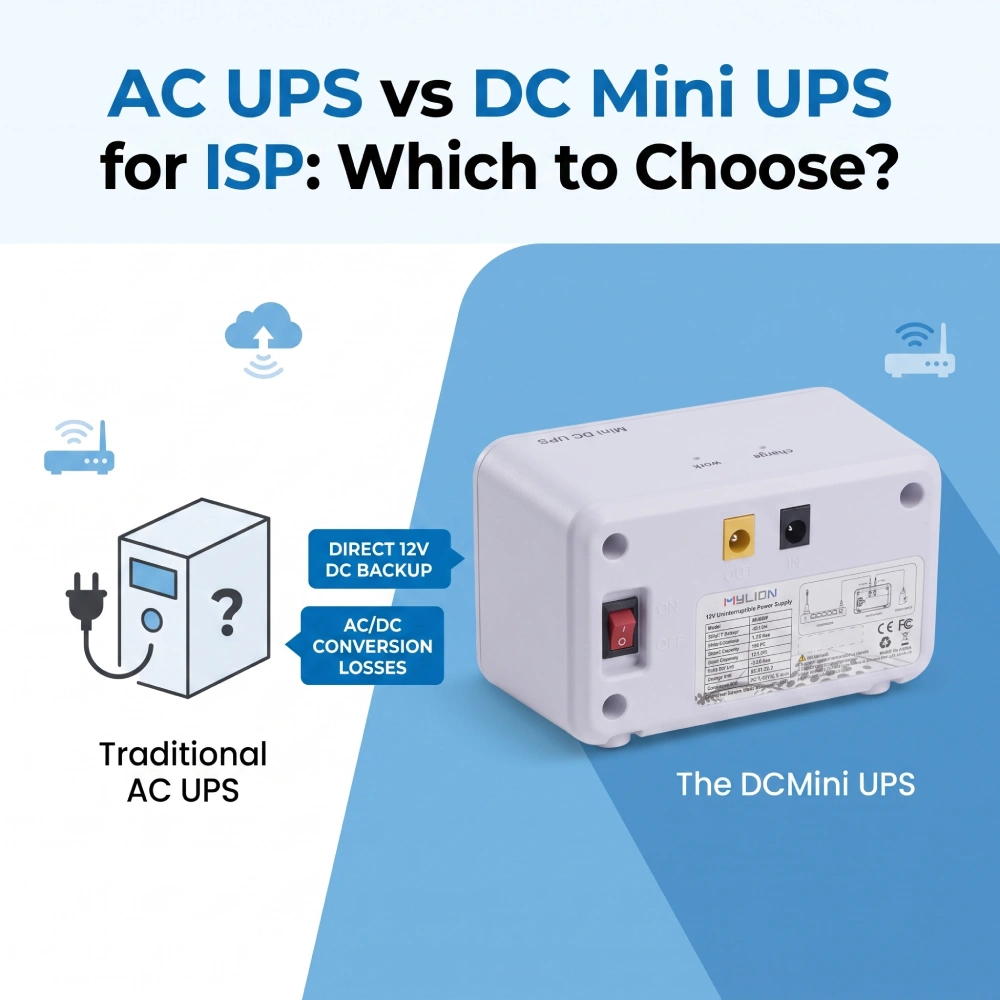
Pour les fournisseurs d'accès à Internet, la disponibilité du réseau n'est pas qu'un simple indicateur technique ; elle est essentielle à la fidélisation de la clientèle et à la réputation de la marque. Pour lutter contre les fluctuations de courant et les pannes de réseau, les fournisseurs d'accès à Internet déploient des stratégies de couverture. Systèmes UPS à travers leur infrastructure.
Cependant, les architectes réseau sont confrontés à un choix crucial : déployer des architectures traditionnelles Onduleur secteur pour FAI infrastructure de base versus infrastructure moderne Systèmes mini-onduleurs CC En périphérie du réseau. Si les onduleurs CA restent la norme pour la sauvegarde à grande échelle, l'expansion rapide du FTTH et des réseaux de périphérie a déplacé les besoins en énergie vers les onduleurs CC pour les déploiements de modems et de routeurs à large bande.
Ce guide analyse les variables techniques et financières de la conception de l'alimentation électrique des télécommunications, en précisant dans quels cas un FAI devrait privilégier un onduleur et pourquoi les réseaux périphériques modernes évoluent rapidement vers ce type d'alimentation. Solutions mini-onduleurs CC comme le Mylion Mini UPS.
Comprendre les bases : l'alimentation de l'infrastructure des FAI
Pour prendre des décisions stratégiques en matière de déploiement, il est crucial de comprendre comment l'énergie circule dans l'infrastructure des télécommunications. Le réseau électrique commercial distribue l'énergie en courant alternatif (CA), dont le sens s'inverse périodiquement. Cependant, la quasi-totalité des équipements modernes de télécommunications et de réseaux — des routeurs centraux de grande taille aux petits ONT installés dans le salon d'un client — fonctionnent nativement en courant continu (CC).
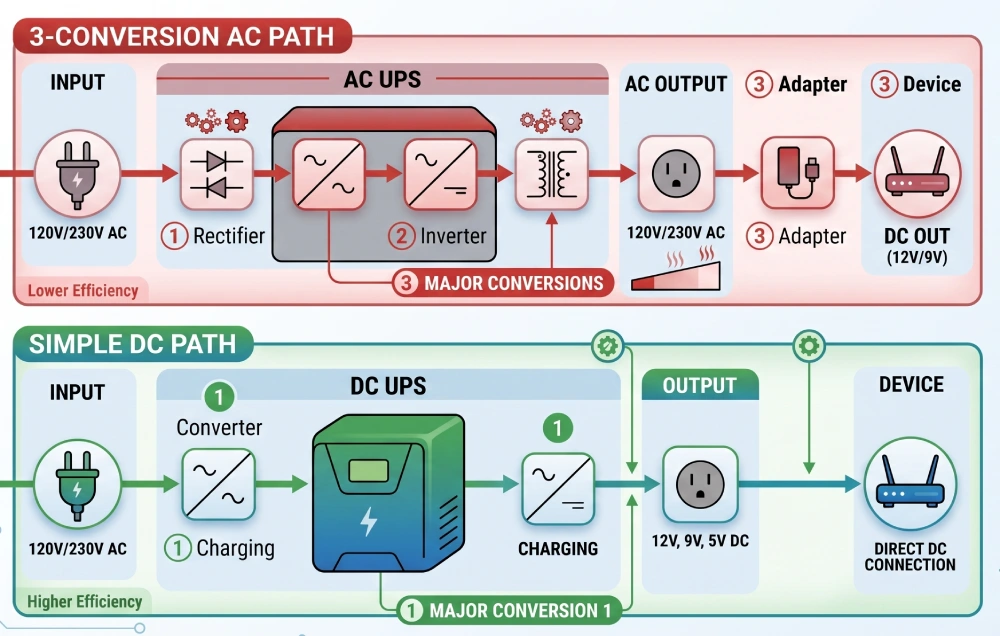
Un onduleur Il capte le courant alternatif du réseau, le convertit en courant continu pour charger sa batterie interne, puis le reconvertit en courant alternatif pour alimenter les appareils connectés.
Un mini-onduleur CCEn revanche, ce système capte le courant alternatif du réseau, le convertit en courant continu pour charger sa batterie, puis fournit directement ce courant continu au périphérique réseau. Ceci élimine complètement l'étage d'inversion final, créant ainsi une solution d'alimentation de secours simplifiée et très efficace pour les réseaux périphériques des fournisseurs d'accès Internet.
3 scénarios où les FAI devraient choisir un onduleur AC
Malgré la popularité croissante des systèmes de micro-alimentation CC en périphérie de réseau, les systèmes d'alimentation sans coupure CA traditionnels restent irremplaçables dans plusieurs scénarios d'infrastructure centrale. Les architectes réseau doivent spécifier les déploiements d'onduleurs CA dans les conditions suivantes :
Infrastructure centrale à haute puissance
Au cœur du réseau de tout fournisseur d'accès Internet se trouvent les centres de données, les centraux téléphoniques et les points de présence (PoP) principaux. Ces environnements abritent des routeurs centraux massifs, des commutateurs réseau haute capacité et des baies de serveurs à haute densité qui nécessitent des milliers de watts.
Les systèmes d'alimentation sans coupure (UPS) à courant alternatif de grande envergure — souvent fonctionnant en parallèle et soutenus par des générateurs diesel — sont les seules solutions capables de gérer les exigences massives en matière de charge, de dissipation thermique et de distribution d'énergie triphasée requises par l'infrastructure de télécommunications de base.
Compatibilité avec les équipements existants
De nombreux fournisseurs d'accès Internet utilisent encore du matériel ancien dans leurs centres de distribution. Les anciennes passerelles de télécommunications, les multiplexeurs d'accès DSL (DSLAM) à ligne cuivre et les équipements de diagnostic spécialisés sont souvent dotés d'alimentations intégrées fonctionnant uniquement en courant alternatif, sans possibilité d'entrée en courant continu.
Lorsqu'un nœud d'infrastructure contient du matériel hautement spécialisé ou ancien qui nécessite strictement une tension alternative standard de 110 V/220 V, un système d'alimentation sans coupure (UPS) est obligatoire pour garantir la compatibilité sans annuler les garanties ni nécessiter de modernisation électronique personnalisée.
Environnements à dispositifs mixtes
De nombreux bureaux de terrain, points de présence (POP) et centres régionaux des FAI contiennent un mélange de types d'équipements : ordinateurs de bureau, moniteurs, commutateurs réseau et équipements de routage ainsi que des équipements de télécommunications.
Dans ces environnements, un seul onduleur peut alimenter simultanément plusieurs types d'appareils. Il constitue un filet de sécurité électrique universel qui assure le fonctionnement de l'ensemble de l'environnement physique lors d'une panne de réseau, et pas seulement des paquets de données.
Comparaison des mini-onduleurs CA et CC pour les FAI : matrice de déploiement par niveau de réseau
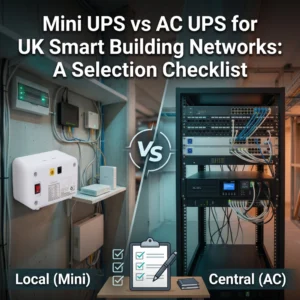
Pour simplifier la planification de l'infrastructure, les architectes réseau peuvent se référer à cette matrice de déploiement optimisée. Celle-ci aligne la méthode d'alimentation électrique appropriée avec les différents niveaux du réseau, garantissant ainsi que les systèmes CA haute performance restent au cœur du réseau tandis que des solutions agiles sans conversion, comme… Mini-onduleur Mylion dominer le bord.
Scénario de déploiement | Solution recommandée | Justification principale |
Centres de données et bureaux centraux | Onduleur | Besoins en énergie triphasée de forte puissance, charges informatiques complexes. |
Concentrateurs matériels hérités | Onduleur | Exigence stricte concernant les entrées standard 110V/220V. |
Installations à usage mixte | Onduleur | Il faut alimenter à la fois le matériel informatique et les appareils standard du bâtiment. |
Équipement chez le client (CPE) | Onduleur mini CC | Encombrement réduit, élimine les pertes de conversion, alimentation directe du routeur. |
Terminaux de réseau optique FTTH | Onduleur mini CC | S'intègre dans les boîtiers de câblage, haute efficacité, mise à l'échelle économique. |
Points d'accès PoE distants | Onduleur mini CC | Alimentation CC native, capacités d'injection PoE intégrées. |
Pourquoi les mini-onduleurs CC dominent les réseaux de périphérie des FAI
Pour résoudre le problème de l'alimentation en périphérie de réseau, les fournisseurs d'accès Internet visionnaires abandonnent les unités de climatisation encombrantes au profit d'unités ciblées. micro-alimentation CC solutions. En fournissant directement une alimentation CC aux périphériques alimentés en CC, y compris routeurs, ONT, et CPE—Les fournisseurs d'accès Internet éliminent les pertes de conversion, réduisent l'encombrement des équipements et améliorent l'expérience de l'utilisateur final.
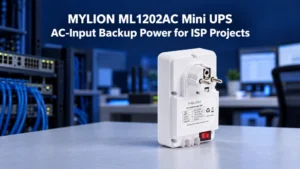
C'est ici que le Mini-onduleur Mylion est devenu un atout stratégique pour les opérateurs de télécommunications. Conçu spécifiquement pour résilience du réseau FAIL'onduleur Mylion Mini UPS s'intègre directement entre la prise murale et le CPE (tel qu'un routeur, modem ou ONT), offrant plusieurs avantages distincts :
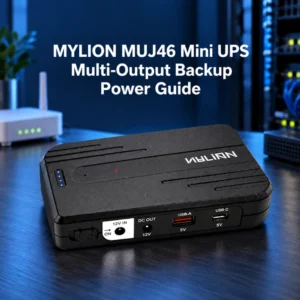
- Rendement énergétique direct :En fournissant des tensions continues exactes (généralement 5 V, 9 V ou 12 V), Mylion élimine la pénalité liée à la double conversion. Onduleur mini CC pour routeur Fournit efficacement l'énergie de la batterie directement à la carte mère du routeur.
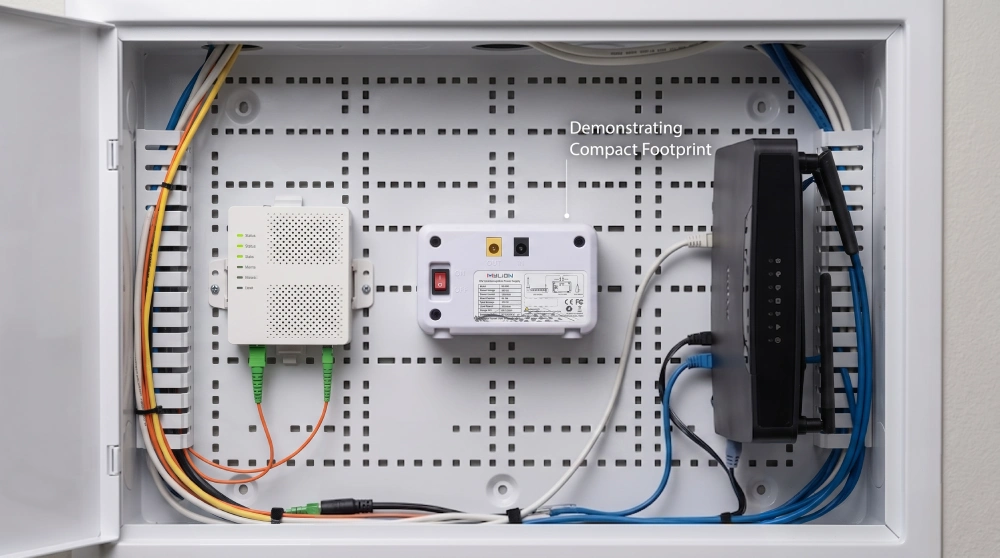
- Encombrement réduit et évolutivité :Mesurant une fraction de la taille des unités de climatisation traditionnelles, le Mini-onduleur pour FAI Les dispositifs peuvent être facilement installés à l'intérieur des boîtiers de câblage structuré.
- Technologie avancée du lithium :Contrairement aux batteries SLA classiques qui tombent en panne après deux ans, Mylion utilise Batterie LiFePO₄ technologie, offrant plus longtemps alimentation de secours pour FTTH
- Capacités PoE :Certains modèles Mylion intègrent la technologie PoE, permettant aux fournisseurs d'accès Internet d'alimenter des antennes extérieures distantes, des points d'accès sans fil ou des téléphones VoIP.
En garantissant que la connexion Wi-Fi et fibre locale reste active même en cas de panne de courant dans le quartier, les FAI tirent parti des produits Mylion pour maintenir les accords de niveau de service (SLA) et maintenir les clients connectés lors d'urgences critiques.
FAQ
Q1 : Puis-je utiliser un mini-onduleur CC pour alimenter un équipement CA ?
Q2 : Puis-je utiliser un onduleur AC pour alimenter des routeurs et des ONT DC ?
Q3 : Quelle autonomie puis-je attendre d’un onduleur Mylion Mini DC ?
Q4 : Les mini-onduleurs Mylion prennent-ils en charge plusieurs tensions de sortie ?
Q5 : Quelle technologie de batterie utilisent les unités Mylion Mini UPS ?
Q6 : L’absence de temps de transfert est-elle importante pour les équipements des fournisseurs d’accès Internet ?
Conclusion
L'architecture de la diffusion internet moderne se rapproche du consommateur, ce qui rend fiabilité du réseau périphérique plus crucial que jamais. Bien que robuste Onduleur Les systèmes auront toujours une présence obligatoire dans les centres de données, les centraux téléphoniques et les environnements à services mixtes ; ils sont fondamentalement inadaptés à la périphérie du réseau.
Pour CPE, FTTH Les FAI doivent adopter des nœuds et du matériel de routage localisé. Alimentation CC-CC, qui offre une efficacité inégalée, un encombrement réduit et une durée de vie de la batterie supérieure. En déployant Solutions mini-onduleurs CCLes fournisseurs d'accès Internet peuvent ainsi garantir la résilience de leurs points d'extrémité de réseau les plus vulnérables, assurant une connexion continue à leurs clients, quelle que soit la stabilité du réseau électrique local.

 Français
  English
  简体中文
简体中文  Deutsch
  Italiano
  Español