
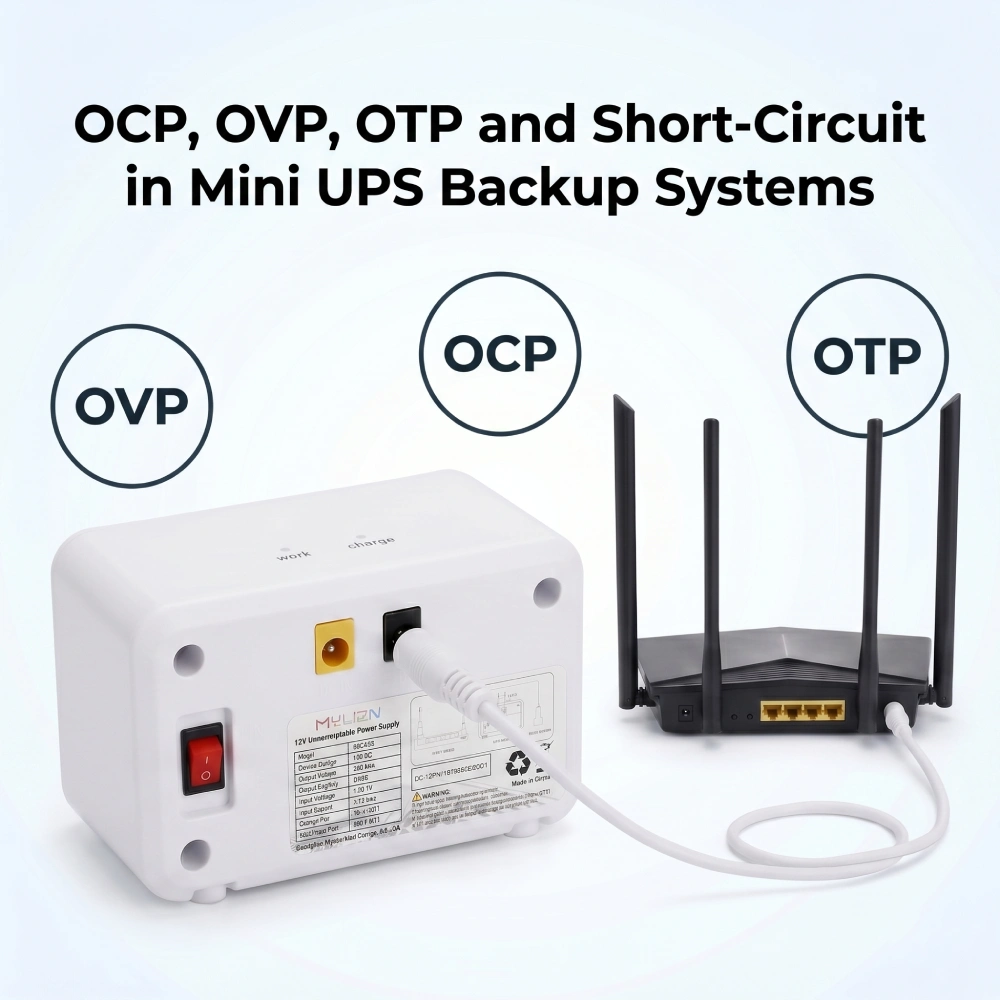
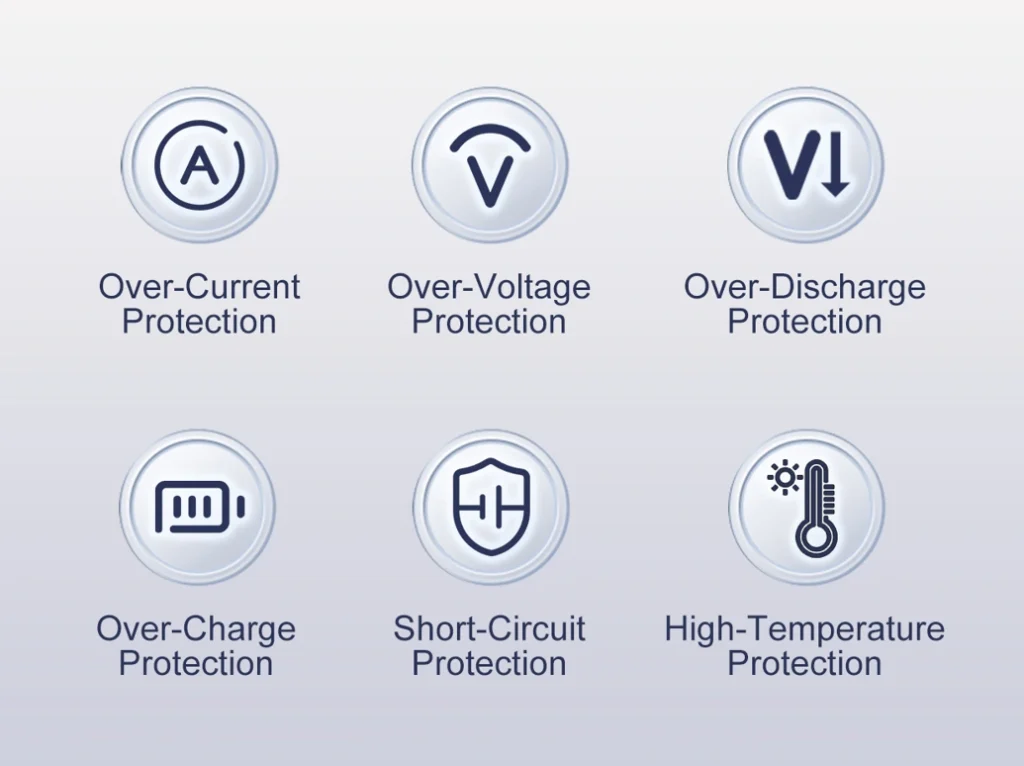
La conception du système de protection est l'une des différences les plus importantes entre un produit d'alimentation grand public et un produit destiné aux projets. Solution de secours Mini UPSPour les systèmes Mini UPS utilisés dans les télécommunications, les fournisseurs d'accès Internet et les applications industrielles, quatre mécanismes de protection (contre les surintensités, les surtensions, les surcharges et les courts-circuits) doivent être parfaitement compris avant l'approbation d'un échantillon. Un Mini UPS bien conçu garantit non seulement la sécurité, mais améliore également la fiabilité à long terme dans les environnements fonctionnant 24 h/24 et 7 j/7.
Tableau récapitulatif : Principales fonctions de protection d’un mini-onduleur
Type de protection | Ce que ça fait | Condition de déclenchement typique | Mode de récupération (exemple) |
OCP (Surcharge)–Actuel) | Limite le courant de sortie lorsque la charge dépasse la plage de sécurité | >110-150% de courant nominal | Récupération automatique après réduction de charge |
OVP (Over–Tension) | Empêche la tension de sortie de dépasser le niveau de sécurité. | >105-120% de tension nominale | Verrouillage ou récupération automatique |
OTP (Over–Température) | Réduit ou coupe la production lorsque la température interne est trop élevée. | >60-85°C (selon la conception) | Récupération automatique après refroidissement |
Court–Circuit | Coupe immédiatement la sortie en cas de court-circuit des bornes. | >200% de courant nominal ou instantané | Récupération automatique ou redémarrage après la suppression de la panne |
Ce tableau vous donne un aperçu rapide. Les sections suivantes expliquent chaque protection en détail et pourquoi elles sont importantes pour vous. Sélection de mini-onduleurs.
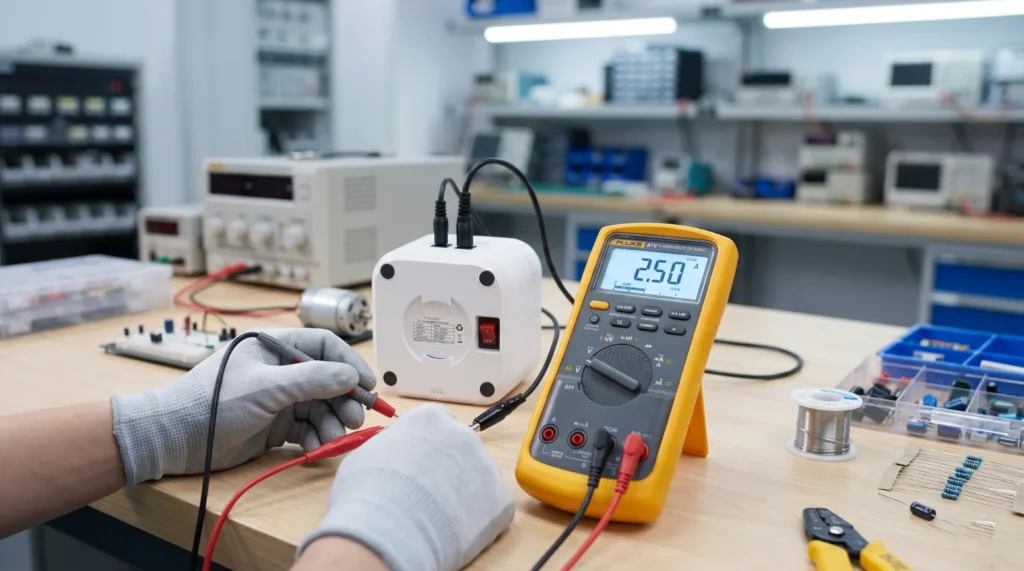
Protection contre les surintensités (OCP)
La protection contre les surintensités (OCP) limite le courant de sortie lorsque la charge connectée dépasse la plage de fonctionnement admissible du mini-onduleur. Ceci contribue à réduire les risques liés aux surcharges, aux branchements incorrects ou aux défauts internes. Sans protection OCP adéquate, un mini-onduleur peut surchauffer, voire subir une panne catastrophique.
Ce que les acheteurs doivent vérifier :
- Courant continu nominal (fonctionnement normal)
- Capacité de courant de crête (par exemple, pour les charges de type moteur)
- Seuil de protection (par exemple, 120% de courant nominal)
- Comportement de récupération – automatique ou à verrouillage
Pour les applications de télécommunications et de fournisseurs d'accès Internet où plusieurs appareils partagent un seul mini-onduleur, la protection contre les surintensités (OCP) empêche une charge défectueuse d'arrêter l'ensemble du système.
Protection contre les surtensions (OVP)
La protection contre les surtensions (OVP) empêche la tension de sortie de dépasser un niveau sûr. Ceci est particulièrement important pour la protection des équipements de communication sensibles (ONT, ONU, routeur, CPE) connectés au mini-onduleur. Une surtension peut endommager irrémédiablement les composants électroniques basse tension.
Points clés de validation :
- Précision de la tension de sortie en charge et en régime de charge
- Tension de déclenchement OVP (supérieure à la normale maximale mais inférieure au seuil d'endommagement de l'appareil)
- Temps de réponse – suffisamment rapide pour protéger les circuits intégrés sensibles
De nombreuses solutions Mini UPS de qualité professionnelle incluent également une protection contre les surtensions en entrée afin de protéger la batterie interne contre un adaptateur secteur défectueux.
OTP : Protection contre la surchauffe
La protection contre la surchauffe (OTP) protège le mini-onduleur lorsque sa température interne dépasse la plage de fonctionnement sécuritaire. Le comportement thermique est influencé par la conception du boîtier, le courant de sortie, le courant de charge et la température ambiante. Dans les armoires extérieures fonctionnant 24 h/24 et 7 j/7 ou les armoires intérieures non climatisées, la protection OTP est essentielle.
Pourquoi c'est important pour les projets à long terme :
- Empêche le gonflement ou l'emballement thermique des batteries au lithium
- Assure la sécuritéconformité à la certification (UL, IEC, etc.)
- Prolonge la durée de vie du produit en évitant la surchauffe chronique.
Les acheteurs doivent demander des rapports de tests de température, notamment si le mini-onduleur doit être installé dans des environnements à température ambiante élevée ou à l'intérieur d'enceintes étanches.
Protection contre les courts-circuits
La protection contre les courts-circuits est une exigence de sécurité fondamentale pour tout appareil alimenté par batterie. Le mini-onduleur doit réagir rapidement et en toute sécurité en cas de court-circuit accidentel des bornes de sortie, par exemple à cause d'un câble mal branché ou d'un outil métallique.
Caractéristiques souhaitables :
- Limitation rapide du courant (de l'ordre de la microseconde à la milliseconde)
- Aucun dommage n'a été constaté sur le Mini UPS après des courts-circuits répétés.
- Mode de récupération défini : récupération automatique une fois le court-circuit supprimé, ou redémarrage manuel
Dans de nombreuses conceptions modernes de mini-onduleurs, la protection contre les courts-circuits est intégrée dans la même boucle de contrôle que la protection contre les surintensités, mais avec un seuil beaucoup plus bas et une réaction plus rapide.
FAQ
Q1 : Tous les produits Mini UPS ont-ils la même conception de protection ?
Q2 : Les paramètres de protection peuvent-ils être personnalisés ?
Q3 : Pourquoi les acheteurs devraient-ils se renseigner sur la conception de la protection ?
Q4 : Comment puis-je vérifier rapidement si un Mini UPS dispose d'une protection adéquate contre les courts-circuits ?
Comment MYLION accompagne les acheteurs B2B
MYLION se spécialise dans Mini-onduleur CC B2B et des solutions de secours par batterie au lithium pour les télécommunications, les fournisseurs d'accès Internet et les applications industrielles. Nous accompagnons nos clients avec :
- Sélection du produit basée sur le courant de fonctionnement réel et l'autonomie.
- Validation des échantillons et vérification des paramètres de protection pour chaque mini-onduleur
- Exigences personnalisées en matière de câbles, d'étiquettes et de boîtiers
- Préparation des documents de certification (CE, FCC, UL, RoHS, etc.)
- Documentation relative à l'inspection de la production et à l'expédition
Tous nos produits Mini UPS sont conçus avec une protection multicouche contre les surintensités, les surtensions, les surchauffes et les courts-circuits afin de répondre aux besoins des installateurs professionnels et des intégrateurs de systèmes.
Besoin d'un mini-onduleur ou d'une solution de secours par batterie au lithium pour votre ONT, ONU, routeur, CPE ou équipement de télécommunications ? Contactez MYLION !
Note de conformité
Les exigences de certification dépendent de la configuration du produit, du marché cible, de l'adaptateur secteur, de la capacité de la batterie et de l'application finale. Les acheteurs doivent vérifier les exigences applicables avant la production en série.
 Français
  English
  简体中文
简体中文  Deutsch
  Italiano
  Español