
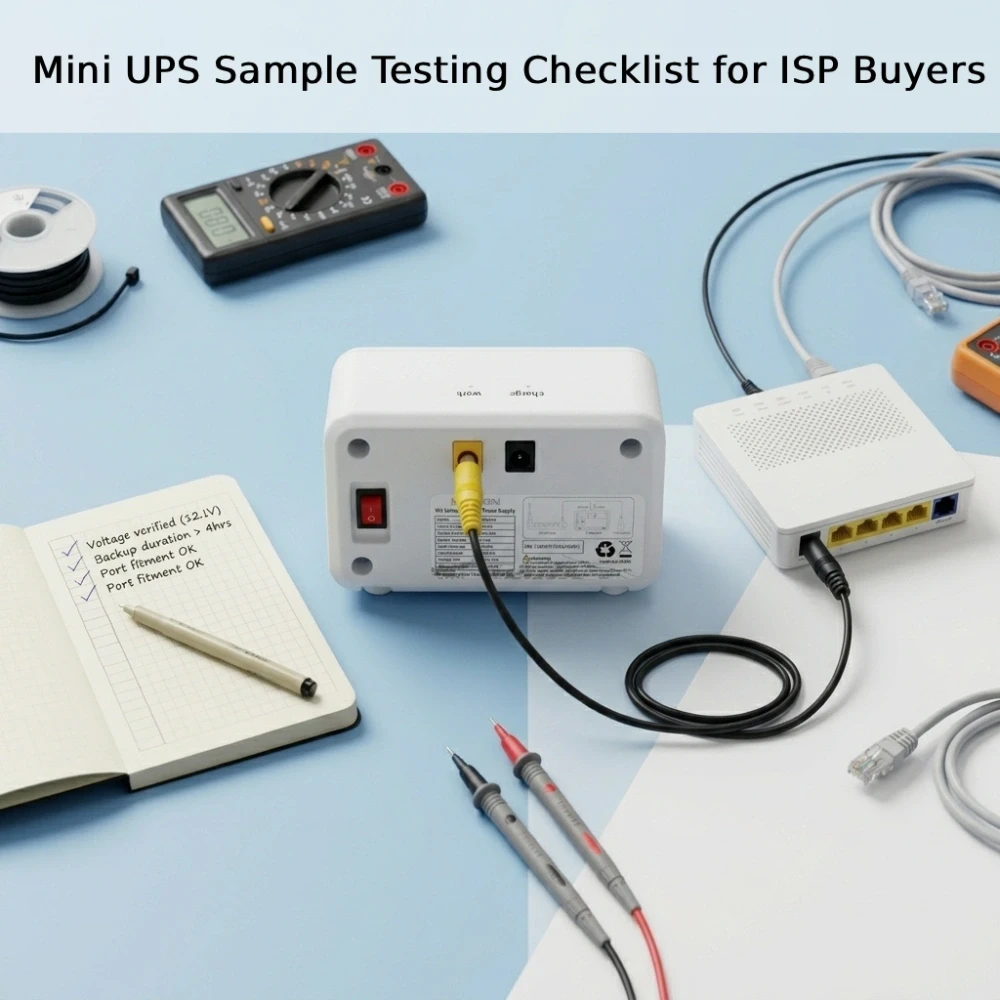
Les tests d'échantillons constituent l'étape cruciale entre la recommandation d'un produit et son approbation pour la production en série. Sans liste de contrôle structurée, les acheteurs s'exposent à des malentendus, des résultats incohérents et des cycles de tests répétitifs. Ce guide propose un cadre pratique et reproductible pour Évaluation d'échantillons de Mini UPS — vous aider à prendre des décisions éclairées et basées sur des données avant la validation du projet.
Liste de vérification avant le test
Utilisez le tableau ci-dessous pour vérifier toutes les conditions préalables avant de mettre sous tension un échantillon de Mini UPS.
Cocher l'article | Valeurs typiques / Remarques |
Modèle d'appareil cible (ONT, ONU, routeur, CPE, etc.) | Notez la marque et le numéro de modèle exacts. |
Tension d'entrée du dispositif cible | 5 V, 9 V, 12 V, 24 V, 48 V CC (courant) |
Type de connecteur et polarité | Prise jack cylindrique (5,5 × 2,1 mm / 5,5 × 2,5 mm), USB-C, bornier à vis |
Courant de fonctionnement réel (mesuré ou estimé) | mA ou A en fonctionnement normal |
Délai de sauvegarde cible | par exemple, 2 heures, 4 heures, 8 heures |
Nombre d'appareils à sauvegarder | Simple ou multiple (courant de charge total) |
Modèle d'adaptateur de système final | Vérifiez la tension, l'intensité nominale et le connecteur. |
Pendant les tests – Étape par étape
Suivez attentivement ces étapes pour obtenir des résultats reproductibles et significatifs.
- Conditions environnementales d'enregistrement– température ambiante, ventilation et configuration du banc d’essai.
- Chargez complètement le Mini UPSavant tout test de temps de sauvegarde (utilisez l'adaptateur prévu).
- Connectez le ou les périphériques cibles. en mode de fonctionnement réel (et non avec des charges fictives).
- Chronométrage de départdès que l'alimentation est coupée. Enregistrement :
- Heure de début et heure de fin (lorsque l'appareil s'éteint)
- Tension de charge à intervalles réguliers (par exemple, toutes les 30 minutes)
- Tout comportement anormal (clignotement des LED, redémarrages, bruit, etc.)
- Puissance de test–comportement de commutation en cas de défaillance– Débranchez l’entrée AC/DC et observez si l’appareil connecté :
- Reste en ligne sans redémarrage
- Réinitialisations brèves (inacceptables pour de nombreuses applications FAI)
- Indique une chute de tension ou une instabilité pendant le transfert (utiliser un oscilloscope si disponible).
- Répéter les tests clésau moins trois fois – si les résultats varient sensiblement, recherchez la cause.
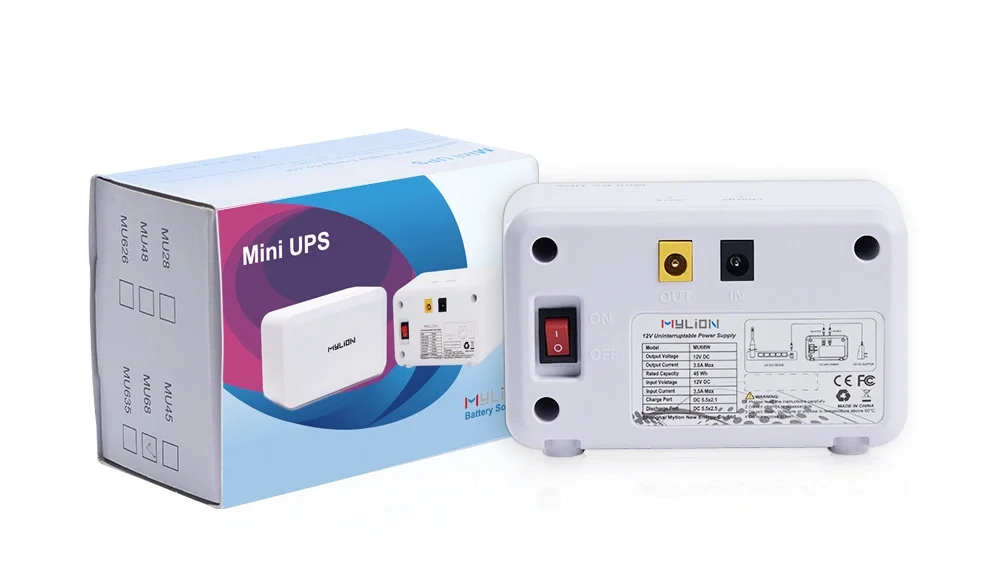
Contrôles de sécurité et de protection
Vérifier | Critères acceptables |
Élévation de température sous charge normale | Chaud mais pas brûlant au toucher (surface ≤ 50 °C) |
Stabilité de la tension de sortie | À ±5% de la tension nominale sous charge variable |
Protection contre les surintensités (si spécifiée) | Coupe ou limite le courant en cas de dépassement de la valeur maximale nominale. |
Protection contre les courts-circuits (si spécifiée) | Récupération automatique ou verrouillage (selon les exigences du projet) |
Après les tests – Documentation et approbation
Une fois les tests terminés, ne sautez pas ces dernières étapes :
- Partager toutes les données– rapports de test, photos et vidéos (surtout si un problème est survenu).
- Analyse des causes profondes– déterminer si le problème est lié à :
- Le Mini UPS lui-même
- L'adaptateur ou la source de charge
- Conditions de test (température, ventilation, charge)
- Inadéquation de la charge (par exemple, le courant dépasse la capacité de l'onduleur)
- Geler la version d'échantillon approuvée – Consignez le firmware, le lot de cellules de la batterie et la révision du circuit imprimé. Utilisez ces informations comme base pour la production en série.
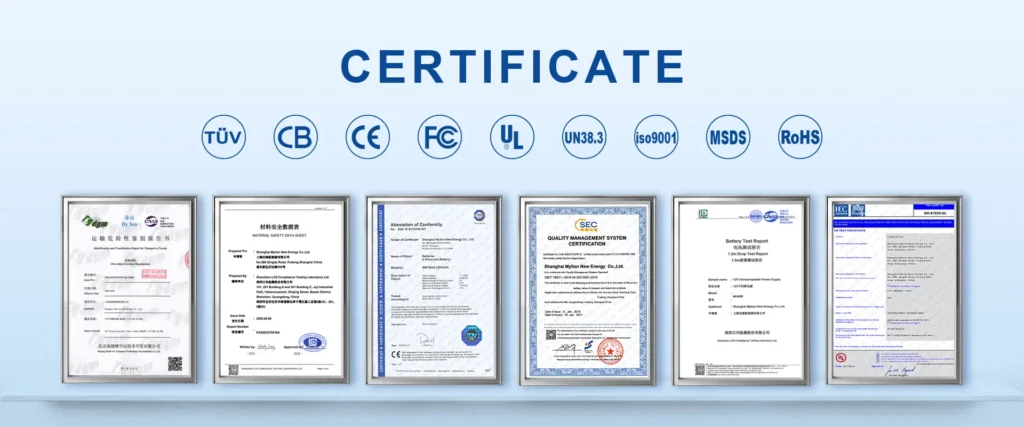
- Confirmer les éléments non techniques– longueur et type de câble, illustration de l'étiquette, emballage, et documents de certification (CE, FCC, RoHS, UN38.3, etc.).
FAQ
Q1 : Pourquoi faut-il convenir à l'avance des résultats anormaux aux tests ?
Q2 : Faut-il tester la durée de la sauvegarde une seule fois ?
Q3 : Que dois-je faire si le résultat de l’échantillon n’est pas conforme aux attentes ?
Q4 : Combien d'échantillons de Mini UPS dois-je demander pour les tests ?
Comment MYLION accompagne les acheteurs
MYLION est spécialisée dans les mini-onduleurs CC B2B et Solutions de secours par batterie au lithium pour les applications de télécommunications, de FAI et industriellesNous accompagnons nos clients tout au long de leur parcours :
- Sélection du produit en fonction de la tension de l'appareil et de la durée de l'autonomie.
- Exemple de guide de validation (y compris des listes de contrôle personnalisées)
- Câbles, étiquettes et emballages personnalisés
- Préparation des documents de certification (CE, FCC, RoHS, UN38.3, etc.)
- documentation relative aux inspections de production et à l'expédition
Nous ne nous contentons pas de vendre des composants – nous vous aidons à tester, valider et déployer en toute confiance.
Besoin d'un mini-onduleur ou d'une solution de secours par batterie au lithium pour votre ONT, ONU, routeur, CPE ou équipement de télécommunications ? Contactez MYLION !
Note de conformité
Les exigences de certification dépendent de la configuration du produit, du marché cible, de l'adaptateur secteur, de la capacité de la batterie et de l'application finale. Les acheteurs doivent vérifier les exigences applicables avant la production en série.
 Français
  English
  简体中文
简体中文  Deutsch
  Italiano
  Español