
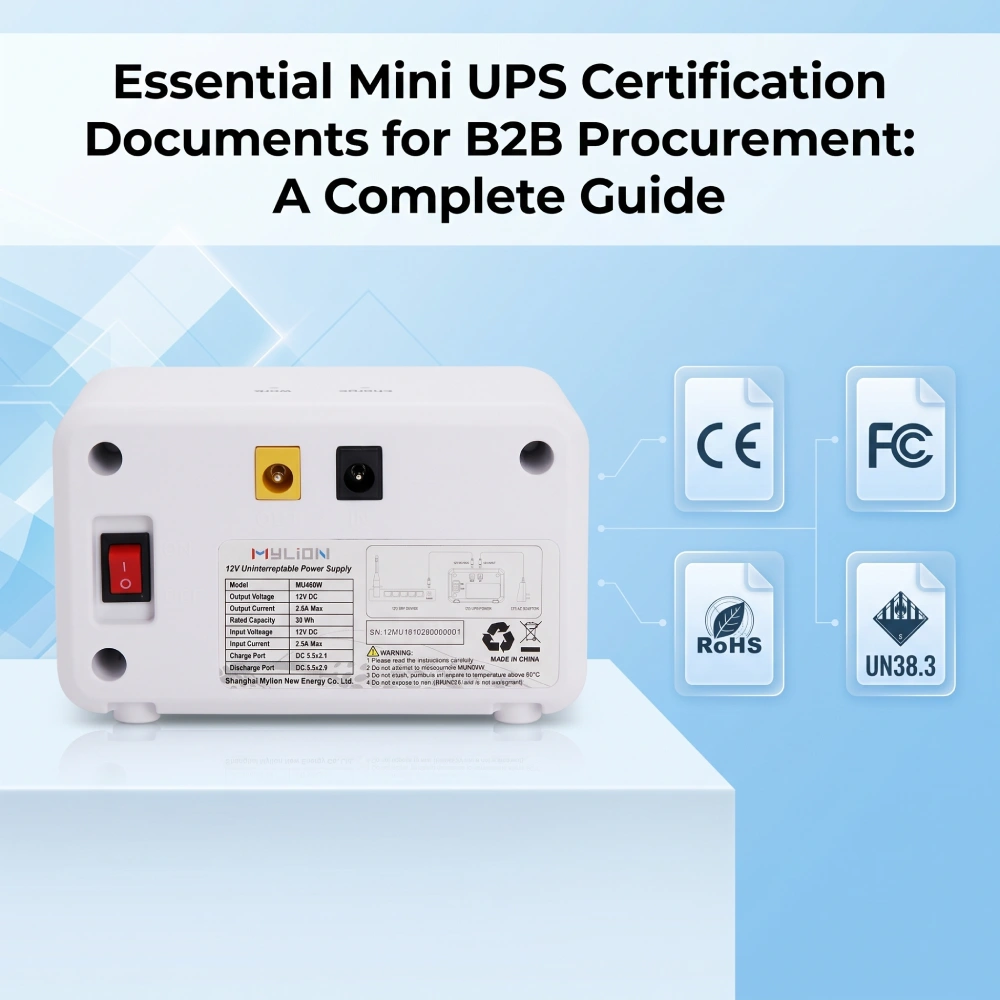
Before ordering mini UPS samples for a router or optical network terminal (ONT), ask the supplier for a list of documents matched to the equipment it will ship. The list should identify the cell, battery pack, finished UPS and external power adapter. For each document, your compliance reviewer needs to know which model it covers, who issued it and which decision it supports.
The distinction matters when comparing quotes. Two suppliers can offer the same output voltage and send folders with the same certificate logos. One folder may identify the complete UPS and its adapter. The other may identify only the cell inside the battery. The marks in the cover illustration identify document categories. For a model decision, use the underlying records.
Which mini UPS certification documents should an ISP request?
Start with the destination market, tender requirements and proposed kit. Ask your reviewer to identify the applicable requirements. Then use this checklist to request the evidence for each item.
| Item on the quote | What to match before approval |
|---|---|
| 细胞 | Match the manufacturer and exact cell designation to the component record. Check any conditions placed on its use. |
| 电池组 | Match the assembly model and revision to the evidence offered for the pack. Keep the cell reference in a separate entry. |
| Finished UPS | Request the covered model list and the configuration evaluated. For an electromagnetic compatibility (EMC) report, check the equipment under test, power supply, cables and operating mode. |
| External adapter | Record the maker, part number and regional variant. Establish whether the finished-product evidence includes the adapter in the carton. |
| Battery shipping evidence | Request the applicable UN 38.3 test summary. Match the identified cell, battery or product and the report reference to the goods being offered. |
Use the tender’s wording in the request. If it asks for a finished-product safety report and an EMC report, give each its own line. Record the standard and edition printed on the document, the covered model, the revision and any limitations. If the quote uses a private-label name, ask for the link between that name and the evaluated model.
What if the tender names CE, FCC or a battery standard?
If an EU declaration of conformity is requested, compare the manufacturer, product identifier and applicable legislation with the proposed supply. The EU lists the identifying information in its declaration of conformity guidance. For an FCC request, ask your compliance reviewer which evidence the device requires. Match any submitted test report to the electronics, ports, cables and adapter that were evaluated.
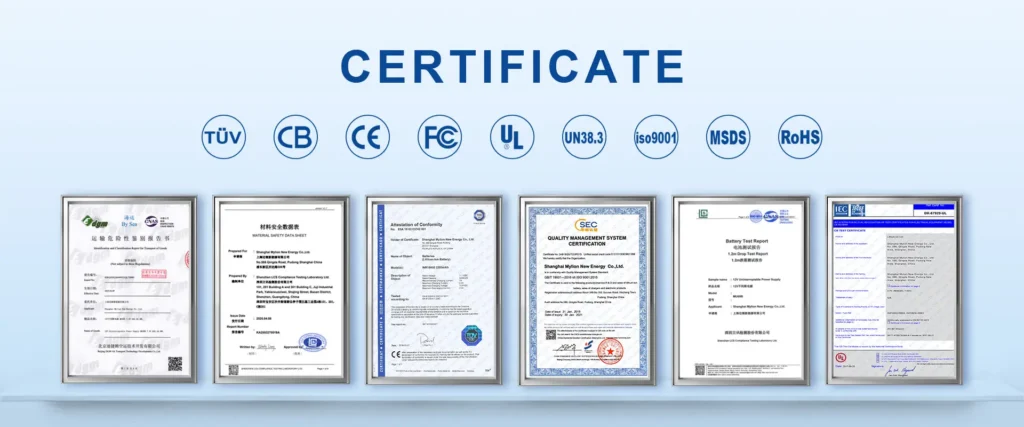
If the tender specifies IEC 62133-2, check whether the report names the cell or the battery assembly. The standard addresses portable sealed secondary lithium cells and batteries within its scope. If the supplier also provides an IECEE CB certificate, ask for its associated report and model list. File a restriction of hazardous substances (RoHS) declaration against the product or material it identifies. Keep the safety data sheet (SDS) with the handling information for the goods. Keeping these lines separate makes it clear which tender questions still need an answer.
What does a UL cell record establish?
A UL Recognized Component record applies to the identified component under its conditions of use. To verify a claim about a finished mini UPS, look for evidence covering the finished model. UL explains this distinction in its guide to component recognition. Its Product iQ certification database supports searches by identifiers including the UL file number. Compare the holder, model designation and scope with the supplier’s offer.
A transport document answers a different question. The U.S. Pipeline and Hazardous Materials Safety Administration shows the model identification, test report reference and results fields in its UN 38.3 test summary guide. Use those fields to identify the tested article. Leave finished-product safety, electromagnetic compatibility and carrier acceptance as separate review items.
A different adapter turns up in the production quote. What now?
Suppose the sample and the finished-UPS report identify Adapter A. The production packing list names Adapter B. Both labels show the same output voltage. Here is what purchasing can record immediately.
- Cell evidence. Keep the original reference if the supplier confirms the cell designation and configuration are unchanged. Record exactly what that reference covers.
- Finished UPS with Adapter B. Mark the combination open. Ask for the covered variant list or a documented assessment of the change by the responsible reviewer. A data sheet for Adapter B alone leaves the combination unresolved.
- Release decision. Tie approval to the exact adapter and UPS revision that the reviewer accepts. If the supplier returns to Adapter A, correct the packing list and verify it against the agreed configuration.
This is an illustrative purchasing decision. A substitution can require a document correction, further evaluation or additional testing. The evidence and the applicable requirements determine which.
What should stay in the procurement file?
Keep one register row per claim. A usable row contains the quoted item and revision, document type and number, issuer, covered models, conditions, review result, and the person responsible for the next action. In the adapter example, the row can read “Production kit with Adapter B — report names Adapter A — hold for variant evidence — compliance reviewer.” A colleague can act on that entry without reopening every attachment.
What if the names differ? The supplier on a quotation, the certificate holder and the brand on the sample may be different companies. Ask for the model appendix or an authorized cross-reference that connects the label on your sample to the evaluated unit. If the underlying report is confidential, arrange a controlled review of the relevant pages. Record what the reviewer saw and which questions remain open.
Before issuing the purchase order, compare the approved register with the final quotation, sample label and packing list. Record any agreed deviations and require proposed substitutions to be identified before release. Keep the device performance check alongside the paperwork. If the ONT must stay online during power transfer, use the router and ONT switchover checklist to define a separate sample test.
Request documents for your proposed kit
For a MYLION document review, send the destination market, tender wording, proposed UPS or equipment label, adapter arrangement and sample stage. If the model is still undecided, give the router or ONT model instead. A useful line to include in the RFQ is “For each requested document, please identify the covered model and revision, the issuer reference, and any difference between the evaluated configuration and the kit you propose to supply.” Request a configuration-specific document review.
 简体中文
 English
 Deutsch
 Français
 Italiano
 Español