
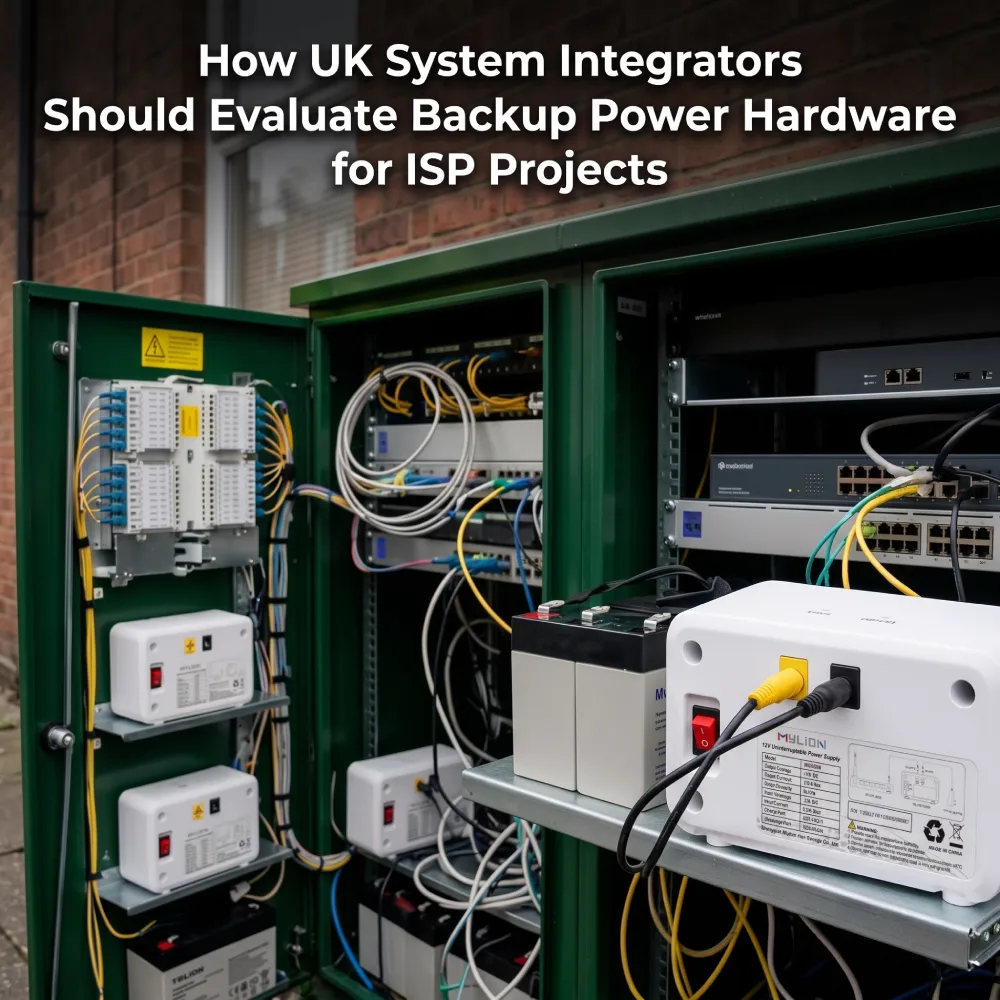
The UK broadband market continues to expand as ISPs and network operators deploy and upgrade FTTP infrastructure.
For system integrators, backup power is an important part of these projects. A poorly matched solution can cause equipment shutdowns, installation problems, additional field support and higher maintenance costs.
The challenge is not simply finding a 不间断电源 with enough battery capacity. System integrators need to evaluate whether the backup power hardware is suitable for the actual network equipment, installation environment and project requirements.
This guide explains the main factors UK system integrators should consider when evaluating backup power hardware for ISP and broadband projects.
The Reality of UK ISP Deployments: Key Pain Points for SIs
System integrators may need to deploy backup power across very different network environments, from customer premises and small equipment cabinets to larger broadband infrastructure.
Several common challenges can affect backup power selection.
Environmental Conditions
Backup power equipment may be installed in locations with different temperatures, humidity levels and ventilation conditions.
For outdoor cabinets or other demanding environments, the enclosure, battery system and operating conditions should be reviewed carefully before deployment.
Compliance Requirements
Backup power hardware used in UK projects should be supplied with the appropriate product documentation for the intended application and market.
The required conformity, safety and battery transport documents can vary by product type and configuration. System integrators should therefore confirm the applicable documentation for the exact model being purchased rather than relying on general supplier claims.
Maintenance and Field Service Costs
Every field replacement increases project cost.
If a backup power unit fails frequently or the battery needs regular replacement, system integrators may face additional engineer visits, support requests and service interruptions.
For larger ISP deployments, lifecycle and maintenance requirements should therefore be considered alongside the initial purchase price.
空间限制
Space is often limited around network equipment.
Traditional backup systems can be too large for installations involving compact routers, ONTs, ONUs or other customer-premises equipment.
A smaller DC backup solution may be more practical where the network device already operates from low-voltage DC power.
Crucial Evaluation Criteria for Backup Power Hardware
To reduce deployment risk, system integrators should evaluate backup power hardware based on both technical compatibility and long-term project requirements.
1. Battery Chemistry and Lifespan
Legacy lead-acid batteries are no longer viable for modern ISP deployments due to their weight, short lifespan (2-3 years), and temperature sensitivity. Evaluate hardware utilizing LiFePO4(磷酸铁锂) or advanced lithium-ion chemistries. These offer a 5 to 10-year design life, deeper discharge cycles, and superior thermal stability, drastically reducing replacement cycles.
2. Form Factor and Modularity
Space is a premium commodity in telecom enclosures. Hardware must be compact and adaptable. Look for high power-density designs—such as ultra-compact Mini DC UPS units for end-user premises (CPE) and small street cabinets.
3. Remote Management and Telemetry
A blind backup system is a liability. Hardware should support smart battery management systems (BMS) with remote telemetry. The ability to monitor battery health, voltage, and temperature remotely allows SIs to shift from reactive emergencies to predictive maintenance.
4. Certification and Safety
Ensure the manufacturer provides full documentation for UKCA, CE, RoHS, and UN38.3 (for battery transport). Deploying uncertified hardware in UK telecom infrastructure introduces unacceptable legal and operational risks.
Critical ISP Application Scenarios
Different parts of an ISP network have different backup power requirements.
Customer Premises Equipment
For FTTH deployments, customer-side equipment such as routers, ONTs and ONUs may go offline when the local power supply fails.
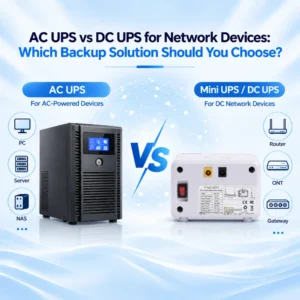
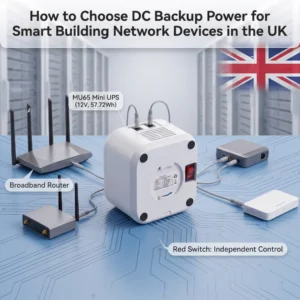
A compact Mini DC UPS can be evaluated for suitable CPE applications where low-voltage DC backup power is required.
The system integrator should confirm:
- device input voltage;
- current requirement;
- connector type;
- combined device load;
- target backup time.
Street Cabinets and Fiber Nodes
Street cabinets and field equipment may require a different type of backup solution.
These installations can have higher loads and more demanding environmental conditions than customer-premises applications.
Selection should consider installation temperature, enclosure protection, system load and the required backup duration.
The required runtime should be defined by the project rather than assumed from a standard figure.
Edge Data Centers and Points of Presence
Aggregation equipment, switches and routing hardware usually require a different backup architecture from a Mini UPS used for CPE.
System integrators may need higher-capacity rack-mounted battery systems, UPS equipment or other power infrastructure depending on the network design.
The correct solution should be selected according to the actual load, redundancy requirements and project architecture.
The MYLION Solution: Empowering System Integrators
MYLION 提供 迷你型UPS和直流备用电源解决方案 for telecom operators, ISPs, system integrators and other B2B network projects.
The focus is not only on supplying a backup power unit, but also on helping project teams evaluate whether the selected solution matches the actual network equipment.
For ISP and broadband projects, MYLION solutions can be evaluated based on:
- device voltage and current requirements;
- router, ONT, ONU and CPE applications;
- connector and cable requirements;
- single-device or multi-device backup;
- target backup time;
- installation space;
- project-specific configuration requirements.
For subscriber-side applications, MYLION offers compact Mini UPS options that can be evaluated for suitable routers, ONTs, ONUs and other broadband devices.
Where projects require different voltage, interface or installation requirements, the correct configuration should be confirmed before sample approval and bulk procurement.
Standard Hardware vs. MYLION Solutions
特征 | Standard Backup Hardware | MYLION ISP Solutions |
电池化学 | Traditional Lead-Acid (SLA) | Advanced Lithium-Ion / LiFePO4 |
Lifecycle | 2 – 3 Years | 5 – 10 Years |
外形尺寸 | Bulky, heavy, difficult to mount | High power-density, compact, rack/wall mountable |
Environmental Tolerance | Poor (Degrades rapidly in cold/heat) | Robust (Wide operating temperature range) |
总拥有成本 | High (Frequent truck rolls for replacement) | Low (Install-and-forget reliability) |
How MYLION Supports ISP and System Integration Projects
MYLION Mini UPS product range covers different subscriber-side and broadband applications.
MU68W can be evaluated for suitable 12V router, ONT and ONU backup applications where a compact Mini UPS is required.
MU35W provides another option for suitable higher-power 12V broadband device applications.
For CPE and broadband equipment using compatible USB-C power architectures, MUC85 provides a different evaluation direction from traditional DC-output Mini UPS products.
ML1202AC can be considered for suitable ONT, ONU and dual-device broadband backup applications.
常问问题
Q1: What should a UK system integrator check when selecting backup power for an ISP project?
Q2: Is a Mini UPS suitable for router and ONT backup?
Q3:一台迷你型UPS能否同时为光网络终端(ONT)和路由器供电?
Q4: How should backup time be evaluated?
Q5: What compliance documents should UK buyers request?
Q6: Can MYLION support ISP project evaluation?
Q7: Does MYLION support OEM or customized projects?
结论
For UK system integrators, selecting backup power for an ISP project is not simply a question of choosing a larger battery.
A reliable evaluation starts with the network device and considers voltage, current, connector, load, backup time, installation environment, compliance and supplier capability.
For larger broadband deployments, sample testing and pilot validation are particularly important. They help identify compatibility problems before they become field problems.
 简体中文
简体中文  English
  Deutsch
  Français
  Italiano
  Español