
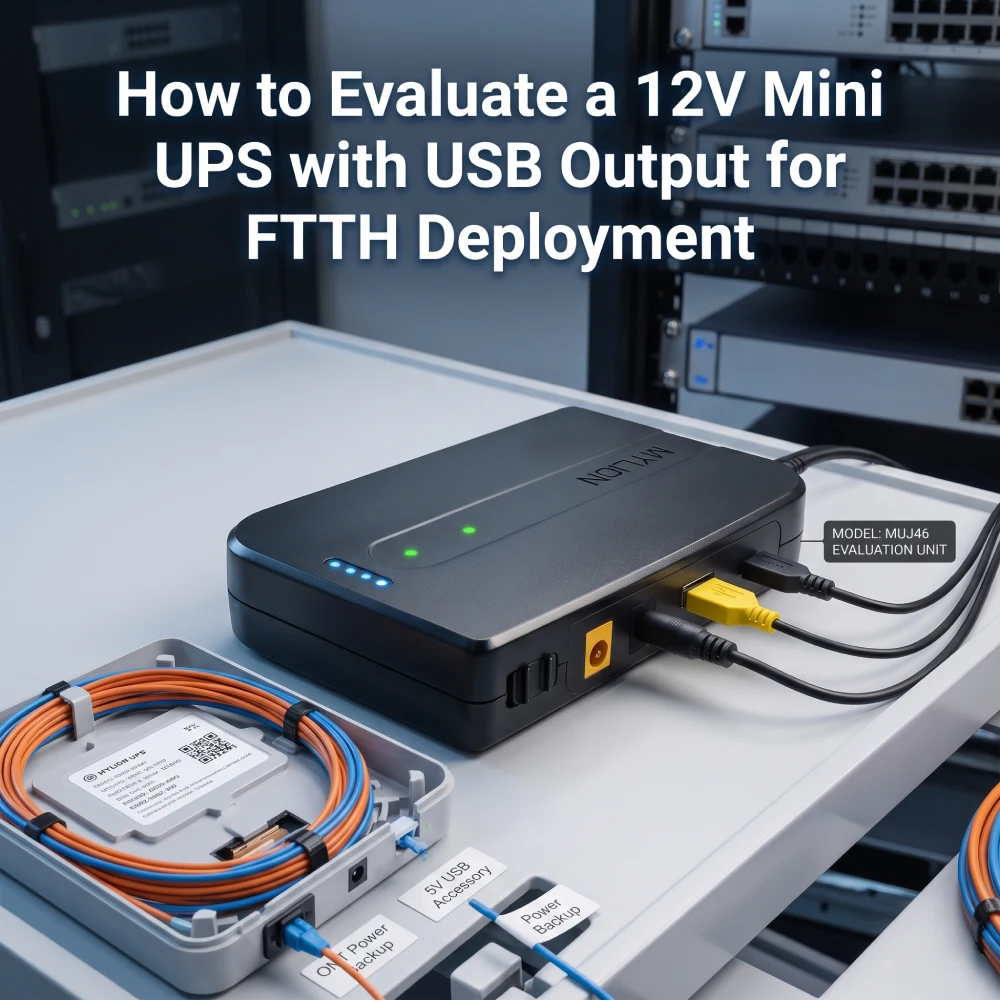
A 12V Mini UPS with USB output can be a practical choice when an FTTH or broadband installation needs backup for one low-power 12V network device and a selected 5V USB-powered accessory. The correct decision still depends on voltage, continuous and peak load, combined output, connector fit, USB protocol and the required backup time. Port count alone does not establish compatibility.
MYLION MUJ46 is designed for mixed 12V DC and 5V USB backup scenarios. It is not a universal answer for every ONT, router or multi-device combination. For a project deployment, the model should be evaluated against the actual device set and installation conditions before a bulk order is approved.
Why Mixed-Output Backup Becomes a Deployment Problem
Subscriber-side broadband equipment is rarely standardized around one device family. An ISP may deploy several ONT or ONU models, routers from different suppliers, and small 5V accessories across the same network. The power architecture may look simple on a desk, but small differences create field risk at scale.
- A device label may show 12V, while its real working current and startup peak remain unknown.
- Two ports may each show an individual maximum, but the Mini UPS still has one combined system limit.
- A USB-C connector may provide fixed 5V output without supporting USB-C Power Delivery.
- DC plugs with a similar appearance may have different internal dimensions or polarity requirements.
- A runtime figure from a light-load test may not represent the customer’s actual device mix.
The MYLION MUJ46 Solution for Mixed 12V and 5V Loads
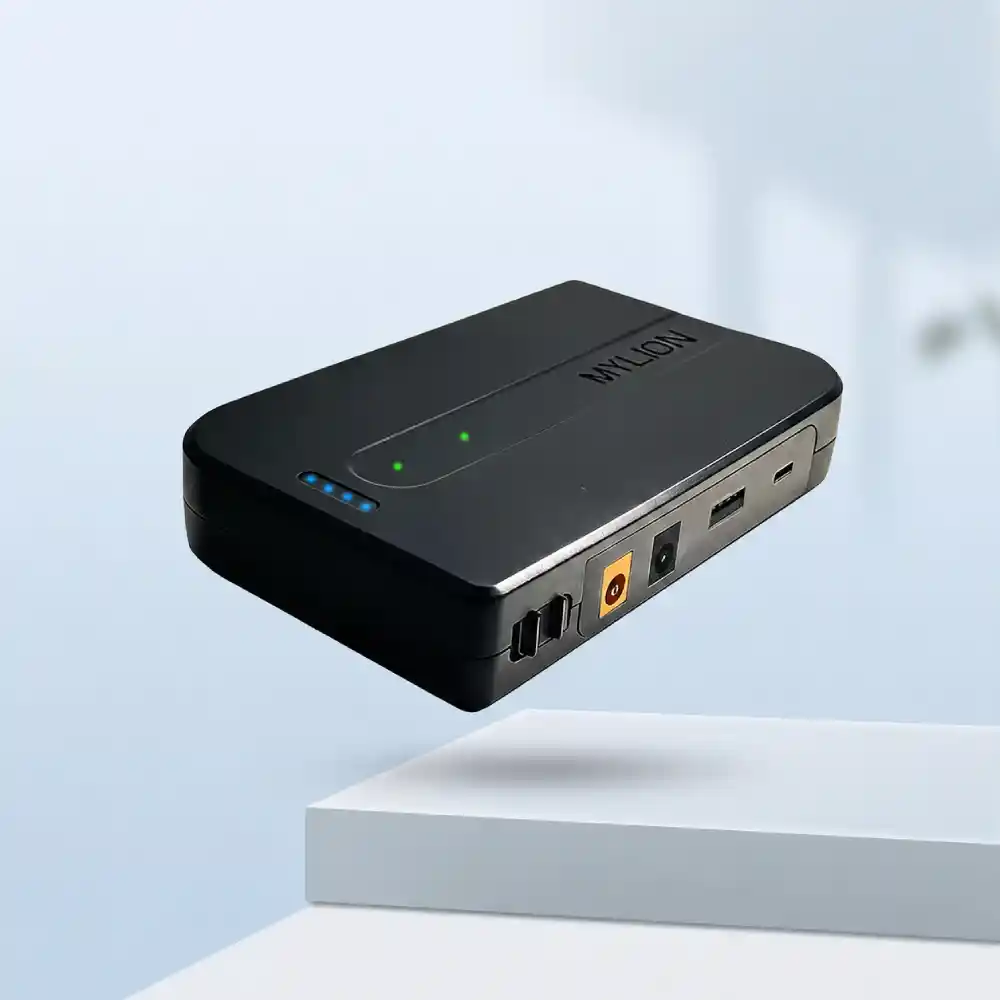
MUJ46 Mini UPS is a compact lithium-ion Mini UPS for projects that need one primary low-power 12V device together with a selected 5V USB-powered accessory. Its advantages include:
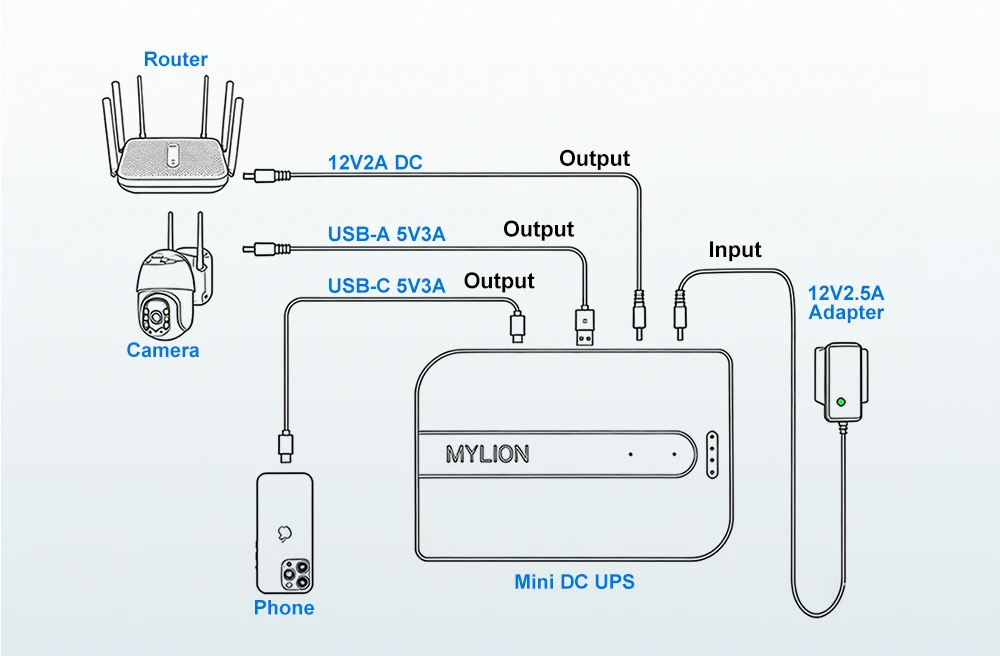
- Mixed-output flexibility:One 12V DC output plus USB-A and USB-C 5V outputs for validated mixed-load configurations.
- Clear 12V load boundary:5A continuous and 2A maximum on the 12V DC path, helping buyers distinguish normal load from short-term maximum capability.
- Managed combined output:Up to 18W total when all three outputs operate together, with power allocated according to the connected load.
- Compact indoor deployment:A 145 × 90 × 26mm, approximately 0.3kg fire-resistant ABS enclosure for space-sensitive FTTH and broadband installations.
- Project-oriented evaluation:A practical starting point for standardized device, cable and installation kits when the full configuration has been validated.
The USB-C port is a fixed 5V output, not an established USB-C PD output. Individual port maximum values cannot be added together as available system power, and the final mounting, cable routing, combined load and environment must be confirmed for the project.
See the MUJ46 multi-output Mini UPS product page for the commercial product overview and to request the current datasheet.
Application scenarios of MUJ46 Mini UPS
FTTH Subscriber-Side Backup
MUJ46 may fit a subscriber-side installation where one compatible 12V ONT, ONU, modem or low-power router is the main load and a selected 5V accessory also needs backup. Its mixed-output layout can simplify the power arrangement when the complete device set has been validated.
Explore MYLION’s FTTH subscriber-side backup direction for related deployment paths.
ONT or ONU Backup with a 5V Accessory
An ONT or ONU can be considered only when its voltage, actual continuous load, startup behavior, connector and polarity match the MUJ46 output path. A 5V accessory may be added if its USB requirements and the total simultaneous load remain within the approved system limit.
Review the broader ONT and ONU backup solutions when the project includes several device types or requires a different output level.
Distributor and Integrator Kits
For distributors and system integrators, MUJ46 can be evaluated as part of a standardized kit built around an approved device family, cable set and installation method. A standardized kit is more useful than a generic compatibility list because it makes voltage, connector, cable and runtime assumptions visible to the installer.
Where MUJ46 Should Not Be Assumed to Fit
- A 12V device whose continuous working current exceeds 1.5A, even if its short-term requirement appears close to the 2A maximum.
- A device that requires 9V, 15V, 20V or another voltage not provided by the selected output path.
- A USB-C PD device that requires protocol negotiation or a higher USB-C voltage profile.
- Two 12V devices connected through an unapproved splitter or cable arrangement.
- Outdoor, high-temperature, sealed or moisture-exposed deployment without an approved environmental review.
Seven Technical Decision Factors
1. Match the Operating Voltage Exactly
Start with the device’s required input voltage, not with the Mini UPS capacity. A 12V output is relevant only to a device designed to operate from that 12V path. USB accessories should be checked separately because connector shape does not establish voltage or protocol compatibility.
2. Use Real Working Load, Not Only the Adapter Rating
The original adapter rating is a useful screening input, but it is usually a maximum supply rating rather than the device’s constant consumption. Measure or obtain the device’s real operating power where possible. Include startup, wireless activity, attached peripherals and other modes that can change load.
3. Keep Continuous and Maximum Current Separate
For MUJ46, the current approved 12V DC rating is 1.5A continuous and 2A maximum. A device that needs 2A continuously should not be approved on the assumption that a maximum rating is a continuous rating. When the normal load is close to the continuous boundary, allow engineering margin and validate the sample under the real operating cycle.
4. Calculate the Combined Load Across All Active Outputs
Add the real simultaneous power of every connected device, then check both the individual port limits and the 18W total system limit. Do not add the maximum values printed for the DC, USB-A and USB-C outputs and treat that sum as available system power. Multi-port startup and load changes should also be tested because peaks may overlap.
5. Confirm Connector, Polarity and Cable Rating
A connector that appears to fit may still have the wrong internal dimension, polarity or current capability. Confirm the device socket, the selected MUJ46 cable configuration, polarity, cable length and cable rating. Check the complete installed path, not only the Mini UPS housing.
6. Distinguish Fixed 5V USB-C from USB-C PD
USB-C describes a connector format; it does not automatically establish Power Delivery support. The current approved MUJ46 data lists a fixed 5V USB-C output. If a router, CPE or gateway expects USB-C PD negotiation, another approved solution path may be required.
7. Treat Runtime as a Condition-Based Result
MYLION uses battery energy divided by working load as a formula estimate. With the current approved MUJ46 battery energy of 37.44Wh and a 12W test load, the MYLION roundup rule gives a 4-hour formula estimate: ROUNDUP(37.44Wh ÷ 12W, 0). This is not a tested runtime or a guarantee.
Actual runtime can change with conversion efficiency, the Mini UPS’s own consumption, battery condition, temperature, cable loss, protection cutoff, output path and changes in device load. For multi-output operation, use the total working load of all connected devices and validate the final configuration with samples.
How MYLION Supports Project Evaluation
MYLION supports Mini UPS model matching and OEM/ODM cooperation for B2B projects, subject to technical and commercial review. For MUJ46 evaluation, the useful starting point is a real device list rather than a general request for “a 12V Mini UPS.” MYLION can review the device requirements, output architecture, connector path, runtime target and sample plan before a project moves toward bulk approval.
If MUJ46 is not the right electrical or runtime fit, review the Mini UPS product range for a more suitable power, runtime or interface direction.
FAQ
Q1: Can MUJ46 power an ONT and a router at the same time?
Q2: Does the MUJ46 USB-C port support USB-C Power Delivery?
Q3: Is the 12V output rated at 2A continuously?
Q4: How long will MUJ46 run my device?
Q5: Are DC5521 and DC5525 automatically interchangeable?
Q6: Can MUJ46 be customized for an OEM or ODM project?
Conclusion
MUJ46 Mini UPS is a practical candidate when a project needs compact backup for one compatible low-power 12V device and a selected 5V USB accessory. The decision should be based on voltage, continuous and peak load, combined output, USB protocol, connector fit and runtime under the real device configuration. For ISP or integrator rollout, validate a representative device and cable matrix before bulk approval.



 English
  简体中文
简体中文  Deutsch
  Français
  Italiano
  Español