
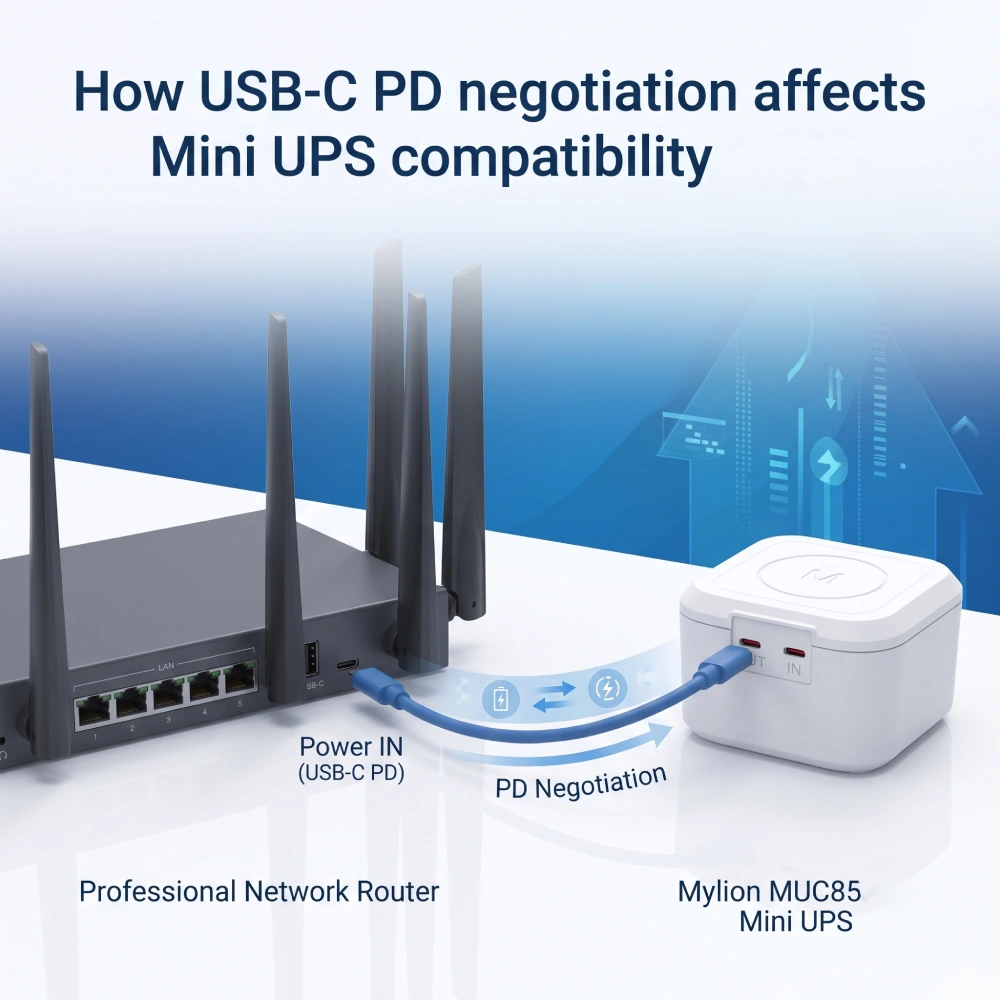
Actualmente, el panorama del hardware de red está experimentando una transformación radical. Los sectores de telecomunicaciones e informática están adoptando rápidamente la tecnología USB-C Power Delivery (PD) para gateways de red modernos, CPE 5G y routers Wi-Fi 7 de alto rendimiento. Si bien USB-C ofrece una versatilidad y densidad de potencia increíbles, introduce una capa de comunicación digital compleja que las baterías de respaldo tradicionales nunca tuvieron que gestionar: la negociación PD.
Para los dispositivos Mini UPS, comprender la negociación USB-C PD no es solo una cuestión técnica, sino la diferencia entre un dispositivo que mantiene su red en línea sin problemas durante un corte de energía y uno que se niega a cargar o alimentar su equipo en absoluto. Este artículo explora cómo funciona la negociación PD, por qué crea desafíos de compatibilidad para los Mini UPS y cómo la Solución mini UPS USB-C PD de Mylion aborda estas cuestiones.
¿Qué es la negociación USB-C PD?
USB Power Delivery es un protocolo estandarizado de negociación de energía que funciona a través del conector USB-C. A diferencia de la carga USB tradicional, que proporciona una salida fija de 5 V, PD permite una negociación inteligente y dinámica entre dispositivos para determinar los niveles óptimos de voltaje y corriente.
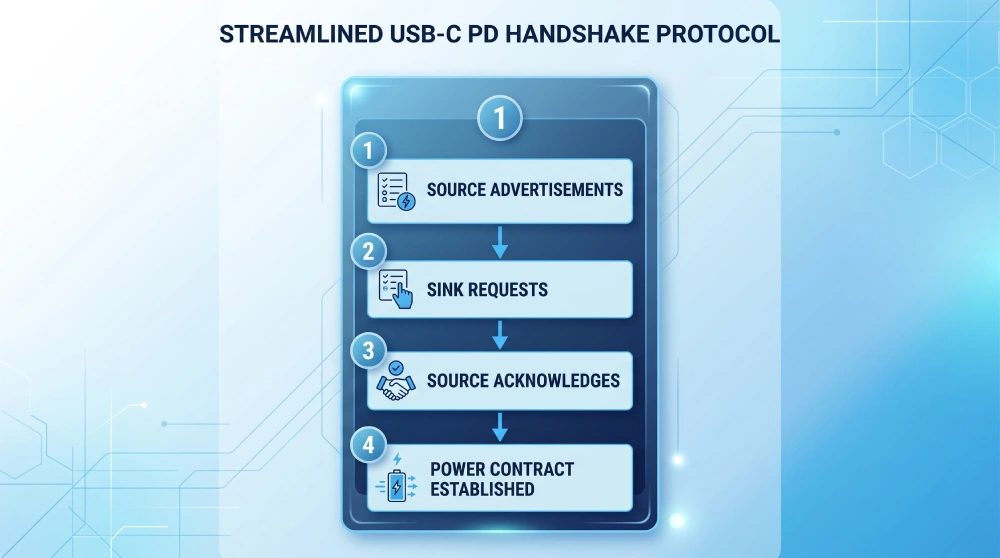
Cuando conectas una fuente USB-C PD (como un cargador o un mini SAI con salida PD) a un dispositivo receptor (como un router o un ordenador portátil), se desarrolla un proceso de negociación estructurado:
- La Fuente anuncia sus capacidadesmediante el envío de un mensaje de Capacidades de origen que contenga uno o más objetos de datos de potencia (PDO). Cada PDO describe un par específico de voltaje y corriente; por ejemplo, 5 V/3 A, 9 V/3 A, 12 V/3 A, 15 V/3 A o 20 V/3,25 A.
- El fregadero solicita un perfil adecuado.A partir de las capacidades anunciadas, seleccione el voltaje y la corriente que se ajusten a sus propias necesidades.
- La Fuente reconoce la solicitudy modifica su resultado para satisfacer el contrato solicitado.
- Se establece un contrato de suministro eléctrico.y la fuente suministra energía a los niveles negociados.
Esta negociación se realiza a través de los pines del canal de configuración (CC) USB-C mediante comunicación por código de marcado bifásico (BMC). Todo el proceso suele completarse en el primer segundo de conexión.
PD admite múltiples niveles de voltaje: 5V, 9V, 12V, 15V y 20V en el rango de potencia estándar (SPR), con un rango de potencia extendido (EPR) que alcanza hasta 48V. La introducción de Fuente de alimentación programable (PPS) En USB PD 3.0 se perfeccionó aún más esta capacidad, permitiendo que los dispositivos soliciten voltaje en incrementos de 20 mV entre 3,3 V y 21 V.
Por qué la negociación de PD es fundamental para la compatibilidad de los mini UPS
Al implementar sistemas de alimentación de respaldo en miles de hogares de suscriptores, un proveedor de servicios de Internet no puede permitirse incompatibilidades de hardware. La integración de USB-C PD en los sistemas de respaldo de batería introduce varios puntos críticos de fallo si la arquitectura de negociación es defectuosa.
1. La trampa de respaldo de 5 V
Si el protocolo de enlace PD falla debido a un firmware del controlador deficiente o cables de baja calidad, el protocolo USB-C exige que la salida de alimentación se establezca por defecto en 5 V por seguridad. La mayoría de los enrutadores de red y ONT requieren 12V, 15V o 20V para encenderse. Si el Mini UPS vuelve a 5 VEl router simplemente no se enciende, lo que hace que la batería de respaldo sea completamente inútil durante un apagón.
2. Caídas de voltaje durante la transferencia de corriente alterna a batería.
Los power banks de consumo a menudo reducen el contrato PD a 0V o 5V al cambiar de modo de paso a batería, lo que obliga a una renegociación. Esta interrupción de una fracción de segundo reinicia la puerta de enlace conectada. Un verdadero Mini UPS debe mantener un contrato PD continuo e ininterrumpido con tiempo de transferencia cero (0 ms) durante un fallo de la red eléctrica.
3. División de potencia entre múltiples dispositivos
Muchas implementaciones modernas requieren alimentar dos dispositivos, como un ONT de fibra óptica y un nodo de malla Wi-Fi independiente. Cuando se utiliza un cargador USB-C multipuerto estándar, al conectar un segundo dispositivo, el controlador debe renegociar la alimentación del primero, lo que provoca un reinicio momentáneo. Un mini SAI profesional Deben contar con controladores de potencia aislados que eviten conflictos de negociación de múltiples puertos.
Característica | Mini UPS tradicionales | Power Bank USB estándar | Mini UPS USB-C PD |
Comunicación | Salida de voltaje fijo | Carga rápida simple de 5V o estática | Negociación dinámica de PD (PDO) |
Tiempo de transferencia | 0 ms (UPS real) | Retraso (>10 ms, provoca reinicios) | 0 ms (Tiempo de transferencia cero) |
Estabilidad multipuerto | Ferrocarriles independientes | Fuerza la renegociación (se interrumpe la conexión) | Controladores IC inteligentes aislados |
Cómo los productos Mylion Mini UPS abordan los desafíos de la negociación de PD
Mylion ha desarrollado una gama de mini SAI que aprovechan la tecnología USB-C PD para solucionar estos problemas de compatibilidad. Su enfoque demuestra cómo una implementación cuidadosa de PD puede crear soluciones de alimentación de respaldo versátiles y fiables.
MUC85: Mini UPS USB-C PD de alta capacidad para dispositivos de red
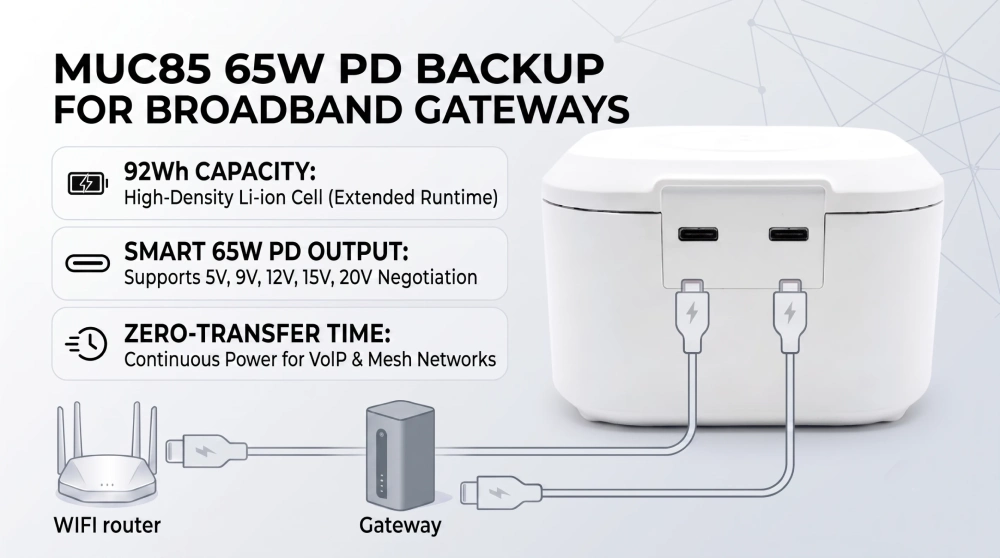
El Mylion MUC85 es un 92 Wh de alta capacidad Solución de alimentación de respaldo USB-C PD. Incorpora un puerto PD bidireccional Tipo-C que admite una entrada y salida de 65 W. El dispositivo ofrece una amplia gama de PDO: 5 V/3 A, 9 V/3 A, 12 V/3 A, 15 V/3 A y 20 V/3,25 A.
Esta amplia cobertura PDO garantiza la compatibilidad con una amplia gama de dispositivos:
- 5 VPara teléfonos inteligentes, tabletas y dispositivos USB básicos.
- 9 Vpara teléfonos de carga rápida y algunos equipos de red
- 12 Vpara routers, módems, ONT y muchos dispositivos IoT
- 15V para ciertos ordenadores portátiles y equipos industriales
- 20VPara portátiles de alta potencia y equipos de red exigentes.
Con una capacidad de batería de 92 Wh, el MUC85 proporciona de 7 a 8 horas de autonomía para dispositivos de 12 V/1 A y de 3 a 4 horas para dispositivos de 12 V/2 A.
Tiempo de transferencia cero para transiciones sin problemas
El MUC85 ofrece 0 ms (Tiempo de transferencia cero) Conmutación. Cuando falla la red eléctrica, la batería de iones de litio asume la carga instantáneamente sin necesidad de renegociar la conexión PD. El router conectado nunca experimenta una caída de tensión, lo que evita los reinicios constantes.
Control inteligente mediante circuitos integrados para una negociación estable.
El Mylion MUC85 incorpora un control inteligente mediante circuito integrado (IC) que gestiona de forma inteligente los procesos de carga y descarga, evitando el sobrecalentamiento, la sobrecarga y los cortocircuitos. Esta gestión inteligente garantiza que:
- La negociación de PD se gestiona de forma fiable incluso en condiciones de carga variables.
- La tensión y la corriente de salida se mantienen estables, protegiendo los componentes electrónicos sensibles de sobretensiones y fluctuaciones.
- El SAI (Sistema de Alimentación Ininterrumpida) cambia sin problemas entre los modos de carga y descarga sin interrumpir la alimentación de los dispositivos conectados.
Salidas PD adicionales
El MUC85 Mini UPS incluye un puerto PD Tipo-C secundario que admite hasta 30W, Permite el suministro simultáneo de energía a varios dispositivos. Esto resulta especialmente útil en instalaciones de red donde varios dispositivos (enrutador, ONT, conmutador) requieren alimentación de respaldo.
Buenas prácticas para garantizar la compatibilidad de los mini SAI USB-C PD
Basándonos en las consideraciones técnicas anteriores, aquí hay pautas prácticas para seleccionar e implementar Soluciones Mini UPS USB-C PD:
1. Verifique los requisitos de voltaje del dispositivo.
Antes de seleccionar un Mini UPS, verifique los requisitos de voltaje y corriente de cada dispositivo que necesite alimentar. Un enrutador que requiere 12 V/2 A no funcionará con un Mini UPS que solo proporciona 5 V o 9 V.
2. Confirmar la compatibilidad con PD en ambos extremos.
No todos los dispositivos USB-C son compatibles con PD. Si un dispositivo solo admite carga básica de 5 V, es posible que un mini SAI PD no le suministre energía. En estos casos, considere usar un puerto USB-C sin PD (si está disponible) o un cable USB-A a USB-C, que proporciona 5 V sin necesidad de negociación PD.
3. Utilice cables PD certificados.
La calidad del cable es fundamental. Utilice cables con certificación USB-IF y con la potencia nominal adecuada para sus necesidades. Un cable de 60 W limitará el rendimiento de un mini SAI de 100 W, y no tendrá ninguna indicación visual de esta limitación. Los productos de Mylion cuentan con las certificaciones CE, FCC, ROHS y UN38.3, lo que garantiza que cumplen con rigurosos requisitos de seguridad y calidad.
4. Pruebe la cadena de potencia completa.
Antes de implementar un Mini UPS USB-C PD en un entorno de producción, pruebe la cadena de alimentación completa: adaptador de pared → Mini UPS → dispositivo, con los cables específicos que planea utilizar. Verifica que:
- El Mini UPS se carga correctamente desde el adaptador de pared.
- El dispositivo conectado se enciende y funciona con normalidad gracias al SAI (Sistema de Alimentación Ininterrumpida).
- La transición entre la alimentación de CA y la batería es imperceptible (tiempo de transferencia cero).
Preguntas frecuentes
P1: ¿Puedo usar cualquier cargador USB-C para cargar un mini SAI USB-C PD?
P2: ¿Por qué mi dispositivo USB-C no se enciende cuando lo conecto a un SAI PD Mini?
P3: ¿El uso de un Mini UPS PD dañará un dispositivo que no sea PD?
P4: ¿Cómo puedo saber si mi mini UPS admite el voltaje correcto para mi dispositivo?
P5: ¿Puede un mini SAI cargar y alimentar dispositivos simultáneamente?
Conclusión
La negociación USB-C PD es la columna vertebral invisible de la entrega de energía moderna: un sofisticado protocolo de enlace digital que determina si sus dispositivos reciben la energía que necesitan. Aplicaciones de mini UPSComprender este proceso de negociación es esencial para garantizar la compatibilidad en todo el diverso ecosistema de dispositivos USB-C.
Para garantizar una continuidad de red sin interrupciones, los proveedores de servicios de Internet y los integradores de sistemas deben adoptar soluciones de alimentación inteligentes. Mini UPS Mylion USB-C solución Combina una amplia compatibilidad con PDO, un flujo de energía bidireccional y una gestión inteligente para proporcionar energía de respaldo confiable en una amplia gama de aplicaciones.
 Español
  English
  简体中文
简体中文  Deutsch
  Français
  Italiano