
Introduction
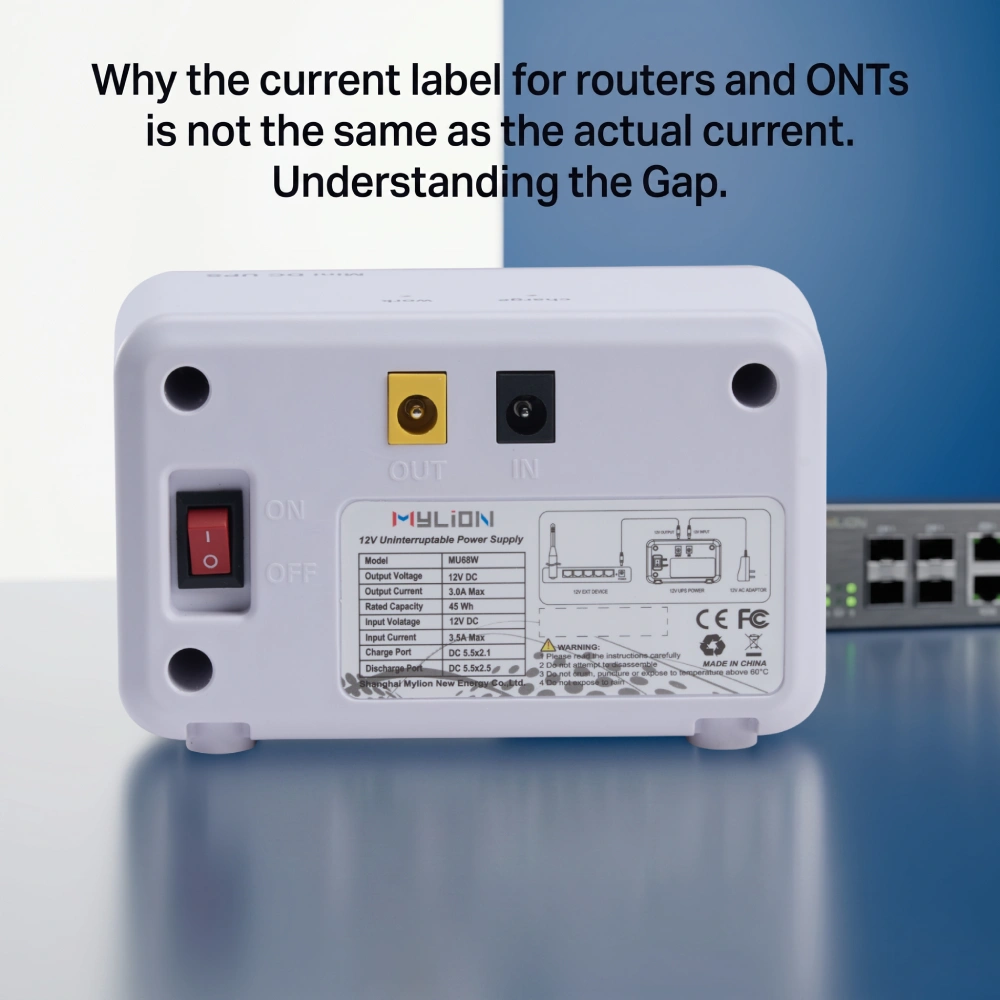
Dans les réseaux de télécommunications, l'instabilité du réseau local se traduit directement par des violations des accords de niveau de service (SLA), une perte de clients et de lourdes sanctions financières. Pour garantir une disponibilité continue du réseau, les fournisseurs d'accès Internet déploient Mini-onduleur Les unités constituent l'ultime ligne de défense chez le client. Toutefois, lorsque les directeurs des achats et les directeurs techniques fournissent Solutions de secours Mini UPS Quant aux routeurs et aux ONT, ils sont fréquemment victimes d'un malentendu technique coûteux.
L'hypothèse fausse la plus courante est : « Mon adaptateur de routeur indique 12 V 2 A, j'ai donc besoin d'un Mini-onduleur qui supporte une puissance continue de 24 W. La réalité est tout autre : Cette valeur de 2 A correspond à la capacité de sortie maximale de l'adaptateur, et non à la consommation électrique réelle du périphérique réseau. Et confondre les deux est l'erreur la plus courante dans le dimensionnement de l'alimentation de secours pour les équipements réseau.
Cet article explique pourquoi le courant indiqué et le courant réel sont fondamentalement différents, comment mesurer la consommation réelle de vos routeurs et ONT, et comment utiliser ces informations pour choisir le bon équipement. Mini-onduleur.
Que signifie réellement « courant indiqué » : la capacité maximale de l’adaptateur
Lorsque vous examinez le bloc d'alimentation fourni avec un ONT GPON ou un routeur Wi-Fi, les spécifications électriques imprimées représentent les capacité nominale maximaleLa consommation réelle des adaptateurs secteur est différente de la consommation typique. Leur puissance nominale est toujours supérieure aux besoins réels de l'appareil. Il ne s'agit pas d'un défaut, mais d'une pratique de conception délibérée.
Les fabricants surdimensionnent les adaptateurs pour plusieurs raisons :
- Marge de sécurité :Un dispositif tampon protège l'adaptateur contre la surchauffe lors des pics de charge.
- Disponibilité des composants :Les valeurs nominales standardisées des adaptateurs simplifient la gestion de la chaîne d'approvisionnement
- Conception thermique : Les adaptateurs de puissance supérieure chauffent moins sous charge normale.
- Support maximal :Certains appareils présentent des surtensions momentanées au démarrage ou des ports USB qui consomment du courant supplémentaire.
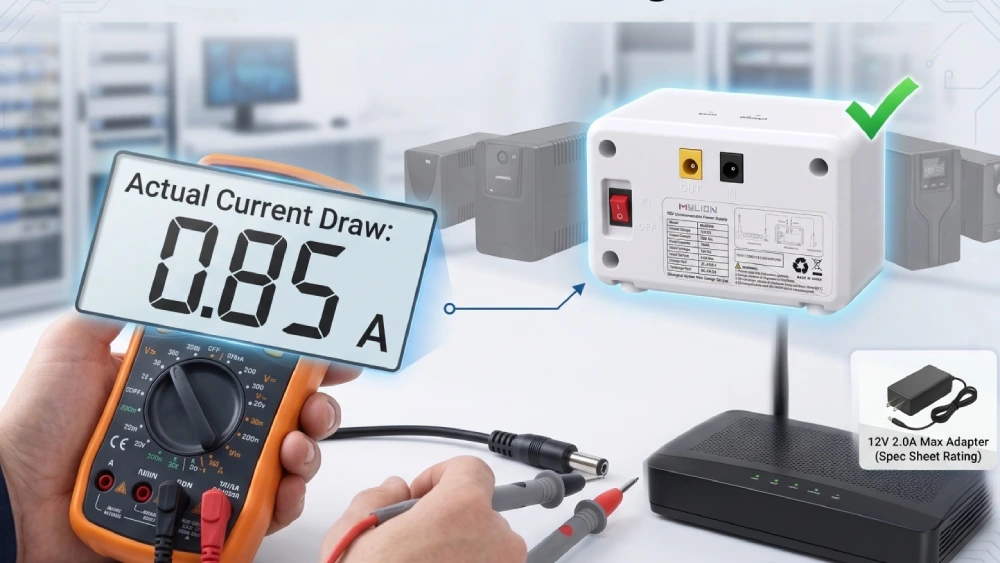
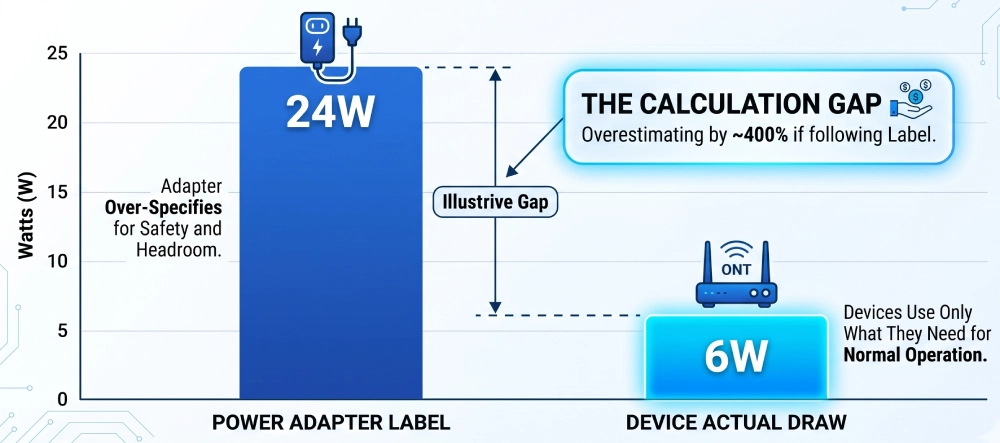
Par exemple : un routeur Wi-Fi fourni avec un 12V 2A (24W) L'adaptateur ne consommera généralement que quelques grammes. 0,5 A à 0,8 A (6 W – 9,6 W) en fonctionnement normal et soutenu.
C’est pourquoi le simple fait de regarder l’étiquette de l’adaptateur vous conduira presque toujours à surestimer la consommation d’énergie — souvent d’un facteur de 2 à 4.
Que signifie réellement « courant réel » : la consommation électrique réelle de l’appareil
Le courant réel correspond à la charge électrique exacte que le matériel réseau consomme réellement. Mini-onduleur en fonctionnement quotidien. Cette mesure est dynamique et fluctue en fonction de l'état du matériel en temps réel :
- Trafic inactif vs trafic actif :Un débit de données plus important augmente la consommation d'énergie du processeur.
- Activation de la bande Wi-Fi :La diffusion bi-bande (2,4 GHz et 5 GHz) ou tri-bande (6 GHz) exige beaucoup plus de puissance que le fonctionnement mono-bande.
- Utilisation des ports Ethernet :Le nombre de câbles LAN connectés et la distance de transmission physique ont un impact sur la consommation d'énergie des puces PHY.
- Alimentation USB :Les ports USB actifs consomment un courant dédié (5A pour USB 2.0 ; 0,9A pour USB 3.0).
- Charge du processeur :Les routeurs modernes basés sur ARM subissent des pics de courant transitoires lors du traitement du chiffrement VPN ou de l'inspection approfondie des paquets (DPI).
Données réelles de consommation électrique des périphériques réseau
Type d'appareil | Évaluation de l'étiquette de l'adaptateur | Consommation de courant réel typique | Puissance réelle (W) |
Routeur FAI standard | 12 V 1,5 A (18 W) | 0,5 A – 0,58 A | 6W – 7W |
ONT GPON typique | 12V 1,0A (12W) | 0,41 A (typ.) / 0,58 A (crête) | 5 W (typ.) / 7 W (crête) |
ONT FTTH optimisé | 12V 0,5A (6W) | 0,2A | 2,5 W |
Pourquoi l'écart entre le courant indiqué et le courant réel est important pour le choix d'un mini-onduleur
S'appuyer fréquemment sur le calcul aveugle « Courant d'étiquette × Tension » exagère les besoins réels en énergie d'un facteur 2 à 4.Dans le cadre d'un déploiement FAI comprenant des dizaines de milliers de nœuds, cela représente des millions de dollars de budget mal alloué.
Les conséquences d'une erreur de calcul Mini-onduleur Les paramètres de déploiement incluent :
- Surdimensionnement (gaspillage d'investissements) :Vous payez un prix exorbitant pour sauvegarder une « charge fantôme » qui n'existe pas, vous procurant Mini-onduleur des modèles dotés de batteries inutilement massives.
- Sous-dimensionnement (la menace de panne) :Si vous taillez un Mini-onduleur En se basant uniquement sur une consommation moyenne réduite et en ignorant le pic de consommation au démarrage de l'appareil, une coupure de courant déclenchera instantanément… Mini-onduleur Protection contre les surintensités (OCP), provoquant l'arrêt complet de l'équipement.
Pour plus de précision Mini-onduleur Pour les calculs d'exécution, la seule métrique qui compte est puissance réelle (W), et non l'ampérage indiqué (A). La formule principale est : W = V (Volts) × A réel (Ampères).
Comment mesurer la consommation réelle de courant : trois méthodes pratiques
Concevoir un système mathématiquement solide Mini-onduleur En configuration, les équipes techniques de télécommunications peuvent utiliser trois méthodes pour mesurer la consommation électrique réelle du CPE :
Méthode 1 : Compteur de puissance à brancher (la plus pratique)
Installez un wattmètre (comme un Kill-A-Watt) entre la prise murale et l'adaptateur secteur. Forcez le routeur à effectuer un test de débit continu et mesurez la consommation électrique. Bien que cette mesure prenne en compte la légère perte de conversion de l'adaptateur, elle établit une base de référence très fiable. Mini-onduleur dimensionnement.
Méthode 2 : Étiquette d’entrée du périphérique (estimation la plus rapide)
Ignorez complètement le bloc d'alimentation. Vérifiez plutôt l'étiquette du fabricant sur le châssis inférieur du routeur ou de l'ONT. La valeur d'entrée indiquée ici (par exemple, « Entrée : 12 V ⎓ 0,5 A ») représente les caractéristiques du matériel. seuil de fonctionnement maximal prévu (6W) sans périphériques USB externes, ce qui le rend beaucoup plus réaliste que l'adaptateur secteur.
Méthode 3 : Multimètre CC (Très haute précision)
Branchez un multimètre numérique en série avec le câble d'alimentation CC. Cela permet aux ingénieurs de surveiller en temps réel et avec précision la consommation de courant CC pendant la phase d'établissement de la connexion au démarrage et pendant la transmission de données en régime permanent à pleine charge.
Exemple de calcul de déploiement en situation réelle :
Un ONT actif consomme 12 V × 0,4 A (4,8 W) tout en étant associé à un routeur Wi-Fi consommant 9 V × 0,6 A (5,4 WLa charge réseau combinée réelle est simplement 10,2 W, nettement inférieure aux 30W+ suggérés par la combinaison des étiquettes de leurs adaptateurs.
Application de ces connaissances : Choisir le bon mini-onduleur pour routeurs et ONT
Une fois la puissance réelle (W) confirmée, vous pouvez définir précisément votre stratégie de gestion des batteries. La formule est la suivante : Capacité de la batterie (Wh) ÷ Charge réelle (W) = Autonomie (heures).
MYLION propose une gamme de mini-onduleurs conçus pour différents profils d'équipements réseau. Voici comment ils correspondent à des applications concrètes :
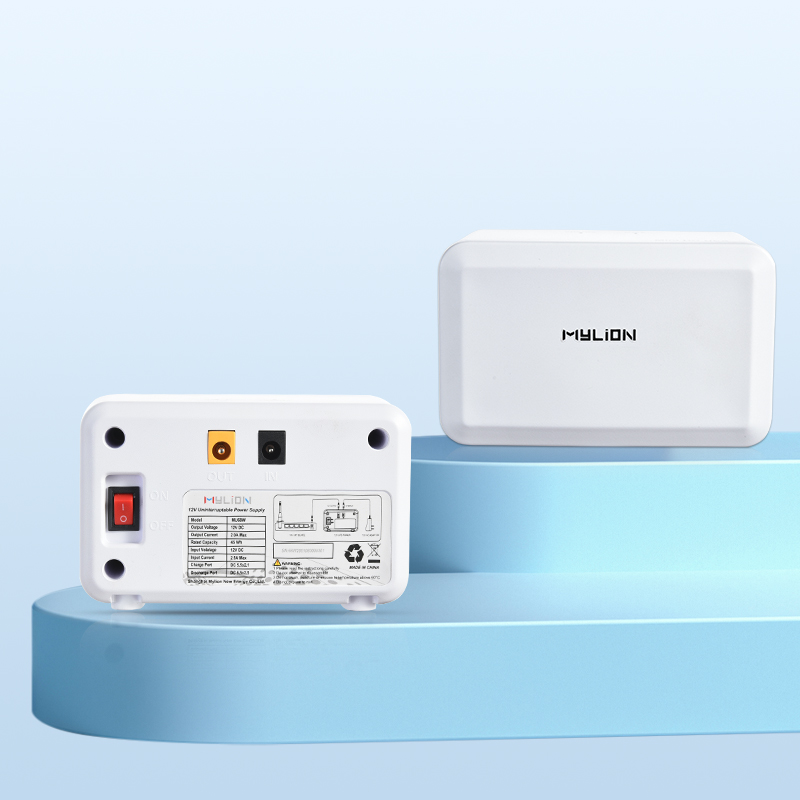
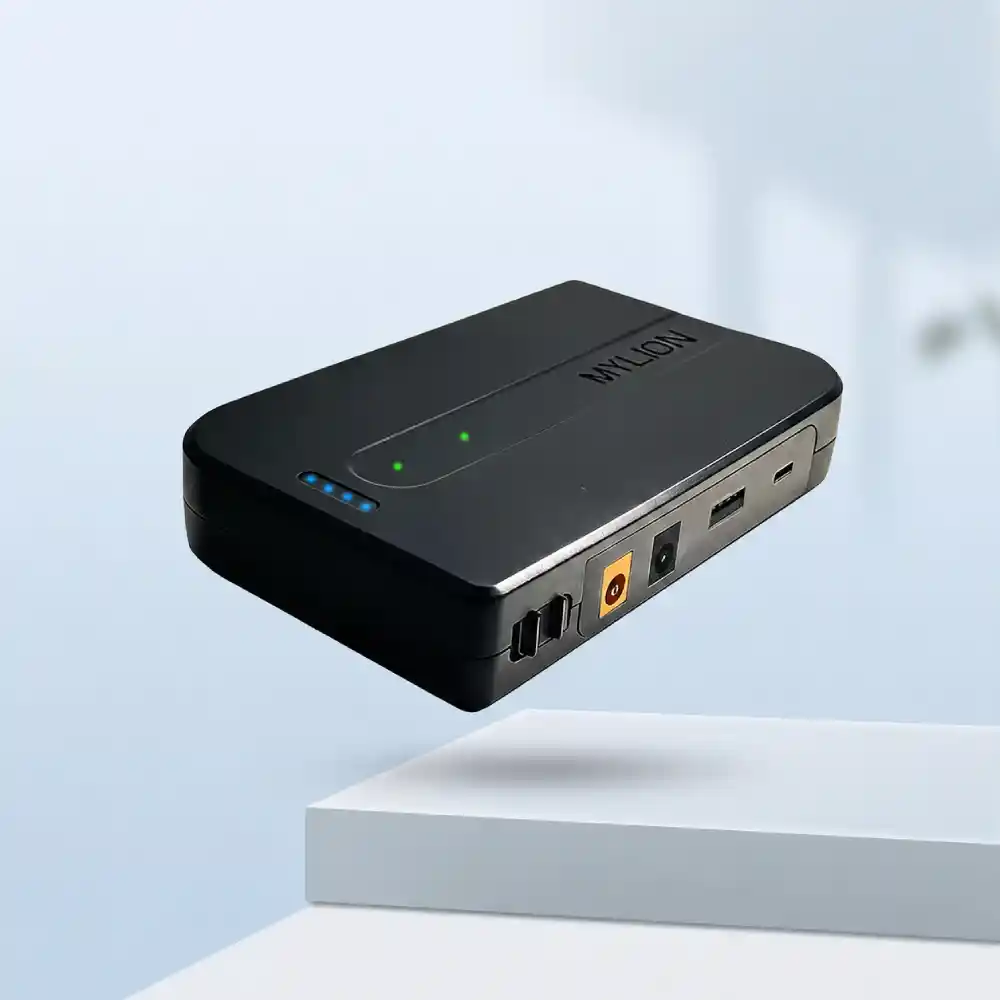
MU68 Mini-onduleur: Doté d'un énorme 68 Wh Capacité avec une sortie de 12 V 3 A. Conçu pour les installations haut de gamme à double appareil (ONT + routeur), il offre une alimentation robuste 4,5 à 5 heures de l'autonomie sous une charge réelle continue de 12 W.
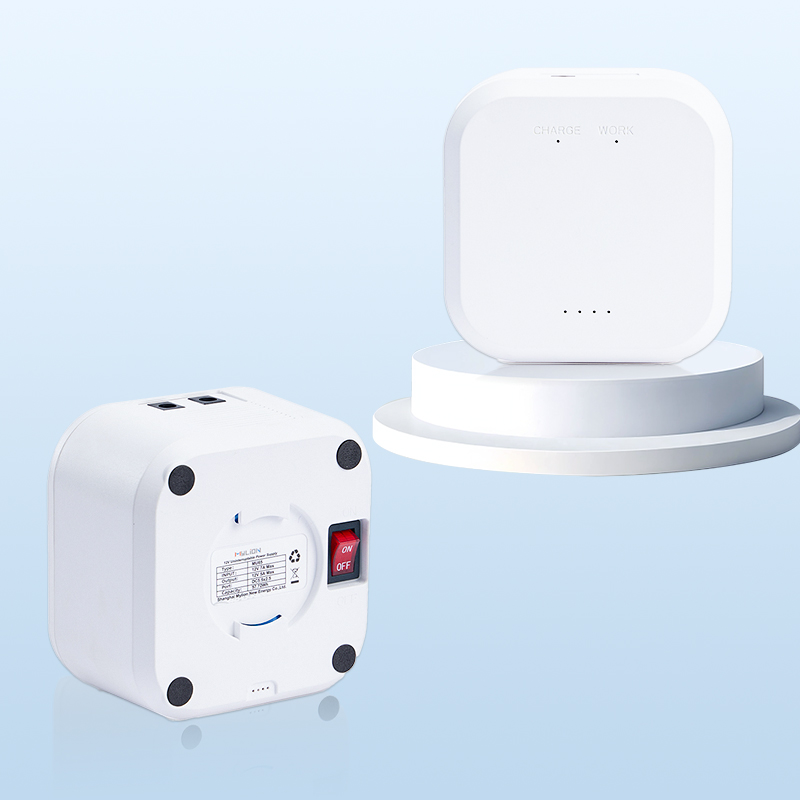
MU35 Mini-onduleur: Une alimentation 12V haute puissance Mini-onduleur conçu spécifiquement pour répondre aux exigences énergétiques plus élevées des routeurs Wi-Fi 6/7 de nouvelle génération et des passerelles périphériques d'entreprise.
MU26 Mini-onduleur: Équipé d'un 19.24Wh capacité et sortie 12 V 3 A. Il s'agit de la norme optimale à retour sur investissement élevé. Mini-onduleur pour les déploiements massifs de haut débit résidentiel.
MUMini-onduleur C85: Doté d'une alimentation USB-C PD de 65 W (20 V / 3,25 A), il prend en charge les tensions de sortie 5 V / 9 V / 12 V / 15 V / 20 V. Idéal pour les appareils réseau modernes alimentés par USB-C/PD et les CPE 5G.

Mini-onduleur MUC85
Mini-onduleur MU68
Mini-onduleur MUJ46
Mini-onduleur MU35
Pourquoi l'approche d'ingénierie MYLION est importante
Notre Mini-onduleur Ces systèmes fournissent une sortie CC extrêmement stable avec une rigueur stricte Temps de transfert : 0 msEn cas de panne du réseau, il n'y a aucune perte de paquets, aucun redémarrage de routeur et une conformité SLA sans faille pour les abonnés haut débit.
FAQ
Q1 : Puis-je utiliser un mini-onduleur avec une intensité nominale supérieure à celle requise par mon routeur ?
Q2 : Puis-je utiliser un mini-onduleur avec un courant de sortie inférieur à celui indiqué sur l’étiquette de mon adaptateur ?
Q3 : Quel est le moyen le plus rapide de connaître la consommation électrique réelle de mon routeur déployé ?
Q4 : Quelle est la différence entre Ah (ampères-heures) et Wh (watt-heures) ?
Q5 : MYLION fournit-il des connecteurs CC personnalisés pour des marques de routeurs spécifiques ?
Q6 : Qu’est-ce qu’un temps de transfert nul et pourquoi est-ce important ?
Conclusion
Le courant nominal correspond à la capacité maximale ; le courant réel est la consommation effective. L’écart entre les deux n’est pas un défaut : il s’agit d’une caractéristique de conception intentionnelle qui offre une marge de sécurité. Cependant, pour le dimensionnement des onduleurs, cet écart peut s’avérer problématique s’il n’est pas compris.
MYLION's Solutions Mini UPS Conçues pour les déploiements télécoms et haut débit réels, ces solutions proposent des modèles adaptés aux besoins énergétiques réels des appareils, et non à des valeurs maximales théoriques. Optimisez votre infrastructure et vos coûts de déploiement en alignant précisément vos besoins en énergie.




 Français
  English
  简体中文
简体中文  Deutsch
  Italiano
  Español