
Réponse directe
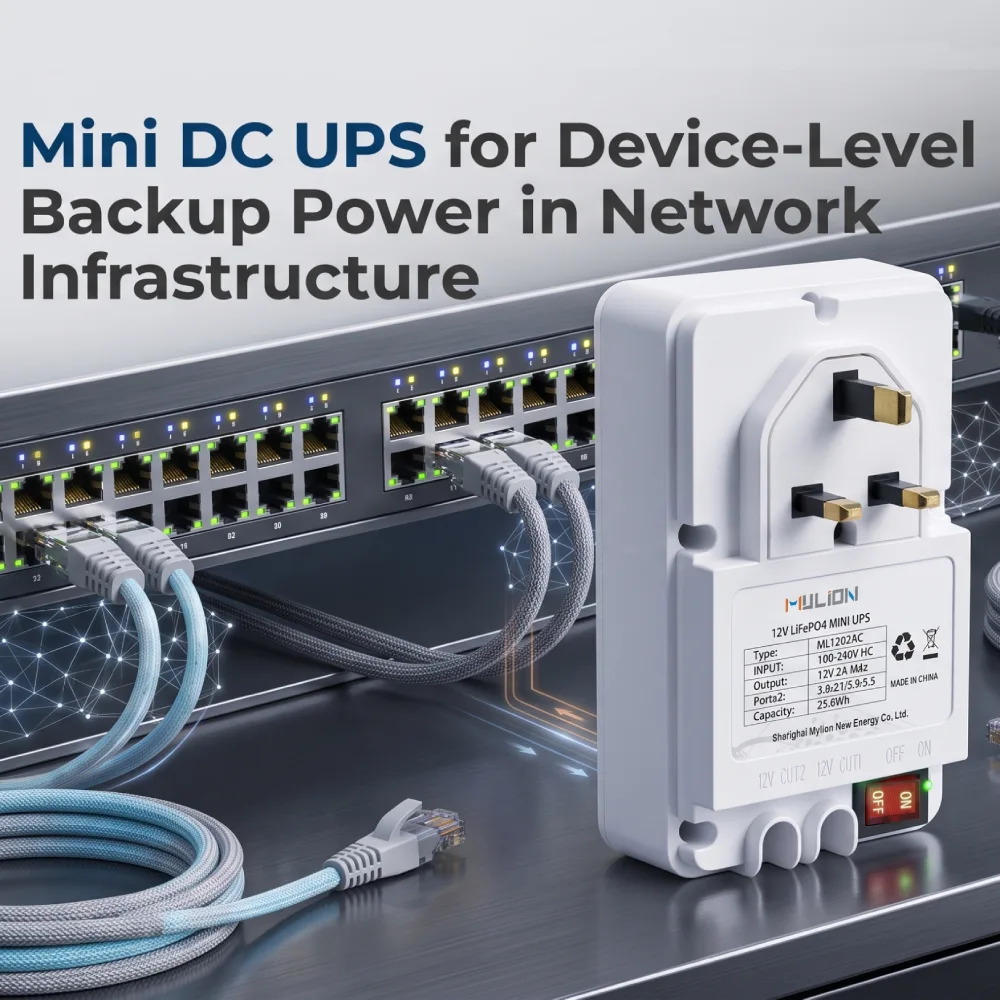
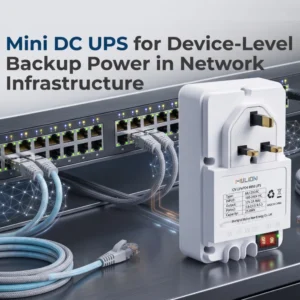
UN Mini-onduleur CC Il s'agit d'une solution d'alimentation de secours compacte conçue pour maintenir le fonctionnement des appareils CC basse tension compatibles en cas de coupure de courant. Dans les infrastructures réseau, elle est couramment utilisée pour les routeurs, les passerelles, les terminaux ONT/ONU, les équipements CPE, les modems et certains équipements de communication.
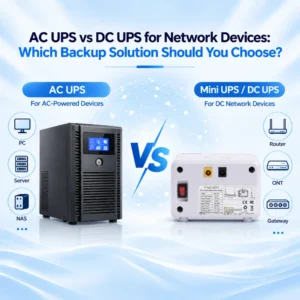
Contrairement à un onduleur AC de grande taille qui protège une baie, une armoire ou une pièce entière, un mini-onduleur DC est généralement installé à proximité de chaque appareil. Il est donc particulièrement adapté aux déploiements de réseaux haut débit distribués, FTTH, FAI, télécommunications et petits réseaux où de nombreux terminaux critiques sont répartis sur différents sites.
Le choix d'un mini-onduleur CC ne doit pas se faire uniquement en fonction de son nom. La tension, la charge continue, la demande au démarrage, le connecteur, la polarité, le calibre du câble et l'autonomie requise doivent tous être vérifiés avant utilisation.
Qu'est-ce qu'un mini onduleur CC ?
Un mini-onduleur CC est un petit système d'alimentation sans interruption destiné aux équipements compatibles fonctionnant en courant continu. Il combine généralement une entrée d'alimentation externe, un stockage sur batterie interne, la gestion de l'alimentation, la protection et une sortie CC contrôlée dans un seul appareil.
Dans une configuration typique :
- L'adaptateur externe alimente l'appareil connecté pendant la période de fonctionnement normal sur secteur.
- Le mini onduleur CC maintient sa batterie interne chargée.
- En cas de coupure de courant externe, le Mini DC UPS bascule sur batterie de secours et continue d'alimenter l'appareil connecté, dans les limites de sa puissance de sortie approuvée.
Pour l'infrastructure réseau, cela peut contribuer à réduire les cycles de redémarrage, à maintenir l'accès à distance et à maintenir en ligne certains points d'accès haut débit lors de brèves ou instables coupures de courant.
Pourquoi l'alimentation de secours au niveau des appareils est importante
L'infrastructure des réseaux modernes est de plus en plus distribuée. Un projet de haut débit ou de communication peut comprendre de nombreux petits appareils, pourtant essentiels, installés dans différents foyers, bureaux, bâtiments ou sites distants.
Voici quelques exemples courants :
- Routeurs
- Modems
- Passerelles réseau
- Terminaux ONT / ONU
- Dispositifs CPE
- Dispositifs de communication sans fil sélectionnés
- Équipements IoT ou connectés au réseau sélectionnés
Si un terminal tombe en panne, les conséquences peuvent être plus importantes que ne le laisse supposer sa taille. L'accès à Internet peut être interrompu, la gestion à distance peut devenir impossible, les données de surveillance peuvent être saturées et la qualité du service client peut se dégrader.
Un système d'alimentation sans coupure centralisé protège les équipements situés à un seul endroit. Cependant, il ne couvre pas nécessairement tous les points de terminaison distribués. Un mini-système d'alimentation sans coupure CC offre une solution de secours plus locale pour les appareils spécifiques nécessitant une alimentation continue.
Onduleur mini-DC vs onduleur centralisé
Architecture de sauvegarde | Ce qu'il protège | Points forts | Limites |
Onduleur centralisé pour climatisation | Plusieurs appareils dans une même pièce, un même rack ou une même armoire | Gestion simplifiée depuis un seul endroit ; convient aux charges CA groupées | Peut ne pas protéger les terminaux distants ; le câblage peut être complexe |
Mini-onduleur CC | Un périphérique CC compatible ou un petit groupe de périphériques locaux | Proche du point d'extrémité ; utile pour les périphériques réseau distribués ; peut réduire les conversions CA inutiles | Doit correspondre aux exigences de tension, de charge, de connecteur, de polarité et de durée de fonctionnement |
Stratégie de sauvegarde hybride | Équipement de base et points de terminaison sélectionnés | Adaptable aux projets de grande envergure dans le domaine du haut débit ou des télécommunications. | Nécessite une planification pour éviter les lacunes ou les protections dupliquées |
De nombreux projets réels utilisent une approche hybride : une protection UPS centrale pour les équipements principaux, plus des unités Mini DC UPS pour les routeurs critiques, les terminaux ONT/ONU, les périphériques CPE ou autres points d’extrémité distribués.
Où un mini onduleur CC est couramment utilisé
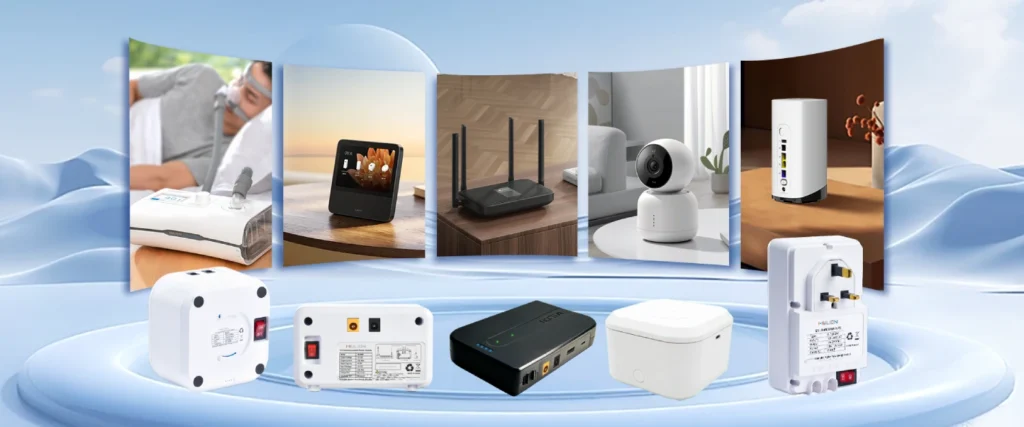
Un mini-onduleur CC peut être évalué pour :
- Sauvegarde du routeur dans les réseaux domestiques, de bureau ou de petites entreprises
- ONT/ONU de secours pour l'accès haut débit FTTH
- Sauvegarde CPE pour les déploiements FAI et télécoms
- Sauvegarde de passerelle dans les systèmes de bâtiments intelligents
- Sauvegarde du modem et des terminaux réseau
- Équipements de communication basse tension sélectionnés
Facteurs clés de sélection
1. Tension de sortie
La tension de sortie du mini onduleur CC doit correspondre aux exigences d'entrée de l'appareil. De nombreux appareils haut débit fonctionnent en 12 V CC, mais ce n'est pas le cas de tous les équipements réseau. Certains appareils peuvent nécessiter une alimentation de 5 V, 9 V, 24 V, 48 V, USB-C PD, PoE ou autre.
La tension doit être vérifiée sur l'étiquette de l'appareil, l'adaptateur d'origine ou la fiche technique.
2. Charge continue
Le courant ou la puissance continue est un critère de sélection primordial. L'appareil connecté doit impérativement respecter les capacités de sortie continue du mini-onduleur CC.
Ne vous fiez pas uniquement à la puissance nominale de l'adaptateur pour connaître la consommation réelle de l'appareil. Par exemple, un appareil livré avec un adaptateur 12 V 3 A ne consomme pas toujours 3 A en continu. Pour vos projets, il est préférable de vous baser sur une charge mesurée ou sur les spécifications fiables de l'appareil.
3. Démarrage et pic de demande
Certains appareils consomment davantage de courant au démarrage, lors de transmissions sans fil, en cas de forte activité, en mode nuit, lors de l'utilisation d'accessoires ou lors de la reconnexion. Si la charge approche la limite du produit, il est recommandé de procéder à des tests sur un échantillon ou à une analyse technique.
La production maximale ne doit pas être décrite comme une production continue.
4. Connecteur et polarité
La compatibilité physique ne garantit pas la compatibilité électrique. Le choix d'un mini-onduleur CC doit vérifier :
- taille de la prise CC
- Polarité
- Calibre du câble
- longueur du câble
- risque de chute de tension
- Que l'on utilise des adaptateurs ou des câbles fendus
Des erreurs de connexion peuvent entraîner une panne, un fonctionnement instable ou endommager l'appareil.
5. Exigence de temps de sauvegarde
L'autonomie dépend de l'énergie de la batterie, de la charge connectée, du chemin de conversion, de la consommation du système, de l'état de la batterie, de la température et des limites de protection.
Une formule d'estimation de base peut utiliser :
Énergie de la batterie (Wh) ÷ charge de travail (W)
Il s'agit d'une estimation et non d'une durée d'exécution garantie. La durée de sauvegarde officielle doit être liée à la charge spécifique du matériel, aux conditions de test et au périmètre d'approbation.
6. Un seul appareil ou plusieurs appareils
Un mini-onduleur CC peut alimenter un appareil ou, dans certaines configurations, un petit groupe d'appareils. La sauvegarde multi-appareils doit vérifier les points suivants :
- Charge continue totale
- Charge maximale de tous les appareils
- exigences en matière de tension de sortie
- Limite de puissance totale du système
- Plan de connexion
- Calibre du câble
- Délai de sauvegarde prévu
Ne présumez pas que « deux appareils » sont pris en charge à moins que les conditions électriques réelles ne correspondent aux capacités du produit.
Comment MYLION prend en charge les projets de mini-onduleurs CC
MYLION fournit Solutions d'alimentation sans coupure (UPS) mini CC pour les routeurs, les terminaux ONT/ONU, les modems, les appareils CPE et autres équipements réseau basse tension compatibles.
Les différents périphériques réseau ont des exigences différentes en matière d'alimentation et d'installation ; la solution appropriée dépend donc de l'application réelle et non de la seule catégorie de périphérique.
Pour les projets courants de fournisseurs d'accès Internet, de fibre optique jusqu'au domicile (FTTH) et de télécommunications, MYLION propose plusieurs options de mini-onduleurs :
- MU68Conçu pour les applications haut débit 12 V standard telles que les routeurs, les terminaux ONT/ONU, les modems et les équipements CPE, il peut servir de point de départ à de nombreux projets de secours 12 V côté abonné.
- MUJ46– convient aux installations FTTH compactes nécessitant un déploiement en ligne, une gestion des câbles plus propre ou des sorties 12 V CC et 5 V USB.
- MU35– conçu pour les routeurs, passerelles et périphériques CPE 12 V à charge élevée, pour lesquels un mini-onduleur 12 V standard peut ne pas fournir une marge de sortie suffisante.
- MUC85– offre une option pour les périphériques réseau compatibles utilisant l'architecture d'alimentation USB-C PD plutôt qu'une entrée CC à tension fixe conventionnelle.
- ML1202AC– peut être évalué pour certains projets où deux appareils basse consommation de 12 V, tels qu'un ONT et un routeur, nécessitent une solution de secours.
FAQ
Q1 : Qu'est-ce qu'un mini onduleur CC ?
Q2 : Un mini onduleur CC est-il la même chose qu’une batterie externe ?
Q3 : Un mini onduleur CC peut-il prendre en charge un routeur et un ONT simultanément ?
Q4 : Puis-je choisir un mini onduleur CC uniquement en fonction de la tension ?
Q5 : Un mini onduleur CC convient-il aux projets de fournisseurs d'accès Internet et de télécommunications ?
Conclusion
Un mini onduleur CC peut fournir une couche pratique de sauvegarde au niveau des périphériques pour les infrastructures réseau distribuées où les routeurs, les terminaux ONT/ONU, les périphériques CPE et autres points d'extrémité ne peuvent pas être entièrement protégés par un onduleur centralisé.
Pour les projets de FAI, de télécommunications ou d'intégration de systèmes, la fourniture des spécifications du dispositif cible et des exigences de déploiement permet à MYLION de recommander des modèles adaptés pour une évaluation plus approfondie et des tests d'échantillons.

 Français
  English
  简体中文
简体中文  Deutsch
  Italiano
  Español