适用于光网络终端 (ONT)、光网络单元 (ONU)、路由器和互联网服务提供商 (ISP) 备份项目的迷你型 UPS

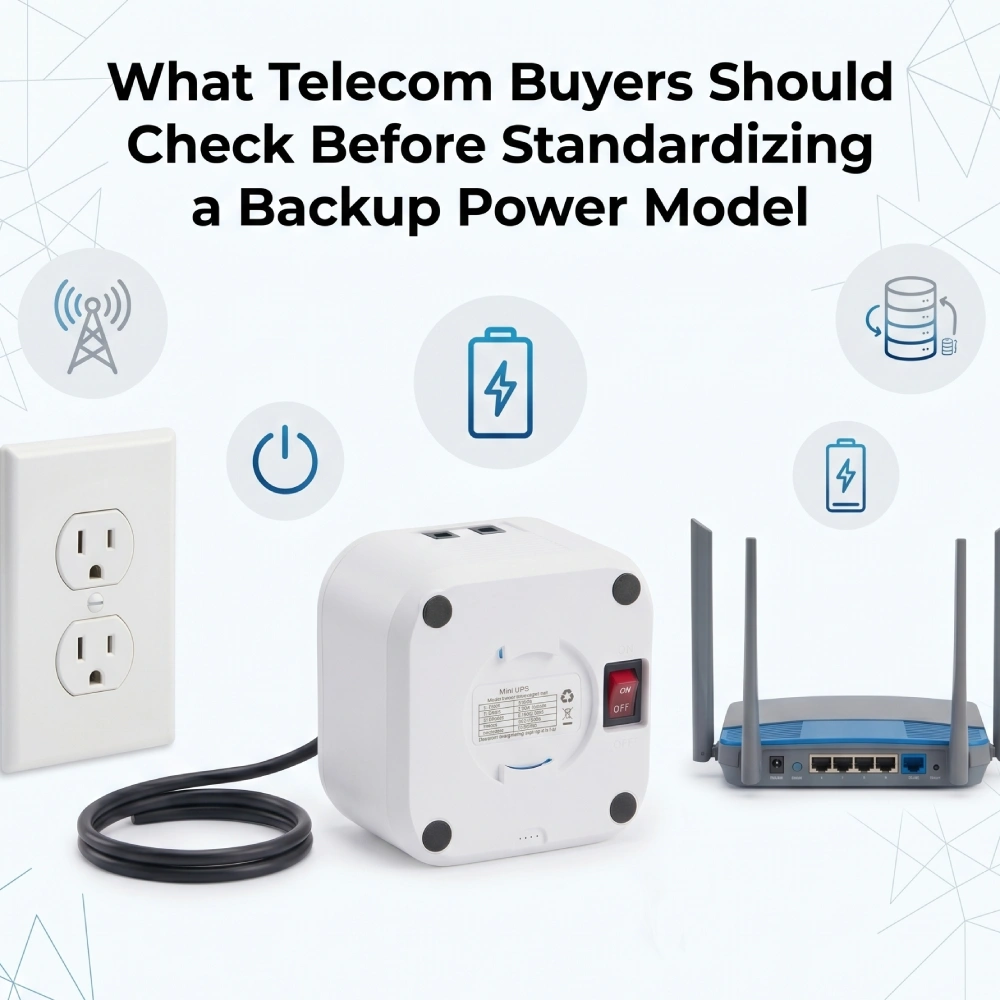
What Telecom Buyers Should Check Before Standardizing a Backup Power Model Across Multiple CPE Devices

What Telecom Buyers Should Check Before Standardizing a Backup Power Model Across Multiple CPE Devices (1)

介绍

Standardization sounds efficient, and in telecom backup programs, it often is. However, standardizing too early or on the wrong technical basis turns operational efficiency into deployment risk, escalating TCO and triggering SLA penalties.

Many procurement teams hope to select a single, universal Mini UPS model for a wide range of CPE. While this is achievable, forcing a single power architecture without validation often creates voltage mismatch, unstable field performance, or an unnecessary customer support burden.

For CTOs and Procurement Directors, the critical question is: “What technical parameters must we verify before standardizing one Mini UPS model across multiple CPE devices?”

Why Buyers Push for Power Standardization

The financial and operational logic behind deploying a standardized Mini UPS for Wi-Fi router and ONT networks is strong:  

  • Easier Procurement: Bulk purchasing power drives down unit costs.
  • Fewer SKUs: Reduces inventory and warehousing complexities.
  • Simpler Installer Training: Technicians master a single deployment protocol.  
  • Predictable Spare Handling: Streamlines warranty and replacement workflows.  
  • Cleaner Distribution: Eliminates kitting errors across channels.  
  • Long-Term Price Leverage: Maximizes vendor negotiation power.  

These advantages only hold if the standardized Mini UPS model is truly compatible with the diverse hardware fleet it supports. If compatibility fails, the cost of field replacements and subscriber churn quickly wipes out upfront procurement savings.

Start with a Device Portfolio Review

Before standardizing any backup power model, telecom buyers should review the actual CPE portfolio.

At minimum, this review should include:

  • Device model family
  • 输入电压
  • Normal operating current
  • Peak or startup current if known
  • 连接器类型
  • Single-device or combined setup requirement
  • Runtime target by service scenario

This creates a realistic view of the hardware spread. Without it, standardization may be based on assumptions rather than evidence.

Check the Voltage Map First

Voltage is the first hard gate in power engineering.

If your portfolio includes only 12V devices, standardizing on a high-efficiency Mini UPS is relatively straightforward.

However, if your network infrastructure mixes 9V, 12V, 24V, or PoE-driven 48V equipment, a single universal backup model becomes impractical.

Critical Risk Note: Voltage mismatch cannot be solved by accessory choices or patch cables. Feeding incorrect voltage to a high-end gateway results in immediate component failure or severe battery degradation. If voltage variation exists across your fleet, your standardization plan must be restructured.

Understand Current Range, Not Just Average Load

Standardization programs frequently fail because engineering teams design for typical power consumption while ignoring the actual spread of load.  

  • Standard ONTs/ONUs:Demand low to moderate continuous current.  High-Performance Wi-Fi 6/7 Routers: Require significantly higher output margins, especially under heavy data throughput.
  • Integrated Gateways: Exhibit demanding, high-amp transient inrush behavior during cold boot sequences.
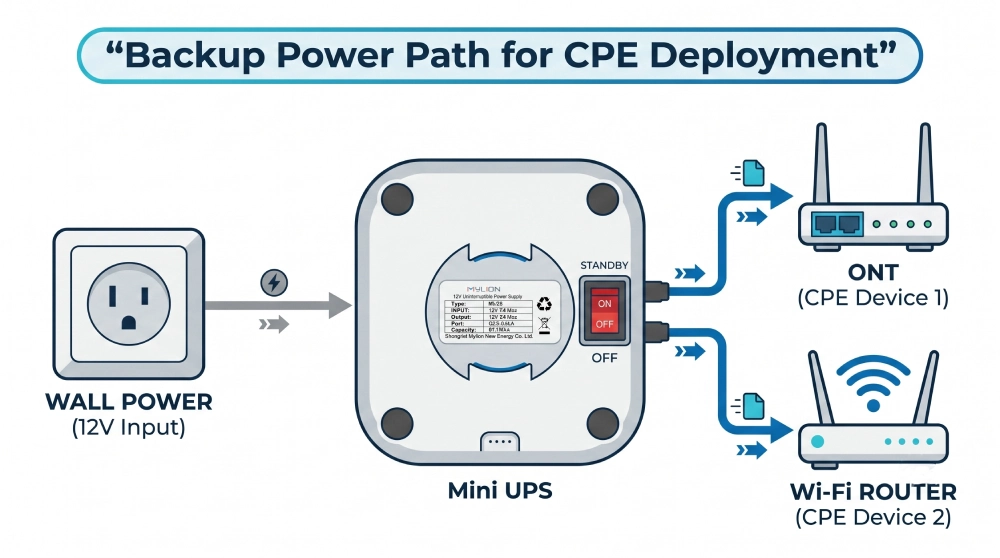
  • Dual-Device Deployments: Running an ONT and a separate router off a single power source shifts the load profile entirely.

A 不间断电源 engineered strictly for the average device will suffer from over-current protection trips when paired with your highest-spec gateways. Buyers must review the entire current range, not just a single reference device, to ensure the upper end of the fleet is comfortably supported.

Review Connector Family Spread

Connector variation is one of the biggest risks to standardization.

Even when voltage and current are acceptable, multiple CPE device families may use different plug sizes or cable logic. If this is ignored, the standardization plan may still fail at the installation stage.

Before standardizing, buyers should confirm:

  • How many connector types are in scope
  • Whether cable kits can be standardized
  • Whether polarity is uniform
  • Whether one adapter strategy can support the portfolio
  • Whether dual-device deployment changes cable requirements

This review often determines whether one product can truly scale cleanly.

Separate One-Model Standardization from One-Program Strategy

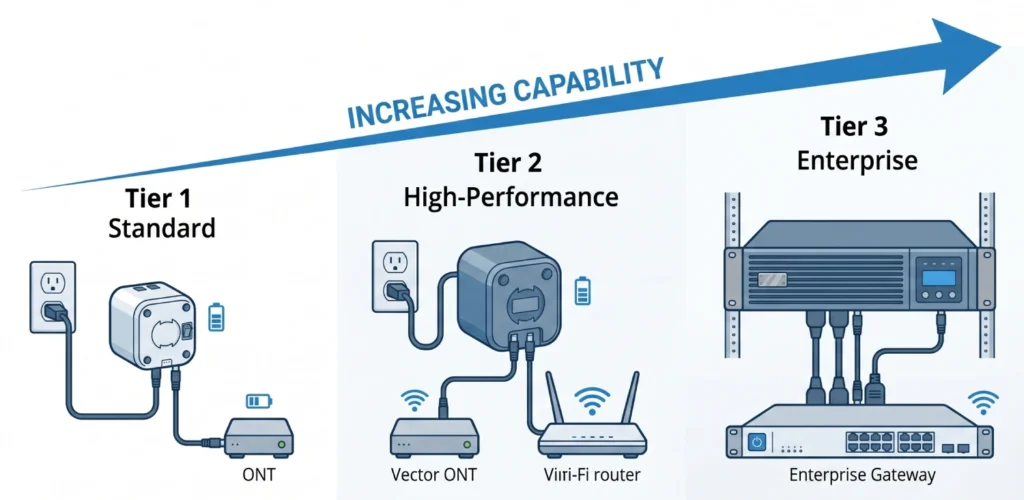
Forcing a single hardware SKU to cover every deployment scenario introduces unnecessary capital expenditure (CapEx) or leaves high-tier services underprotected. Sophisticated telecom operators implement a one-program strategy utilizing a tiered selection of Mini UPS models:  

  • The Standard Tier: A streamlined, cost-effective Mini UPS optimized for standalone ONT / ONU fiber termination points.  
  • The High-Performance Tier: A robust, high-capacity Mini UPS designed for dual-device setups or power-heavy Wi-Fi routers and gateways.  
  • The Enterprise Tier: A specialized, higher-voltage model reserved for advanced edge applications.  

This structured approach preserves procurement leverage and simplifies installer workflows while guaranteeing that each application meets its strict uptime SLA without costly over-specifying.

tiered Mini UPS strategy comparison standard tier vs high performance tier vs enterprise tier

Define Runtime by Service Tier

Runtime expectations should be reviewed before standardization.

If one device family only needs short outage coverage, while another needs longer continuity, then one single backup tier may create either unnecessary cost or weak performance. Runtime should be grouped by service goal and market need, not by convenience alone.

This helps buyers avoid a common trap: standardizing one large battery across every application when different tiers would create a more efficient program.

Pilot the Standardization Logic, Not Just the Product

A strong pilot does more than test whether one sample works.

It should test whether the proposed standardization logic works:

  • Across representative device models
  • Across connector families
  • Across runtime expectations
  • Across installer scenarios
  • Across single-device and dual-device cases where relevant

In other words, the pilot should validate the program structure, not only the hardware unit.

How MYLION Supports Structured Standardization

Mylion是一家专业制造商,专门从事 迷你直流UPS解决方案 for telecom and ISP applications. The Mylion Mini UPS series includes models ranging from 12V 2A to 12V 5A, with options for Type-C PD, waterproof, solar-ready, and LiFePO4 configurations to meet diverse CPE backup requirements.

MYLION 可以支持:

  • 基于设备的模型推荐
  • Output-class comparison for ONT, router, and gateway roles
  • Discussion of connector and cable variation
  • Runtime tier recommendation
  • Selected support for project-based structuring and OEM / ODM needs

Explore the full Mylion Mini UPS lineup!

常问问题

Q1: Can one Mini UPS model cover all CPE devices?

Sometimes, but only if voltage, current, connector, and runtime requirements are truly close enough across the portfolio.

Q2: What should buyers review before standardizing a Mini UPS?

They should review voltage, current range, connector variation, runtime tier, and deployment scenarios. Mylion Mini UPS datasheets are built for this exact comparison.

Q3: Why is average device load not enough?

Because higher-load devices or startup-current spread can make a model unsuitable for the upper end of the fleet.

Q4: Is one-program strategy better than one-model strategy?

Often yes. A structured two-model or tiered Mini UPS program preserves efficiency while reducing mismatch risk.

Q5: Why should pilots include multiple device types?

Because a pilot should validate the standardization logic, not just show that one sample works on one device.

结论

Standardizing a Mini UPS across multiple CPE device families is a high-reward strategy — but only when voltage, current, connector compatibility, and runtime requirements are rigorously validated. A single-model approach works only for homogenous fleets; most telecom operators benefit more from a tiered Mini UPS program.

Mylion 迷你 UPS 解决方案 offer the engineering flexibility, connector support, and output-class range to make that tiered strategy practical and cost-effective. Before you commit to any standardization plan, audit your device portfolio, map your voltage spread, and pilot across real-world scenarios.

Planning to standardize backup power across multiple CPE devices? Contact MYLION!

关于我

迈锂生产系列电池组,锂电池,镍氢电池,LiFe PO4电池,锂聚合物电池,无线充电宝,遥控锂电池,迷你UPS等。广泛应用于便携式电子产品,智能AI机器人,让人们的生活变得便捷, 聪明的。

分享:

最近的帖子

迈锂故事

zh_CN简体中文
滚动至顶部

获取报价