适用于光网络终端 (ONT)、光网络单元 (ONU)、路由器和互联网服务提供商 (ISP) 备份项目的迷你型 UPS

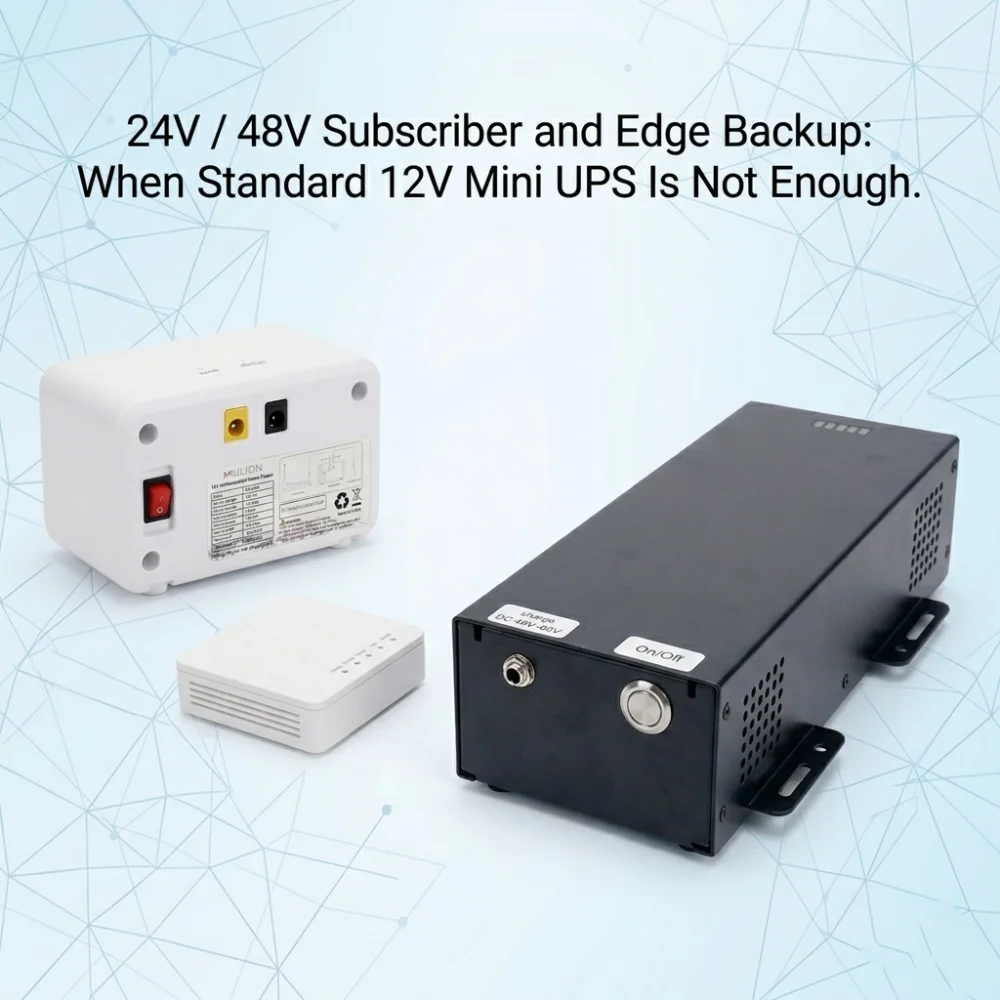
24V/48V 用户和边缘备份:当标准 12V 迷你 UPS 不足以满足需求时

24V 48V Subscriber and Edge Backup When Standard 12V Mini UPS Is Not Enough

介绍

Many Mini UPS discussions begin with 12V because a large number of ONT, ONU, router, and gateway devices operate on 12V DC input. But not every telecom or edge-network application fits that logic.

Some subscriber and edge devices operate on higher voltage rails such as 24V or 48V. In these cases, forcing a standard 12V迷你UPS into the project can create unnecessary complexity, weak architecture, or poor deployment fit. The smarter approach is to identify early when the application should move out of the 12V category and into a 24V / 48V UPS design.

Why 12V Is Common, but Not Universal

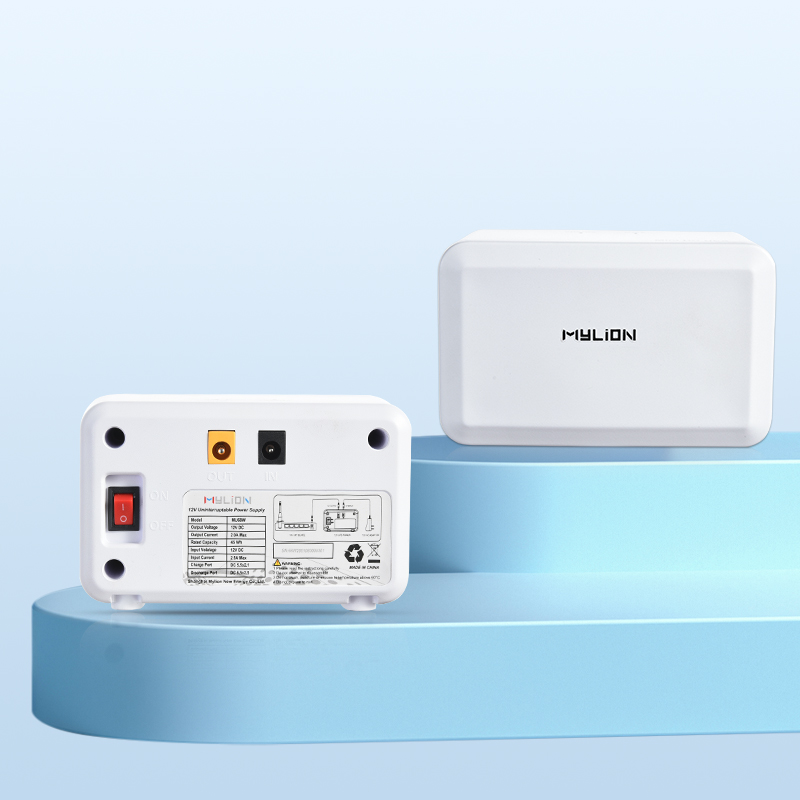
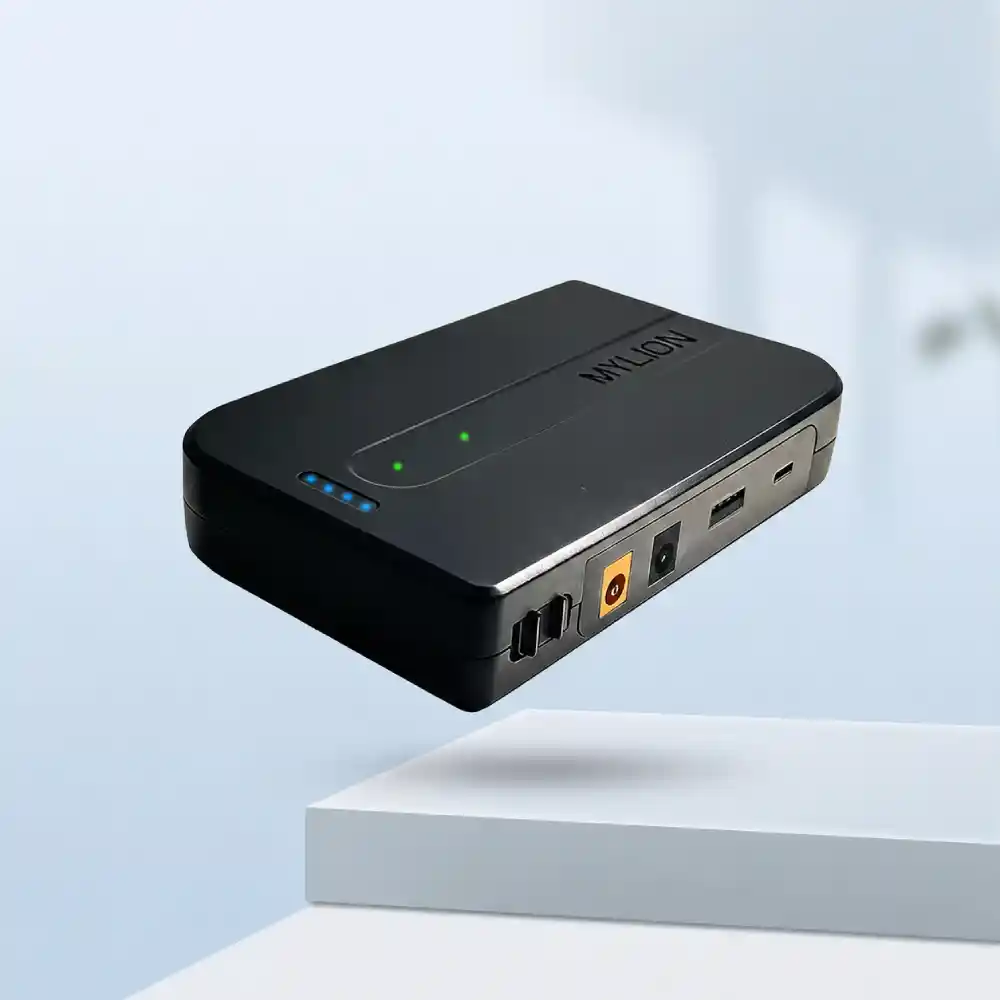
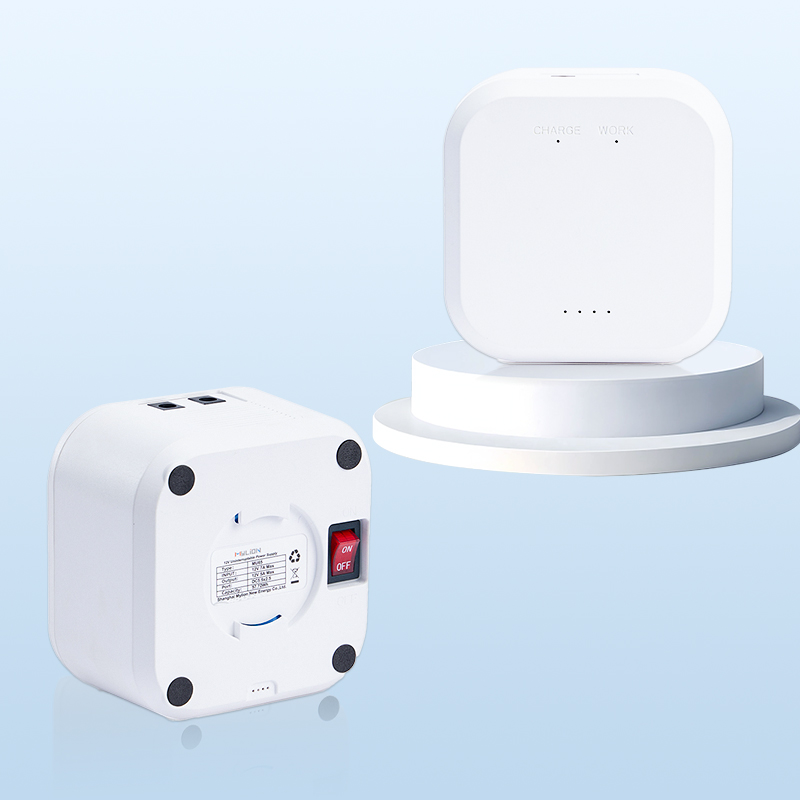
12V Mini UPS solutions are common in broadband and subscriber-edge equipment because they fit many compact devices. That is why MYLION‘s 12V Mini UPS lineup—including the MU68 (standard 12V 3A), MU35 (higherload 12V 5A), 和 MUJ46 (inline FTTH deployment)—is widely adopted by ISPs for FTTH and small-network backup projects.

However, higher-voltage applications are common in:

  • Telecom edge equipment
  • Wireless network hardware
  • Outdoor communication units
  • Selected subscriber-edge or enterprise access systems
  • Devices where current efficiency or existing power architecture favors 24V or 48V

The presence of a strong 12V product line does not mean 12V is always the correct design choice.

Comparison: 12V Mini UPS vs 24V / 48V UPS

The following table helps ISP and telecom project teams quickly identify the right backup architecture:

Comparison Dimension

12V迷你UPS

24V / 48V UPS

典型应用

FTTH broadband, ONT/ONU, routers, gateways

Wireless CPE, outdoor telecom equipment, edge nodes

Native Device Voltage

12V 直流

24V 或 48V 直流

Example Devices

Huawei ONT, Nokia gateway, MikroTik router, GPON terminal

Ericsson radio units, Huawei outdoor CPE, ZTE access devices, industrial switches

Current & Efficiency

Load 3A~5A; higher current leads to notable line losses over longer distances

Current halved (24V) or quartered (48V) at same power; more efficient for long cable runs

部署环境

Indoor, desktop, utility box – benign environment

Outdoor cabinets, towerside, semioutdoor, wider temperature requirements

MYLION Models

MU26 (26.4Wh), MU68 (68Wh), MU35 (12V 5A), MUJ46 (Mixed-output)

MU248 (24V /48Voutput)

Note: The table does not suggest that 24V/48V is always superior. It helps engineering teams choose the correct product category based on native device voltage and deployment environment.

For native 12V devices, MYLION 12V Mini UPS is the most direct and economical choice; for native 24V/48V devices or edge deployments, a 24V / 48V UPS is architecturally correct. More product comparisons.

When Standard 12V Backup Is No Longer the Right Fit

A project should evaluate a 24V / 48V UPS when:

  • The device input itself is 24V or 48V
  • The power architecture is already designed around higher voltage
  • The load level makes 12V current draw less efficient or less practical
  • The installation environment is closer to telecom edge than basic home subscriber backup
  • The project needs a cleaner power path without unnecessary conversion layers

Trying to “adapt everything to 12V” can create more complexity than it saves. Once voltage architecture diverges, the backup solution should follow the application, not the convenience of the existing catalog.

Why Higher-Voltage Backup Can Be Better for Some Projects

A 24V / 48V UPS approach can be more suitable because it may offer:

  • Better alignment with the native device input
  • Reduced need for workaround conversion
  • Cleaner project architecture
  • More practical support for selected telecom and wireless applications
  • Better fit for edge-network equipment outside the standard ONT / router class

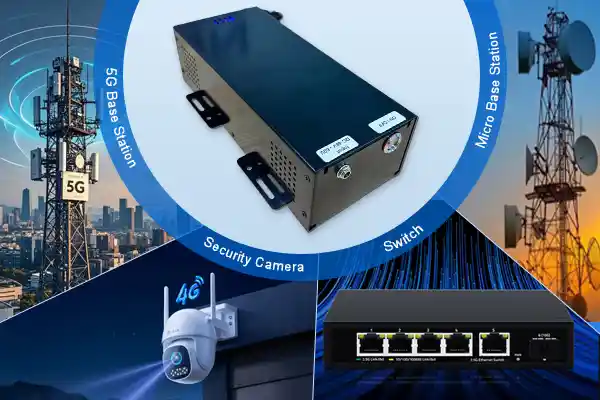
For ISPs deploying wireless CPE, outdoor bridge equipment, or telecom radios, MYLION supports selected 24V / 48V UPS projects through models such as MU248, which is designed for non-standard voltage architectures.

This does not mean higher voltage is always superior. It means it is more suitable when the target equipment and deployment environment call for it.

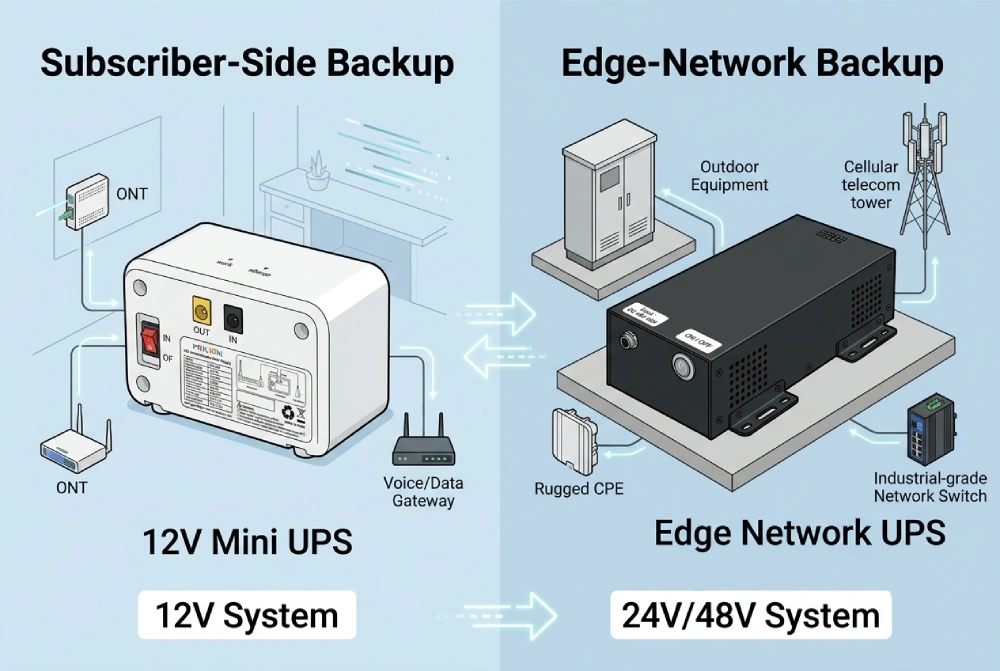
Subscriber-Side vs Edge-Network Use

It helps to separate two broad categories.

Subscriber-side standard backup often includes:

  • 12V ONT / ONU
  • 12V router
  • 12V gateway
  • Compact indoor backup kits

Edge-network or specialized telecom backup may include:

  • Higher-voltage communication devices
  • Outdoor or cabinet equipment
  • Wireless network hardware
  • Devices positioned beyond the basic subscriber indoor environment

Understanding where the project sits on this spectrum helps determine whether standard 12V Mini UPS logic still fits or whether a 24V / 48V UPS solution should be evaluated instead.

What Buyers Should Check Before Moving to 24V / 48V

Before selecting a higher-voltage backup solution, buyers should review:

  • Device input voltage and tolerance
  • Actual load requirement
  • Runtime target
  • Installation environment
  • Connector and interface logic
  • Whether the application is subscriber-side, edge-side, or mixed
  • Whether a standard higher-voltage model is available or project adjustment is needed

This keeps the project grounded in actual device requirements rather than in broad assumptions about telecom power architecture.

A Common Mistake: Treating Higher Voltage as a Purely Industrial Topic

Some buyers assume that 24V / 48V UPS is only relevant for large industrial systems. That is too narrow.

In reality, many telecom and communication projects sit between compact subscriber backup and large industrial infrastructure. These projects may still be small enough to need a compact backup product, but they operate on higher-voltage logic. A supplier that only understands 12V Mini UPS products will often miss this space completely.

For ISP and telecom professionals evaluating edge computing deployments, 迈锂 supports everything from standard 12V迷你UPS for FTTH to 24V/48V UPS for specialized edge equipment.

How Runtime and Output Class Should Be Discussed

As with 12V systems, higher-voltage backup still requires the same disciplined review:

  • Real load, not assumption
  • Runtime by service target
  • Device matching, not generic labeling
  • Deployment fit, not only theoretical capability

The difference is that the architecture discussion starts from the higher-voltage system role. Buyers should resist the temptation to reduce the conversation to “higher voltage means bigger product.” It is really about correct system fit.

For ISPs seeking a systematic approach to last-mile backup, MYLION provides project-ready 12V Mini UPS models such as MU68 (68Wh, 0ms transfer time) with full certifications for bulk deployment.

MUC85迷你UPS

MU68 迷你 UPS

MUJ46迷你UPS

MU35迷你UPS

How MYLION Supports 24V / 48V Telecom Backup Needs

MYLION supports selected 24V / 48V telecom and edge backup requirements where standard 12V Mini UPS products are not the correct fit. This helps customers bridge the gap between compact broadband backup and more specialized communication power needs.

For higher-voltage projects, MYLION can support:

  • Evaluation of 24V / 48V device requirements
  • Discussion of runtime target and application role
  • Product positioning for edge-network and telecom use
  • Standard-model recommendation where suitable
  • Selected project-based cooperation where needed

探索 MYLION‘s complete Mini UPS portfolio, including both 12V Mini UPS and 24V / 48V UPS solutions.

常问问题

Q1: When is a 24V or 48V backup solution better than 12V?

When the device input and project power architecture are already based on 24V or 48V, or when forcing a standard 12V Mini UPS creates poor fit.

Q2: Is 24V / 48V only for large industrial systems?

No. It can also be relevant for compact telecom and edge-network devices that use higher-voltage logic—particularly wireless CPE, outdoor cabinets, and telecom radios.

Q3: Can a 12V Mini UPS be adapted to every telecom device?

No. If the equipment is designed for higher voltage, a 12V workaround may increase complexity and reduce suitability.

Q4: What should buyers review first?

They should review native device voltage, actual load, runtime target, and deployment environment before deciding between a standard 12V Mini UPS and a 24V / 48V UPS.

Q5: Does higher voltage automatically mean better backup?

No. It simply means a better fit where the application requires it.

结论

For ISP and telecom professionals, backup power is not a one-size-fits-all decision. Standard 12V Mini UPS solutions remain the backbone of FTTH subscriber backup. MYLION‘s 12V product line, including MU26, MU68, MU35, and MUJ46, delivers proven reliability for these mainstream applications.

However, a properly selected 24V / 48V UPS aligns with your power architecture, eliminates unnecessary conversion losses, and provides a more robust foundation for network resilience.

By evaluating device specifications, load requirements, and runtime targets before selecting between 12V Mini UPS and 24V / 48V UPS, telecom operators can reduce downtime, improve service continuity, and lower long‑term maintenance costs.

Not sure whether your project should stay in 12V Mini UPS or move to 24V / 48V backup? Contact MYLION!

关于我

迈锂生产系列电池组,锂电池,镍氢电池,LiFe PO4电池,锂聚合物电池,无线充电宝,遥控锂电池,迷你UPS等。广泛应用于便携式电子产品,智能AI机器人,让人们的生活变得便捷, 聪明的。

分享:

最近的帖子

迈锂故事

zh_CN简体中文
滚动至顶部

获取报价