
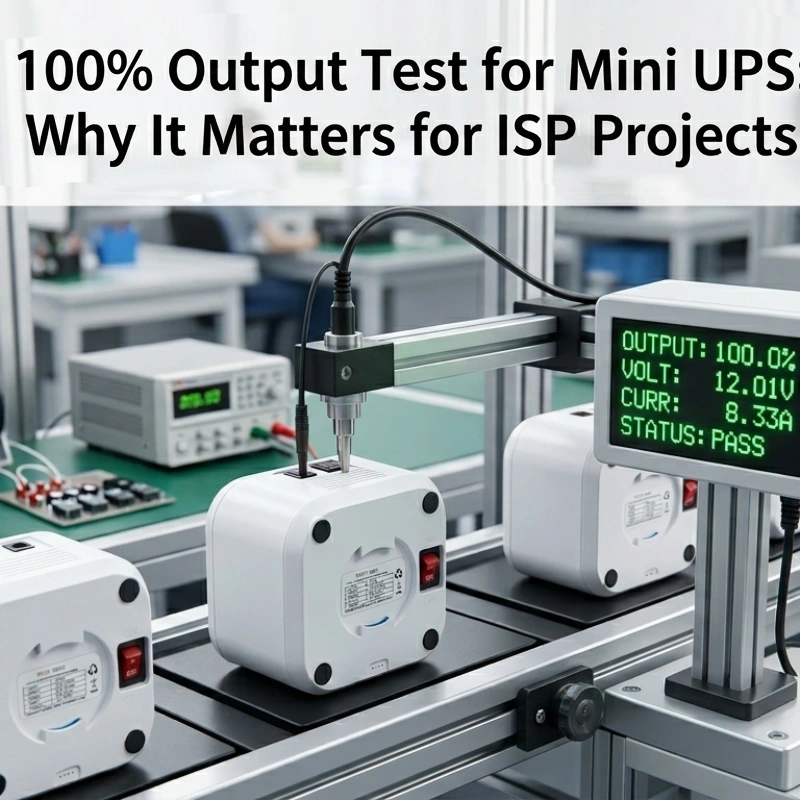
For ISP and telecom backup projects, sample performance is not enough. The real challenge is whether mass production units can consistently meet the approved specification. This is why 100% output testing and clear inspection records are important for Mini DC UPS production.
Why 100% Testing Matters
- Scale of deployment – A Mini UPS may be deployed by the thousands. Even a 0.5% defect rate can translate into dozens of field failures, service complaints, and costly replacements.
- Consistency is key– Output voltage, output current, charging behavior, and AC-to-battery switching performance must be identical from unit to unit.
- B2B quality focus– For project-based buyers, repeatability matters more than sample appearance. Each unit should perform as the golden sample did.
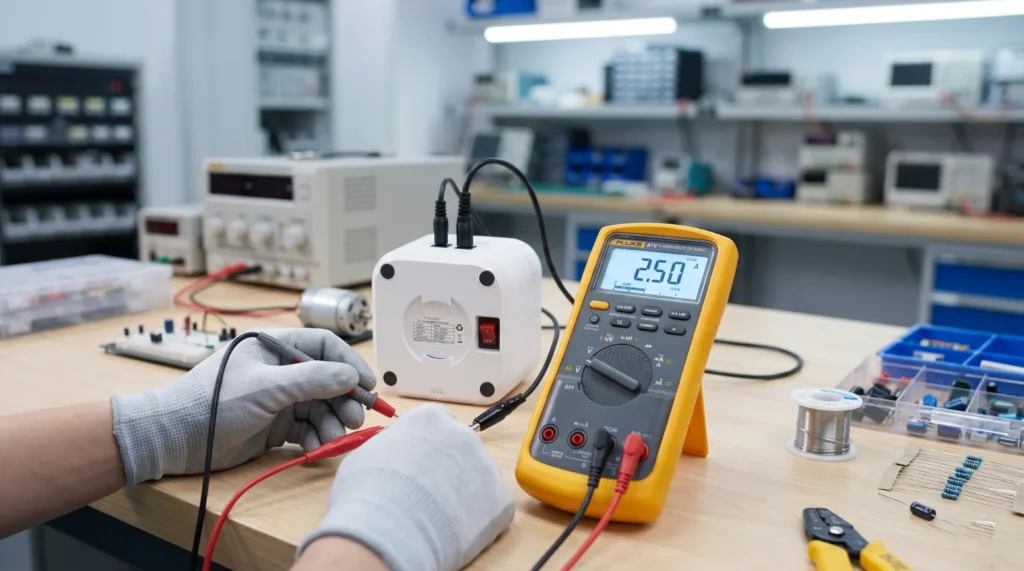
Typical Production Tests for Mini UPS
To ensure every shipped unit meets specifications, MYLION performs the following tests on each unit. The table below summarizes the test items, their purpose, and why they matter for ISP projects.
Test Item | Description / Standard | Why It Matters for ISP Projects |
Incoming Inspection | Cells, PCBA, cables, enclosure parts | Prevents defective components from entering production line |
Charging Function Test | Verifies charge voltage, current, and termination | Ensures UPS recharges properly after every discharge cycle |
Output Voltage Test | No-load and full-load voltage measurement | Confirms stable voltage to ONT/ONU/router (±5% typical) |
Load Test (Rated Current) | Runs UPS at specified continuous output current | Validates thermal and electrical performance under real load |
Battery Discharge / Capacity Test | Measures actual backup time vs. design target | Guarantees the promised runtime for your equipment |
Power Switching Test | Simulates AC loss, measures switchover time (typ. <10ms) | Critical for uninterrupted network connectivity |
Protection Function Test | Overload, short circuit, over-discharge protection | Protects both UPS and expensive telecom devices |
Final Inspection | Appearance, label, plug polarity, packaging | Ensures shipment-ready condition and compliance with buyer requirements |
Traceability: A Must for Large ISP Deployments
When hundreds or thousands of Mini UPS units are deployed across multiple sites, traceability becomes a lifesaver.
- Serial number or QR code – Each unit can be linked to its production batch, inspection results, and shipment records.
- Fast root cause analysis – If a quality issue appears in the field, traceability helps identify affected batches quickly and take targeted corrective action.
- Pre–production agreement– For large customers, the traceability format and data sharing method should be defined before mass production, not after a complaint arises.
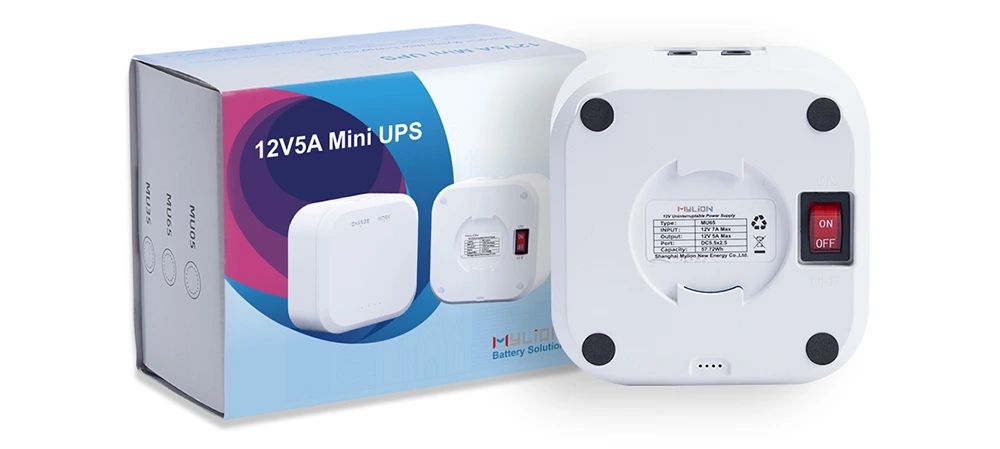
What Buyers Should Request from Their Mini UPS Supplier
To avoid project delays and field issues, request the following documentation before mass production:
- Final approved electrical specification
- Sample approval record (with photos and test data)
- Inspection standard (accept/reject criteria)
- Outgoing inspection report (100% test summary per batch)
- Packaging and label confirmation (including country-specific markings)
- Clear defect handling process (e.g., rework, replacement, or credit note)
FAQ
Q1: Does 100% output test replace all reliability testing?
Q2: Should buyers request test reports for every shipment?
Q3: What is the biggest benefit of traceability?
Q4: Does 100% output testing increase production lead time?
How MYLION Supports Buyers
MYLION specializes in B2B Mini DC UPS and lithium battery backup solutions for telecom, ISP, industrial, and networking applications.
We support customers through:
- Product selection and sample validation
- Custom cable, label, and enclosure requirements
- Certification documentation (CE, FCC, RoHS, UN38.3, etc.)
- Production inspection with 100% output test records
- Shipment documentation and traceability reporting
Need a Mini UPS or lithium battery backup solution for ONT, ONU, router, CPE or telecom equipment? Contact MYLION!
Compliance Note
Certification requirements depend on product configuration, target market, power adapter, battery capacity, and final application. Buyers should confirm the applicable requirements before mass production.

 English
  简体中文
简体中文  Deutsch
  Français
  Italiano
  Español