
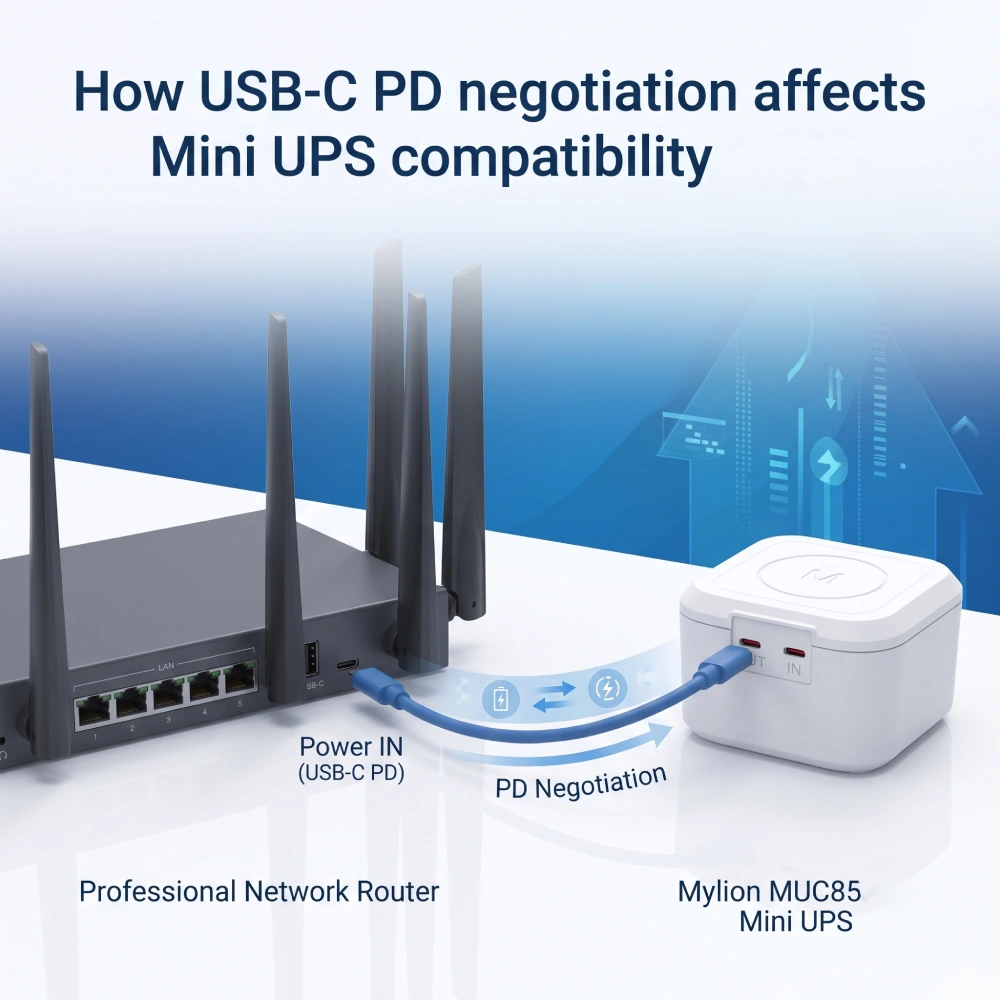
Today, the landscape of network hardware is undergoing a massive shift. The telecom and IT industries are rapidly adopting USB-C Power Delivery (PD) for modern network gateways, 5G CPE, and high-performance Wi-Fi 7 routers. While USB-C offers incredible versatility and power density, it introduces a complex digital communication layer that traditional backup batteries never had to manage: PD negotiation.
For Mini UPS devices, understanding USB-C PD negotiation isn’t just technical trivia—it’s the difference between a device that seamlessly keeps your network online during an outage and one that refuses to charge or power your equipment at all. This article explores how PD negotiation works, why it creates compatibility challenges for Mini UPS, and how the Mylion USB-C PD mini UPS solution addresses these issues.
What Is USB-C PD Negotiation?
USB Power Delivery is a standardized power-negotiation protocol that runs over the USB-C connector. Unlike traditional USB charging, which delivers a fixed 5V output, PD enables intelligent, dynamic negotiation between devices to determine optimal voltage and current levels.
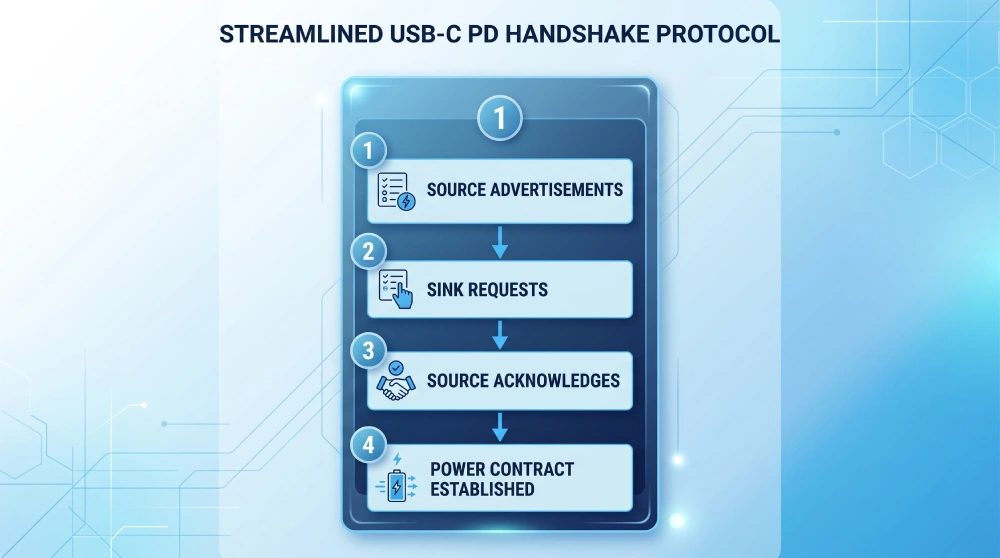
When you connect a USB-C PD source (like a charger or a Mini UPS with PD output) to a sink device (like a router or laptop), a structured negotiation process unfolds:
- The Source advertises its capabilitiesby sending a Source Capabilities message containing one or more Power Data Objects (PDOs). Each PDO describes a specific voltage-current pair—for example, 5V/3A, 9V/3A, 12V/3A, 15V/3A, or 20V/3.25A.
- The Sink requests a suitable profilefrom the advertised capabilities, selecting the voltage and current that match its own requirements.
- The Source acknowledges the requestand alters its output to satisfy the requested contract.
- A power contract is established, and the source delivers power at the negotiated levels.
This negotiation happens over the USB-C Configuration Channel (CC) pins using Bi-phase Mark Code (BMC) communication. The entire process typically completes within the first second of connection.
PD supports multiple voltage levels: 5V, 9V, 12V, 15V, and 20V in Standard Power Range (SPR), with Extended Power Range (EPR) reaching up to 48V. The introduction of Programmable Power Supply (PPS) in USB PD 3.0 further refined this capability, allowing devices to request voltage in 20mV increments between 3.3V and 21V.
Why PD Negotiation is Critical for Mini UPS Compatibility
When deploying backup power across thousands of subscriber homes, an ISP cannot afford hardware incompatibilities. The integration of USB-C PD into battery backups introduces several critical failure points if the negotiation architecture is flawed.
1. The 5V Fallback Trap
If the PD handshake fails due to poor controller firmware or sub-standard cables, the USB-C protocol mandates that the power output must default to 5V for safety. Most network routers and ONTs require 12V, 15V, or 20V to power up. If the Mini UPS falls back to 5V, the router simply will not turn on, rendering the backup battery completely useless during an outage.
2. Voltage Drops During AC-to-Battery Transfer
Consumer-grade power banks often drop the PD contract to 0V or 5V when switching from pass-through to battery, forcing a re-negotiation. This split-second lapse reboots the connected gateway. A true Mini UPS must maintain a continuous, unbroken PD contract with zero transfer time (0ms) during grid failure.
3. Multi-Device Power Splitting
Many modern deployments require powering two devices—such as a fiber ONT and a separate Wi-Fi mesh node. When a standard multi-port USB-C charger is used, plugging in a second device forces the controller to renegotiate power for the first device, causing a momentary reboot. A professional Mini UPS must have isolated power controllers that prevent multi-port negotiation conflicts.
Feature | Traditional Mini UPS | Standard USB Power Bank | USB-C PD Mini UPS |
Communication | Fixed Voltage Output | Simple 5V or Static Fast Charge | Dynamic PD Negotiation (PDOs) |
Transfer Time | 0ms (True UPS) | Delayed (>10ms, causes reboots) | 0ms (Zero Transfer Time) |
Multi-Port Stability | Independent rails | Forces renegotiation (drops connection) | Isolated Smart IC controllers |
How Mylion Mini UPS Products Address PD Negotiation Challenges
Mylion has developed a range of Mini UPS products that leverage USB-C PD technology to address these compatibility challenges. Their approach demonstrates how thoughtful PD implementation can create versatile, reliable backup power solutions.
MUC85: High-Capacity USB-C PD Mini UPS for Network Devices
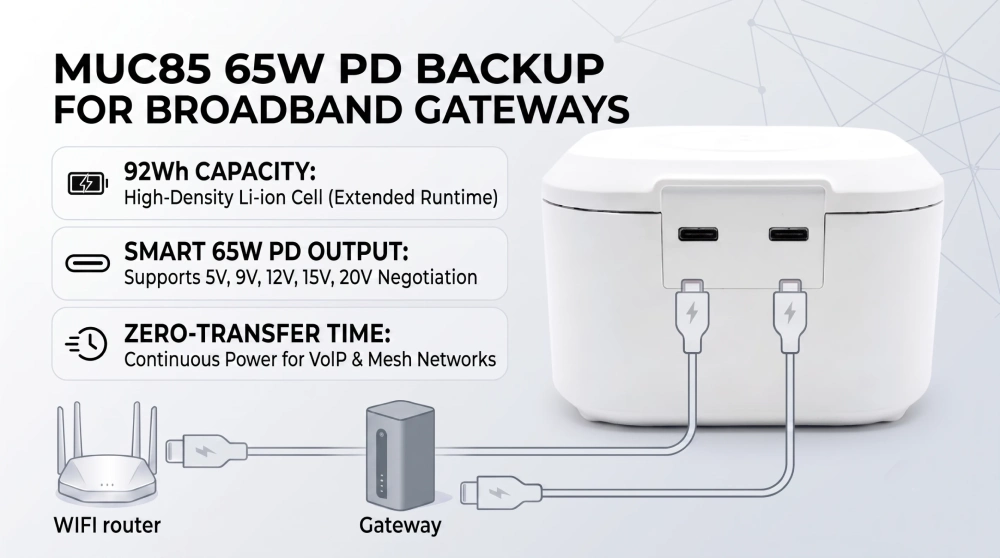
The Mylion MUC85 is a 92Wh high-capacity USB-C PD backup power solution. It features a bidirectional Type-C PD port supporting 65W input and output. The device advertises a comprehensive range of PDOs: 5V/3A, 9V/3A, 12V/3A, 15V/3A, and 20V/3.25A.
This broad PDO coverage ensures compatibility with a wide spectrum of devices:
- 5Vfor smartphones, tablets, and basic USB devices
- 9Vfor fast-charging phones and some network equipment
- 12Vfor routers, modems, ONTs, and many IoT devices
- 15V for certain laptops and industrial equipment
- 20Vfor high-power laptops and demanding network gear
With a 92Wh battery capacity, the MUC85 provides 7-8 hours of backup for 12V/1A devices and 3-4 hours for 12V/2A devices.
Zero Transfer Time for Seamless Transitions
The MUC85 delivers 0ms (Zero Transfer Time) switching. When the AC grid fails, the lithium-ion battery instantly takes the load without renegotiating the PD connection. The connected router never experiences a voltage drop, preventing reboot cycles.
Smart IC Control for Stable Negotiation
Mylion MUC85 incorporates Smart IC control that intelligently manages charging and discharging processes while preventing overheating, overcharging, and short circuits. This smart management ensures that:
- PD negotiation is handled reliably even under varying load conditions
- Voltage and current output remain stable, protecting sensitive electronics from surges and fluctuations
- The UPS transitions seamlessly between charging and discharging modes without dropping power to connected devices
Additional PD Outputs
The MUC85 Mini UPS includes a secondary Type-C PD port supporting up to 30W, enabling simultaneous power delivery to multiple devices. This is particularly valuable for network installations where multiple devices (router, ONT, switch) require backup power.
Best Practices for Ensuring USB-C PD Mini UPS Compatibility
Based on the technical considerations above, here are practical guidelines for selecting and deploying USB-C PD Mini UPS solutions:
1. Verify Device Voltage Requirements
Before selecting a Mini UPS, check the voltage and current requirements of each device you need to power. A router that requires 12V/2A will not operate from a Mini UPS that only outputs 5V or 9V.
2. Confirm PD Support on Both Ends
Not all USB-C devices support PD. If a device only supports basic 5V charging, a PD Mini UPS may not deliver power at all. In such cases, consider using a non-PD USB-C port (if available) or a USB-A to USB-C cable, which delivers 5V without requiring PD negotiation.
3. Use Certified PD Cables
Cable quality matters. Use USB-IF certified cables rated for the power levels you need. A 60W-rated cable will bottleneck a 100W-capable Mini UPS, and you’ll have no visual indication of the limitation. Mylion’s products are certified to CE, FCC, ROHS, and UN38.3 standards, ensuring they meet rigorous safety and quality requirements.
4. Test the Complete Power Chain
Before deploying a USB-C PD Mini UPS in a production environment, test the complete power chain: wall adapter → Mini UPS → device, with the specific cables you plan to use. Verify that:
- The Mini UPS charges correctly from the wall adapter
- The downstream device powers on and operates normally from the UPS
- The transition between AC power and battery is seamless (zero transfer time)
FAQ
Q1: Can I use any USB-C charger to charge a USB-C PD Mini UPS?
Q2: Why won't my USB-C device power on when connected to a PD Mini UPS?
Q3: Will using a PD Mini UPS damage a non-PD device?
Q4: How do I know if my Mini UPS supports the right voltage for my device?
Q5: Can a Mini UPS simultaneously charge and power devices?
Conclusion
USB-C PD negotiation is the invisible backbone of modern power delivery—a sophisticated digital handshake that determines whether your devices receive the power they need. For Mini UPS applications, understanding this negotiation process is essential for ensuring compatibility across the diverse ecosystem of USB-C devices.
To ensure seamless network continuity, ISPs and system integrators must transition to intelligent power solutions. Mylion USB-C Mini UPS solution combines broad PDO support, bidirectional power flow, and intelligent management to deliver reliable backup power across a wide range of applications.
 English
  简体中文
简体中文  Deutsch
  Français
  Italiano
  Español