
Direct Answer
Choosing between a 12V and 24V Mini UPS starts with the network device.
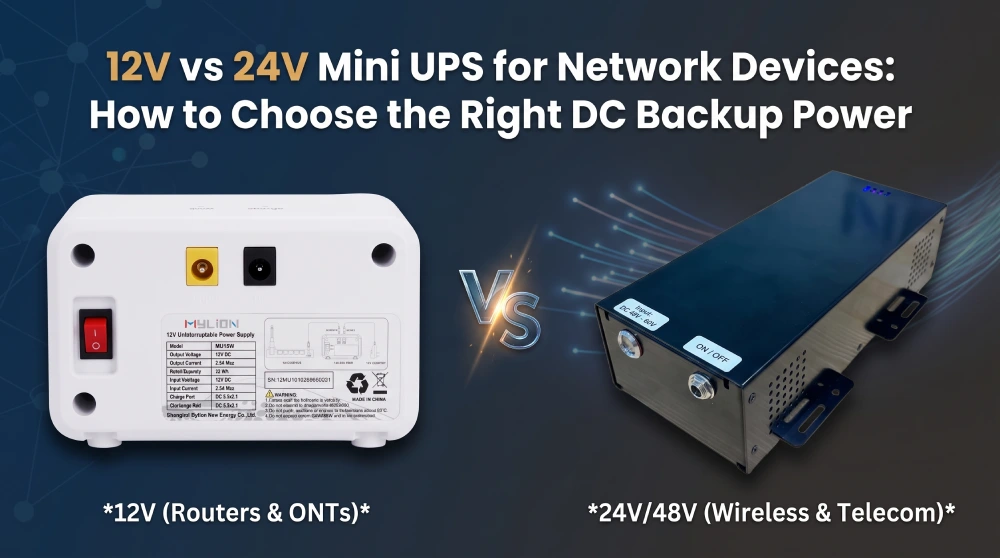
Many routers, ONTs, ONUs, and broadband gateways use 12V DC power, making a 12V Mini UPS a common choice for subscriber-side backup. Other wireless, telecom and edge-network devices may require 24V or higher-voltage DC power.
For ISPs, telecom operators and system integrators, the goal is to match the Mini UPS with the device, deployment environment, and required backup time.
Why 12V Mini UPS Is Common in Broadband Networks
A large number of customer-premises network devices are built around 12V DC input. This includes many routers, ONTs, ONUs, modems and broadband gateways.
That makes the 12V Mini UPS particularly useful for FTTH and broadband deployments.
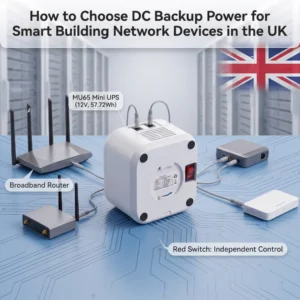
Instead of installing a traditional AC UPS at every subscriber location, an ISP can use compact DC backup power close to the network device. This keeps the backup architecture simple and makes deployment easier in homes, offices and other customer-premises environments.
12V Mini UPS: Use Cases and Key Advantages
A 12V Mini UPS is usually worth evaluating when the target equipment already operates on 12V DC.
MYLION’s current Mini UPS reflects this demand. Models including MU68, MU35 and MUJ46 are designed around different 12V broadband backup scenarios.
Typical applications include:
- Wi-Fi routers
- ONT and ONU devices
- Broadband gateways
- Modems
- CPE
- Selected communication terminals
For ISPs deploying large numbers of subscriber-side devices, the important advantage is not simply that 12V is common. It is that there are multiple Mini UPS configurations available for different loads and installation styles.
The main advantages of a 12V Mini UPS are therefore practical:
- Fits many common subscriber-side broadband devices
- Compact enough for customer-premises deployment
- Provides direct DC backup without a separate AC conversion stage
- Offers different product directions for standard, higher-load and mixed-output applications
- Can be evaluated device by device before large-scale deployment
24V Mini UPS: When You Need It and Why
Not every network application fits the standard 12V Mini UPS model.
Wireless CPE, outdoor bridges, radio equipment and some telecom or edge-network devices may operate on 24V or 48V DC.
A better approach is to choose a 24V Mini UPS or dedicated higher-voltage DC backup solution that matches the equipment from the beginning.
This is particularly relevant for applications such as:
- Wireless CPE
- Outdoor wireless bridges
- Radio equipment
- Selected telecom terminals
- Edge-network devices
- Other 24V or 48V DC equipment
MYLION’s MU248 is designed for this type of application. The current MYLION product line positions MU248 as a 24V/48V DC Mini UPS for wireless CPE, outdoor bridges, radio equipment and selected telecom devices.
12V vs 24V DC Backup Power: Key Differences
Selection Area | 12V Mini UPS | 24V Mini UPS |
Typical applications | Router, ONT, ONU, modem, gateway, CPE | Wireless CPE, outdoor bridge, radio and selected telecom equipment |
Typical deployment | Subscriber premises, FTTH and small network devices | Wireless, edge and higher-voltage network applications |
Product direction | Broad range of compact Mini UPS options | More specialized DC backup architecture |
MYLION examples | MU68, MU35, MUJ46 | MU248 |
Choose Mini UPS: Match by Scenario
For most ISP and system-integration projects, start with the deployment scenario.
Scenario 1: Standard 12V Router, ONT or ONU
If the equipment uses 12V DC and belongs to a typical FTTH or broadband subscriber installation, begin with a standard 12V Mini UPS direction.
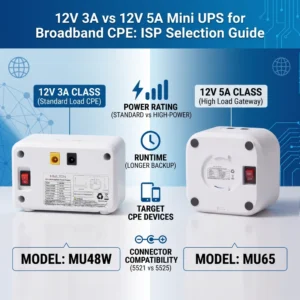
A model such as MU68W can be evaluated for mainstream router, ONT, ONU and CPE applications.
Scenario 2: Higher-Load 12V Gateway or CPE
Some routers, gateways and CPE require more output capacity than smaller broadband devices.
In this case, moving to a higher-load 12V Mini UPS such as MU35W may be more appropriate than simply using the same unit deployed for low-power ONTs.
Scenario 3: 12V Device Plus USB-Powered Equipment
If the deployment includes both a 12V network device and compatible USB-powered equipment, a multi-output architecture may simplify installation.
MUJ46 provides 12V DC together with USB outputs and is positioned for compact FTTH and mixed-output backup scenarios.
Scenario 4: 24V or 48V Wireless / Telecom Equipment
If the target device uses 24V or 48V, move away from the standard 12V Mini UPS category.
For these projects, MU248 provides a dedicated MYLION 24V/48V direction for compatible wireless and telecom equipment.
Where MYLION Fits
MYLION provides Mini UPS and DC backup solutions that can be evaluated for compatible low-voltage network and communication devices.
For 12V, 24V or other project directions, MYLION should evaluate the actual device specification before recommending a product direction. The required information includes:
- Device model
- Input voltage
- Current or wattage
- Startup or peak load
- Connector and polarity
- Required backup time
- Installation environment
- Project quantity
This helps avoid the common mistake of selecting only by voltage or by device category.
FAQ
Q1: Is 24V backup power better than 12V?
Q2: Can I use a 12V Mini UPS for a 24V device?
Q3: Does higher voltage mean longer backup time?
Q4: Can two 12V outputs be combined to make 24V?
Q5: What if my 12V network device requires more power?
Q6: Does MYLION offer a Mini UPS for 24V network devices?
Conclusion
Choosing between a 12V and 24V Mini UPS becomes much easier once the decision starts with the network device.
For routers, ONTs, ONUs and many broadband CPE applications, a 12V Mini UPS is often the natural starting point. For wireless, edge or telecom equipment designed around 24V or 48V DC, a dedicated higher-voltage backup solution is usually the better architecture.
MYLION provides different Mini UPS directions for these scenarios, including MU68, MU35 and MUJ46 for 12V applications and MU248 for compatible 24V/48V projects. The final model should be selected according to the actual device and deployment requirement rather than voltage alone.
 English
  简体中文
简体中文  Deutsch
  Français
  Italiano
  Español