
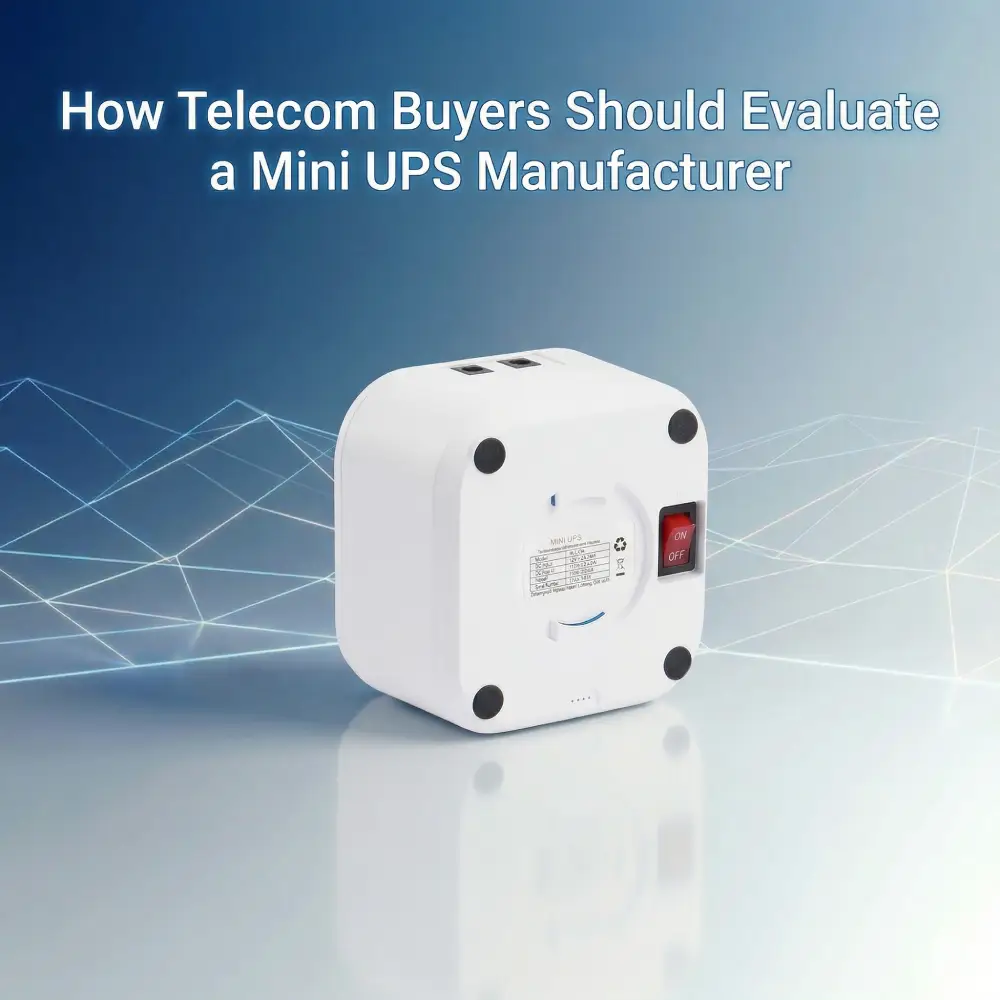
Choosing a mini UPS manufacturer is not only about price. Telecom and ISP buyers need to assess engineering capability, production consistency, quality control, customization support and real experience in backup power projects. A reliable manufacturer should be able to match device requirements, support OEM needs and deliver stable products for long-term deployment.
As networks expand into remote areas and urban infrastructure becomes more complex, the demand for reliable backup power has reached unprecedented heights. However, for telecom buyers, choosing the right Mini UPS manufacturer is a critical decision that affects network uptime, operating costs, and long-term reliability.
Manufacturer vs trading company: why it matters
When sourcing backup power solutions for critical telecom infrastructure, the distinction between a direct manufacturer and a trading company is paramount. This difference fundamentally impacts supply chain transparency, technical support, and risk mitigation.
Working directly with a manufacturer provides:
- Direct communication with engineers and production teams.
- Faster resolution of modifications and quality issues.
- Better long-term pricing options.
- Stable quality control aligned with your standards.
If you are planning a long-term telecom project, choosing a Mini UPS manufacturer to build your uninterruptible power supply system will allow you to better control the situation and reduce unexpected situations that may arise in the future.
Quick Comparison: Direct Manufacturer vs. Trading Company
Evaluation Criteria | Direct Manufacturer | Trading Company | Strategic Impact on Telecom Industry |
Engineering & Technical Support | In-house R&D team | Relies on third-party factory feedback | Prevents Service Level Agreement (SLA) breaches |
Cost & Budget Allocation | 100% factory-direct pricing | Hidden middleman markups | Significantly lowers Total Cost of Ownership (TCO) |
Quality Control & Consistency | 100% quality testing | Random sampling | Reduces maintenance and replacement costs |
Customization & OEM | Personalized customization | Difficult to implement minor customizations | Seamless network integration, ensuring the UPS matches specific routers |
What technical capabilities should be verified
Before confirming a partnership, telecom buyers must verify the manufacturer’s technical capabilities. Understand what technical features distinguish high-end commercial uninterruptible power supplies from disposable consumer devices. If the uninterruptible power supply fails, the customer loses their network connection, and the network service provider takes the blame.
Key technical areas to evaluate:
- Voltage Compatibility: Modern telecom deployments often require powering multiple devices simultaneously. Ensure the uninterruptible power supply is compatible with standard telecom voltages (12V, 24V, 48V DC).
- Advanced Battery Management System (BMS): Premium manufacturers should utilize a BMS, and you need to verify its protection features against overcharging, deep discharging, short circuits, and extreme temperatures.
- Transfer Time: Confirm that the BMS designed by the manufacturer can achieve microsecond-level transfer times (typically <0ms to 5ms) to ensure routers do not reboot during power sags.
- POE Integration: For WISPs, integrating Gigabit PoEwith active standard compliance (such as 802.3af/at) directly into the UPS is a key technical capability.
- Battery Cell Grading: High-end manufacturers strictly use Grade-A lithium-ion or LiFePO4 cells with perfectly matched internal resistance to ensure lifespan.
Mylion, as a reliable Mini UPS manufacturer, possesses these technical capabilities. Furthermore, they will provide sample units for telecom buyers to test in order to evaluate integration strength.
Key questions about customization and OEM support
Telecom projects rarely deploy standard off-the-shelf hardware. Whether you are deploying Fiber to the Home (FTTH) in an urban environment or building microwave backhaul sites in rural areas, your backup power solution must meet specific network requirements.
Ask potential manufacturers:
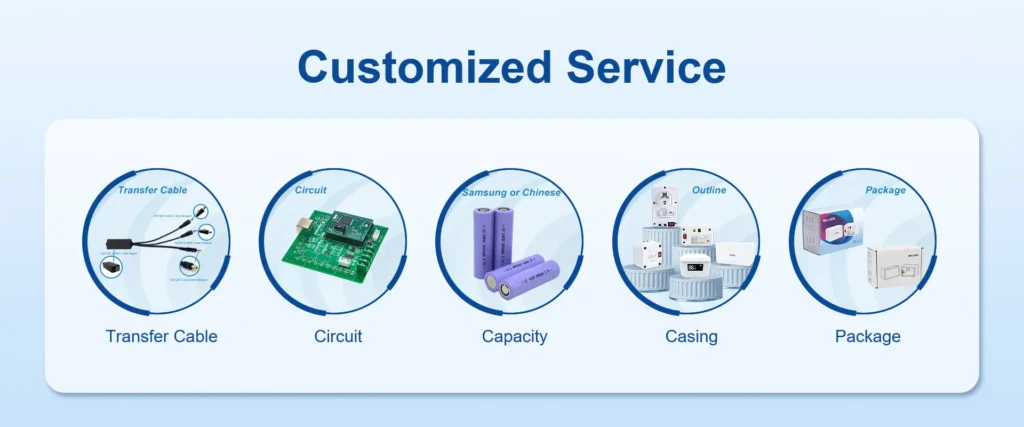
- Can you customize battery capacity based on load and runtime requirements?
- Can you design custom cable lengths to fit specific wall-mounted enclosures while avoiding cable clutter?
- Do you support OEM branding, casing design, and interface modifications?
- What is the Minimum Order Quantity (MOQ) for custom configurations?
- Can you provide firmware modification services to adjust charging algorithms or communication protocols?
Strong Mini UPS manufacturers view customization as a core competency rather than an exception. OEM support is particularly crucial for system integrators and telecom equipment providers who require seamless integration with their own product lines.
Quality control, aging test and reliability standards
In the telecom sector, reliability is non-negotiable. Small UPS units deployed in street cabinets or base station equipment rooms may have to operate under extreme temperatures, humidity, and electrical noise. Quality assurance is mandatory.
Key quality indicators:
- 100% Burn-in Test:Every unit should undergo burn-in testing under full load conditions to identify early failures before shipping.
- ICT (In-Circuit Testing):Automated testing of PCBA components to ensure assembly accuracy.
- Environmental Testing:Verifying performance under high/low temperatures and humidity conditions, especially for outdoor or semi-outdoor deployments.
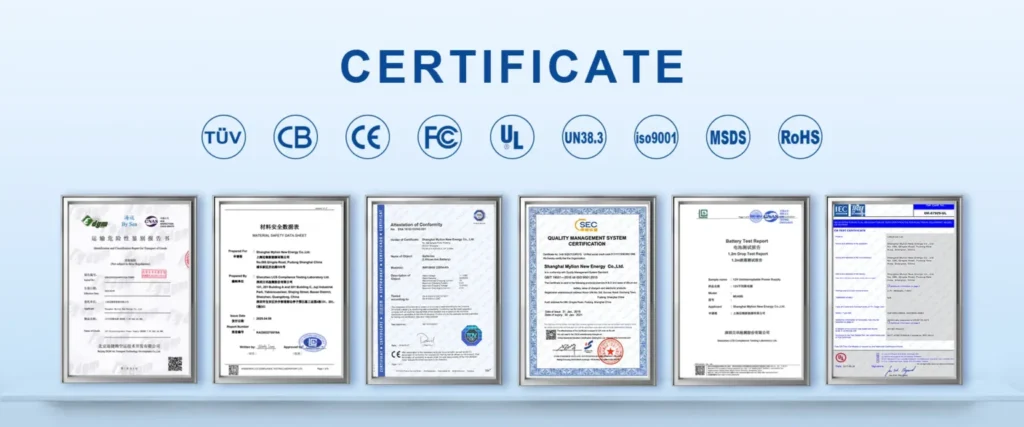
- Certifications: Look for CE, FCC, RoHS certifications, and if required by specific markets, UL or other local compliance standards. This also includes UN38.3 and MSDS to ensure lithium battery products are transported safely and legally worldwide.
Telecom buyers can request quality control reports and aging test data from manufacturers. Transparent manufacturers will provide documentation demonstrating their commitment to reliability.
Why project experience in telecom matters
Designing a consumer power bank is fundamentally different from designing a telecom-grade UPS. Manufacturers with specific telecom project experience understand the unique pain points faced by network operators.
A manufacturer with telecom industry experience will offer:
- Regional Compliance Ready: Already compliant with EU and US standards (RoHS, CE, FCC), eliminating the need to start certification from scratch.
- Adaptability to Harsh Power Environments: Mini UPShave rapid charging capabilities to handle frequent power outages and are resilient against grid fluctuations and voltage sags.
- Understanding of Your Business Goals: They will communicate using metrics like SLAs, churn reduction, and network uptime, rather than just focusing on technical specs.
- Easy Deployment: Providing clean, wall-mountable designs suitable for Fiber to the Home deployments.
- Rich Track Record: Experience collaborating with major telecom operators and internet service providers on large, multi-site deployment projects.
Experience dictates foresight; an experienced partner will proactively suggest fail-safes that a general manufacturer might overlook.
How to reduce sourcing risk in long-term cooperation
Telecom infrastructure projects typically last for years, roll out in phases, and require ongoing maintenance. Choosing a manufacturer is a long-term commitment. To mitigate sourcing risks:
Reach clear agreements on the following:
- Product Lifecycle Support: Ensure the manufacturer commits to maintaining compatibility and providing spare parts for 5 to 7 years.
- Supply Chain Stability: Evaluate their component sourcing strategy. Do they rely on single-source components?
- Communication & Support Architecture: Define engineering support, response times, and escalation paths.
- Scalability: Can the manufacturer increase production to meet sudden project expansion demands?
A reliable partner will work with you to establish a long-term supply agreement, striking a balance between cost predictability and operational flexibility.
Mylion Mini DC UPS Solution
Mylion has become a highly trusted Mini UPS manufacturer, focusing especially on telecom and ISP applications. We specialize in providing customized, premium small UPS solutions for various project deployments. Mylion’s mini DC UPS product line is designed to meet the specific needs of modern network infrastructure.
Key Features of Mylion Mini UPS:
- Broad Compatibility: Offers 12V, 24V, and 48V configurations to meet telecom equipment requirements.
- Smart Battery Management: Built-in BMS with comprehensive protection and status monitoring features.
- Compact and Rugged Design: Optimized for space-constrained cabinets and harsh environments.
- Customization Support: Provides OEM branding, capacity customization, and casing design services.
Mylion Mini UPS Manufacturer Advantages
Key Evaluation Area | Mylion Premium Advantage | Tangible Benefits for Telecom Buyers |
Battery Quality | 100% Grade-A lithium batteries | Significantly extends product life, lowering total cost of ownership (TCO) |
System Reliability | Smart BMS with microsecond switching | Zero network drops; protects Service Level Agreement (SLA) compliance |
Quality Assurance | 100% full-load burn-in testing on every unit before shipping | Avoids “truck rolls” by detecting defects early |
Customization | Deep OEM support: custom voltages, precise cable lengths, and custom branding | Faster on-site installation |
Design & Appearance | Zero-deformation industrial design, heat-resistant materials | Professional appearance; no structural damage |
Leveraging years of project experience collaborating with telecom operators and system integrators, Mylion provides the engineering depth, production consistency, and quality assurance required for long-term deployments.
FAQ
Q1: What is the typical transfer time for a telecom-grade mini UPS?
A reliable small UPS for telecom applications should achieve seamless transfer within 10 milliseconds to prevent equipment resets or data loss.
Q2: How does a mini DC UPS differ from a traditional AC UPS in telecom setups?
It differs from the double-conversion operating principle of a traditional AC UPS. A Mini DC UPS provides direct DC-to-DC power, significantly extending backup runtimes in a smaller footprint.
Q3: What is the importance of a burn-in test?
Burn-in testing involves running each UPS unit under full load for a specified time to identify potential defects. This is a critical quality control step that ensures reliability prior to shipping.
Q4: How does working directly with a manufacturer benefit my project?
Compared to working through a trading company, partnering directly with a manufacturer offers better pricing, faster engineering support, greater customization flexibility, and more stable quality control.
Q5: Does Mylion support OEM customization?
Yes. Mylion offers comprehensive OEM support, including casing design, battery capacity, output voltage, and current ratings to meet specific project requirements.
Conclusion
Choosing a Mini UPS manufacturer is a strategic decision that directly impacts the reliability, scalability, and cost-effectiveness of a telecom network. By prioritizing manufacturers over trading companies, verifying technical capabilities, demanding stringent quality control, and seeking proof of telecom project experience, buyers can significantly reduce procurement risks and ensure the success of a long-term partnership.
A reliable manufacturer does more than just deliver a product—they become a trusted partner in maintaining network uptime and supporting infrastructure growth.
 English
  简体中文
简体中文  Deutsch
  Français
  Italiano
  Español