
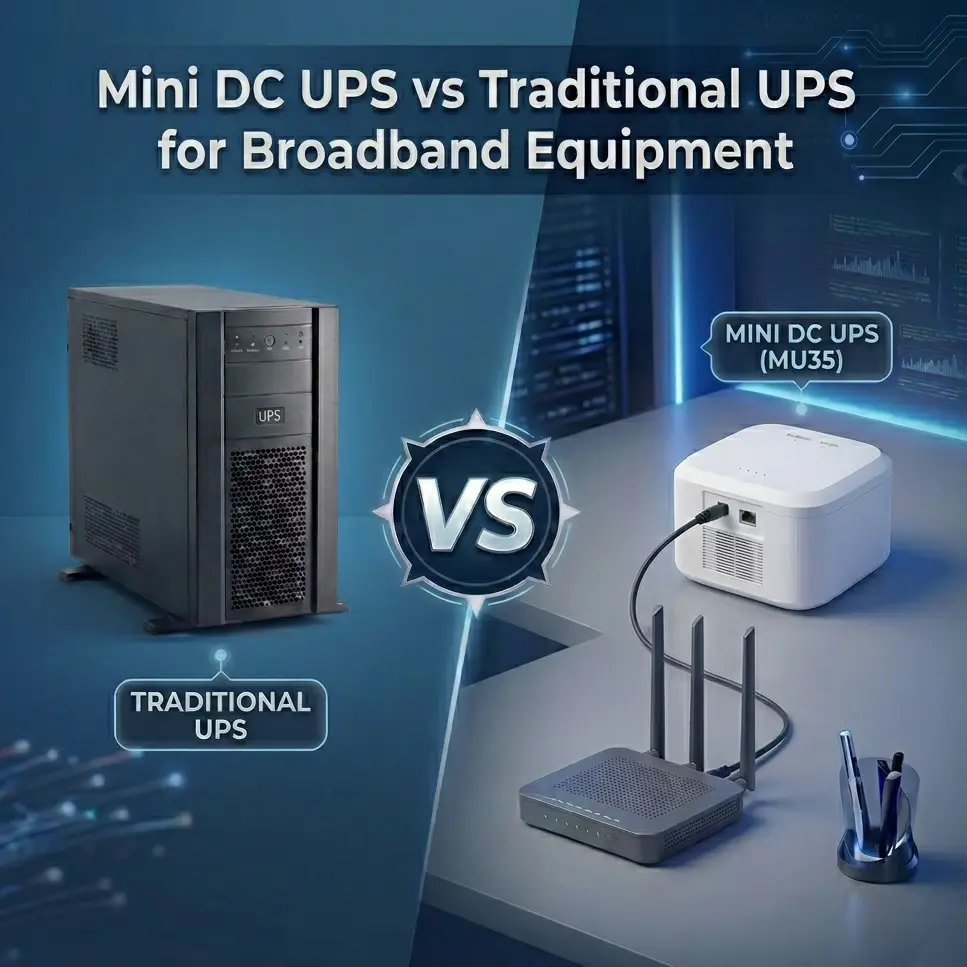
When planning backup power for broadband equipment, buyers often compare mini DC UPS products with traditional AC UPS systems. While both can keep devices running during outages, they are designed for different use cases. For low-power telecom devices such as routers, ONTs and ONUs, a mini DC UPS is often more compact, more efficient and easier to deploy.
Choosing the wrong type of uninterruptible power supply can lead to wasted energy, complex installation processes, and unnecessary battery replacement costs. Understanding the fundamental difference between direct current (DC) and alternating current (AC) backup solutions is essential for Internet Service Providers (ISPs), system integrators, and infrastructure project managers looking to maintain reliable connectivity.
How mini DC UPS and AC UPS differ
The primary difference between a mini DC UPS and a traditional AC UPS lies in their input/output architecture and the type of equipment they are designed to support.
A traditional AC UPS is a system originally designed for centralized IT environments. It takes wall outlet power (AC), converts it to DC to charge an internal battery, and then converts it back to AC to supply power via standard outlets. This double-conversion process results in significant energy loss. These units are built for high-wattage appliances like servers, computers, and monitors.
A mini DC UPS, in contrast, is engineered specifically for modern network infrastructure. It accepts AC power, converts it to DC to charge the battery, but outputs pure DC power directly. Most broadband equipment—including routers, ONTs (Optical Network Terminals), and ONUs (Optical Network Units)—natively run on DC power (typically 5V, 9V, or 12V). By eliminating the final DC-to-AC conversion, a mini DC UPS bypasses the inefficiency of traditional units and delivers power exactly how telecom devices need it.
When a traditional UPS makes sense
Despite the advantages of DC systems for telecom gear, traditional AC UPS units are not obsolete. They remain the correct choice in specific scenarios, typically within centralized, AC-centric environments.
You should consider a traditional AC UPS if:
- You need to power multiple device types: If you need to back up a desktop computer, a network switch, and a monitor alongside your router, an AC UPS is necessary.
- High wattage is required:Devices with motors or high-wattage servers require the raw power output that a traditional UPS provides.
- Your environment is a centralized data center: In facilities where racks use standard C13/C14 power connectors and space is climate-controlled, AC UPS units fit the existing infrastructure.
However, for the specific use case of keeping broadband internet alive during outages—especially in distributed telecom networks, FTTH access points, and outdoor cabinets—a traditional AC UPS is often oversized, inefficient, and impractical.
Why mini DC UPS is often better for router, ONT and ONU backup
For broadband equipment and the broader telecom infrastructure that supports it, the mini DC UPS is the superior choice. Here is why it outperforms traditional systems for routers, ONTs, ONUs, and project-level deployments.
- Native Compatibility & Eliminated Adapters
Routers and fiber optic terminals are DC devices. Plugging them into a traditional AC UPS requires them to use their original bulky AC adapters. A mini DC UPS features direct barrel jack or terminal block outputs, removing the need for these adapters. This simplifies cabling, reduces failure points, and cleans up installation spaces.
- Higher Efficiency & Longer Runtime
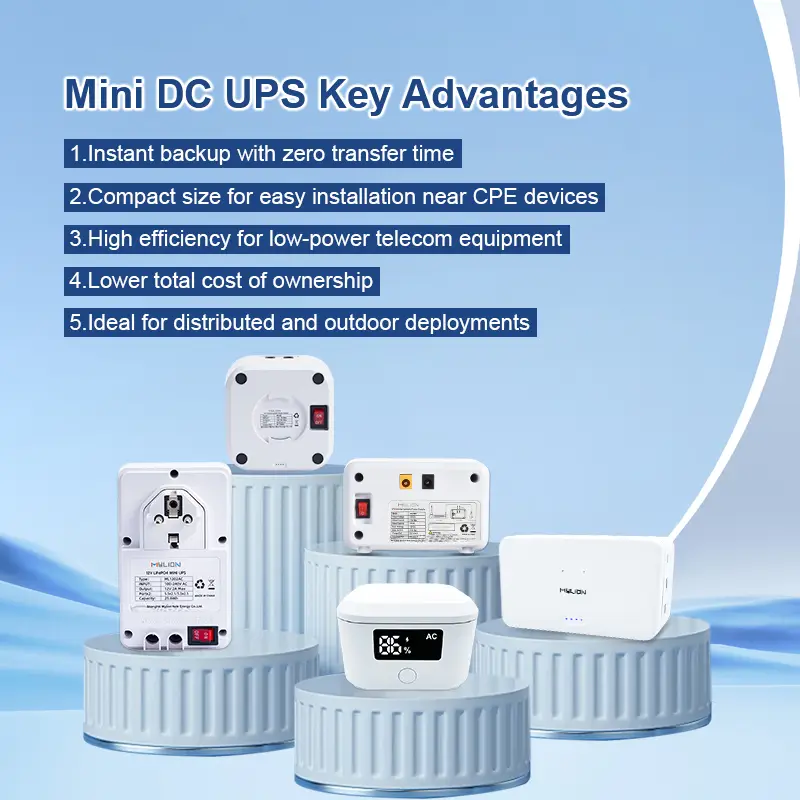
Because there is no “DC to AC” inversion step, mini DC UPS units operate at significantly higher efficiency (90-95%) for low-power telecom loads. Traditional AC UPS units often operate at 70-85% efficiency in these scenarios. This means a mini DC UPS can run the same router for 20-30% longer on the equivalent battery capacity—a critical advantage during extended outages.
- Cleaner, More Stable Power
Since broadband equipment runs on DC, removing the inverter eliminates electrical noise (harmonics) that can sometimes interfere with sensitive networking equipment, ensuring more stable data transmission.
Installation, efficiency and size considerations
When deploying backup power in the field or at scale, physical footprint, installation speed, and environmental adaptability are critical. The following table illustrates why mini DC UPS systems are preferred for distributed telecom projects:
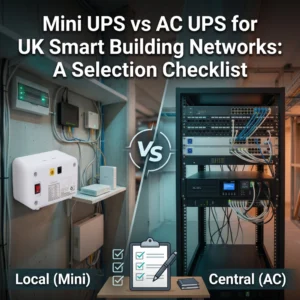
| Feature | Mini DC UPS (Telecom-Optimized) | Traditional AC UPS |
| Designed Use Case | Telecom networks, ISP infrastructure, distributed edge nodes | Data centers, server rooms, centralized IT |
| Output Type | Direct DC output (5V/9V/12V/24V) | AC output (110V/220V) |
| Installation | Plug-and-play; wall-mounted or integrated into existing cabinets | Floor or rack-mounted; often requires complex wiring |
| Footprint & Weight | Compact and lightweight; fits in space-constrained enclosures | Bulky and heavy; requires dedicated space |
| Operating Environment | Supports indoor, outdoor cabinets, and harsh environments | Primarily indoor, temperature-controlled environments |
For ISPs performing large-scale installations, the mini DC UPS reduces truck roll time. Technicians can mount the unit quickly without site modification, a critical factor for FTTH and FTTx rollouts.
Cost and maintenance comparison
The total cost of ownership (TCO) for a mini DC UPS is substantially lower than that of a traditional AC UPS for broadband and telecom applications. When scaled across thousands of network nodes, these differences become financially decisive.
- Initial Purchase Price: Mini DC UPS units typically cost less because they require fewer internal components (no heavy inverter or multiple AC outlets).
- Battery Technology: Traditional UPS units usually use Valve-Regulated Lead-Acid (VRLA) batteries. These typically last 2–3 years and degrade faster in hot environments. Mini DC UPS solutions (like Mylion) frequently utilize lithium batteries or LiFePO4 batteries, which last 5–8 years and tolerate higher temperatures.
- Energy Bills: Because the mini DC UPS wastes less energy as heat during the charging and discharging cycle, it results in measurable savings on electricity costs over time, especially when deployed at scale.
Which solution fits ISP and telecom deployment better
For Internet Service Providers (ISPs) and large-scale telecom deployments, the choice is unequivocally a mini DC UPS. As networks evolve toward fiber-to-the-home (FTTH), 5G, and smart city infrastructure, the need for localized, efficient, and scalable backup power becomes critical.
Scalability and Project Suitability are key factors. ISPs need to manage thousands of backup units across:
- FTTH / FTTx access networks (last-mile infrastructure)
- Outdoor telecom cabinets and roadside nodes
- Smart city surveillance and IoT gateways
- Remote or off-grid telecom installations
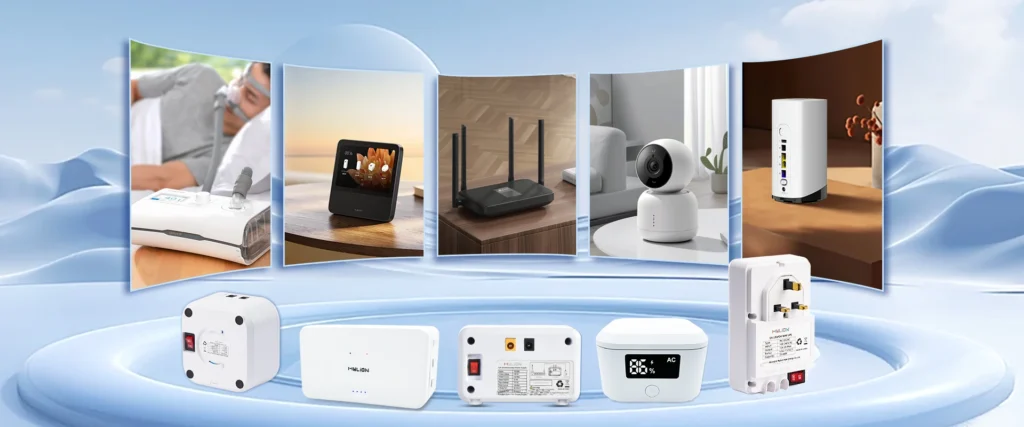
A traditional AC UPS cannot scale efficiently in these decentralized environments. Modern mini DC UPS solutions offer features essential for professional deployment:
- Compact design, capable of being easily expanded to thousands of nodes
- Low total cost of ownership for telecommunications and internet service provider projects
- OEM/ODM customization options for system integrators
- Standardized DC interfaces that reduce spare parts inventory complexity
For a telecom operator deploying hundreds of new fiber connections per month, using a project-optimized mini DC UPS simplifies logistics, reduces long-term support tickets, and ensures reliable connectivity—the ultimate metric of service quality.
Mylion Mini DC UPS Solution
For broadband equipment manufacturers, ISPs, and system integrators looking for a reliable backup power source, the Mylion Mini DC UPS series offers specially designed solutions. As a professional Mini UPS manufacturer focused on B2B markets, Mylion provides engineering support, stable long-term supply, and OEM/ODM customization.
Key models for telecom and broadband applications include:
- 2A MU26 Mini UPS– Ideal for ONU and basic router backup in fiber access networks with stable 12V output.
- 3A MU48 Mini UPS– Suitable for higher-load routers and CPE devices requiring extended runtime.
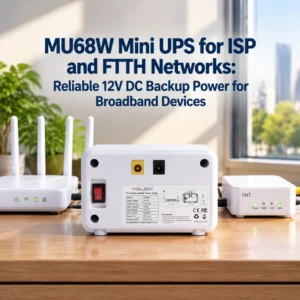
- 3A MU68 Mini UPS– Designed for multi-device support in compact telecom cabinets.
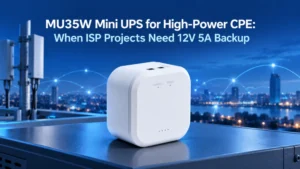
- 5A MU05 / MU65 / MU35 Mini UPS– Provide high-current output and enhanced thermal stability for demanding network equipment and ISP edge nodes.
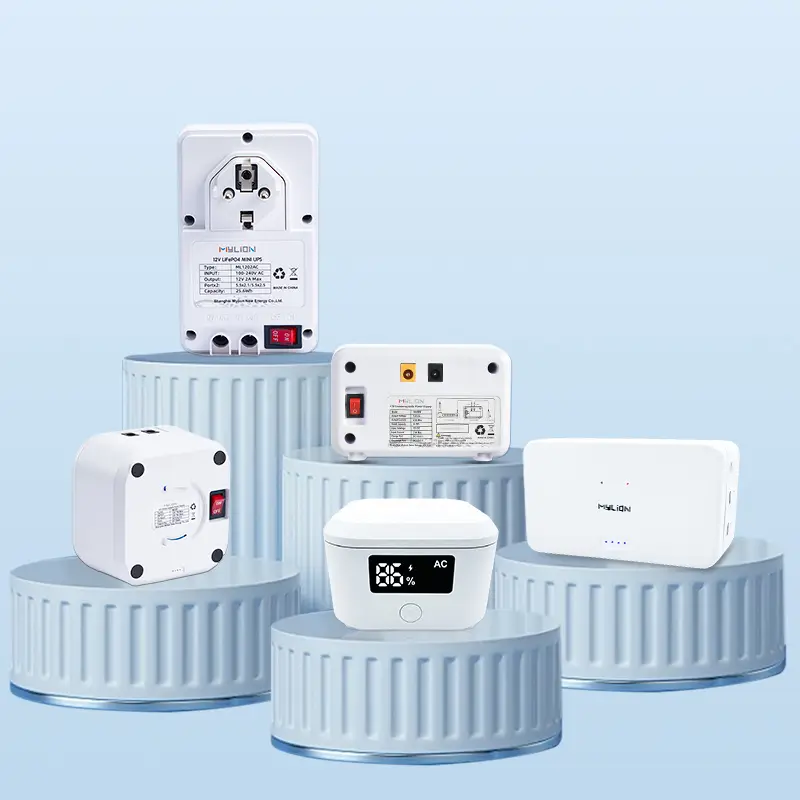
Key features of Mylion Mini UPS:
- Multiple voltage options:Offers 5V, 9V and 12V outputs to accommodate common telecommunications equipment.
- Lithium battery technology: Utilizes lithium batteries or LiFePO4, featuring longer cycle life and higher safety.
- Compact design: Slim profile, suitable for professional installations.
- Plug-and-play:Equipped with universal DC cables, eliminating the need for original equipment power adapters.
Whether you are deploying a smart home network or managing a municipal fiber network, Mylion can offer professional Mini UPS solutions to ensure uninterrupted network connectivity during power outages.
FAQ
Q1: Can I use the Mini DC UPS with any router?
Most routers, ONTs, and ONUs use 5V, 9V, or 12V DC input. As long as the mini DC UPS matches the voltage and provides sufficient current (amperage), it will work. Mylion’s solutions offer multiple voltage options to match common telecom equipment.
Q2: How long will a mini DC UPS power my broadband equipment?
Runtime depends on the battery capacity and device power draw. A typical mini DC UPS (e.g., 12V/10Ah) can power a standard router (10W) for 10–12 hours. For project deployments, Mylion can help calculate runtime based on specific load requirements.
Q3: Are lithium batteries suitable for continuous use?
Yes. The high-quality small DC UPS equipment produced by Mylion uses lithium batteries or the LiFePO4 chemical system. It has excellent thermal stability and low risks.
Q4: Is the small DC UPS easier to install than traditional UPS?
Yes. Since it does not require the original power adapter of the device, fewer cables are needed during installation and the size is also smaller. Many devices are also equipped with installation holes, making it easy to install them securely on the wall.
Q5: How to choose the appropriate mini-type uninterruptible power supply (UPS) for my broadband equipment?
To select the appropriate mini-type uninterruptible power supply, three key parameters need to be considered: voltage, current and interface type. For different project levels, Mylion’s engineering team can provide customized suggestions based on your specific equipment list.
Conclusion
While traditional AC UPS units have their place in data centers and office environments, they are often an inefficient and cumbersome solution for broadband equipment. For routers, ONTs, and ONUs, the mini DC UPS provides superior efficiency, longer battery lifespan, easier installation, and a lower total cost of ownership.
As internet connectivity becomes essential infrastructure, ensuring that broadband equipment remains online during power outages is critical. By choosing a purpose-built DC backup solution like the Mylion Mini DC UPS, ISPs and homeowners can enjoy reliable, clean, and efficient backup power without the overhead of a traditional AC system.
 English
  简体中文
简体中文  Deutsch
  Français
  Italiano
  Español