
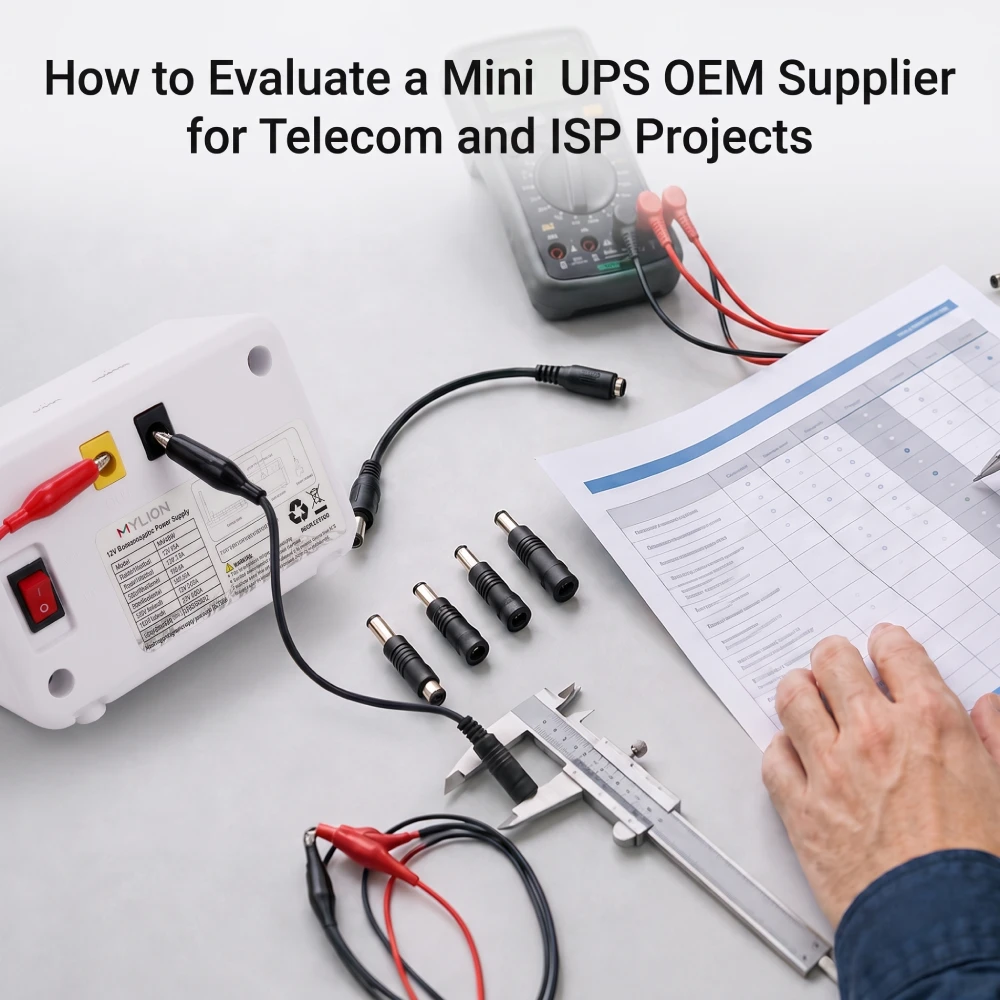
Direct answer: A strong Mini UPS OEM supplier should offer more than one generic model. Buyers should evaluate whether the supplier can explain and match continuous current, maximum output, total power, battery energy, interfaces, input design, and battery chemistry to the actual router, ONT, ONU, modem, gateway, or CPE application.
For an ISP, telecom operator, network equipment brand, distributor, or system integrator, OEM capability is closely connected to product capability. A supplier may offer logo and packaging customization, but the project will still fail if the Mini UPS does not match the connected device. Product range, parameter accuracy, application judgment, connector support, and sample evaluation are therefore the most practical starting points.
What OEM Capability Means for a Mini UPS Project
In a Mini UPS project, OEM support may include branding, packaging, manuals, regional plugs, connectors, cables, accessories, or selected product configurations. Not every change has the same technical impact. A label change is different from changing output current, battery energy, circuit design, or battery chemistry.
A credible supplier should first decide whether the requirement can be met by an existing approved product, a supported configuration, or a project that needs additional technical review. This protects the buyer from treating every customization request as automatically available.
Start with the Parameters That Determine Product Fit
Continuous Current and Maximum Current
Continuous current is the output a Mini UPS is approved to support during sustained operation. Maximum current describes a higher boundary that should not be rewritten as continuous capability. For example, 2.5A continuous / 3A maximum is not the same as 3A continuous.
Output Power and Battery Energy
Output power, expressed in watts, indicates the load class the product can support. Battery energy, expressed in watt-hours, is mainly related to runtime. A product with more Wh can provide longer backup under comparable conditions, but higher Wh does not automatically mean higher current capability. Buyers should confirm output first and then compare energy for the required backup duration.
Interfaces and Total-System Limits
DC5521 and DC5525 may look similar, but the connector dimensions, polarity, cable rating, and device socket must be confirmed. Multi-output products also require a total-load check. The rating of one DC or USB port cannot be added freely to the ratings of the other ports when the product has a defined total-system power limit.
Input Design and Battery Chemistry
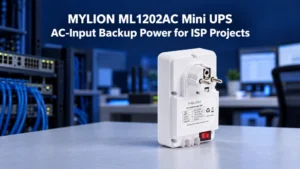
Most compact Mini UPS models use a DC input, while some installations benefit from direct AC input. Lithium-ion and LiFePO4 are also different product directions. Chemistry should be selected according to the approved product design and project requirements, not reduced to a universal claim that one chemistry is always better.
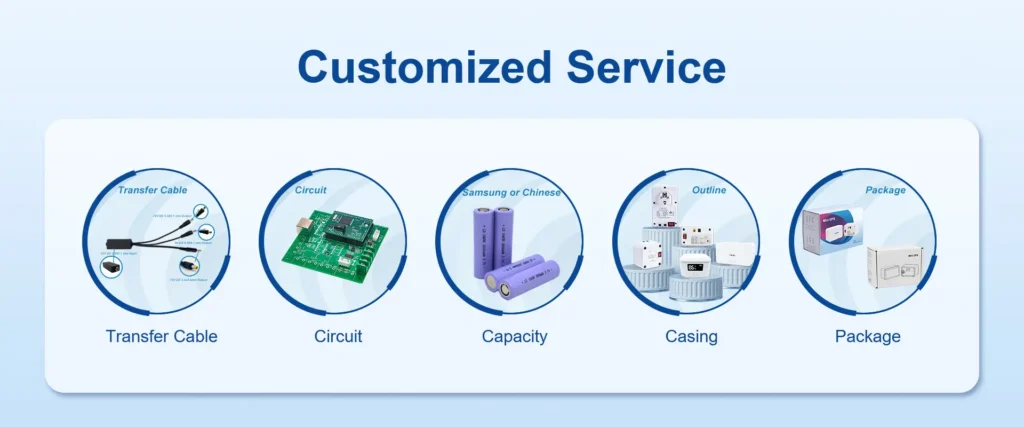
MYLION Standard and High-Power 12V Mini UPS Options
MYLION offers various models of 12V Mini UPS. The main difference between these models is the combination of output capability and battery energy.
Models | Approved output | Battery energy | Product direction |
12V; 2.5A continuous / 3A maximum; 36W max | 18.72Wh | Compact entry-level backup for compatible ONT, ONU, router, modem, or low-power CPE. | |
12V; 2.5A continuous / 3A maximum; 36W max | 29.6Wh | Standard 12V backup with more energy than MU26W. | |
12V; 2.5A continuous / 3A maximum; 36W max | 44.4Wh | Mainstream standard 12V option for ISP and broadband projects. | |
12V; 4A continuous / 5A maximum; 60W max | 56.16Wh | Higher-power direction for compatible higher-load routers, gateways, modems, or CPE. | |
MU35W / MU35L | 12V; 4A continuous / 5A maximum; 60W max | 75.6Wh | Higher-power, longer-runtime direction for compatible network equipment. |
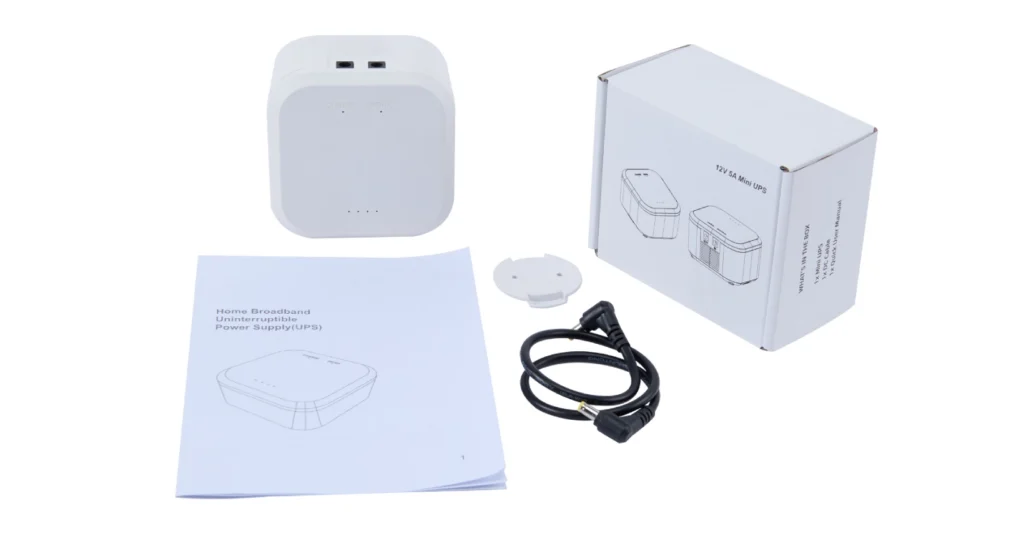
MYLION Options for Multi-Output and AC-Input Applications
Some projects are defined less by higher current and more by the required connection architecture. MYLION also provides product directions for mixed DC and USB loads or two low-power 12V devices.
Models | Output and input design | Battery / chemistry | Best used as a candidate for |
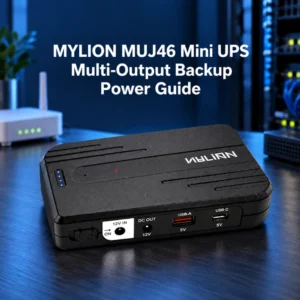
12V DC: 1.5A continuous / 2A maximum; USB-A and USB-C: 5V, 3A max each; 18W total-system limit | 37.44Wh; lithium-ion | One compatible 12V device plus selected USB-powered equipment, subject to the combined 18W limit. | |
Same output arrangement and 18W total-system limit as MUJ46 | 50.4Wh; lithium-ion | A similar mixed-output application requiring more battery energy. | |
100-240V AC input; two 12V DC outputs, each 2A maximum; 24W total-system limit | 25.6Wh; LiFePO4 | Two compatible low-power 12V devices, such as selected ONT-plus-router combinations, after combined-load verification. |
These products should not be described as universally supporting two devices. The final decision depends on voltage, combined continuous load, peak demand, total-system limit, connector and cable capability, and the specific device combination.
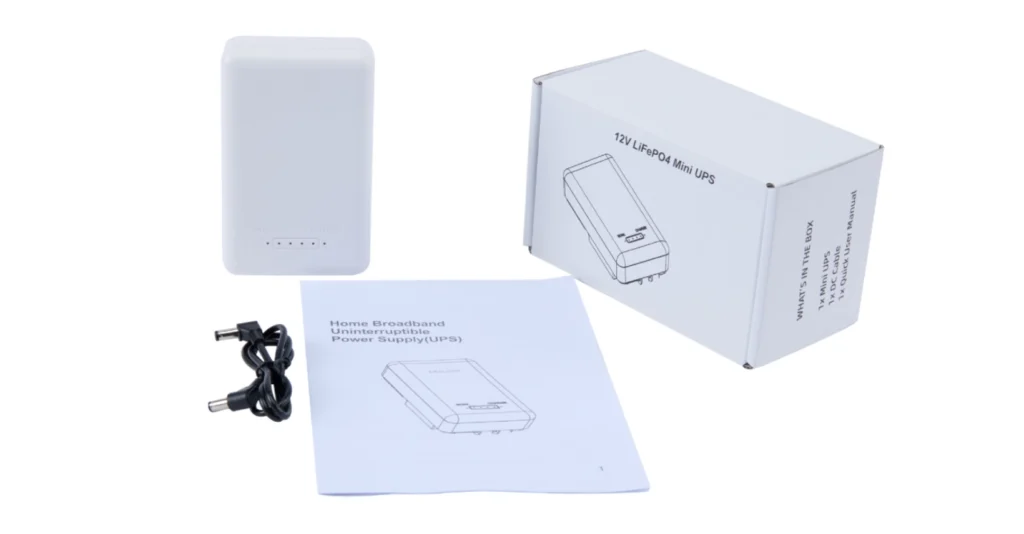
How to Match a MYLION Mini UPS to the Application
A readable product comparison should lead to a simple selection process:
- Confirm the device voltage and input type. A 12V product is not a substitute for a 24V, 48V, PoE, or unsupported USB-C requirement.
- Measure or verify the normal continuous load and the maximum or startup demand.
- Choose an output class that can support both sustained operation and the relevant peak condition.
- After output is confirmed, compare battery Wh against the required runtime and actual working load.
- Confirm the connector, polarity, cable length, cable rating, adapter, and installation arrangement.
- For multiple devices or outputs, calculate the combined load and check both port-level and total-system limits.
- Test a representative sample with the real device, final cable, power source, and expected operating conditions before volume deployment.
How MYLION Supports Product Evaluation
MYLION provides Mini UPS products and DC backup solutions for global B2B customers, including telecom operators, ISPs, network equipment companies, system integrators, brands, and professional distributors.
MYLION’s project approach begins with the actual device and deployment requirement. Voltage, continuous and peak load, connector and cable conditions, backup target, input design, environment, target market, number of devices, and project stage should be reviewed before recommending a model. Product availability, OEM options, documents, and other requirements must be confirmed for the specific model and configuration.
FAQ
Q1: Is a 12V 5A Mini UPS always better than a 12V 3A model?
Q2: Does a larger Wh value mean the Mini UPS has higher output power?
Q3: Can one Mini UPS support an ONT and router at the same time?
Q4: What should a buyer send before requesting an OEM Mini UPS recommendation?
Conclusion
The most useful way to evaluate a Mini UPS supplier’s OEM capability is to begin with its products and parameter discipline. A capable partner should offer clearly differentiated product platforms, separate continuous from maximum output, distinguish power from battery energy, explain interface and total-load limits, and match the solution to the actual device rather than the device category alone.
MYLION’s standard 12V, long-runtime, higher-power, mixed-output, and AC-input Mini UPS directions give project buyers several practical starting points. The final model should still be selected from confirmed voltage, load, runtime, connector, device combination, and deployment conditions. Once product fit is established, OEM branding, packaging, cable, connector, documentation, and sample requirements can be evaluated for the specific project.

 English
  简体中文
简体中文  Deutsch
  Français
  Italiano
  Español