
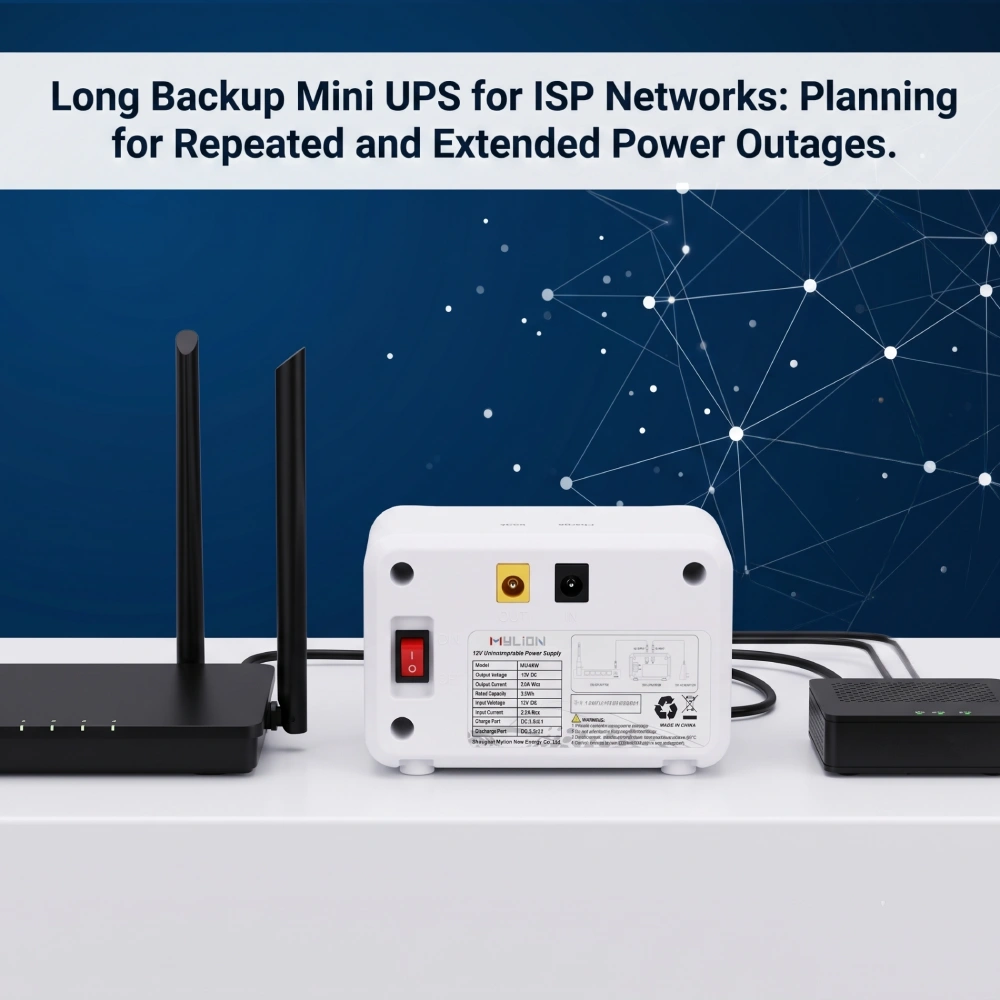
For ISPs and telecom operators, a long backup Mini UPS should not be selected by battery capacity alone. The real question is whether the backup system can keep the required router, ONU, ONT, CPE, modem, or gateway powered through the actual outage pattern at the installation site.
This becomes especially important in regions where power may fail several times a day. A Mini UPS that performs well during one long outage may provide less runtime during the next interruption if the battery has not had enough time to recharge.
For ISP networks, long-backup Mini DC UPS systems are a fundamental requirement for ensuring the normal operation of the network.
Why Long Backup Matters for ISP Networks
At an FTTH or broadband subscriber site, internet connectivity may depend on several powered devices.
Typical equipment includes:
ONT / ONU → Router → Wi-Fi or local network
Other deployments may use a modem, gateway, wireless CPE, network bridge, or additional communication equipment.
If one required device loses power, the subscriber can lose connectivity even when the upstream fiber or telecom network is still available.
A properly selected Mini UPS can help maintain local equipment during utility power interruptions and reduce unnecessary device restarts, support calls, and field-service pressure.
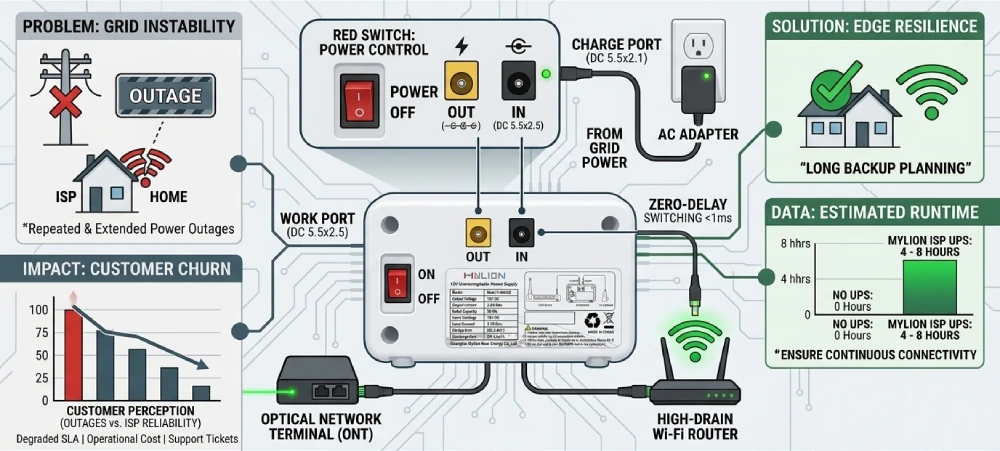
Start With the Actual Network Load
Adapter Rating Is Not Actual Consumption
A common mistake is using the power adapter label as the device’s normal power consumption.
For example, a router supplied with a 12V 3A adapter does not necessarily consume 36W continuously. The adapter rating normally indicates the power it is capable of supplying.
For better Mini UPS planning, identify:
Input | Why It Matters |
Device voltage | Must match the backup output |
Normal operating load | Main factor affecting runtime |
Maximum/peak current | Important for output capability |
Original adapter | Helps evaluate system power input |
Connector and polarity | Required for physical compatibility |
Number of devices | Determines combined load |
Where possible, actual operating power should be measured on representative equipment before a large ISP rollout.
Runtime Depends on Load
At a simplified level:
Reference runtime ≈ usable battery energy ÷ connected load
Real performance also depends on conversion losses, battery condition, temperature, output configuration, cutoff conditions, and other system factors.
This is why a Mini UPS cannot have one universal backup time for every router or ONT.
Repeated Outages Change the Backup Requirement
One Long Outage vs. Several Outages
Consider two different situations.
Scenario A:
One power outage lasts three hours, followed by a long period of stable utility power.
Scenario B:
Power fails for one hour, returns briefly, fails again, and repeats several times.
Even if the total outage time is similar, Scenario B can be more demanding.
When electricity returns, the Mini UPS must power the network equipment while recovering battery energy. If the recovery period is short, the next outage may begin before the battery returns to a high state of charge.
Multi-Device Backup Requires Combined-Load Planning
Many FTTH installations need to keep both an ONT/ONU and a Wi-Fi router online.
If two devices operate simultaneously, their combined load determines both the required Mini UPS output capability and the expected runtime.
For example:
Device | Example Load |
ONT | 8W |
Router | 12W |
Combined load | 20W |
The example is only illustrating the calculation method; actual equipment should be checked individually.
A dual-output Mini UPS must also be evaluated against its total system power limit. The maximum rating of Output A and Output B should not automatically be added together unless the approved product specification explicitly supports that simultaneous total.
Recharge Capability Is Part of Long-Backup Design
Battery capacity receives most of the attention, but the input power system is equally important during repeated outages.
When utility power is available, the external adapter may need to:
- Run the connected router, ONT, or CPE
- Support the Mini UPS electronics
- Recharge the internal battery
If the available adapter power is insufficient, battery recovery may take longer than expected.
For networks experiencing frequent interruptions, the correct evaluation should therefore consider the complete power path:
Utility Power → Adapter → Mini UPS → Network Equipment
A larger battery does not automatically create a better repeated-outage solution if the available recharge window or input power is insufficient.
MYLION Mini UPS Solutions for ISP and Telecom Networks
MYLION offers different Mini UPS families for routers, ONU/ONT equipment, CPE, gateways, modems, Wi-Fi equipment, and professional communication devices.
The correct model depends on the load, voltage, number of devices, interface, required runtime, and deployment conditions.
MYLION Product Selection Overview
MYLION Products | Product Direction | Typical ISP / Telecom Fit |
MU26W, MU48W, MU68W, | Standard 12V Mini UPS family | Router, ONU, ONT, modem, standard CPE |
MU65W, MU35W, MU35L | Higher-power 12V family | Higher-load routers, gateways, modems and CPE |
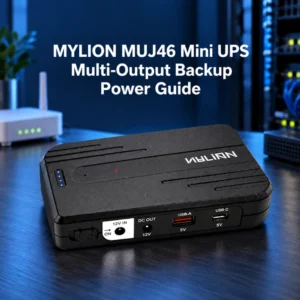
MUJ46-2A, MUJ435-2A | 12V + USB multi-output family | 12V network device plus USB-powered equipment |
ML1202AC | AC-input dual-12V Mini UPS | ONU + router and other dual 12V installations |
MUC85 | USB-C PD Mini UPS | USB-C-powered routers, modern gateways and CPE |
MU248 | 24V / 48V communication Mini UPS | Wireless CPE, bridges, radio and professional telecom equipment |
Standard 12V Router, ONU and ONT Backup
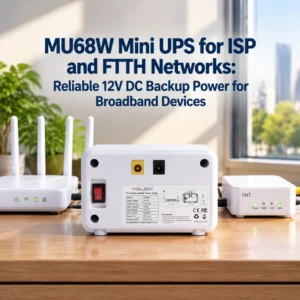
For conventional 12V broadband equipment, models such as MU26W, MU48W, MU68W provide different options within MYLION’s standard 12V Mini UPS family.
They are suitable starting points for applications involving routers, ONU, ONT, modems, and standard CPE where the actual device requirement remains within the approved output capability.
The final selection should be driven by load and target runtime, rather than simply choosing the highest-capacity model.
Higher-Power Routers and Gateways
Some modern gateways, high-performance routers, and CPE equipment require more continuous current.
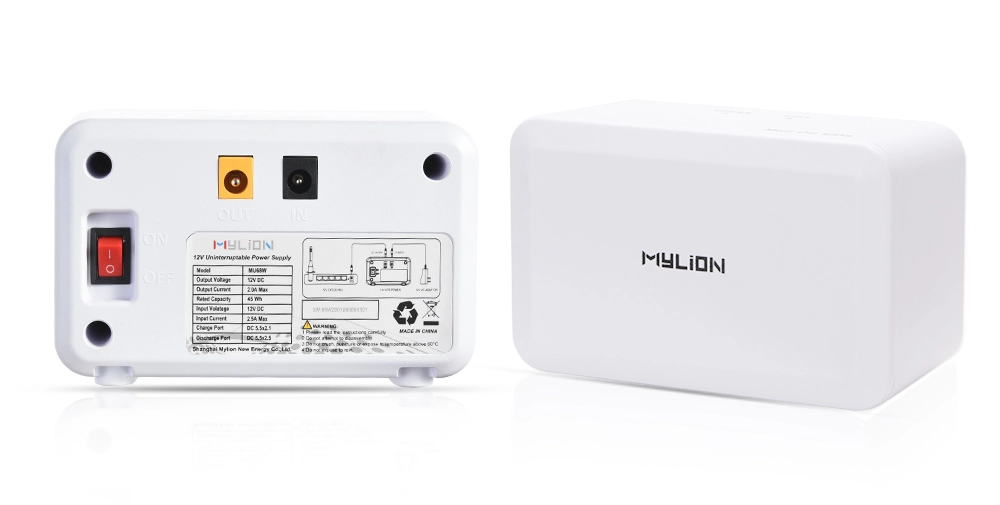
For these applications, MU65W, MU35W and MU35L belong to MYLION’s higher-power 12V family.
They provide a different output class from the standard 12V series and can be evaluated where higher continuous power is required.
Using a higher-power model does not automatically mean longer runtime. Runtime still depends on the specific product configuration and actual connected load.
ONT + Router Backup
Where both an ONT and router must remain online, MYLION can evaluate several solution directions.
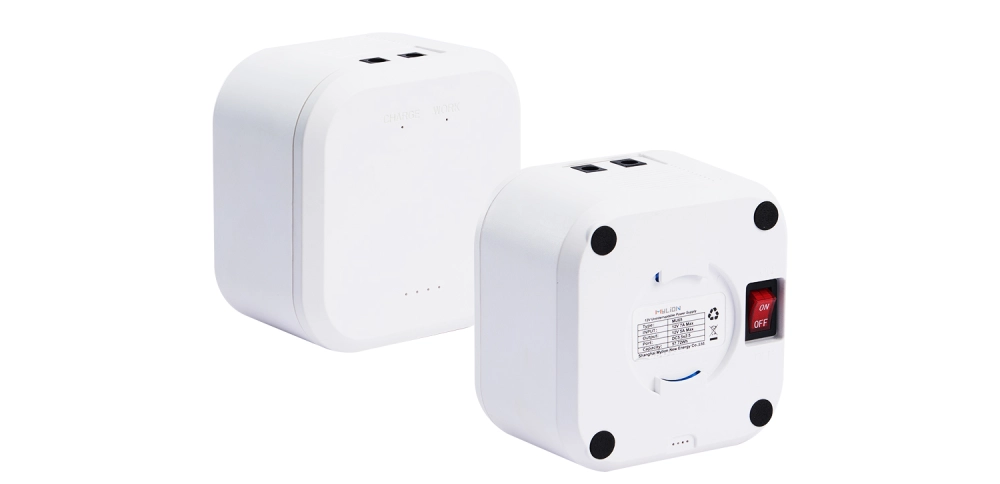
ML1202AC is designed around direct AC input and dual 12V outputs for suitable dual-device applications.
For other requirements, MUJ46-2A, MUJ435-2A configurations may be considered depending on the device combination.
The combined load, connector configuration, and simultaneous-output limits must always be confirmed.
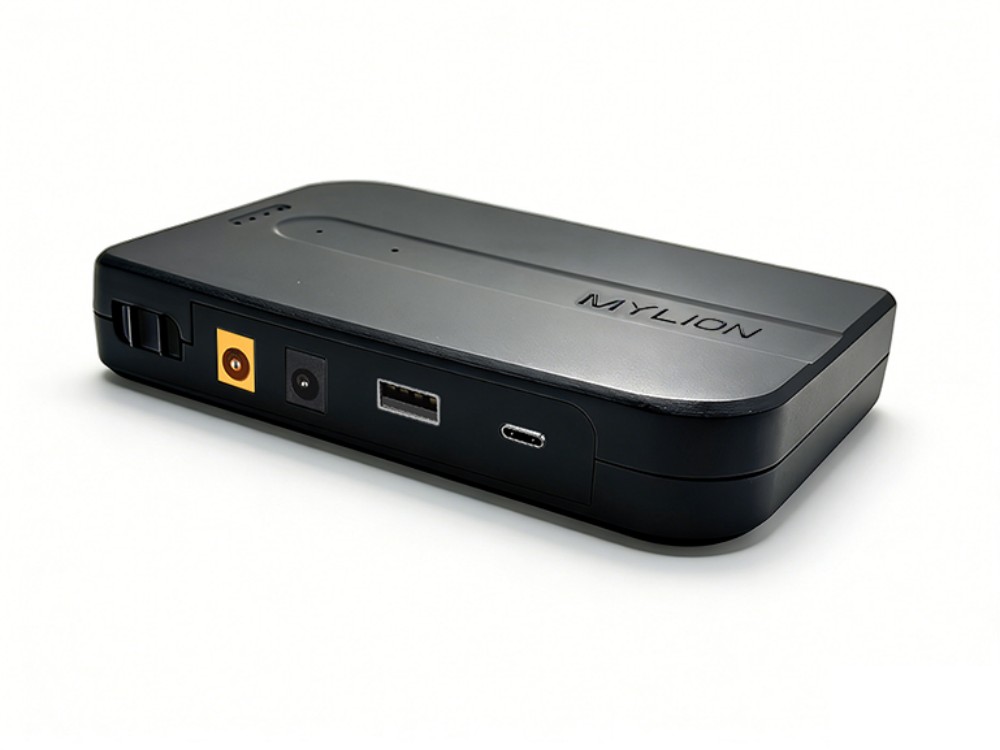
USB-C PD Gateways
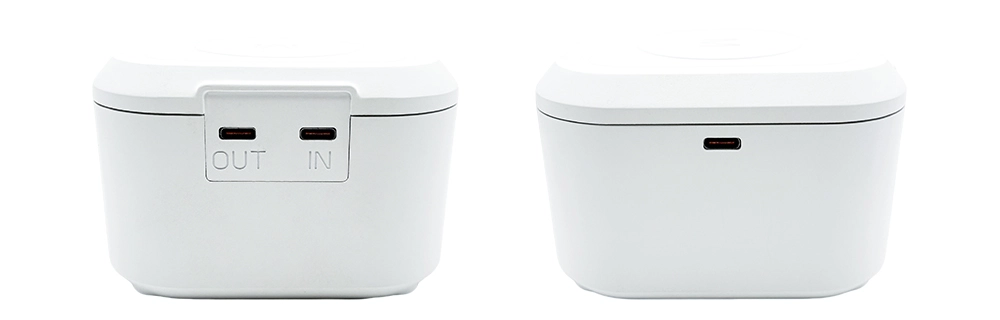
For modern network devices powered through USB-C, MUC85 provides a MYLION USB-C PD solution direction.
USB-C compatibility requires more than matching the connector shape. The project should verify:
- Required PD voltage
- Power level
- Source/device roles
- Cable capability
- Power negotiation
- Simultaneous-output conditions
A USB-C port should never be assumed to support every USB-C-powered router or gateway automatically.
24V and 48V Telecom Equipment
Professional communication installations may use higher DC voltages than residential routers.
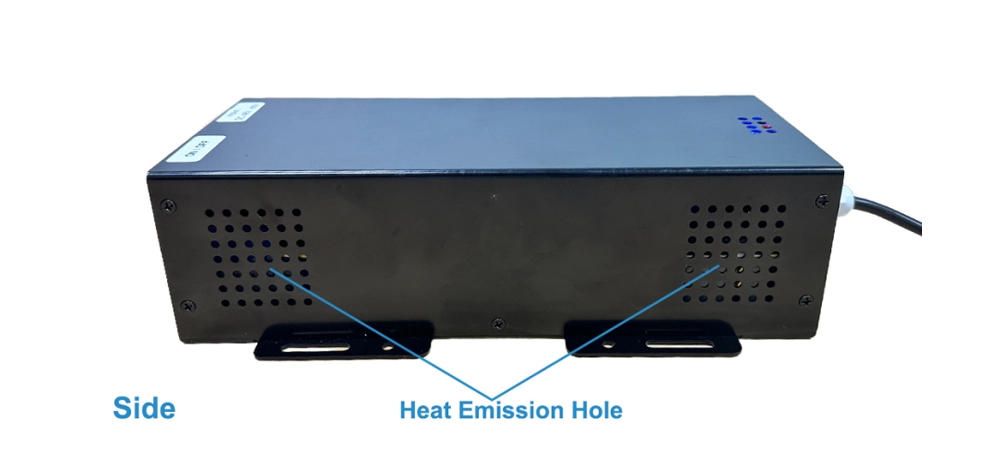
For wireless CPE, bridges, radio equipment, and other communication applications requiring 24V or 48V, MU248 provides a project-oriented MYLION solution direction.
These applications should receive additional technical review because output voltage, interfaces, installation conditions, target market, and device behavior may differ significantly from standard 12V subscriber equipment.
FAQ
Q1: How do I calculate the required Mini UPS runtime?
Q2: Can one Mini UPS support both an ONT and router?
Q3: Which MYLION Mini UPS is suitable for a high-power router?
Q4: Does MYLION offer USB-C PD Mini UPS solutions?
Q5: Does MYLION have Mini UPS solutions for 24V or 48V telecom devices?
Q6: Can a long-backup Mini UPS guarantee internet availability?
Conclusion
A long backup Mini UPS for ISP networks should be planned around the real operating environment—not simply the largest battery specification.
MYLION offers multiple Mini UPS product directions for standard 12V routers and ONTs, higher-power gateways, dual-device installations, USB-C PD equipment, and 24V/48V telecom applications.
 English
  简体中文
简体中文  Deutsch
  Français
  Italiano
  Español