
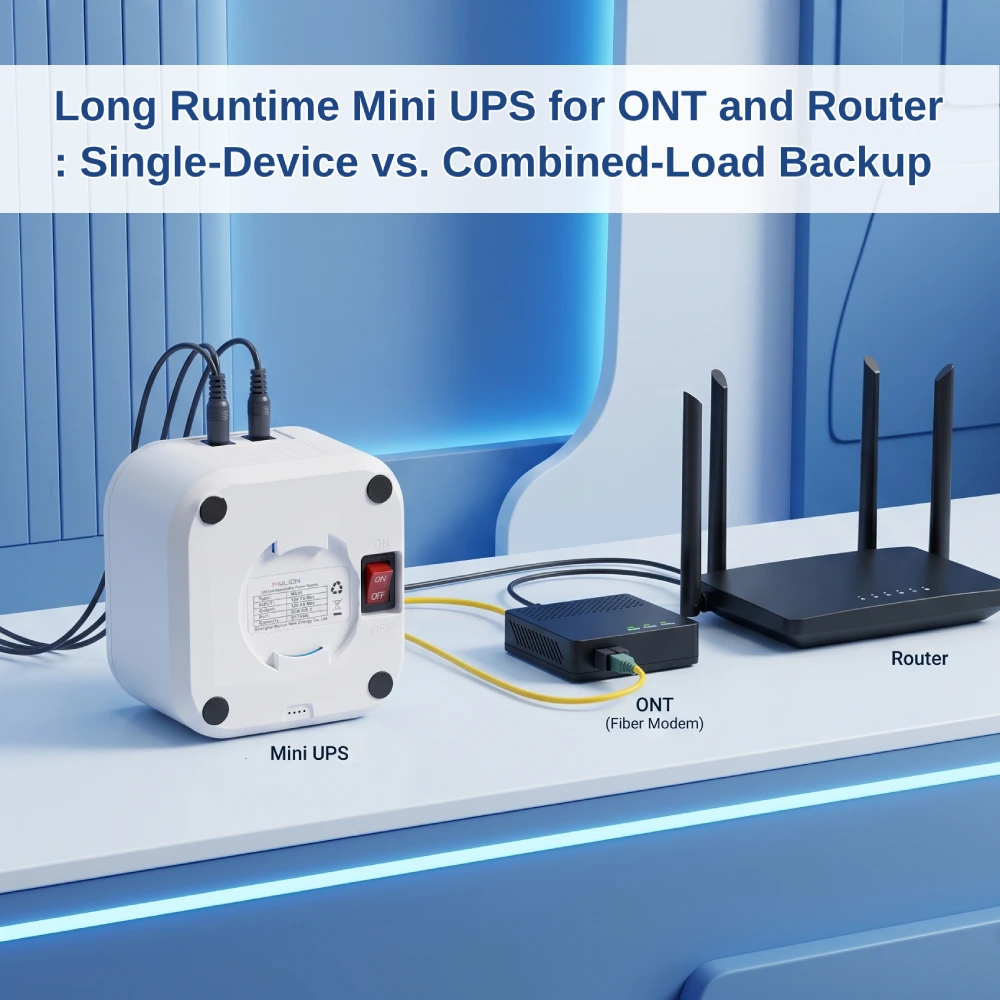
A long-runtime Mini UPS can keep an ONT, router, gateway, or other network device operating during a local power outage. However, the achievable backup time depends on more than battery capacity.
An ONT powered by itself creates a different load profile from an ONT and router powered together. When two devices share one Mini UPS, their continuous power consumption must be added, their peak loads must be checked, and the expected runtime must be recalculated.
For ISPs, telecom operators, and system integrators, understanding this difference is essential when evaluating a Mini UPS for FTTH and customer-premises network continuity.
Why Long-Runtime Backup Matters for ONT and Router Deployments
A fiber network may remain operational upstream while the customer loses connectivity because the local ONT or router has no power.
Short or recurring outages can lead to:
- Subscriber connectivity interruptions;
- ONT and router reboot cycles;
- Increased support calls;
- Avoidable field-service visits;
- Inconsistent backup performance across different CPE models;
- Reduced confidence in an ISP’s continuity solution.
A long-runtime Mini UPS can extend the backup window, but it must match the actual network equipment. Selecting the largest battery without checking voltage, load, connector, and peak current can still result in reboots or unsuitable runtime.
What Determines Mini UPS Runtime?
The three primary factors are:
- Battery energy, measured in watt-hours;
- The actual continuous power consumed by the connected equipment;
- System conditions such as conversion efficiency, temperature, cable loss, battery condition, and protection cutoff.
A practical formula estimate is:
Estimated runtime = Battery energy in Wh / Actual load in W
The actual device load should be used whenever possible. The current printed on a power adapter normally represents the adapter’s rated capability, not necessarily the power continuously consumed by the ONT or router.
Measurements should cover normal operation as well as higher-load conditions such as startup, Wi-Fi transmission, heavy network traffic, and connected accessories.
Single-Device Backup
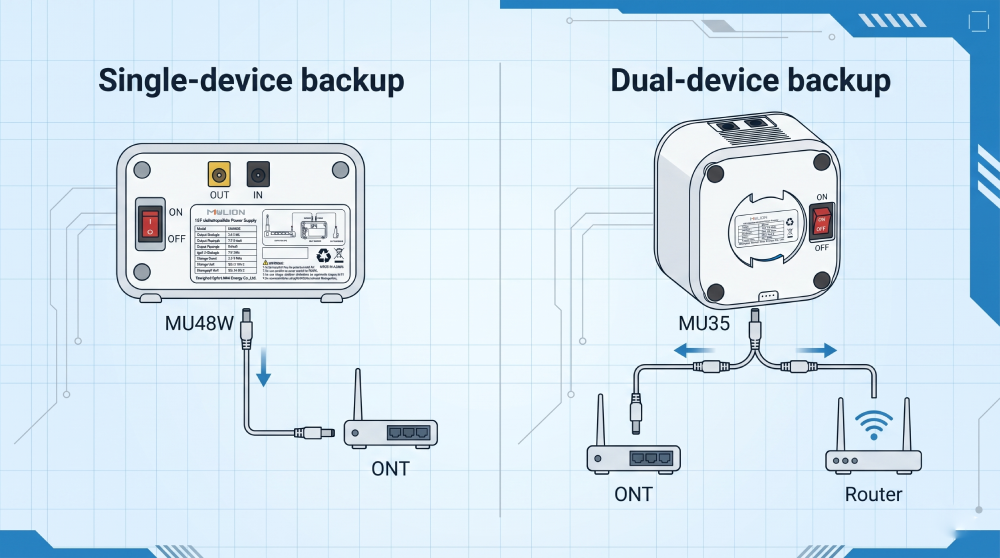
A single-device setup uses the Mini UPS to support one ONT, router, modem, gateway, or compatible CPE device.
This arrangement generally offers:
- A simpler load calculation;
- Fewer connectors and cables to verify;
- Lower total power consumption;
- Longer backup time from the same battery energy;
- Easier device-level sample testing;
- More straightforward fault isolation.
For example, the MYLION MU35 Mini UPS has 75.6Wh of battery energy. At a 12W reference load, its formula-estimated backup time is approximately seven hours.
This is a reference estimate under a defined load, not a guaranteed runtime for every ONT or router. Actual performance depends on the connected device and operating conditions.
When Single-Device Backup Is Appropriate
- Only the ONT must remain online;
- Only the router or gateway is considered critical;
- The devices are installed in different locations;
- Independent backup is preferred for fault isolation;
- One device has a significantly higher load than the other;
- The project requires different backup times for different devices.
Combined-Load Backup for ONT and Router
In a combined-load setup, one Mini UPS supports both the ONT and router.
Combined load = ONT continuous power + Router continuous power
Both devices must also be checked for:
- Required operating voltage;
- Continuous current;
- Startup and peak current;
- Connector size and polarity;
- Cable and output configuration;
- Simultaneous startup behavior;
- Required backup time.
The number of available connectors alone does not determine whether two devices can be supported. The complete electrical load must remain within the Mini UPS’s continuous output capability, while peak demand and connection requirements must also be satisfied.
How Combined Load Changes Runtime
As the total load increases, the available backup time decreases. Using the MU35’s 75.6Wh battery energy as an example:
- At a 12W total load, the formula estimate is approximately seven hours.
- If the measured combined load is 18W, the formula estimate is approximately five hours.
- If the measured combined load is 24W, the formula estimate is approximately four hours.
The 18W and 24W examples illustrate the calculation method. They are not test results for a specific ONT-and-router combination.
Actual runtime may be affected by load changes, conversion efficiency, system consumption, temperature, battery condition, cables, connectors, and protection settings. Real-device testing remains necessary for project validation.
Single-Device vs. Combined-Load Backup
Decision factor | Single-device backup | Combined ONT and router backup |
Total load | Based on one device | Sum of both devices |
Expected runtime | Usually longer at a lower load | Usually shorter as total load increases |
Peak assessment | One device’s startup and dynamic demand | Peaks from both devices, including possible overlap |
Cabling | One compatible connection | Approved connections for both devices |
Validation | Test one device with the Mini UPS | Test the complete ONT-and-router system |
Failure impact | One device depends on the unit | Both devices depend on the same unit |
Deployment complexity | Lower | Higher |
Typical objective | Dedicated backup with maximum runtime | Integrated FTTH continuity with fewer backup units |
The right architecture depends on the network design. Single-device backup prioritizes simplicity, fault isolation, and longer runtime at a lower load. Combined-load backup can simplify the installation, but it requires more careful power assessment and system testing.
MYLION MU35 Long-Runtime Mini UPS Solution
The MYLION MU35 is designed for 12V high-power, long-runtime network backup applications.
Key product characteristics include:
- 6Wh battery energy;
- 12V DC output;
- 4A continuous output;
- 5A maximum output;
- Flame-retardant ABS enclosure.
The continuous and maximum output ratings serve different purposes. The 4A continuous rating represents sustained load capability, while the 5A maximum rating must not be treated as continuous output.
MU35 can be evaluated for:
- High-power router backup;
- Gateway and modem backup;
- High-load CPE applications;
- Longer-runtime single-device backup;
- Conditional ONT-and-router combined-load projects;
- Professional ISP and broadband continuity deployments.
Compatibility should always be determined from the actual voltage, continuous load, peak demand, connector, polarity, and required runtime.
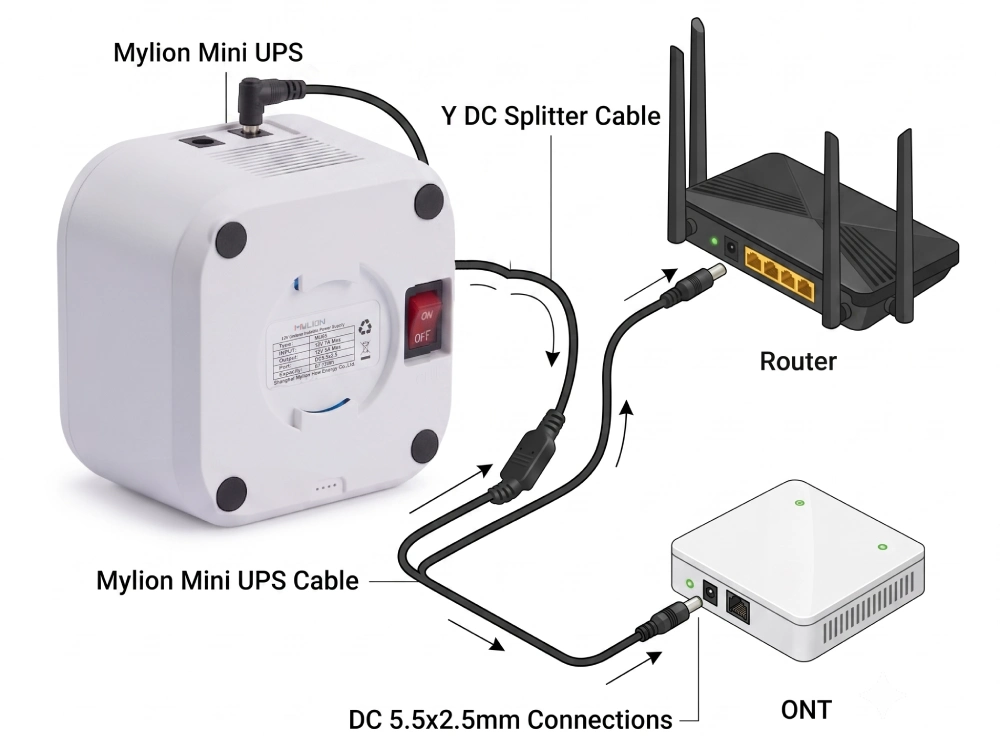
Why MU35 Is Relevant to Combined-Load Projects
An ONT-and-router combination may require more output capability and battery energy than a standard single-device application.
MU35 combines a 75.6Wh battery with 12V DC output rated at 4A continuous and 5A maximum. This makes it a relevant candidate where:
- Both devices require compatible 12V power;
- Their combined continuous load is within the sustained output capability;
- Startup and peak loads have been evaluated;
- The required cable configuration has been confirmed;
- The estimated runtime meets the project target;
- Samples can be tested with the actual equipment.
A higher output rating does not automatically guarantee longer runtime. Output capability determines whether the Mini UPS can support the load, while battery energy and actual power consumption determine how long it can support that load.
Typical Applications
FTTH Customer-Premises Equipment
A combined ONT-and-router solution can help keep the subscriber connection active when local utility power fails. ISPs should test the exact CPE combination used in the deployment.
High-Power Router and Gateway Backup
Higher-performance routers, gateways, and CPE devices may need stronger continuous-current support. MU35 can be evaluated when the device’s 12V input, load, connector, and backup-time requirements are compatible.
Small Business Connectivity
Branches, offices, retail sites, and remote work locations may depend on a router or gateway for cloud applications, VoIP, payment systems, and remote management. A long-runtime Mini UPS can extend network availability during outages.
Remote Broadband Installations
Longer backup windows can be valuable where grid interruptions are frequent or field access is difficult. The complete installation should be validated under representative load, temperature, and cable conditions.

How ISPs and Integrators Should Evaluate Runtime
Before selecting a long-runtime Mini UPS, collect the following information:
- ONT and router models;
- Input voltage for each device;
- Actual continuous current or working power;
- Startup and peak current;
- Required backup duration;
- Connector size and polarity;
- Required cable length;
- Whether both devices start simultaneously;
- Installation environment;
- Target market;
- Project quantity;
- OEM or ODM requirements.
For pilot evaluation, test the Mini UPS, ONT, router, and final cable configuration as one system. Record the load, operating conditions, switchover behavior, device stability, and achieved runtime.
FAQ
Q1: Can one MU35 power both an ONT and a router?
Q2: How long can MU35 power an ONT and router?
Q3: Does MU35 provide 5A continuously?
Q4: Should runtime be calculated from the adapter label?
Q5: Is a larger battery enough for dual-device backup?
Q6: What if the ONT and router use different voltages?
Conclusion
Choosing a long-runtime Mini UPS for an ONT and router starts with the load. A single-device setup generally provides simpler validation and longer runtime at a lower total load. A combined-load setup can support a more integrated FTTH backup design, but the ONT and router must be evaluated as one electrical system.
With 75.6Wh of battery energy and 12V DC output rated at 4A continuous and 5A maximum, the MYLION MU35 is a strong candidate for high-power and long-runtime network backup evaluation. Final selection should be based on actual device power, peak demand, connection requirements, target runtime, and sample-test results.

 English
  简体中文
简体中文  Deutsch
  Français
  Italiano
  Español