
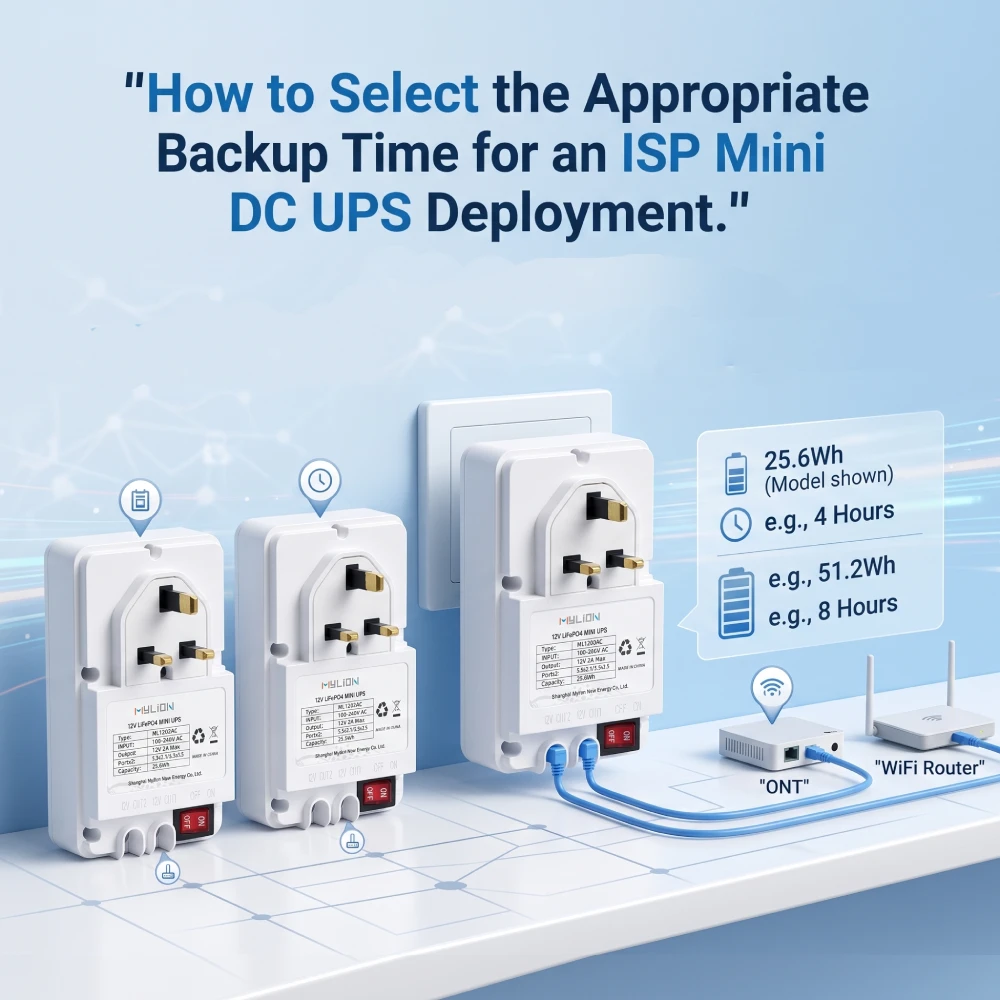
For an ISP or FTTH rollout, choosing a Mini DC UPS is not simply about selecting the largest battery. The right backup time depends on which devices must stay online, how much power they actually use, and how long service needs to continue during an outage. The practical approach is to define the service target first, make a simple runtime estimate, and then validate the solution with the real ONT, ONU, router, or CPE before wider deployment.
This makes the selection process easier for network operators, system integrators, and procurement teams while keeping the focus on the real goal: maintaining service continuity for end users.
What Should an ISP Decide Before Choosing a Mini DC UPS?
Start with the service requirement, not the battery capacity.
1. Decide which devices must stay online
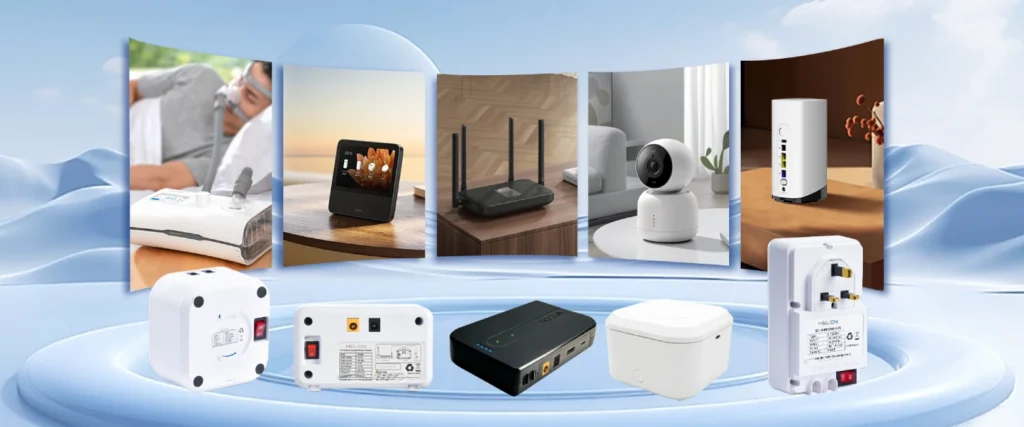
Some projects only need to protect an ONT or ONU. Others need to keep both the ONT and the Wi-Fi router running. In some installations, a gateway, voice device, or other CPE may also be part of the backup requirement.
The more devices a Mini DC UPS needs to support, the more important it is to look at their combined power use rather than the requirement of one device alone.
2. Set a realistic backup-time target
The target should reflect the outage pattern in the market, the type of subscriber, the operator’s support model, and how quickly power is normally restored. A residential FTTH rollout may need a different target from a business broadband or remote-site deployment.
Instead of asking for “the longest possible backup time,” define a useful service window that can be tested and repeated across the project.
How Do You Know the Real Power Use of an ONT or Router?
Use the device’s real working power whenever possible. The number printed on a power adapter usually shows what the adapter can supply, not what the device continuously consumes in normal operation.
For a practical project check, measure the ONT, router, or CPE while it is working normally. If several devices will share the same backup solution, add their normal power use together. This gives a much more useful starting point for comparing Mini DC UPS options.
It is also worth checking whether the device has a noticeably higher demand when starting up or operating under heavier traffic. You do not need to turn this into a complicated engineering exercise, but the selected backup unit should have enough margin for normal real-world use.
How Do You Estimate Mini DC UPS Backup Time?
A simple planning estimate can be made by comparing the battery energy with the power used by the protected equipment:
Estimated backup time ≈ battery energy (Wh) ÷ working load (W)
For example, a 44.4 Wh battery supporting a 12 W device load gives a theoretical value of about 3.7 hours. For early-stage planning, that can be treated as roughly four hours under the stated reference load.
This is useful for comparing capacity options, but it should not be presented as a guaranteed runtime. Actual backup time can change with the device load, battery condition, temperature, power conversion, cables, and other operating conditions.
What Should You Check Besides Backup Time?
A longer runtime is only useful if the backup unit is compatible with the equipment. Before choosing a model, confirm the basic fit of the complete power setup.
- Output voltage: the backup unit must match the power requirement of the ONT, router, gateway, or CPE.
- Connector and cable: the plug size, polarity, cable type, and required accessories must be correct.
- Number of devices: if one Mini DC UPS will power more than one device, confirm that the combined demand is within the product’s approved capability.
- Power requirement: check normal working demand and allow reasonable margin for startup or short periods of higher load.
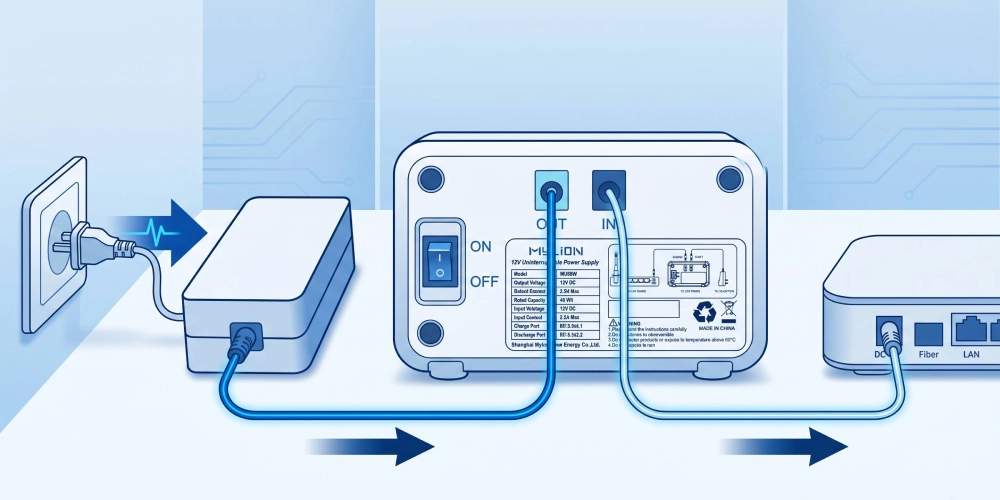
- Installation setup: confirm how the Mini DC UPS will connect to the existing adapter, device, and deployment environment.
This is why battery capacity alone should never be used as the only selection criterion. The right solution balances compatibility, backup time, installation simplicity, and the needs of the overall deployment.
How Should an ISP Validate a Mini DC UPS Before Deployment?
For a B2B rollout, sample or pilot testing is the most reliable way to confirm that the backup solution works as expected with the actual equipment.
Use the same ONT, ONU, router, gateway, cables, connectors, and adapters planned for the project. Then simulate a power outage and confirm that the required service remains available for the target period without an unexpected device restart.
A useful pilot does not need to be complicated. It should simply answer three questions:
- Does the equipment remain powered and connected when mains power is interrupted?
- Does the system meet the project’s target backup time under the agreed working condition?
- Does the device return to normal charging and operation when mains power is restored?
Record the device models, test condition, runtime, and any service interruption. This gives engineering, procurement, and operations teams a clear result that can be repeated and reviewed.
How Can MYLION Help Match the Right Mini DC UPS?
MYLION supports global B2B customers with Mini UPS project selection, sample evaluation, and deployment preparation. The recommended direction depends on the actual equipment and project requirements rather than simply choosing the highest-capacity unit.
For ISP and telecom projects, MYLION can review standard 12 V backup requirements, higher-load applications, multi-device setups, and other approved Mini UPS directions based on the device information provided.
Which MYLION Mini UPS Options Support Different Runtime Targets?
The table below provides a shortlist framework based on current approved public product data. It does not confirm compatibility with a particular ONT, router, or gateway. Voltage, load, connector, output limits, and field conditions still require verification.
Model | Approved output / architecture | Battery energy | Formula estimate at 12 W |
12 V DC; 2.5 A continuous / 3 A maximum | 18.72 Wh | 2 hours | |
12 V DC; 2.5 A continuous / 3 A maximum | 29.6 Wh | 3 hours | |
12 V DC; 2.5 A continuous / 3 A maximum | 44.4 Wh | 4 hours | |
12 V DC; 4 A continuous / 5 A maximum | 56.16 Wh | 5 hours | |
12 V DC 1.5 A continuous / 2 A maximum + USB | 37.44 Wh | 4 hours | |
AC input; dual 12 V outputs, each up to 2 A | 25.6 Wh | 3 hours |
What Information Should You Send for a Faster Recommendation?
A short project brief is usually enough to narrow the selection quickly. The following information is especially helpful:
Project information | What to provide |
Device | ONT, ONU, router, gateway, or CPE brand and model |
Power | Working voltage and measured power or current, if available |
Backup target | Required backup time for the real service scenario |
Connection | Connector type, cable needs, and number of devices to be powered |
Project | Quantity, target market, project stage, and OEM/ODM requirements if applicable |
With this information, the MYLION team can identify suitable evaluation options and reduce unnecessary sample cycles.
FAQ
Q1: What is a Mini DC UPS?
Q2: How long can a Mini DC UPS power an ONT?
Q3: Can I choose a Mini DC UPS from the adapter label alone?
Q4: Does higher output power guarantee longer runtime?
Q5: Is a formula estimate a guaranteed backup time?
Conclusion
For an ISP or FTTH project, the best Mini DC UPS is not simply the model with the biggest battery. Start by defining which devices must stay online and for how long. Use the real working load to make a simple backup-time estimate, confirm compatibility with the equipment, and validate the shortlisted solution in a sample or pilot test.
This approach gives technical teams a clear test target, procurement teams a practical comparison basis, and network operations a backup solution linked to actual service continuity.

 English
  简体中文
简体中文  Deutsch
  Français
  Italiano
  Español