
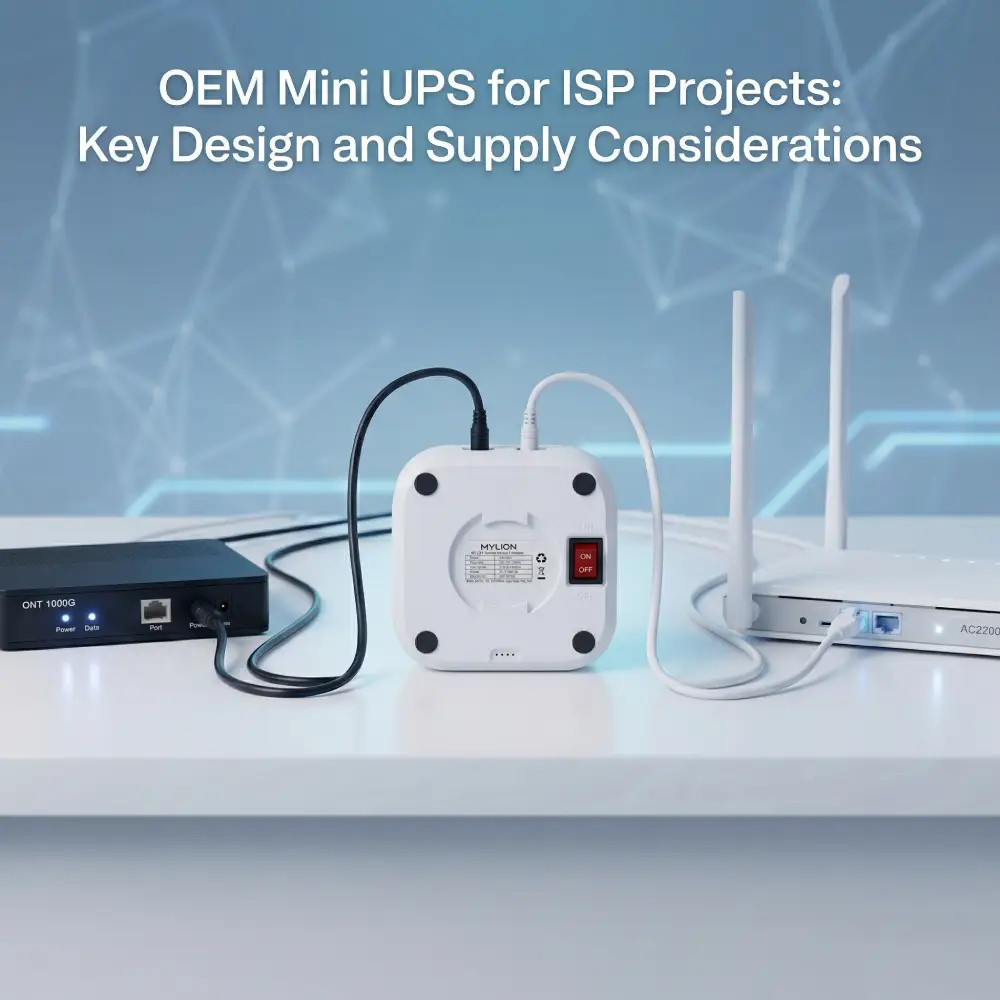
Many ISP and telecom projects require more than a standard off-the-shelf backup power product. OEM mini UPS solutions allow buyers to customize voltage, connectors, housing, packaging and branding to fit their deployment needs. For successful project execution, buyers should look beyond the sample stage and review engineering support, testing process and mass production capability.
This article walks through the key design and supply considerations when sourcing OEM mini UPS for ISP projects—helping you avoid common pitfalls and build a reliable partnership. MYLION specializes in exactly this type of tailored backup power solution, with a proven track record across ISP and telecom deployments.
Why ISPs may need OEM or customized mini UPS
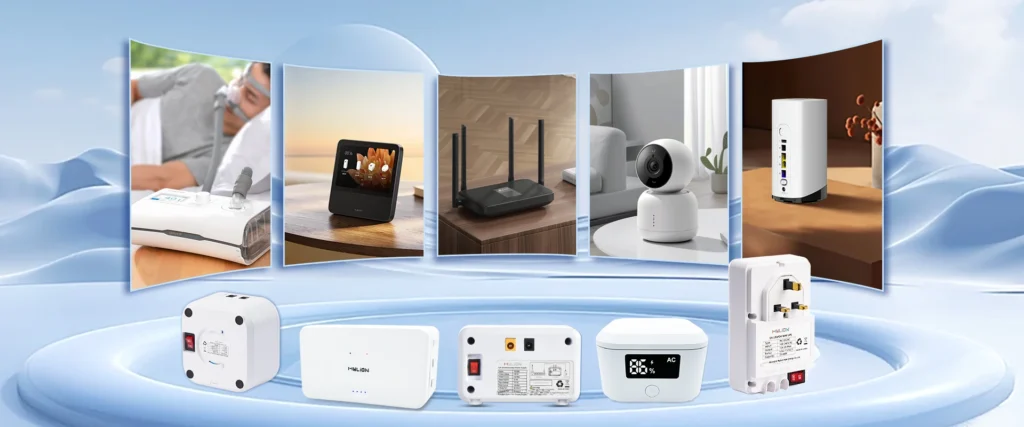
For broadband and telecom deployments, one size rarely fits all. Different installation environments—indoor, outdoor, roadside cabinets, or multi-dwelling units—place different demands on backup power. Equipment such as routers, ONTs, ONUs, and CPEs may require specific output voltage, current rating, or connector types that a standard mini UPS does not offer.
A OEM mini UPS project can start with a simple branding changes, but often extends to technical adjustments, such as:
- Output voltage design
- Connector pin layout
- Enclosure design
- Cable configuration
- Packaging requirements
For ISPs, these changes directly improve product fit, simplify field deployment, and create a more consistent user-side experience.
MYLION has delivered thousands of such customized units to ISPs across North America, Europe, and Australia, adapting quickly to local equipment and field conditions.
Common ISP Equipment Power Requirements
Device Type | Typical Input Voltage | Typical Current | Common Connector | Typical Runtime Need |
ONT (GPON) | 12V DC | 0.5A – 1.0A | 2.1mm DC jack | 2 – 4 hours |
ONU (Ethernet) | 5V DC / 12V DC | 1.0A – 2.0A | USB-A / 2.5mm DC | 1 – 3 hours |
Router (Wi-Fi) | 9V DC / 12V DC | 0.8A – 1.5A | 2.1mm DC jack | 2 – 4 hours |
Outdoor CPE | 24V PoE / 12V DC | 0.3A – 0.8A | RJ45 / DC terminal | 4 – 6 hours |
ONT + Router combo | 12V DC | 1.2A – 2.0A | 2.5mm DC jack | 3 – 5 hours |
Voltage, connector and runtime customization
The most common technical customizations for ISP projects revolve around three areas: voltage, connector, and runtime.
- Voltage and current – Many CPEs and ONUs operate at 5V, 9V, 12V, or even adjustable ranges. A fixed-output standard UPS may not match. OEM design allows precise matching to your device input specifications.
- Connector type – DC barrel jacks (2.1mm, 2.5mm), USB-A, USB-Cor proprietary connectors. The wrong connector creates field rework. OEM suppliers can match your exact connector and polarity.
- Runtime expectations – Short interruptions (30 minutes) vs. longer backup (4–6 hours) require different battery capacity and charging logic. Your supplier should calculate runtime based on actual load (current draw) of your ONT/CPE models.
MYLION offers flexible voltage options from 5V to 24V, supports all common connector types, and provides runtime calculation based on your actual device testing—not theoretical estimates.
OEM Mini UPS Customization Options
Customization Item | Typical Options | Why It Matters for ISP Projects |
Output voltage | 5V, 9V, 12V, 24V, or adjustable (e.g., 9–12V) | Match ONT/router input to avoid overvoltage damage |
Output current | 0.5A – 3.0A (continuous) | Ensure stable startup and peak load handling |
Battery capacity | 2,600mAh – 10,000mAh (Li-ion/LiFePO₄) | Determines actual runtime under load |
Connector type | 2.1mm/2.5mm DC, USB-A, USB-C, screw terminals | Eliminate field adapter work, reduce truck rolls |
Charging logic | CC/CV, trickle charge, low-temp protection | Extend battery life in outdoor cabinets |
Cable length | 30cm – 150cm detachable or fixed | Fit different enclosure layouts |
Branding, packaging and project-specific requirements
In the highly competitive EU and US telecom sectors, physical hardware is a direct extension of the ISP’s brand. An OEM mini UPS should be visually integrated into the overarching service package.
- Silk-screen or laser marking – Your logo, model number, and safety markings on the housing.
- Custom housing color or shape – To match existing CPE aesthetics or fit narrow enclosures.
- Retail or bulk packaging – Printed boxes for subscriber handouts, or simple industrial packaging for field stock.
- Cable configuration – Fixed cable vs. detachable cable; cable length; color coding.
- Labeling and manuals – Local language instructions, regulatory marks (CE, FCC, RoHS), and installation warnings.
These project-specific customization requirements may seem minor, but they directly impact users’ perception of the product and the efficiency of installation technicians. A reputable OEM supplier will provide a clear list of customization options and confirm every detail before production.
MYLION offers B2B buyers OEM logo printing, custom packaging design, and voltage/capacity customization services. We provide branding options with low minimum order quantities and support manuals in multiple languages.
Supply chain stability and mass production readiness
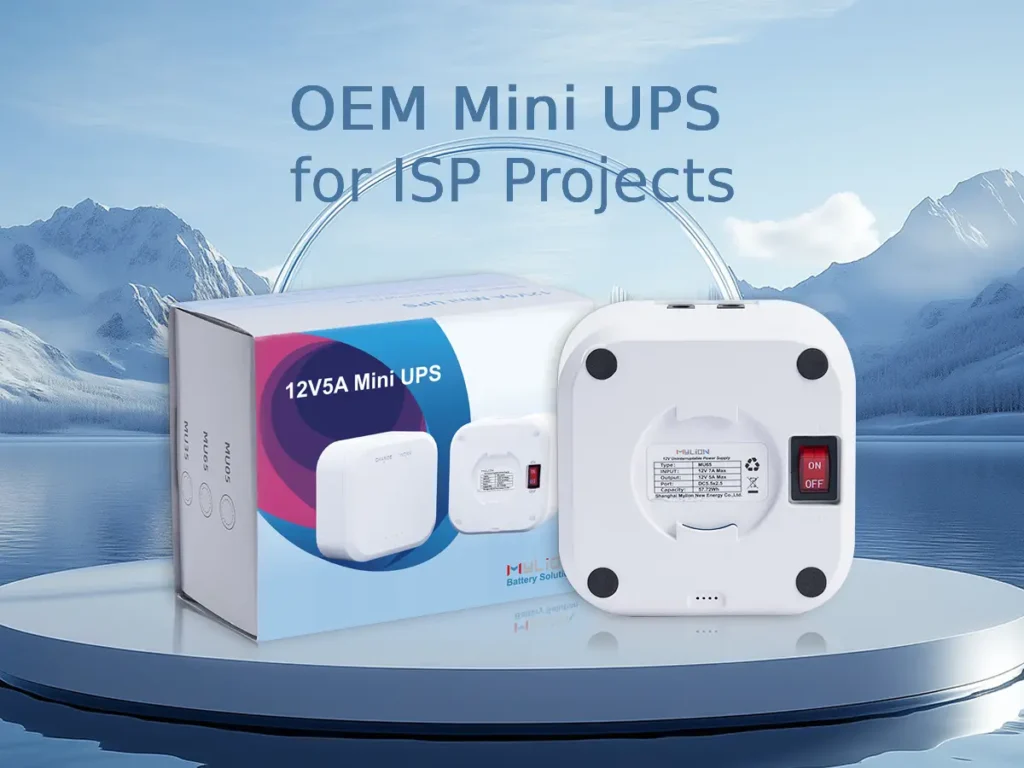
One of the biggest risks in OEM mini UPS projects is the gap between a working sample and repeatable mass production. Many suppliers are capable of producing a fully functional prototype, but this does not guarantee consistent performance, uniform quality, or the ability to deliver reliably at scale.
Telecom and broadband projects require repeated, high-volume shipments over multi-year rollout schedules. Therefore, supply capability is equally as important as the product design itself. When evaluating suppliers, ask about:
- Component sourcing – Are battery cells, PCBA components, and connectors from reliable, traceable sources? Any substitution policy?
- Production planning – What is their typical lead time for 1k, 5k, or 10k units? Do they buffer critical components?
- Quality control – Does every unit go through voltage, load, and charging tests before packing?
- Consistency – Have they delivered similar OEM projects for other ISPs or telecom brands?
MYLION maintains long-term partnerships with Tier 1 battery cell suppliers and operates its own PCBA production line. We have a comprehensive quality management system (ISO 9001) in place and ensure a stable supply chain that meets the requirements of ISP projects.
Testing and qualification before rollout
Validation is a critical step, yet it is often underestimated. Before being rolled out on a larger scale, an OEM’s small UPS products must undergo rigorous real-world testing. This phase goes beyond basic laboratory standards. It requires confirmation of the following:
- Voltage and Connector Verification—Output voltage must be verified under load conditions, not just open-circuit voltage.
- Operational Testing — Connect to actual routers/optical network terminals/optical network units and measure backup duration until power is cut off.
- Charging Behavior — Check charging time, overcharge protection, and battery status indicators.
- Thermal Performance and Durability Testing — Operate at rated load for 24 to 48 hours under expected ambient temperatures.
- Field Pilot — Deploy 20 to 50 units at the actual installation site for 2 to 4 weeks.
Proper validation testing can significantly reduce rework, eliminate field issues, and prevent costly misunderstandings between buyers and suppliers.
MYLION provides detailed sample test reports. Every device complies with UN38.3, CE, RoHS, and FCC standards and undergoes UL testing, 100% functional testing, and comprehensive aging tests—for every production batch.
How to work with an OEM supplier efficiently
For ISP projects, the most effective OEM partner combines deep customization support with unshakeable supply stability and honest communication.
To ensure a smooth OEM mini UPS project, follow these practical steps:
- Define your requirements early – Create a specification sheet with voltage, current, connector type, runtime (minutes vs. hours), operating temperature, and any branding needs.
- Request engineering review – Ask the supplier to confirm application understanding (router, ONT, ONU, CPE) and propose any design adjustments.
- Agree on sample criteria – Specify what “sample approval” means: electrical performance, mechanical fit, runtime test, and any compliance marks.
- Set production quality expectations – Discuss batch testing, defect rate tolerance, and how to handle non-conforming units.
- Maintain clear communication – Use written records for all changes. A good OEM cooperation depends on technical clarity, not just commercial interest.
MYLION follows a structured 4-stage OEM workflow (Requirement → Sample → Pilot → MP), with clear deliverables at each stage. Their project managers are trained to ask the right questions early—reducing the back-and-forth that often delays ISP projects.

MYLION Advantage – Why ISPs Choose Us for OEM Mini UPS
Mylion provides OEM services for compact UPS to ISPs. Here are the benefits MYLION offers for your telecom or networking projects:
- True customization – We adjust voltage, current, connector, cable, housing, battery capacity, and charging logic based on your actual devices.
- Engineering-led approach – Our team understands ONT, ONU, router, and CPE applications. We speak the same technical language as your network engineers.
- Supply you can rely on – We manufacture in compliance with ISO 9001 standards, with traceable battery cells and batch test reports provided for every order.
- Low-MOQ branding – We offer logo printing, custom packaging, and multilingual manuals starting at 500 units.
- Global shipping & compliance – CE, FCC, RoHS, and other certifications available. We ship to ISPs in North Americ, Europe, Middle East, and Australia.
- Proven ISP track record – We have received repeat orders from numerous telecomm carriers and broadband service providers.
When you work with MYLION, you are not buying a sample and hoping for the best. You are getting a documented, repeatable OEM process.
FAQ
Q1: What does OEM mini UPS mean?
It refers to a backup power product that can be customized for project, branding or technical requirements—rather than a standard off-the-shelf model.
Q2: What can usually be customized?
Voltage, connector type, housing, packaging, label, branding, cable configuration, and runtime characteristics are common customization items.
Q3: Why is supply capability important?
Because a good sample is not enough if the supplier cannot maintain stable production for project rollout. ISP projects need repeatable quality and predictable lead times across multiple shipments.
Q4: How long does an OEM mini UPS project take?
Typical timeline: 2–4 weeks for engineering samples, 2–3 weeks for validation and adjustments, then 4–6 weeks for mass production (depending on quantity). Always confirm lead time with your supplier.
Q5: Can I get both UL/CE certification and OEM branding?
Yes. Reputable OEM suppliers can produce certified designs with your branding, but confirm regulatory responsibility and documentation support in advance.
Conclusion
Sourcing an OEM mini UPS for ISP projects is not about finding the cheapest sample. It is about finding a supplier who can deliver consistent quality at scale, support your technical customization needs, and communicate honestly throughout the project lifecycle.
MYLION has established its OEM mini UPS business specifically to address these needs. From voltage and connector design to packaging and repeat shipments, MYLION acts as an extension of your ISP engineering team—not merely a parts supplier.
 English
  简体中文
简体中文  Deutsch
  Français
  Italiano
  Español