Sample testing is the critical bridge between product recommendation and mass production approval. Without a structured checklist, buyers risk misunderstandings, inconsistent results, and repeated test cycles. This guide provides a practical, repeatable framework for evaluating Mini UPS samples — helping you make confident, data-driven decisions before project sign-off.
Pre-Test Checklist
Use the table below to verify all prerequisites before powering up any Mini UPS sample.
Check Item | Typical Values / Notes |
Target device model (ONT, ONU, router, CPE, etc.) | Record exact brand and model number |
Input voltage of target device | 5V, 9V, 12V, 24V, 48V DC (common) |
Connector type and polarity | Barrel jack (5.5×2.1mm / 5.5×2.5mm), USB-C, screw terminal |
Real working current (measured or estimated) | mA or A under normal operation |
Target backup time | e.g., 2 hours, 4 hours, 8 hours |
Number of devices to be backed up | Single or multiple (total load current) |
Final system adapter model | Confirm voltage, current rating, and connector |
During Testing – Step by Step
Follow these steps closely to obtain repeatable, meaningful results.
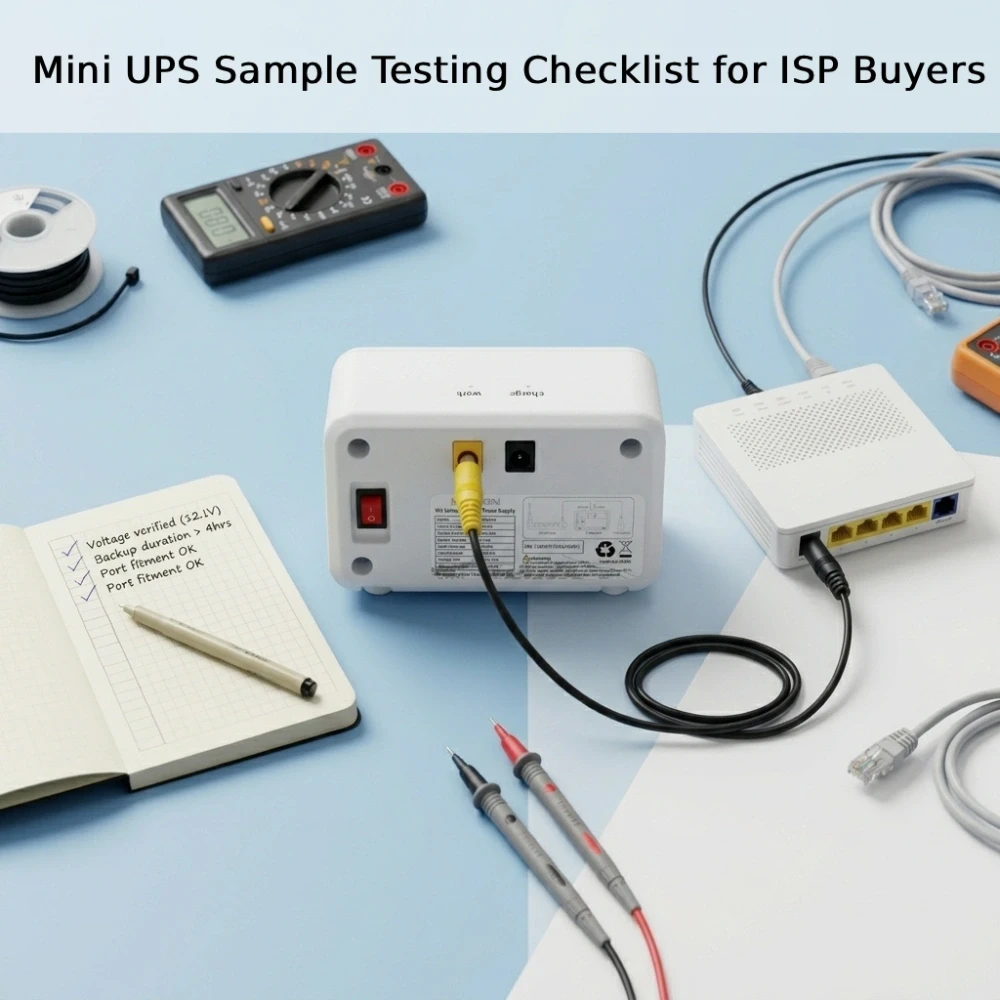
- Record environment conditions– ambient temperature, ventilation, and test bench setup.
- Fully charge the Mini UPSbefore any backup time test (use the intended adapter).
- Connect the actual target device(s) in real working mode (not dummy loads).
- Start timingfrom the moment input power is disconnected. Record:
- Start time and end time (when device shuts down)
- Load voltage at regular intervals (e.g., every 30 minutes)
- Any abnormal behavior (flashing LEDs, reboots, noise, etc.)
- Test power–failure switching behavior– disconnect AC/DC input and observe whether the connected device:
- Stays online without restart
- Briefly resets (unacceptable for many ISP applications)
- Shows voltage drop or instability during transfer (use an oscilloscope if available)
- Repeat key testsat least three times – if results vary significantly, investigate the cause.

Safety and Protection Checks
Check | Acceptable Criteria |
Temperature rise under normal load | Warm but not painfully hot to touch (≤50°C surface) |
Output voltage stability | Within ±5% of rated voltage under varying load |
Over-current protection (if specified) | Shuts down or limits current when exceeding rated max |
Short-circuit protection (if specified) | Automatic recovery or latch-off (per project requirement) |
After Testing – Documentation & Approval
Once testing is complete, do not skip these final steps:
- Share all data– test reports, photos, and videos (especially if any issue occurred).
- Root-cause analysis– determine whether the issue is related to:
- The Mini UPS itself
- The adapter or charging source
- Test conditions (temperature, ventilation, load)
- Load mismatch (e.g., current exceeds UPS rating)
- Freeze the approved sample version – record firmware, battery cell batch, and PCB revision. Use this as the baseline for mass production.
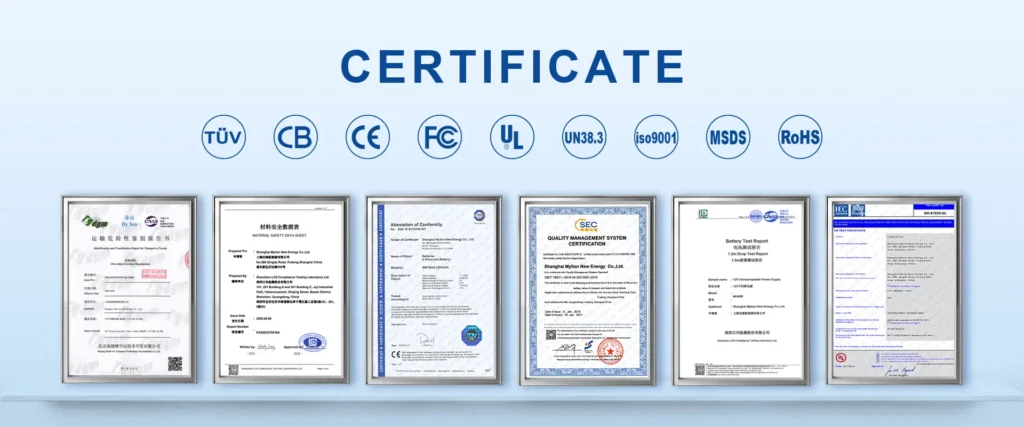
- Confirm non-technical items– cable length and type, label artwork, packaging, and certification documents (CE, FCC, RoHS, UN38.3, etc.).

常问问题
Q1: Why should abnormal tests be agreed in advance?
Q2: Should backup time be tested only once?
Q3: What should I do if sample result is not as expected?
Q4: How many Mini UPS samples should I request for testing?
MYLION如何为买家提供支持
MYLION 专注于 B2B 迷你直流 UPS 和 lithium battery backup solutions for telecom, ISP, and industrial applications. We support customers throughout the entire journey:
- Product selection based on device voltage and backup time
- Sample validation guidance (including custom checklists)
- Custom cables, labels, and packaging
- Certification document preparation (CE, FCC, RoHS, UN38.3, etc.)
- Production inspections and shipment documentation
We don’t just sell components – we help you test, validate, and deploy with confidence.
需要适用于光网络终端 (ONT)、光网络单元 (ONU)、路由器、客户端设备 (CPE) 或电信设备的迷你型 UPS 或锂电池备用电源解决方案吗?请联系 MYLION!
合规说明
认证要求取决于产品配置、目标市场、电源适配器、电池容量和最终应用。买方应在批量生产前确认适用的要求。