
Introduction
In today’s digital economy, telecom and networking infrastructure forms the backbone of communication, data exchange, and critical services. From broadband access and mobile backhaul to IP surveillance and edge computing, continuous connectivity is no longer optional—it is expected. Yet one of the most underestimated risks to network stability remains power reliability.
As Mylion, a professional manufacturer specializing in DC Mini UPS solutions for telecom and networking devices, we work closely with telecom operators, ISPs, and system integrators worldwide. A clear pattern has emerged across different markets and applications: even brief power interruptions can trigger disproportionate operational and financial consequences.
This article explains why Mini UPS systems have become essential components in modern telecom power design, how they address real-world pain points, and why they outperform both no-backup configurations and consumer-grade alternatives such as power banks.
The Power Reliability Challenge in Modern Telecom Networks
Always-On Requirements for Telecom and Networking Devices
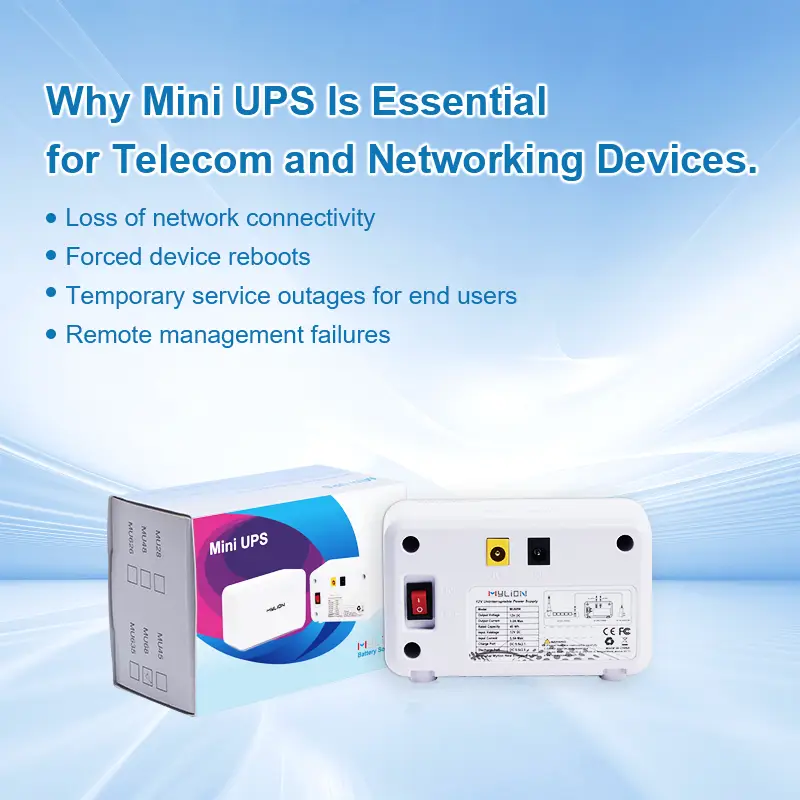
Telecom and networking devices are fundamentally different from consumer electronics. Equipment such as routers, ONT devices, modems, IP cameras, and edge gateways are designed to operate 24/7 under stable power conditions. Any interruption—even lasting a few seconds—can result in:
Loss of network connectivity
Forced device reboots
Temporary service outages for end users
Remote management failures
For telecom operators and ISPs, these events directly affect service-level agreements (SLAs), customer satisfaction, and brand reputation. In distributed networks with thousands of access points, small failures scale into major operational challenges.
The Hidden Impact of Short Power Interruptions
Power outages are not always dramatic blackouts. In many regions, networks suffer from:
Micro power cuts
Voltage fluctuations
Unstable AC supply
Planned maintenance interruptions
While short in duration, these events can still cause routers or ONT equipment to shut down unexpectedly. Once offline, devices may require manual rebooting, remote reconfiguration, or even on-site intervention, significantly increasing maintenance costs.
In access networks, edge locations, and smart security systems, these risks are amplified due to the absence of centralized power protection.
Why Conventional Backup Approaches Fall Short?
Centralized UPS Systems Are Not Designed for the Edge
Traditional UPS systems are effective in data centers and central offices, but they are often impractical for distributed telecom deployments. Their limitations include:
Large physical footprint
Higher installation and wiring complexity
Inefficient protection for individual low-power devices
Increased capital and operational expenditure
As networks evolve toward fiber access, edge computing, and decentralized architectures, power protection must also become more localized and scalable.
Operating Without Dedicated DC Backup Power
Some installations rely solely on direct AC-to-DC power adapters with no backup solution. This approach exposes devices to:
Instant shutdown during outages
Higher failure rates due to unstable input power
Reduced equipment lifespan
In mission-critical environments, operating without DC backup power is no longer a viable option.
What Is a Mini UPS and Why It Matters?
Defining the DC Mini UPS
A Mini UPS is a compact, DC-based uninterruptible power supply specifically designed to support low-voltage telecom and networking equipment. Unlike large UPS systems, Mini UPS units are optimized for:
Routers and modems
ONT and fiber access equipment
IP cameras and smart security devices
Small telecom and edge networking devices
Mini UPS systems provide instant switchover to battery power when the main supply fails, ensuring uninterrupted operation.
Designed for Telecom Power Requirements
Unlike generic backup solutions, industrial Mini UPS systems deliver:
Stable DC output
Fast response time
Compatibility with telecom voltage standards
Reliable battery management
This makes them ideal for protecting sensitive networking electronics that cannot tolerate voltage drops or reboot cycles.

Key Advantages of Mini UPS for Telecom and Networking Applications
Continuous Connectivity and Network Stability
The primary function of a Mini UPS is to maintain uninterrupted power. By preventing unexpected shutdowns, Mini UPS systems help ensure:
Continuous broadband access
Stable network sessions
Reliable remote monitoring and management
For ISPs and telecom operators, this translates into fewer service disruptions and improved customer experience.
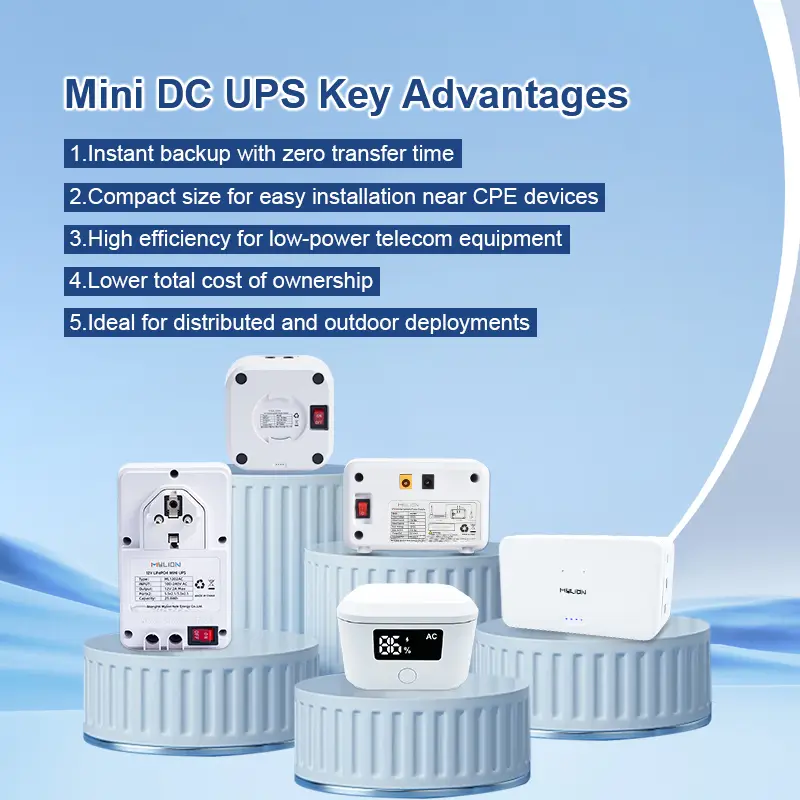
Compact Design and Easy Integration
One of the defining advantages of Mini UPS solutions is their compact form factor. They can be easily integrated into:
Telecom cabinets
Wall-mounted installations
Outdoor enclosures
Existing networking setups
Importantly, Mini UPS units require no major infrastructure changes, making them ideal for both new deployments and network upgrades.
Improved Equipment Reliability and Longevity
Power instability is a leading cause of premature device failure. By delivering clean, stable DC power, Mini UPS systems:
Protect sensitive components
Reduce thermal and electrical stress
Extend the operational lifespan of networking devices
Over time, this contributes to a lower total cost of ownership (TCO).
Mini UPS VS Power Banks: A Critical Distinction
Why Consumer Power Banks Are Not Suitable?
Power banks are designed for personal electronics such as smartphones and tablets. While they may appear similar in concept, they lack the characteristics required for telecom use:
No guaranteed continuous output
Unstable voltage regulation
No automatic switchover during outages
Limited durability and lifecycle
Using power banks in telecom environments introduces reliability risks and maintenance challenges.
Industrial Mini UPS: Purpose-Built for Telecom
In contrast, industrial DC Mini UPS systems are engineered specifically for 24/7 operation. They offer:
Automatic and seamless power transition
Stable DC output under load
Robust battery protection
Long-term reliability
For professional telecom deployments, Mini UPS systems clearly outperform power banks and improvised backup solutions.
Mini UPS as a Standard Component in Modern Network Architecture
Fiber Networks and FTTx Deployments
As fiber networks expand, ONT devices and access equipment are increasingly deployed closer to end users. Mini UPS systems play a critical role in:
Maintaining service continuity during power outages
Supporting uninterrupted voice and data services
Reducing fault reports related to power loss
This has made Mini UPS solutions a standard design element in many FTTx projects.
Smart Security and Edge Networking
IP cameras, access control systems, and edge gateways rely on continuous power to function effectively. A Mini UPS ensures:
Ongoing surveillance and monitoring
Reliable data transmission to central systems
Enhanced security during power disruptions
In smart city and IoT deployments, Mini UPS solutions significantly improve system resilience.

Reducing Maintenance Costs and Operational Burden
Fewer Site Visits and Emergency Interventions
Power-related issues account for a substantial portion of field maintenance activities. By stabilizing power supply at the device level, Mini UPS systems help:
Reduce emergency callouts
Minimize manual reboots
Lower labor and travel costs
This is especially valuable for remote or hard-to-access installations.
Improved Total Cost of Ownership (TCO)
While Mini UPS systems represent a modest upfront investment, they deliver long-term savings by:
Preventing revenue loss from downtime
Extending equipment lifespan
Reducing operational disruptions
For telecom operators and ISPs, these benefits directly support profitability and scalability.
Why Telecom Operators and System Integrators Choose Mini UPS Solutions?
Across global markets, Mini UPS systems are increasingly selected by:
Telecom operators expanding access networks
ISPs managing distributed infrastructure
System integrators deploying turnkey solutions
The reasons are consistent: reliability, scalability, and ease of deployment. Mini UPS solutions align with modern DC power design principles and support the growing demand for resilient networks.
Choosing the Right Mini UPS for Telecom Applications
Key Selection Criteria
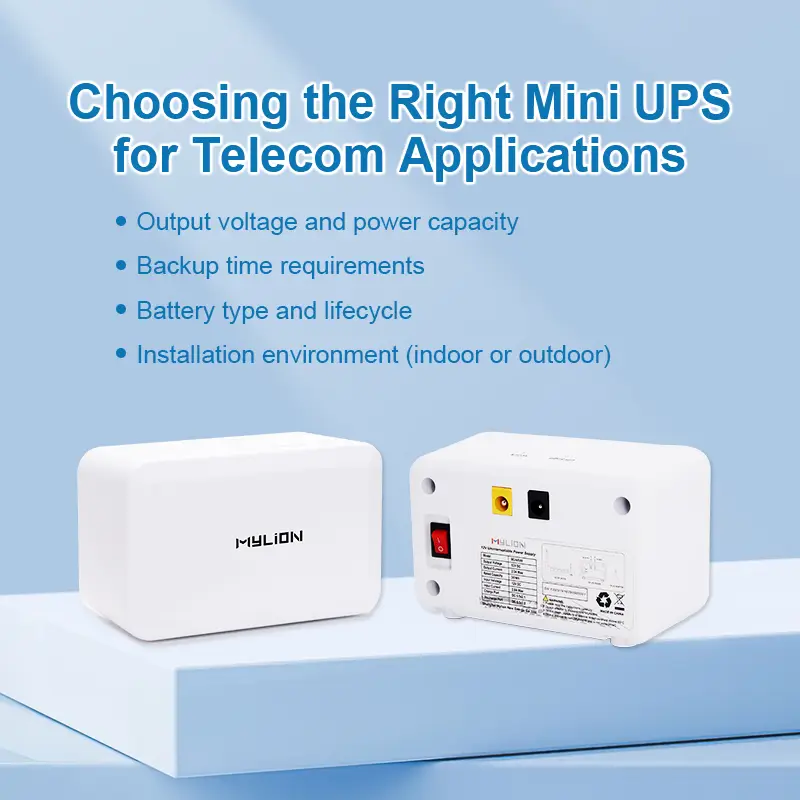
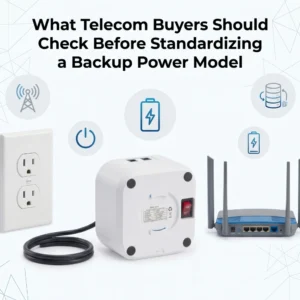
When selecting a Mini UPS for telecom and networking devices, decision-makers should consider:
Output voltage and power capacity
Backup time requirements
Battery type and lifecycle
Installation environment (indoor or outdoor)
A properly matched Mini UPS ensures optimal performance and long-term reliability.
Conclusion: Mini UPS Is No Longer Optional in Telecom Power Design
As telecom and networking infrastructures continue to evolve, power continuity has become a strategic requirement rather than a technical afterthought. Mini UPS systems provide a practical, scalable, and cost-effective solution to protect critical devices from power disruptions.
By ensuring continuous operation, reducing maintenance costs, and improving overall network stability, Mini UPS solutions have become essential components in modern telecom power architecture.
About Mylion
As a professional manufacturer of DC Mini UPS solutions, Mylion is committed to supporting telecom operators, ISPs, and system integrators with reliable backup power systems designed for real-world networking environments.
If you are planning new deployments or upgrading existing telecom infrastructure, contact Mylion to explore Mini UPS solutions tailored to your networking and power requirements.


 English
  简体中文
简体中文  Deutsch
  Français
  Italiano
  Español