
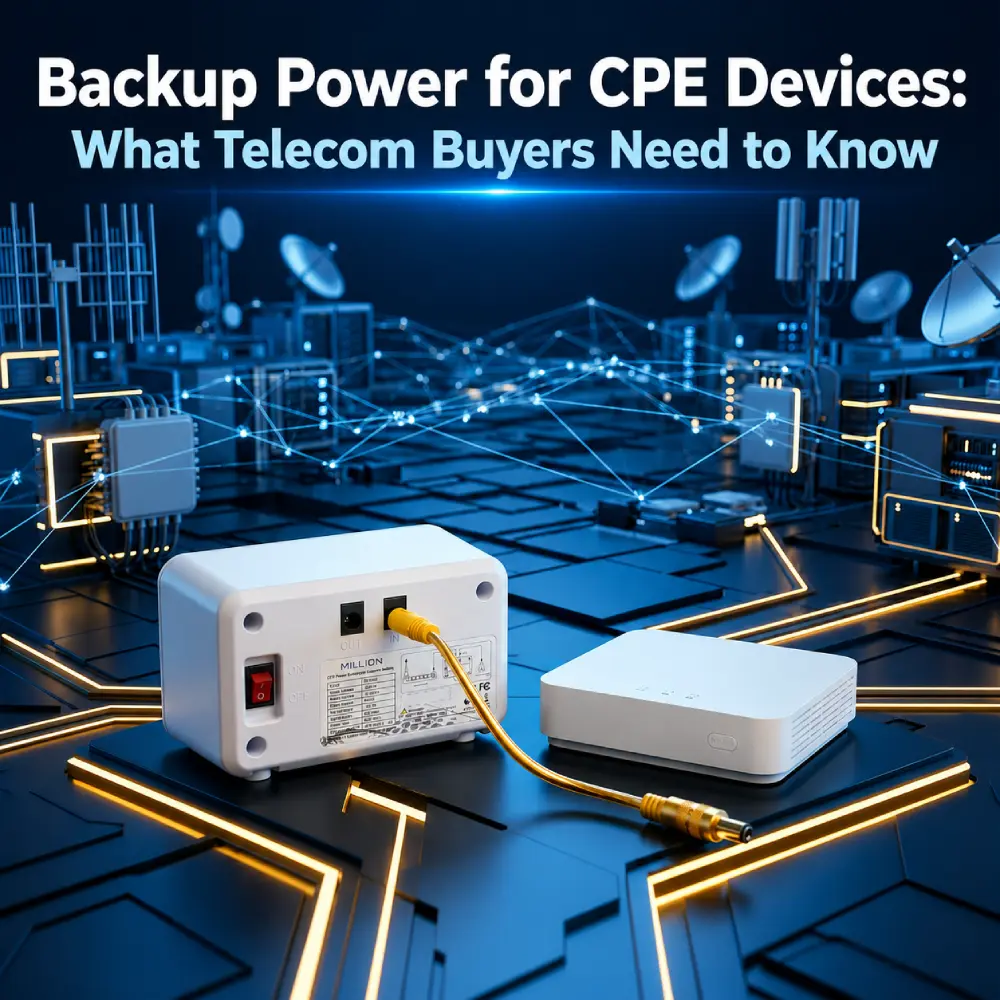
For telecom operators, ISPs, and system integrators, network downtime is no longer acceptable—nor is it purely a core network issue. The weakest link in modern connectivity is often the CPE: ONT, ONU, router, or wireless gateway. When local power fails, even a fully functional fiber or fixed wireless link goes dark, leading to customer complaints, SLA breaches, and costly truck rolls.
Mini UPS is the best solution for CPE backup power supply. It is a backup power supply specifically designed for edge deployment. This guide explains why CPE backup power has become a procurement priority, what to look for in a mini DC UPS, and how solutions like the Mylion MINI UPS deliver reliable, cost-effective power continuity at scale.
Why CPE Backup Power Has Become a Critical Telecom Procurement Priority
Telecom core networks enjoy diesel generators and massive battery banks—but the last mile remains exposed. Most CPEs rely on standard residential AC power. When an outage strikes, the fiber line stays live, yet the terminal shuts down instantly. The result is a complete blackout from the user’s perspective, even though the provider’s infrastructure is intact.
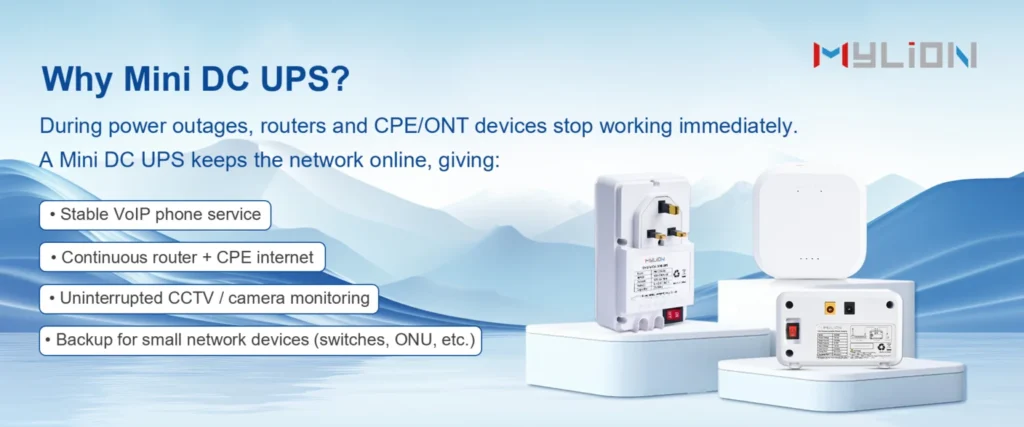
Backup power for CPE devices is no longer optional. The mini DC UPS provides an immediate backup power supply, enabling the equipment to remain online in the event of a power outage.
Its value for telecom buyers includes:
- Service continuity:keeps routers, ONTs, and small switches online during outages, avoiding customer complaints.
- SLA protection:prevents downtime penalties for enterprise and residential broadband contracts.
- Operational efficiency:reduces truck rolls and support calls caused by power-related reboots.
- Device longevity: provides stable voltage, protecting sensitive CPE from surges and brownouts.
Why Choose DC Mini UPS as the Backup Power Supply for CPE?
Traditional AC UPS systems are overkill for CPEs. They convert AC to DC and back to AC, wasting energy, taking up space, and costing more—while CPEs run natively on low-voltage DC. A Mini DC UPS delivers power directly at the required DC level, offering:
- Zero transfer time – No reboot, no session drop, no RF link loss.
- Higher efficiency (>90%) – Less waste, longer runtime from the same battery.
- Compact footprint – Installs behind or beside the CPE.
- Lower total cost of ownership – Ideal for large-scale ISP deployment.
For modern FTTH, FWA, and 5G CPE networks, the mini DC UPS is the clear industry standard.
Five Key Factors for Telecom Choosing CPE Backup Power
When assessing backup power solutions for CPE devices, telecom buyers must consider the following five key factors.
1. Voltage Compatibility
CPEs typically use 5V, 9V, 12V, or 24V DC. A mismatch can destroy the device (over-voltage) or cause boot loops (under-voltage). Always match the UPS output voltage to your device fleet.
Device Type | Typical Voltage |
Home Router | 12V |
ONT / CPE | 9V or 12V |
CCTV Camera | 12V |
Small Switch | 12V or 24V |
2. Battery Capacity & Backup Time
Backup time = battery energy (Wh) ÷ load power (W) × efficiency.
- Basic ONTs draw 5–10W,
- Wi-Fi 6 routers 10–15W,
- High-end CPEs up to 24W.
Choose capacity based on expected outage duration: 2–6 hours for short outages, 8+ hours for unstable grids.
3. Connector Types
Different CPE brands use different DC connectors. The most common are:
- 5 × 2.1 mm (standard for many routers)
- 5 × 2.5 mm
- USB-C (increasingly used for modern CPE)
- Micro-USB
For bulk procurement, ensure the UPS includes interchangeable tips or that your supply chain can source matching adapters. Standardizing on one or two connector types reduces field installation complexity.
4. Battery Chemistry: Li-ion vs. LiFePO₄ vs. Lead-Acid
Attribute | Li–ion | LiFePO₄ | Lead Acid (SLA) |
Cycle life | 500–1,000 | 2,000–6,000+ | 300–500 |
Service life | 4–6 years | 10–15 years | 2–4 years |
Weight (per Wh) | Light | Moderate | Heavy |
Maintenance | None | None | Regular |
Safety (with BMS) | Good | Excellent | Fair |
TCO over 10 years | Low | Lowest | High |
Recommendation: For ISP projects, prefer LiFePO₄ (longest life, safest) or high-quality Li-ion. Avoid lead-acid for CPE backup.
5. Safety & Protection
For telecom-grade reliability, ensure each UPS includes:
- Over-charge and over-discharge protection
- Short-circuit and temperature protection
- Automatic switchover (mains to battery) with <10ms transition
- LED or audible status indicators
These features prevent device damage, reduce warranty claims, and lower field maintenance costs.
Selection Checklist for Telecom Buyers
Use this checklist when evaluating vendors and models:
- Confirm voltage and current of target CPE devices (add 10–20% margin).
- Define required backup duration based on local outage patterns.
- Verify connector compatibility for all device models in your network.
- Select battery chemistry – Li-ion for standard use, LiFePO₄ for high-cycle or outdoor deployments.
- Check safety certifications (CE, FCC, RoHS, UN38.3 for transport).
- Evaluate vendor B2B capabilities – volume pricing, lead times, and technical support.
Mini UPS for Telecom Applications - CPE Backup Power Solution
Mylion offers a full range of Mini DC UPS solutions designed for CPE, ONT, ONU, and router backup. Below is a quick reference table for telecom buyers:
Model | Output Voltage | Output Current | Battery Capacity | Typical Backup Time | Best Application |
MU26 | 12V | 2A | 19.24Wh | 2–6h | Home router+CPE |
MU35 | 12V | 5A | 77.7Wh | 3–8h | Router + small CPE |
MU48 | 5V/12V | 3A | 29.6Wh | 6–12h | Router + ONT |
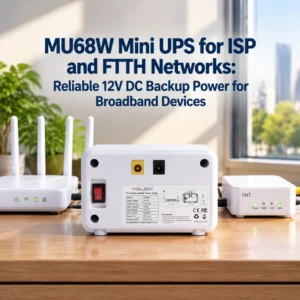
MU68 | 12V | 3A | 45Wh | 6–10h | Frequent outage areas |
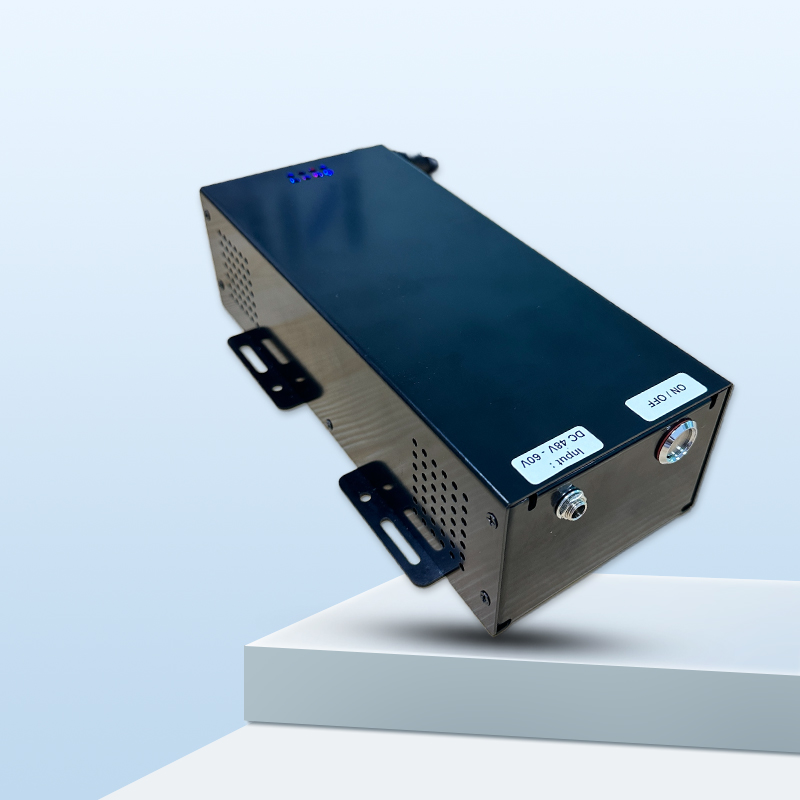
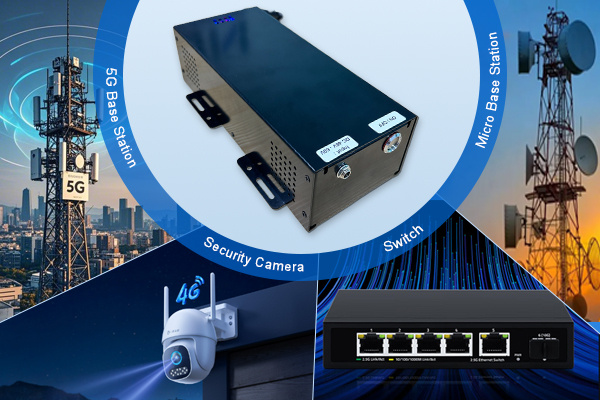
MU248 | 24V/48V | Varies | 102.4Wh | 8–24h | Outdoor / base station |
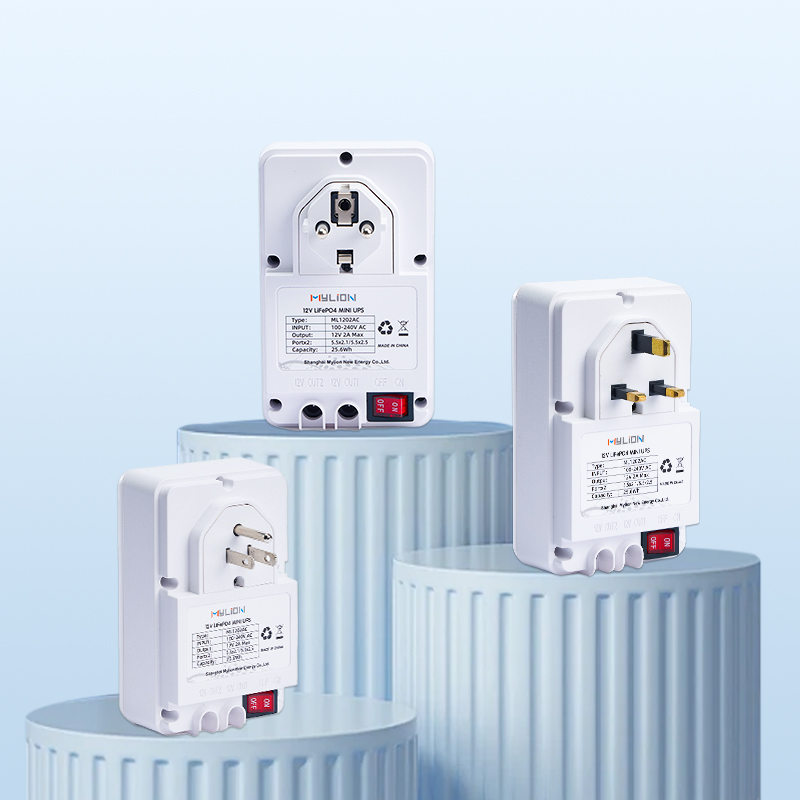
ML1202AC | 12V | 2A | Varies | 2–4.5h | Home network / office |
MUJ46 | 12V + 5V USB | 12V 2A, USB 3A | 38.48Wh | 4–8h | Low-power ONT / router with USB devices |
Recommendations by device type:
High-power CPEs (Wi-Fi 6E/7, MDUs) → Choose 12V 5A models (MU35 Mini UPS, MU05 Mini UPS, MU65 Mini UPS).
Standard CPEs/ONTs → Choose 12V 3A models (MU48 Mini UPS, MU68 Mini UPS, MUC85 Mini UPS).
Low-power ONTs / basic CPEs → Choose 12V 2A models (MU26 Mini UPS, MUJ46 Mini UPS, ML1202AC Mini UPS). MUJ46 also offers dual USB ports for charging 5V devices.
All Mylion Mini UPS features 0ms automatic switchover, intelligent BMS, and multiple safety certifications (CE, FCC, UL, RoHS).
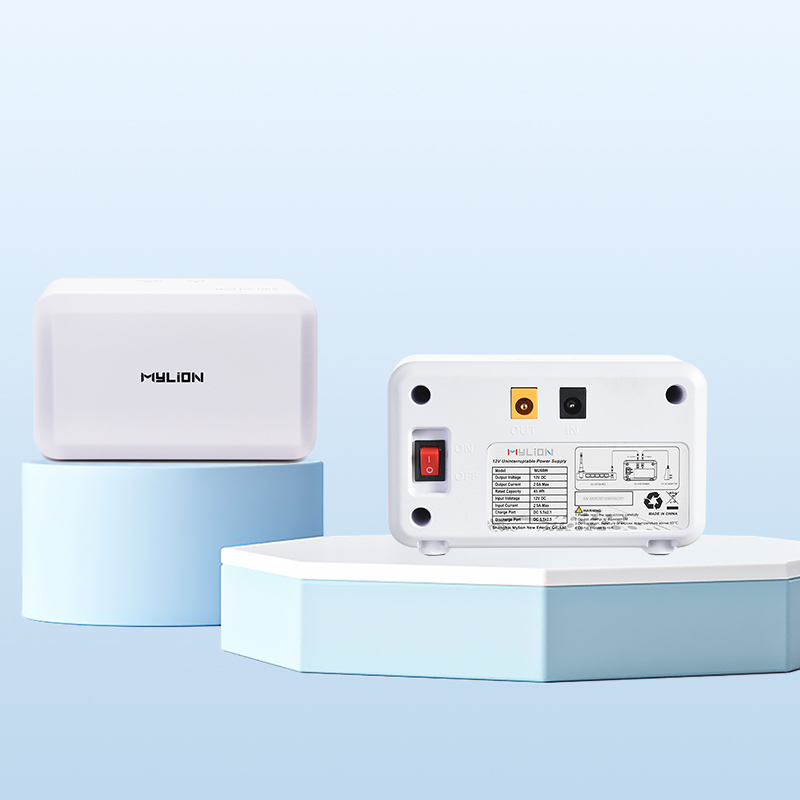

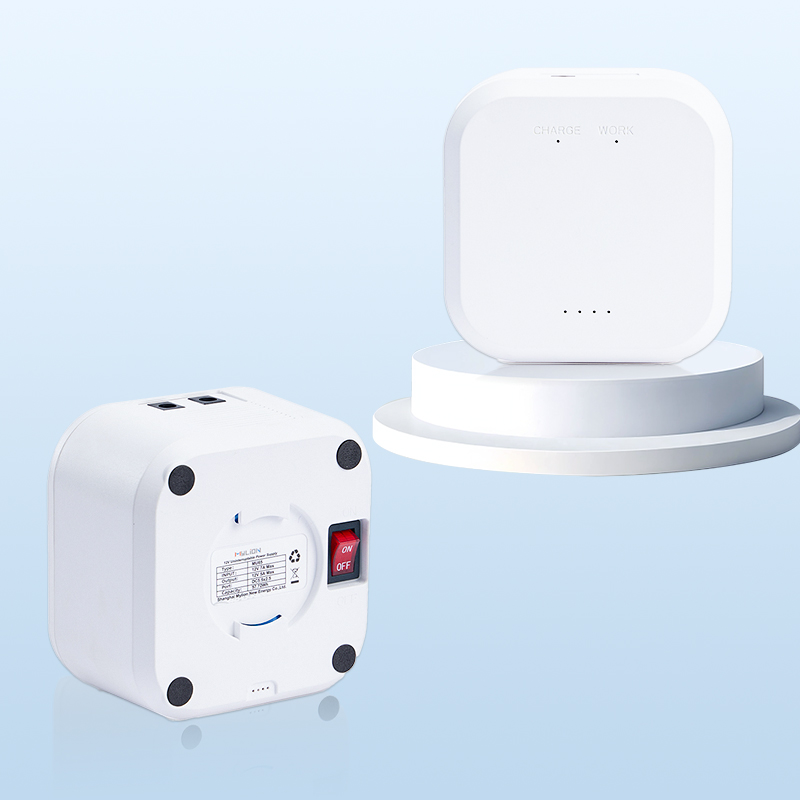
MU26 Mini UPS
MU48 Mini UPS
MU35 Mini UPS
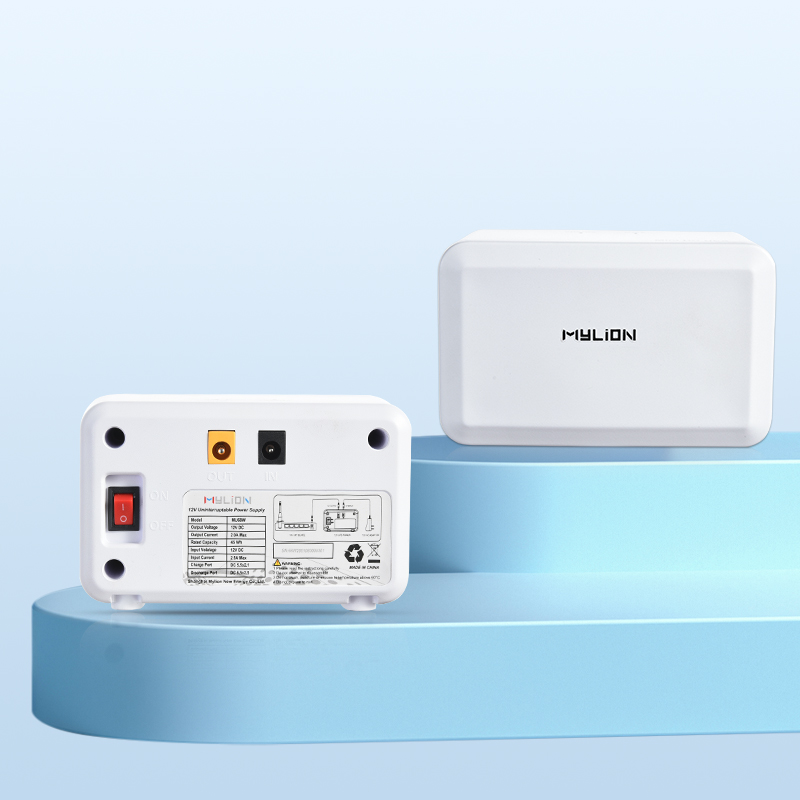
MU68 Mini UPS
LiFePO4 Mini UPS
MU248 Mini UPS
Rea-World Application Scenarios for CPE Backup Power
1. Home Broadband CPE Deployment (Residential FTTH/FWA)
A typical home setup includes one ONT/ONU (5–10W) and a Wi-Fi router (5–15W). Power outages cause instant loss of connectivity and customer complaints.
Recommended models: MU48 (router+ONT combo), MU26 or MUJ46 (router only, with optional USB charging for phones), or ML1202AC.
Key benefits: Zero transfer time, compact size, LED battery indicators, and silent operation. MUJ46’s extra USB ports allow users to keep a smartphone powered during outages.

2. Small Office or Enterprise CPE Deployment (SOHO, MDU, Business Broadband)
Offices and MDUs often require higher power for multiple CPEs, PoE switches, or VoIP gateways. Downtime directly impacts revenue.
Recommended models: MU35 (12V 5A, 77.7Wh), MU68 (12V 3A Li-ion for frequent cycling), or MU248 for 24V/48V MDU ONUs.
Key benefits: High current capacity (5A) for multiple devices, reliable Li-ion performance for daily cycles, robust 24/7 operation.
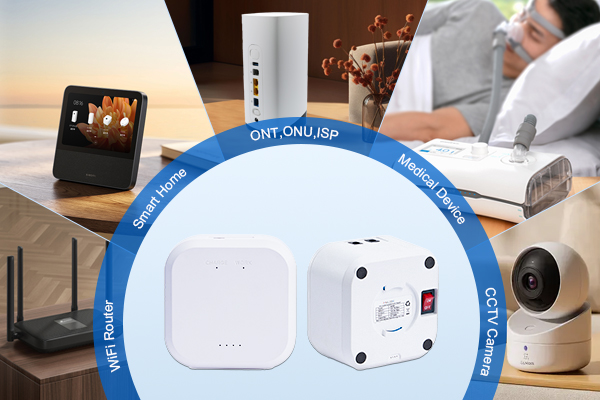
3. Remote or Outdoor CPE Deployment (Rural Broadband, Tower-Mounted CPE, CCTV)
Remote sites (poles, rooftops, towers) face unstable grids, long outages, and harsh weather. Extended runtime (8–24h) and weather resistance are critical.
Recommended models: MU248 (high capacity, waterproof option) or MU68 (compact Li-ion for pole mounting).
Key benefits: 8–24h runtime, Li-ion works reliably in varied temperatures, optional waterproof casing, and easy remote health checks.
By matching the scenario to the right Mini UPS, telecom buyers optimize cost and reliability across residential, business, and remote networks.
Why Choose Mylion as the Backup Power Supply Provider for CPE
Mylion is a trusted B2B manufacturer specializing in Mini DC UPS for telecom, ISP, and system integrator projects.
- 100% factory tested – Consistent quality for large-scale deployment.
- Global certifications – CE, FCC, UL, RoHS – ready for regulated markets.
- OEM/ODM services – Custom PCB designs, branded casings, voltage/connector modifications.
- LiFePO₄ & Li-ion options – Long life, low TCO, enhanced safety.
- Wide voltage support – 5V, 9V, 12V, 24V, 48V – compatible with almost any CPE.
- Proven in the field – Deployed in FTTH, FWA, rural broadband, and 5G CPE networks worldwide.
FAQ
Q1. What is the difference between a DC UPS and a regular AC UPS for CPE?
Q2. Can one DC UPS power multiple CPE devices simultaneously?
Q3. Is it safe to leave a DC UPS connected 24/7?
Q4. What is the typical lifespan of a mini DC UPS battery?
Q5. Can I get customized voltages, connectors, or branding for bulk orders?
Q6. Are these mini UPS compatible with the standard global telecom hardware we currently deploy?
Conclusion
CPE backup power is no longer an accessory—it is a core telecom procurement priority. By deploying purpose-built Mini DC UPS with correct voltage, adequate capacity, and modern lithium or LiFePO₄ chemistry, operators can eliminate last-mile downtime, reduce truck rolls, protect SLAs, and retain customers.
Mylion delivers telecom–grade solutions proven in large-scale ISP projects, backed by full certifications and customization capabilities.
 English
  简体中文
简体中文  Deutsch
  Français
  Italiano
  Español