
Broadband customer-premises equipment is becoming more capable and, in many projects, more power-demanding. Advanced Wi-Fi gateways, fixed wireless CPE, integrated modem-router units and professional network terminals may draw more power than a basic ONT or entry-level router. Their demand can also change during startup, wireless transmission, network registration and high-traffic operation.
For an ISP or system integrator, this means Mini UPS selection cannot stop at matching a 12V label or choosing the largest battery. The backup unit must support the complete electrical and deployment profile of the connected device. Output capability and backup duration are separate decisions, and both must be confirmed before rollout.
This guide explains the selection process for higher-load devices. For a broader overview of application categories, review the MYLION Mini UPS product range and the router, modem and CPE backup solution.
Why Standard Mini UPS Solutions Fail for High-Power CPE Devices
A backup unit that appears suitable on paper can still cause a gateway to restart, shut down or trigger protection.
- Selecting by device category rather than actual electrical requirements;
- Treating the power adapter’s maximum rating as the device’s normal consumption;
- Ignoring startup or wireless transmission peaks;
- Confusing maximum output with continuous output;
- Selecting a high-capacity battery without confirming its output capability;
- Assuming that identical-looking DC plugs have the same dimensions and polarity;
- Estimating runtime without accounting for changing loads or conversion losses.
High output power and long backup duration are separate requirements. A unit may support a relatively high load but provide only a short runtime at that load. A higher-energy battery may run longer, but it is not automatically able to support a higher continuous current.
The Six Inputs Required Before Selecting a Mini UPS
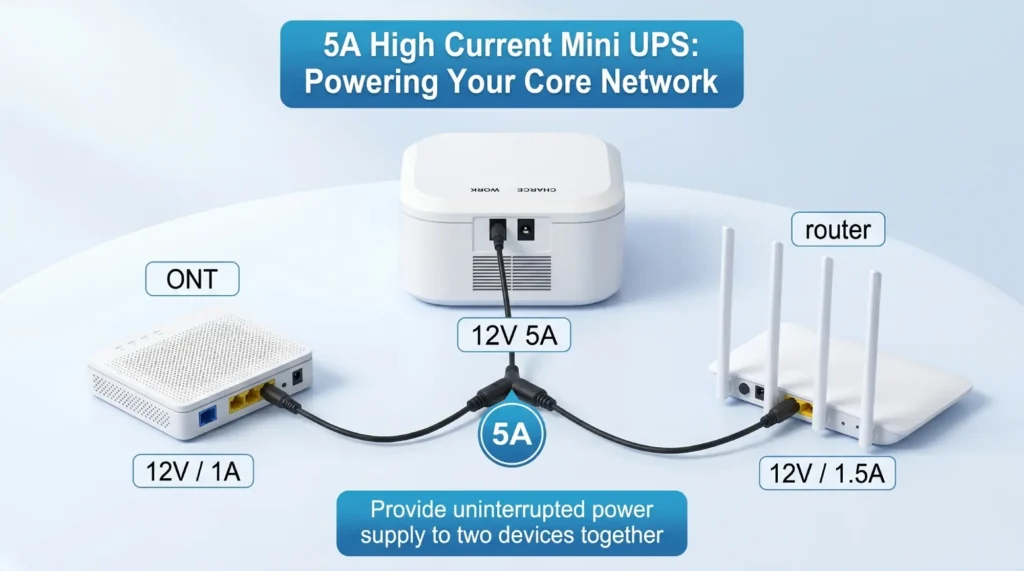
1. Device Operating Voltage
The Mini UPS output voltage must match the CPE or gateway’s approved input voltage.
A 12V solution should not be used by default for 24V, 48V or PoE equipment. These applications require a separately approved product direction or an engineering review.
2. Actual Continuous Load
Continuous load is the power required while the device is operating normally over time.
Where possible, obtain measured operating power under representative conditions. The adapter label is useful as an upper-limit or risk indicator, but it does not necessarily show the device’s real continuous consumption.
Power (W) = Voltage (V) x Current (A)
For example, a 12V device drawing 3A has a calculated load of 36W. This calculation supports initial screening, but final selection must also consider peak demand, temperature, cabling and the approved operating limits of the Mini UPS.
3. Startup and Peak Demand
CPE and broadband gateways may draw more current during:
- Initial power-up;
- Wireless radio activation;
- Network registration;
- High data traffic;
- CPU-intensive processing;
- The startup of connected modules;
- Changes in transmission power.
Peak demand should be defined by its current, duration and repetition pattern. When approved peak-load data is unavailable, the project should proceed to device testing rather than relying on an assumed value.
4. Connector, Polarity and Cable
Voltage compatibility alone is not sufficient. Confirm:
- Input connector type and dimensions;
- Positive and negative polarity;
- Cable length;
- Conductor capability;
- Expected voltage drop;
- Any locking or installation requirements.
A connector that fits physically does not automatically provide an electrically compatible or reliable connection.
5. Required Backup Time
The required runtime should be based on the ISP’s operating objective. This might include maintaining service during short power interruptions, giving users time to complete critical activity, or supporting a defined network continuity policy.
The result must be presented with the reference load. Based on current approved product data:
- A 572Wh configuration produces a formula estimate of 5 hours at a specified 12W reference load.
- A 75.6Wh configuration produces a formula estimate of 7 hours at a specified 12W reference load.
Actual runtime can also be affected by load variation, conversion efficiency, system consumption, temperature, battery condition, output path, cable losses and protection thresholds.
6. Installation Environment
High load combined with elevated temperature or limited airflow can affect system performance and long-term reliability. The evaluation should include:
- Ambient temperature;
- Ventilation;
- Indoor or protected installation conditions;
- Enclosure design;
- Cable and connector temperature rise;
- Required operating life;
- Maintenance and replacement strategy.
Outdoor CPE applications also require confirmation of where the backup unit will be installed and what environmental protection is provided. Outdoor suitability should never be inferred from the CPE application alone.
MYLION High-Power Network Backup Solution
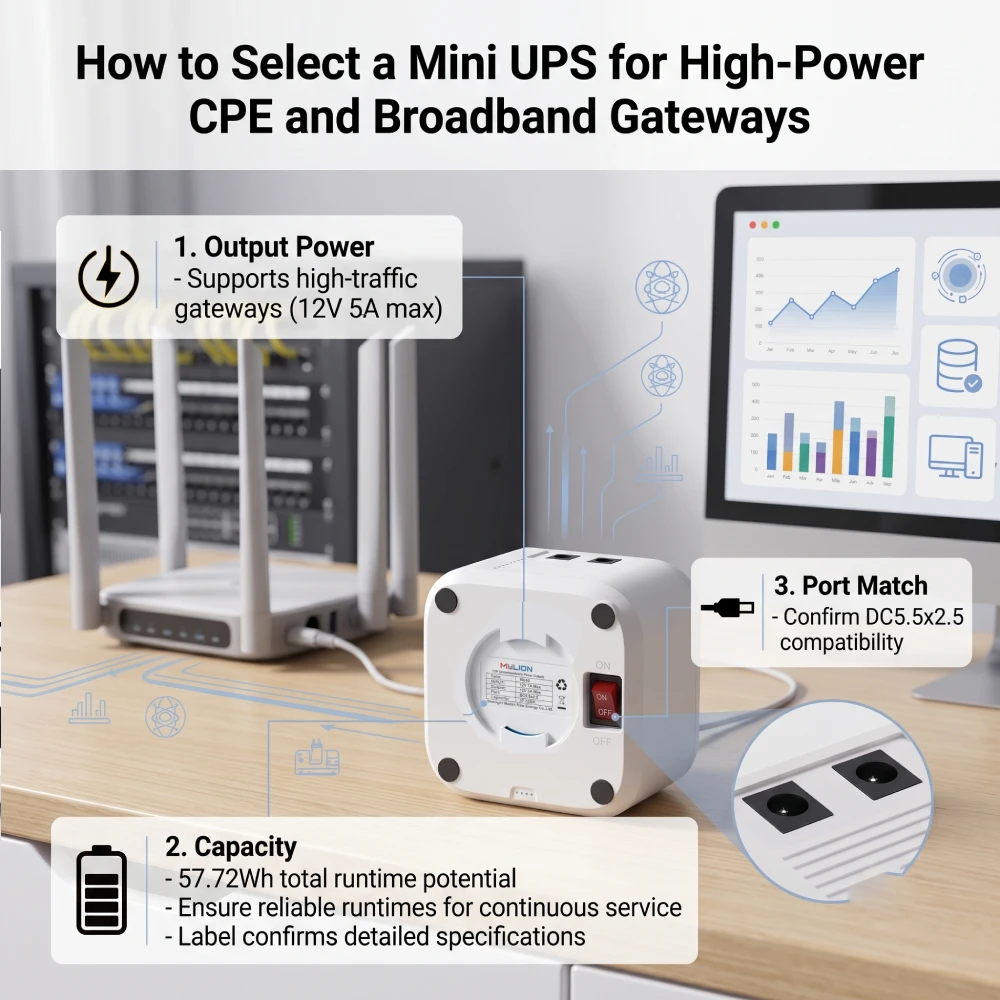
MYLION Provides 12V high-power Mini UPS direction for higher-load routers, gateways, modems and CPE. See the high-power network backup solution for the relevant application category.
Model | Approved output | Energy | Formula estimate | Candidate role |
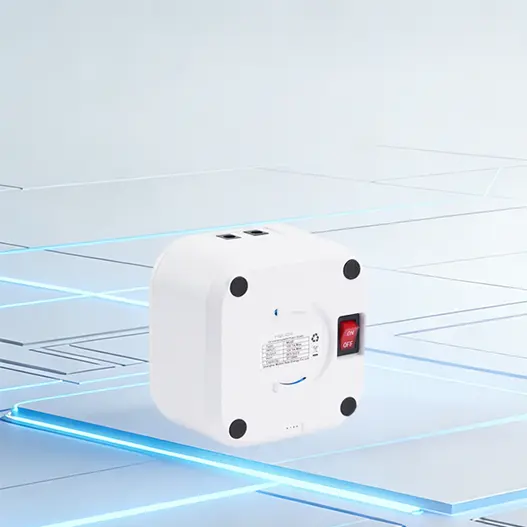
MU65W | 12V DC; 4A continuous; 5A maximum | 57.72Wh | 5 hours at 12W | High-power 12V candidate |
MU35W | 12V DC; 4A continuous; 5A maximum | 75.6Wh | 7 hours at 12W | High-power, longer-runtime candidate |
MU35L | 12V DC; 4A continuous; 5A maximum | 75.6Wh | 7 hours at 12W | High-power, longer-runtime candidate |
The MU65W uses a 57.72Wh battery configuration. The MU35W and MU35L use 75.6Wh configurations for projects that require greater energy capacity while retaining the same approved 12V output direction.
Typical ISP and Broadband Applications
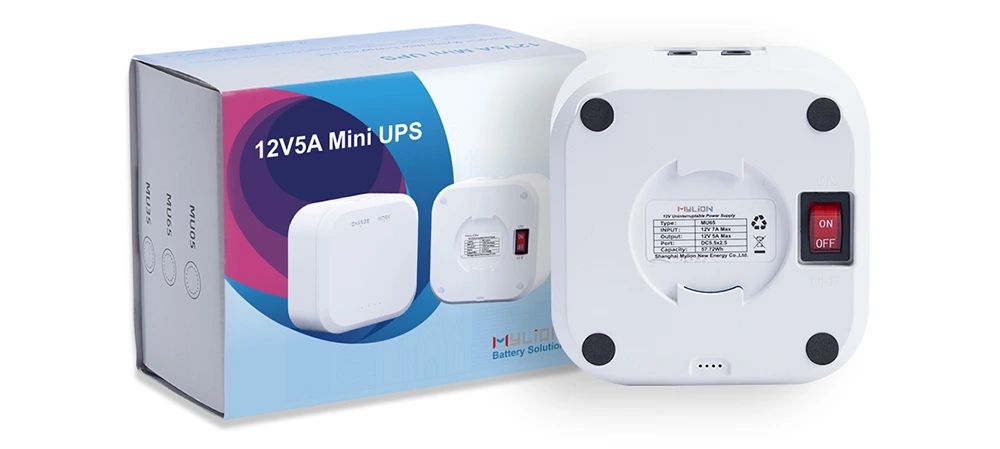
A high-power Mini UPS may be evaluated for:
- High-load indoor CPE;
- Fixed wireless access terminals;
- Integrated broadband gateways;
- Higher-power Wi-Fi routers;
- Modem-router combinations;
- Professional broadband equipment in small-business locations;
- ISP customer-premises network continuity projects.
The application name is only a starting point. Two devices both described as ‘broadband gateways’ may have different voltage, current, startup behavior, connector and environmental requirements.
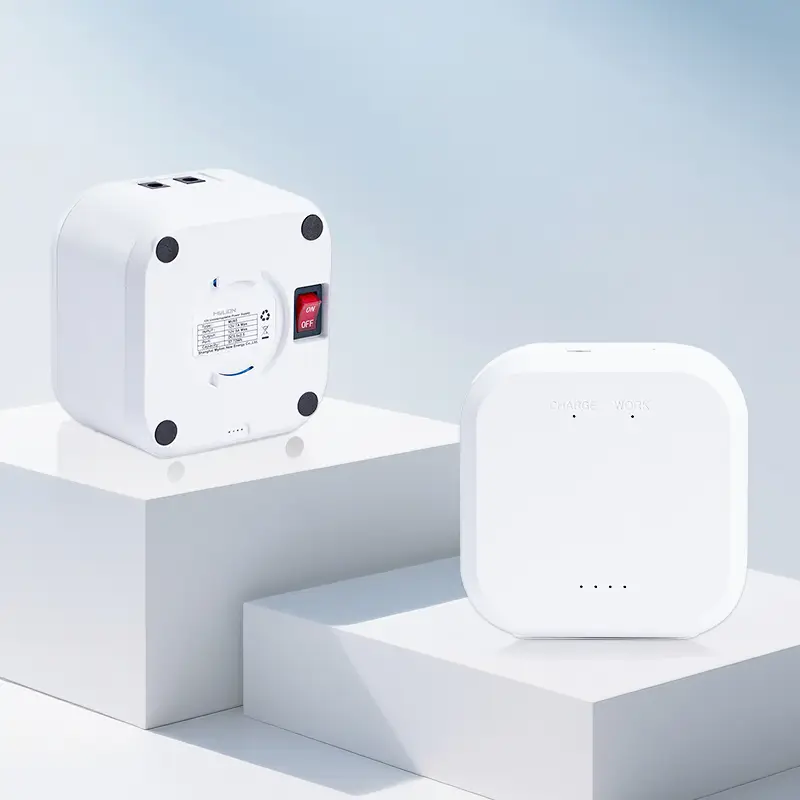
MU65W Mini UPS
MU35W Mini UPS
What to Test Before Volume Deployment
A successful bench calculation is not deployment evidence. Test the complete power path with the actual gateway or CPE, its adapter, the proposed Mini UPS and the final cable configuration.
- Normal continuous operation under representative traffic and radio conditions.
- Initial startup, network registration and reconnection behavior.
- Highest expected traffic, transmission or processing state.
- Input-power interruption and restoration, including whether the device restarts.
- Runtime at a defined operating load and environmental condition.
- Cable voltage drop, connector fit and temperature rise.
- Protection behavior, recovery and repeated interruption cycles.
- Performance across relevant device revisions, firmware versions or deployment variants.
FAQ
Q1: Can an ISP size a Mini UPS using only the adapter label?
Q2: Does a higher-power Mini UPS always provide a longer runtime?
Q3: How do I estimate runtime for a high-power CPE?
Q4: Will the gateway remain online when mains power fails?
Q5: Can a 12V Mini UPS be used for 24V, 48V or PoE CPE?
Q6: What information should an ISP provide for product selection?
Conclusion
Selecting a Mini UPS for high-power CPE and broadband gateways requires more than matching voltage or choosing the largest battery. Start with the actual device load and continuous-output requirement. Then check peak demand, connector and cable performance, input power, installation conditions and the required backup duration.
MYLION’s 12V high-power Mini UPS direction can be evaluated for higher-load routers, modems, gateways and CPE when the requirements fall within approved product conditions. For commercial deployment, confirm the final configuration through device-specific startup, transfer, sustained-load and runtime testing.

 English
  简体中文
简体中文  Deutsch
  Français
  Italiano
  Español