
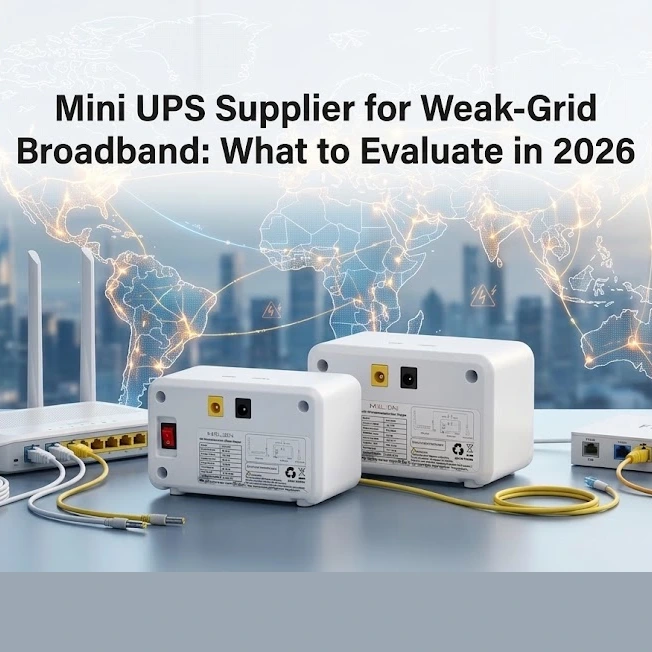
Addressing the Weak-Grid Challenge in Broadband Deployments
Short power outages, sudden voltage drops, and unstable grid conditions remain a persistent challenge for telecom operators, Internet Service Providers (ISPs), broadband network companies, and system integrators. When routers, modems, ONTs, and other customer-premises equipment lose power even briefly, they may reboot and interrupt service continuity for subscribers.
MYLION provides Mini UPS solutions for telecom, ISP, and broadband backup projects, DC backup power solutions, and project support for global B2B customers in telecom, ISP, broadband, security, and related applications.
For organizations deploying backup power at the subscriber side, the objective is not simply to add battery capacity. The more important task is to select a Mini UPS solution that matches the actual network equipment, load profile, connection method, and operating environment.
What Makes Weak-Grid Broadband Different?
In a stable power environment, backup power may only be needed during an occasional outage.
Weak-grid deployments can be more demanding. Broadband equipment may experience short outages, voltage drops, unstable restoration or repeated interruptions. Each event can cause routers, ONTs, ONUs, modems, gateways or CPE devices to restart if the local power path cannot maintain acceptable output.
For a subscriber, even a short equipment reboot may mean a temporary loss of connectivity. For an ISP or system integrator managing a larger deployment, repeated equipment restarts can also increase troubleshooting, support and field-maintenance pressure.
Whether the complete Mini UPS solution works with the actual network device and the real power conditions of the deployment is important.
How MYLION Approaches Mini UPS Selection Risk
Rather than treating Mini UPS selection as a generic backup-power decision, MYLION evaluates applications according to the actual device requirements.
- Device operating voltage
- Working current
- Peak or startup behavior
- Adapter specifications
- Connector and cable requirements
- Installation environment
- Target backup time
Technical confirmation and connector/cable matching can help reduce avoidable selection errors before deployment.
This is particularly important for professional broadband projects, where a mismatch between the Mini UPS and the connected equipment may only become apparent after field installation. For system integrators and network operators managing larger deployments, reducing these compatibility risks can help simplify testing, installation, and subsequent technical support.
A Structured Product Portfolio for Different Load Profiles
MYLION’s Mini UPS portfolio includes multiple product families designed for different voltage, current, runtime, and interface requirements commonly found in broadband and telecom applications.
12V Standard Series
The 12V Standard Series – including the MU26W, MU48W, and MU68W – is designed for entry-level to mainstream broadband backup applications.
The MU26W supports 12V DC output at 2.5A continuous and 3A maximum, with 18.72Wh of battery energy. It is intended for telecom, ISP, and networking applications.
The MU48W provides 29.6Wh of battery energy with the same 2.5A continuous / 3A maximum output profile, supporting ISP and broadband network equipment.
For applications requiring longer backup time, the MU68W extends battery energy to 44.4Wh, making it suitable for selected professional ISP projects.

12V High-Power Series
Higher-load network equipment may require more continuous and peak current than standard Mini UPS models can provide.
The MU65W supports 12V DC input up to 6A and delivers 4A continuous / 5A maximum output, with a 60W total output limit and 56.16Wh of battery energy.
This series is intended for higher-power routers, gateways, modems, and CPE devices whose load requirements exceed standard 2.5A continuous-output applications.
12V High-Power Long-Runtime Series
The MU35W / MU35L combine higher output capability with 75.6Wh of battery energy.
With support for applications requiring up to 4A continuous / 5A maximum output within the applicable system limits, these models are intended for professional gateways and other network devices that require both higher load capability and longer backup time.
12V + USB Multi-Output Series
Some installations require backup power for more than one type of device.
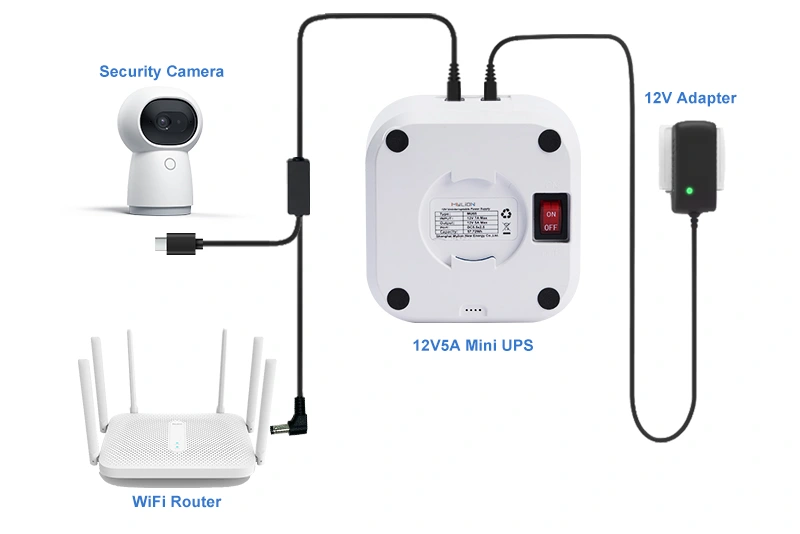
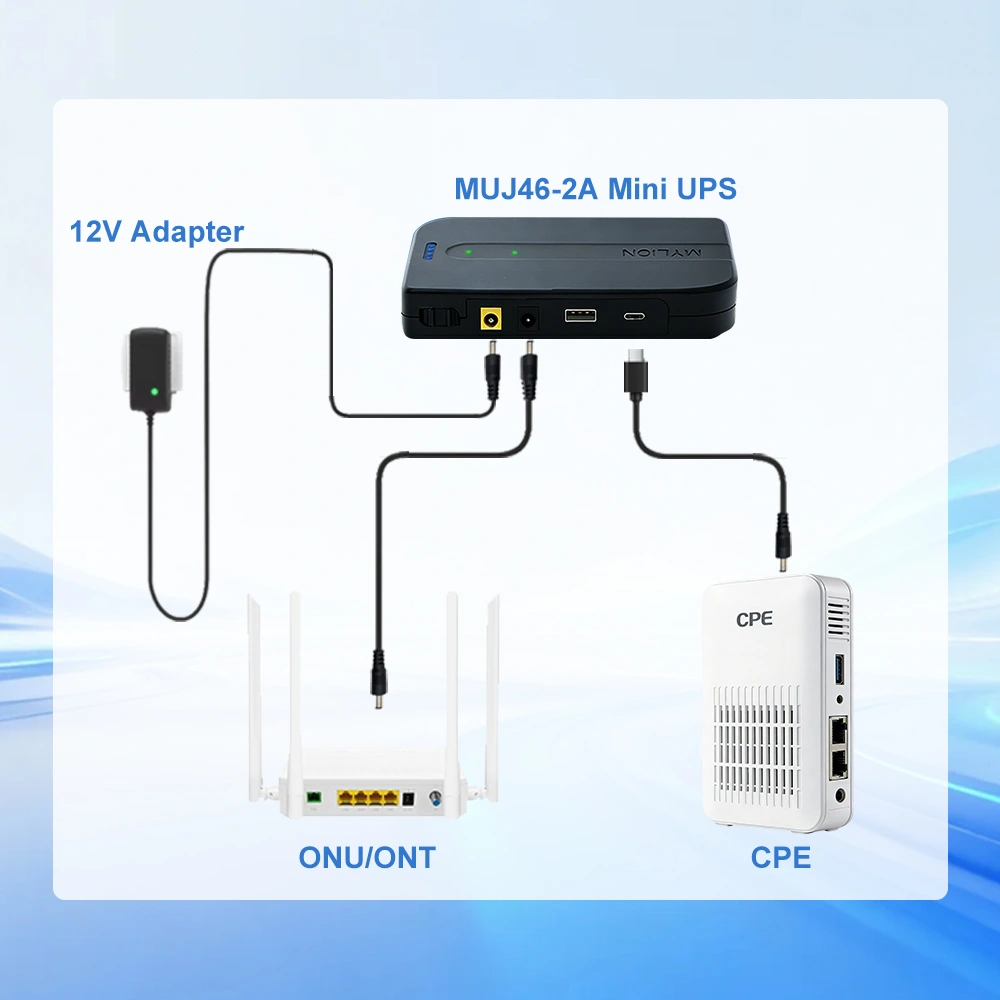
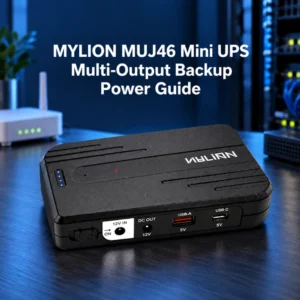
The MUJ46 provides a 12V DC output at 1.5A continuous / 2A maximum together with USB-A and USB-C outputs, within an 18W total system limit. It provides 37.44Wh of battery energy and can support selected small-office, home-office, and networking applications involving both a DC device and a USB-powered accessory.
The MUJ435 extends battery energy to 50.4Wh while retaining the same general multi-output configuration and system power limit.
For all multi-output applications, the total simultaneous load should be verified rather than evaluating each port independently.
AC-Input Dual-Output Series
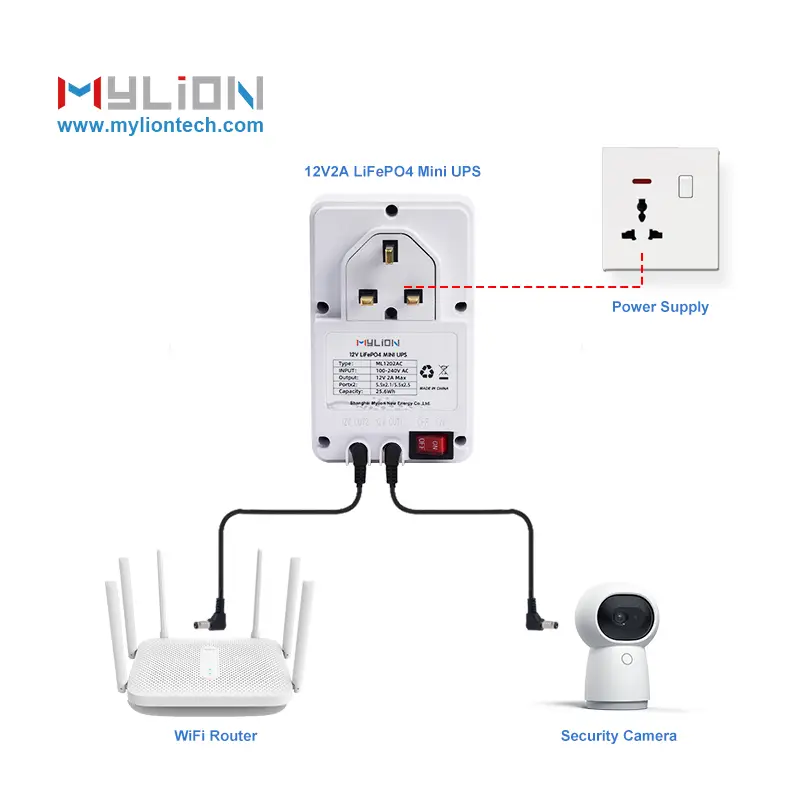
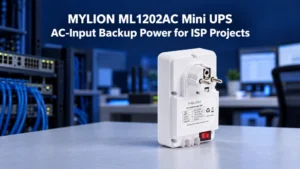
For installations involving two separate 12V devices, the ML1202AC provides an AC-input solution with dual 12V DC outputs.
The model uses LiFePO4 battery chemistry, accepts 100-240V AC input, and provides two 12V DC outputs rated at 2A each within a 24W total system limit. Battery energy is 25.6Wh.
This configuration can simplify selected ONT-and-router installations. For broader application context, see the ONT / ONU backup solution.
Service Model Built Around Project Support
Beyond the Mini UPS hardware itself, MYLION supports B2B customers through project-based technical and commercial coordination.
- Requirement analysis
- Product and model matching
- Sample testing support
- Connector and cable matching
- Private-label and OEM/ODM coordination
- Project documentation support
- Pilot evaluation
- Production preparation
For professional projects, sample validation is an important part of making a project-ready Mini UPS for telecom and broadband selection before wider deployment.
Sample validation allows the customer and supplier to verify whether the selected Mini UPS works with the actual router, ONT, ONU, modem, gateway, CPE, or other connected equipment before moving toward larger quantities.
Pricing is handled according to the specific product, configuration, quantity, project requirements, and commercial conditions rather than through a single fixed project price.
Who MYLION Serves
MYLION supports B2B customers across telecom, ISP, broadband, fiber networking, security, and related DC backup applications.
- Telecom operators and telecom-related companies
- Internet Service Providers
- Broadband network companies
- System integrators
- Network equipment companies
- Distributors and importers
- Brand owners
- OEM/ODM customers
For FTTH and subscriber-side broadband deployments, see MYLION’s FTTH subscriber-side backup solution.
Why choose the MYLION Mini UPS Solution?
For organizations evaluating Mini UPS suppliers for weak-grid broadband projects, the most important consideration is not simply the number of available models.
A dependable solution requires the right combination of product selection, electrical compatibility, connector and cable matching, sample validation, documentation, and project support.
MYLION’s portfolio covers standard, long-runtime, higher-output, multi-output, AC-input, and project-oriented Mini UPS directions, allowing different broadband applications to be evaluated according to their actual voltage, current, runtime, and installation requirements.
For a specific ISP, telecom, or system-integration project, MYLION recommends confirming the connected device, adapter specifications, operating current, connector, required backup time, project quantity, and deployment conditions before selecting the final solution.
FAQ
Q1. What should an ISP check before selecting a Mini UPS?
Q2. Is a higher-capacity Mini UPS always better?
Q3. Can one Mini UPS power both an ONT and a router?
Q4. How long can a Mini UPS run a router or ONT?
Q5. Why are voltage, current, and connector matching important?
Q6. Should samples be tested before a large ISP deployment?
Conclusion
For weak-grid broadband deployments, selecting a Mini UPS is not simply a matter of comparing battery capacity or choosing the highest-rated model. Reliable deployment depends on matching the Mini UPS to the actual router, ONT, ONU, modem, gateway, or CPE.
For ISPs, telecom operators, broadband companies, and system integrators, MYLION supports B2B Mini UPS projects from initial application analysis and product matching through sample validation and preparation for larger-scale deployment.

 English
  简体中文
简体中文  Deutsch
  Français
  Italiano
  Español