
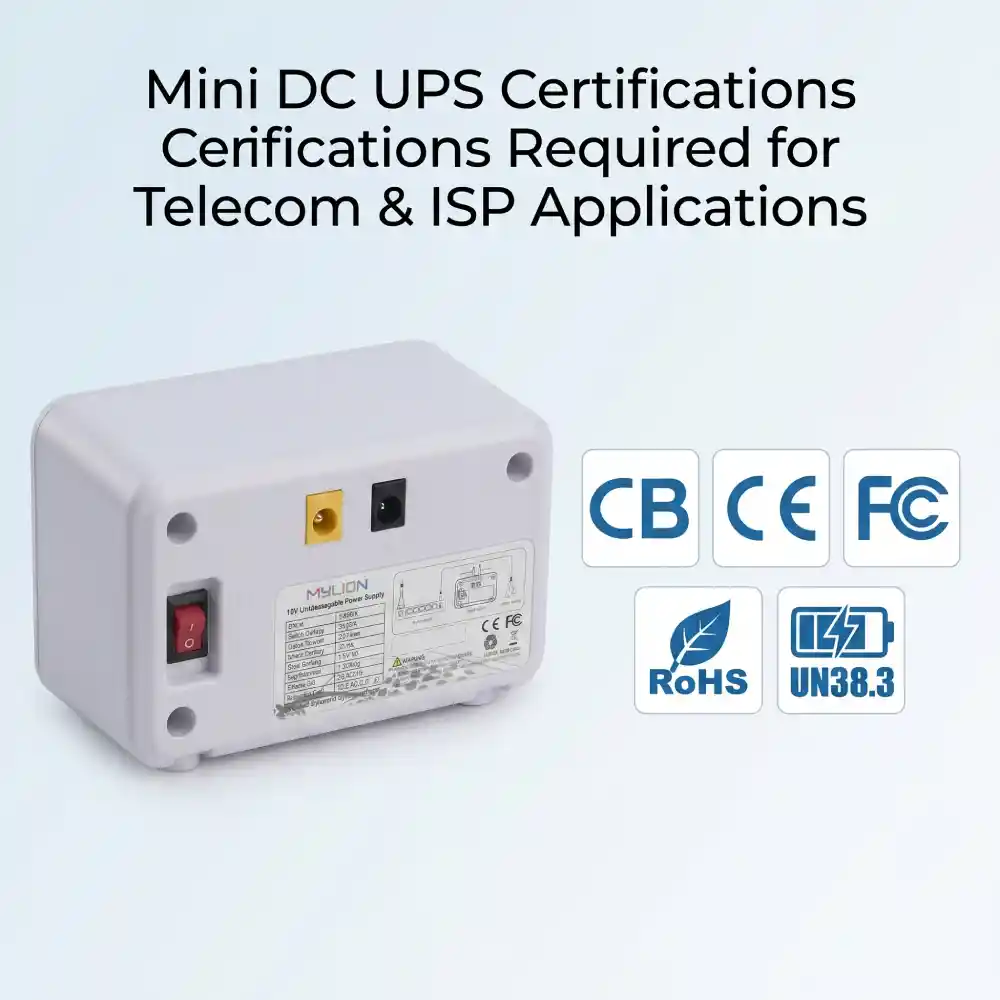
For telecom operators, ISPs, and system integrators, a Mini DC UPS is more than a small backup battery. It is an integral part of a power system connected to communication equipment that may operate 24/7 in homes, offices, telecom cabinets, or network access points. That is why certification and compliance checks should be addressed before sample approval and mass production. Browse our Mini DC UPS series to see available models.
Why Certification Matters
- Certification reduces safety risks, shipment delays, customs holds, and project rejection risks.
- In B2B projects, the same Mini UPS may be paired with different routers, ONTs, gateways, or power adapters. The compliance path often changes depending on the final configuration.
- A professional supplier should neversimply say “we have certificates.” The buyer must verify which model, which adapter, which electrical rating, and which target market the certificate actually covers.
Learn more about MYLION support to see how we help buyers validate certificates.
Common Certifications & Documents Buyers May Request
Certification / Document | Applicable Scope |
IEC 62368-1 / CB Report | Safety evaluation for information and communication technology equipment |
CE Documentation | European market – depends on applicable directives (LVD, EMC, RED, etc.) |
FCC / EMC Documentation | U.S. market – depends on sales channel and usage (intentional radiator vs. incidental) |
RoHS | Restriction of hazardous substances – required for EU and many other regions |
UN38.3 Test Summary | Lithium battery transportation by air, sea, rail, or road |
MSDS / SDS | Material safety data sheet for logistics and customs review |
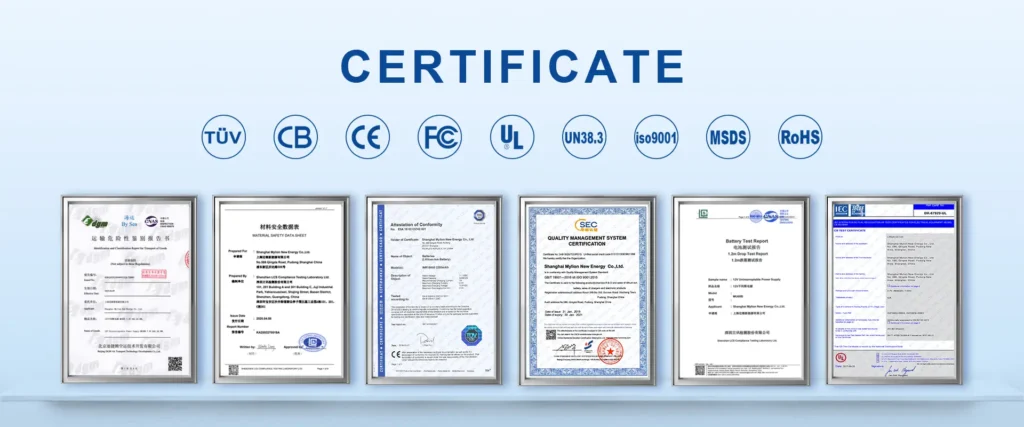
Tip: Always request the full test report (not just the certificate) and verify the test conditions match your exact product configuration.
Key Questions Before Mass Production
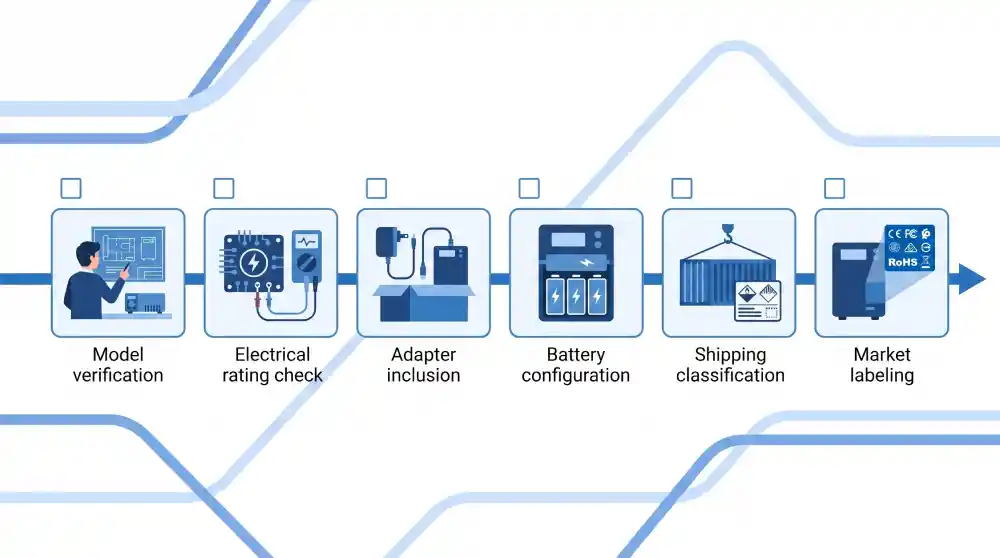
- Is the certificate issued for the exact model number being supplied?
- Does it cover the same input voltage, output voltage, and maximum output current?
- Is the power adapter included in the safety evaluation, or was it tested separately?
- Is the battery capacity and cell configuration identical to the production version?
- Will the product be shipped as a standalone battery, equipment with battery, or battery packed with equipment?
- Does the target market require additional labeling, manuals, or packaging information (e.g., UKCA, PSE, KC, BIS)?
Supplier Risks to Avoid
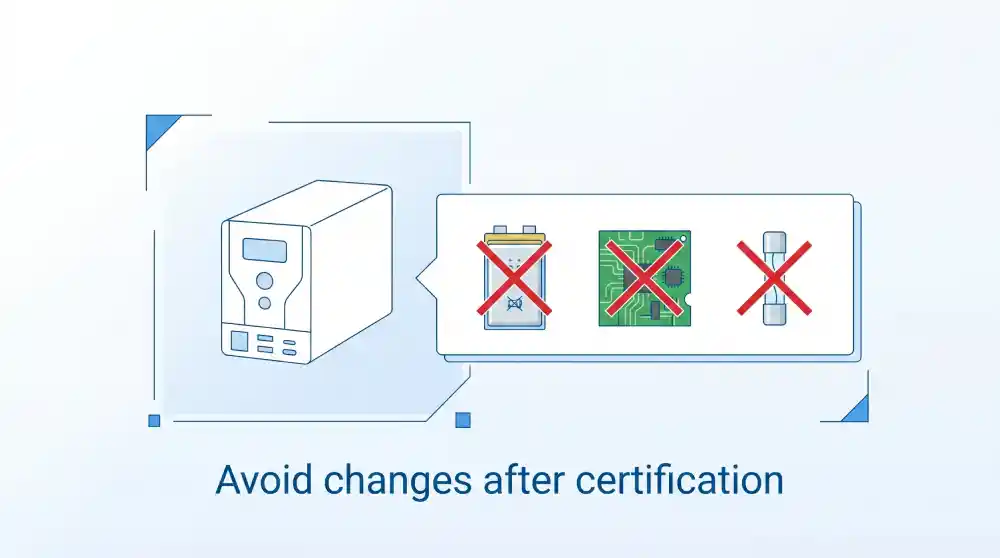
- Using one old certificate for a modified product – even a change in cell, PCBA, fuse, cable, or protection threshold may invalidate the certificate.
- Changing the adapter, cell, PCBA, fuse, cable, or protection threshold after certification without a full impact review.
- Treating shipping compliance as a last-minute logistics task – lithium battery transport requires advance documentation (UN38.3, MSDS, transport label).
- Accepting vague claims like “global certificate” – always ask for a clear document scope and test report.
FAQ
Q1: Is one certificate enough for all countries?
Q2: Should buyers check the power adapter together with the Mini UPS?
Q3: When should certification be discussed?
Q4: What about certifications for Japan, India, or South Korea?
How MYLION Supports Buyers
MYLION specializes in B2B Mini DC UPS and lithium battery backup solutions for telecom, ISP, and industrial applications. We support customers from sample validation to mass production with:
- Product selection and configuration review.
- Custom cable, label, and packaging requirements.
- Certification document preparation (CB, CE, FCC, RoHS, UN38.3, MSDS).
- Pre-production inspection and shipment documentation.
- Risk assessment for configuration changes.
We do not just provide certificates – we help you interpret and validate them for your specific project.
Need a Mini UPS or lithium battery backup solution for ONT, ONU, router, CPE or telecom equipment? Contact MYLION!
Compliance Note
Certification requirements depend on product configuration, target market, power adapter, battery capacity, and final application. Buyers should confirm the applicable requirements before mass production.
 English
  简体中文
简体中文  Deutsch
  Français
  Italiano
  Español