
Introduction: The Power Dilemma for Modern Network Infrastructure
When a power outage strikes, your router, modem, or ONT is the first to go dark—and with it, your entire network. For ISPs, telecom operators, and system integrators, this isn’t just an inconvenience; it’s a service-level agreement (SLA) violation waiting to happen. Mini UPS solutions have emerged as the practical answer, but a critical question divides the market: Should you choose a fixed 12V DC output Mini UPS or one with USB-C Power Delivery (PD) output?
This article compares these two approaches, examines their technical underpinnings, and helps you determine which architecture best serves your router backup power needs. And explore how industry-leading solutions like the Mylion Mini UPS are addressing the diverse power needs of modern enterprise environments.
Understanding the Two Power Architectures
What Is Fixed 12V DC Output?
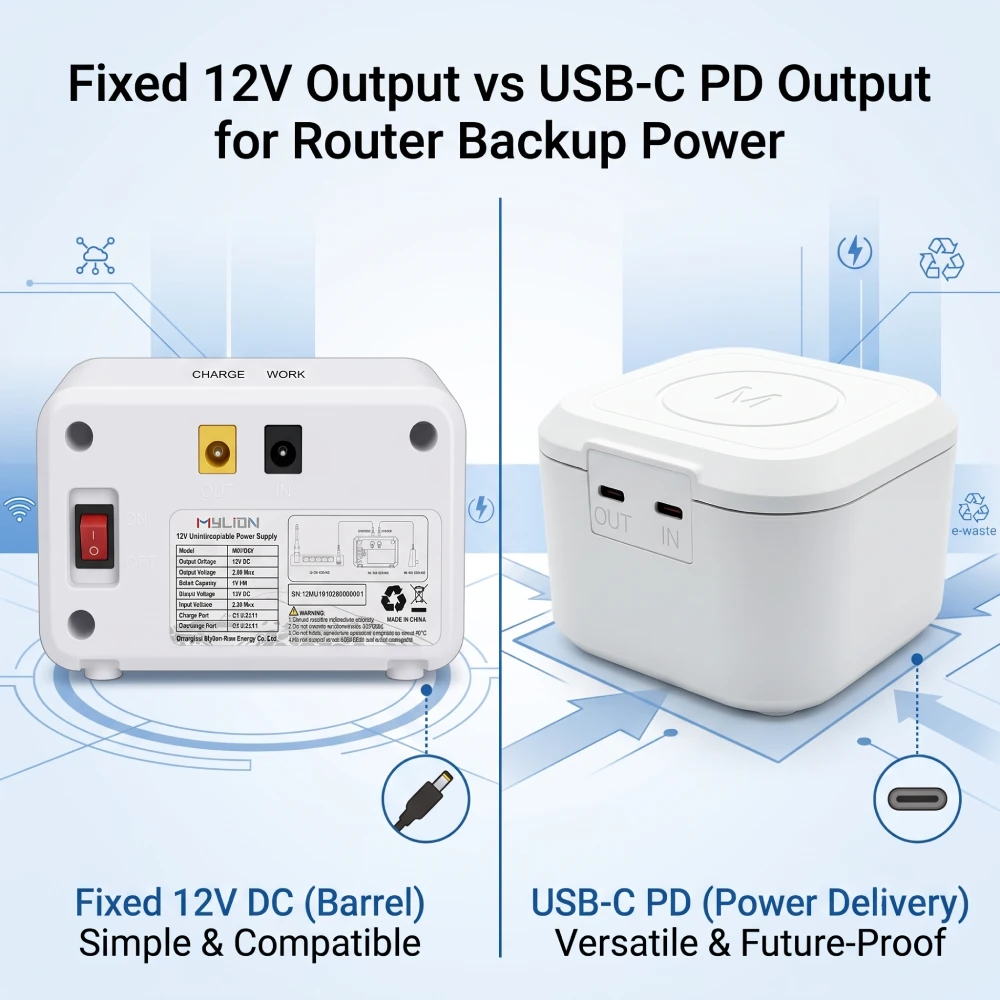
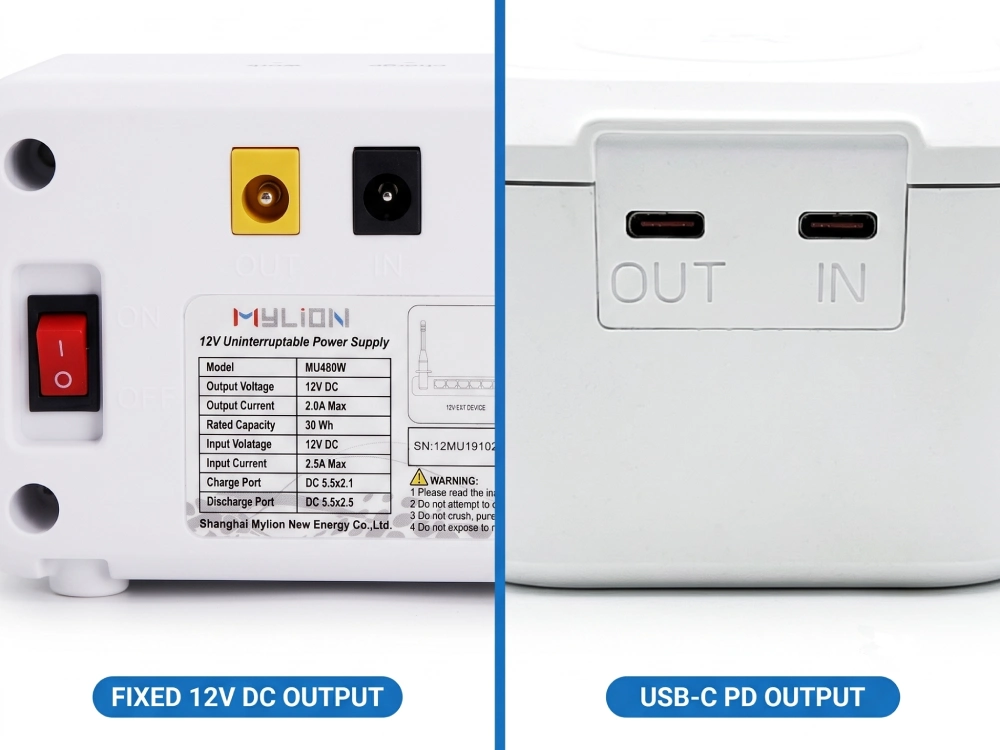
Fixed 12V DC output is the traditional approach. The Mini UPS delivers a regulated 12V DC voltage through a standard barrel connector (typically 5.5mm x 2.1mm or 2.5mm). This matches the native voltage requirement of most routers, modems, ONTs, and ONUs.
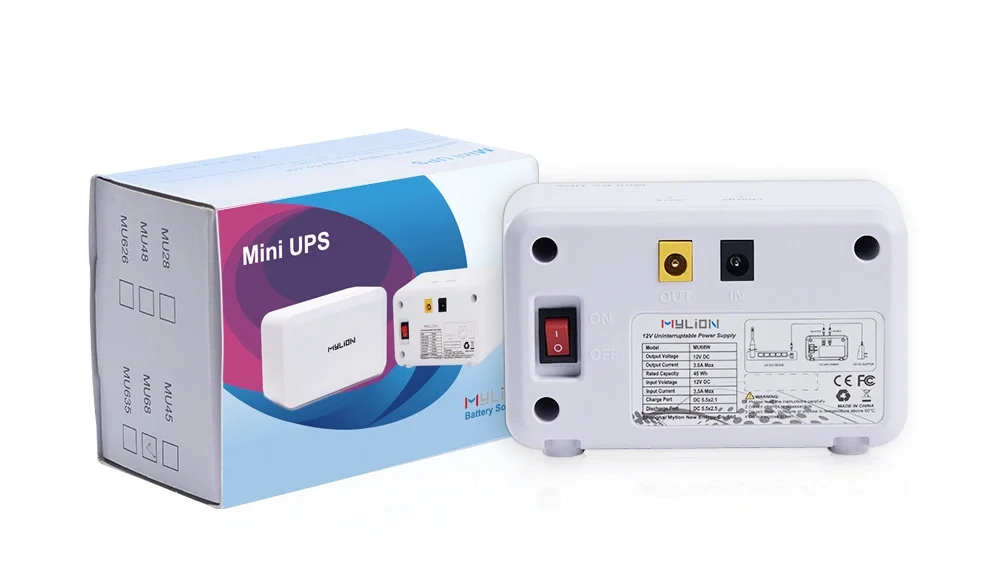
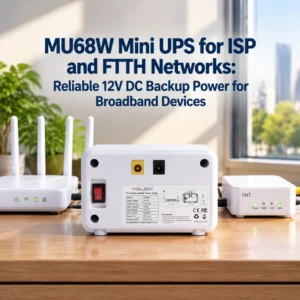
The simplicity is its strength: no negotiation, no protocol handshake—just straight DC power. MYLION MU68 Mini UPS, for instance, provides stable 12V DC backup at up to 3A with zero transfer time, making it a drop-in replacement for the router’s existing power adapter. Similarly, the MUJ46 Mini UPS offers 12V 2A output alongside USB-A and USB-C ports for 5V devices.
What Is USB-C PD Output?
USB-C Power Delivery is a protocol that allows devices to negotiate voltage and current requirements over a USB-C connection. A USB-C PD source advertises a set of Power Data Objects (PDOs)—available voltage and current combinations—and the sink (the device being powered) requests a suitable PDO from that set.
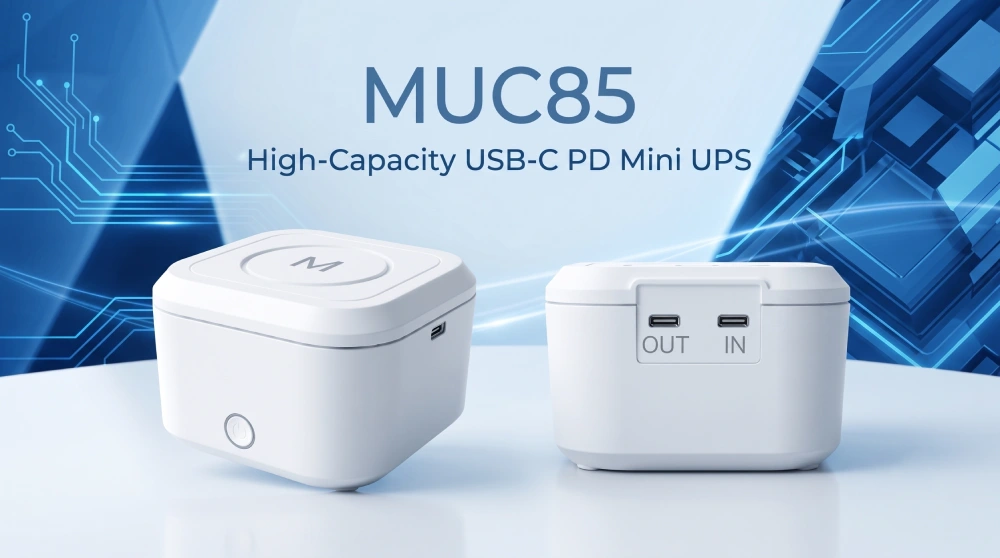
PD supports fixed voltages including 5V, 9V, 12V, 15V, and 20V. For example, MYLION MUC85 65W PD Mini UPS can deliver 5V/3A, 9V/3A, 12V/3A, 15V/3A, and 20V/3.25A. This flexibility is what makes USB-C PD attractive—but it also introduces compatibility complexity.
Fixed 12V vs USB-C PD: A Technical Comparison
The following table offers a direct comparison between the two power delivery methods to aid in your deployment decisions:
Feature | Fixed 12V DC Output | USB-C PD Output |
Voltage | Static (Always 12V) | Dynamic (5V, 9V, 12V, 15V, 20V) |
Connector Standard | DC Barrel (Various sizes) | Universal USB Type-C |
Compatibility | Works with any 12V router | Requires PD-compatible router or trigger cable |
Complexity | Plug and play | Requires PD negotiation |
Efficiency | Direct, no conversion loss | May involve voltage conversion |
Future proofing | Limited to 12V devices | Supports multiple voltage standards |
Ideal Deployment Scenario | Standardized legacy router fleets, ISP rollout | Mixed-device environments, modern edge gateways |
Understanding Router Backup Power Needs in the Modern Enterprise
Before diving into the connector protocols, it is essential to understand why DC-to-DC Mini UPS systems have become the gold standard for router backup power.
A DC-to-DC Mini UPS avoids the inefficiency of traditional AC UPS systems entirely. It stores power in high-density lithium-ion cells and delivers clean, regulated direct current straight to the router. This results in significantly longer backup times in a much smaller physical footprint.
However, delivering that DC power requires a connector and a voltage standard. Routers require specific voltages to operate correctly—too little, and the device will brownout; too much, and its internal circuitry will sustain irreversible damage. This brings us to the core hardware decision: sticking with the legacy fixed 12V standard or adopting the versatile USB-C PD protocol.
The Traditional Standard: Fixed 12V Output Mini UPS
For decades, most enterprise routers, access points, and ISP fiber modems have used a fixed 12V DC input via a 5.5×2.1mm or 5.5×2.5mm barrel jack.
How Fixed 12V Works
Fixed 12V is an unmanaged power delivery method. The UPS’s BMS and converters step the internal battery voltage (e.g., 3.7V or 7.4V) up to a regulated 12V. Power flows immediately—no digital communication between devices.
Advantages for B2B Deployments
- Zero negotiation time– Instant cutover (sub-ms) prevents router reboots and drops VoIP sessions.
- Legacy compatibility – Works with thousands of existing 12V routers without hardware upgrades.
- Hardware simplicity – No PD controller chips, fewer protocol glitches or firmware mismatches.
Disadvantages
- Inflexible – Only outputs 12V; useless for 9V modems or 15V gateways.
- Connector variety – Proprietary barrel sizes force tip-inventory management across mixed fleets.
The Modern Evolution: USB-C Power Delivery (PD)
USB-C PD is an intelligent, active protocol. The source (UPS) and sink (router) digitally negotiate the optimal voltage and current for safe operation.
How USB-C PD Works
A controller chip in the cable or port facilitates a handshake. The router requests a specific voltage (e.g., 12V/2A), and the UPS confirms it can supply that, then smoothly raises output from 5V to the requested level (12V, 15V, or 20V).
Advantages for B2B Deployments
- Universal standard – Aligns with EU and global USB-Cmandates, future-proofing infrastructure.
- Dynamic flexibility – One PD port powers 5V sensors, 12V routers, or 20V laptops—reducing inventory complexity.
- Higher power ceiling – Supports up to 100W (240W with PD 3.1), sufficient for 5G gateways, Wi-Fi 6E nodes, and high-performance edge devices.
Disadvantages
- Negotiation latency – The handshake takes milliseconds; poorly designed PD may cause brief power gaps, triggering router reboots during mains-to-battery transitions.
- Trigger cable requirement – For legacy barrel-port routers, you need a PD trigger (decoy) cable with an IC chip to force 12V output—adding cost and a potential failure point.
Why Mylion Mini UPS is the Ideal Solution for Uninterruptible Connectivity
As a premier manufacturer in the backup power sector, Mylion designs Mini UPS systems specifically tailored for telecommunications, ISP deployments, and B2B infrastructure. Mylion Mini UPS products are engineered to offer the best of both worlds.
MYLION Fixed 12V Mini UPS product line
The MU68, MU48, MU35, and MUJ46 are all fixed 12V output models designed for specific power and runtime requirements:
- MU48: 12V 3A, 29.6Wh—compact backup for low-power ONT/ONU devices
- MU68: 12V 3A, 44.4Wh—standard 12V broadband backup
- MU35: 12V 5A, 77.7Wh—high-power backup for gateways and 5G routers
- MUJ46: 12V 2A + 5V USB—hybrid output for routers plus USB accessories
MYLION USB-C PD Mini UPS
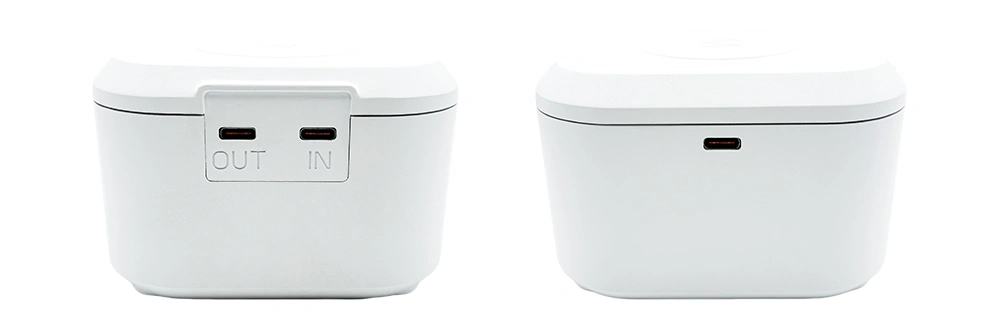
For organizations deploying newer network equipment with native USB-C PD inputs, MYLION MUC85 PD Mini UPS offers several advantages:
- Multi-voltage support: The MUC85 delivers 65W PD with 5V/9V/12V/15V3A, 20V3.25A.
- Dual Type-Coutput design: Its dual Type-C ports (65W + 30W) allow simultaneous powering of two PD devices with different voltage requirements.
- Zero-transfer switching: Smart IC management ensures 0ms transfer switching and full protection.
- High-capacitybattery: The 92Wh battery provides 7–8 hours of runtime at 12W load.
Making the Right Choice for Your Deployment
Choose Fixed 12V DC If:
- Your routers, ONTs, and modems use standard 12V DC barrel connectors
- You need simple, reliable deployment with zero compatibility issues
- You’re deploying in large numbers where consistency matters
- Budget is a consideration (fixed 12V units are generally more cost-effective)
- You need guaranteed runtime calculations
Choose USB-C PD If:
- You’re deploying newer network equipment with native USB-CPD inputs
- You need a single backup solution for devices with varying voltage requirements
- You’re future-proofing for USB-Cadoption
- Regulatory compliance (e.g., EU Common Charger) is a factor
FAQ
Q1: Can I use a USB-C PD power bank to power my 12V router?
Q2: What's the difference between USB-C 5V and USB-C PD?
Q3: How long will a Mini UPS power my router?
Q4: Is USB-C PD more efficient than fixed 12V?
Q5: Does MYLION offer both fixed 12V and USB-C PD Mini UPS?
Conclusion
The choice between fixed 12V DC output and USB-C PD output for router backup power ultimately comes down to your specific deployment requirements. Fixed 12V delivers simplicity, reliability, and predictable performance for the vast majority of routers currently in the field. USB-C PD offers future-proofing and flexibility but introduces compatibility considerations that must be carefully evaluated.
MYLION’s comprehensive Mini UPS portfolio—from the compact MUJ46 to the high–capacity MUC85—ensures there’s a solution for every network backup need. Whether you choose the proven reliability of fixed 12V or the forward-looking flexibility of USB-C PD, the key is selecting a solution that matches your devices, your deployment scale, and your operational requirements.

 English
  简体中文
简体中文  Deutsch
  Français
  Italiano
  Español