
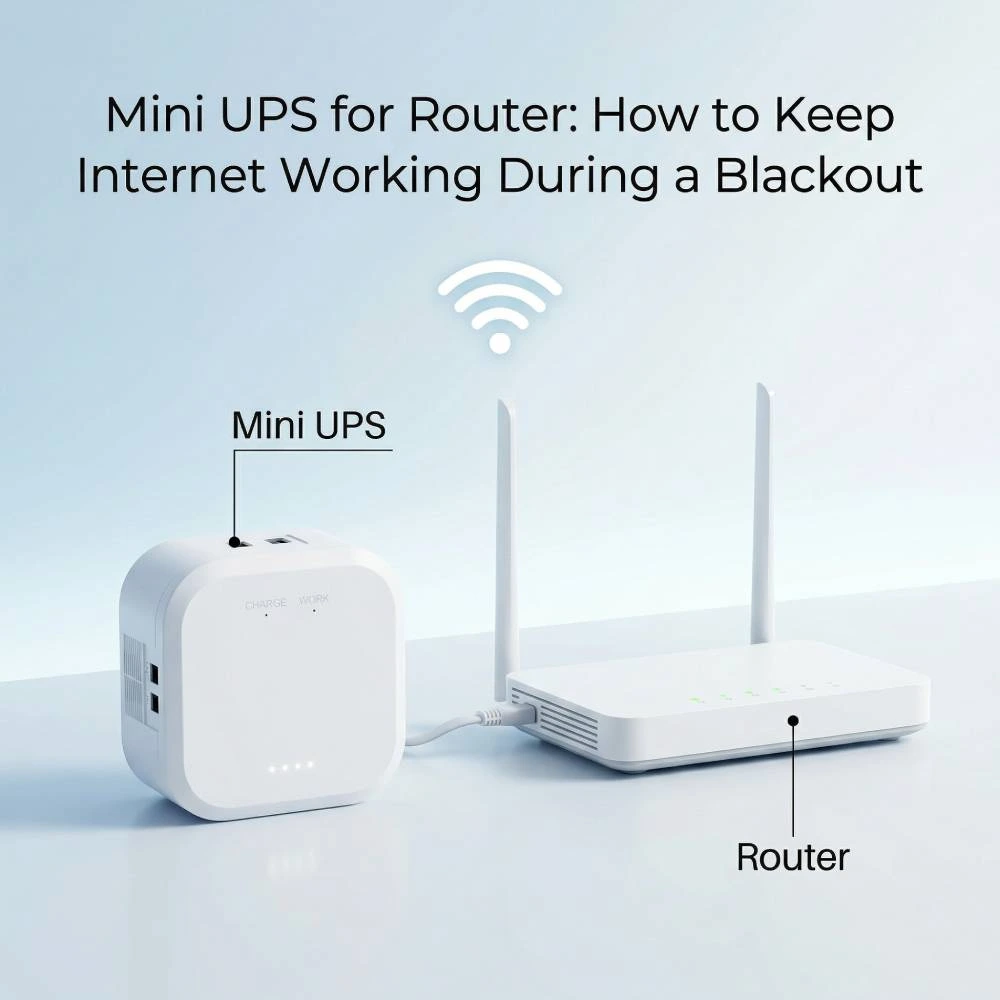
The router may operate normally with only low-voltage direct current (DC), but once the power supply is interrupted, the connections at the network edge will immediately be disrupted. For telecommunications operators, enterprise remote workers, and broadband internet service providers (ISPs), the migration to modern network infrastructure introduces a critical vulnerability at the edge: complete reliance on the local power grid.
To address this issue, a Mini UPS for routers has emerged. It fills this gap, ensuring the normal operation of router equipment during power grid failures, while avoiding the problems of low thermal efficiency and difficult deployment that traditional AC-based uninterruptible power supplies have.
Why routers fail during short and long power cuts
Routers, modems, and ONTs (Optical Network Terminals) rely on the small power adapters that convert high-voltage AC from the wall into low-voltage DC. These adapters have no internal battery backup. When mains power drops—whether for a few seconds or several hours—the connected networking equipment shuts down immediately.
Even brief power flickers can reset a router, leading to several minutes of reboot time before internet connectivity is restored. For remote workers, this means dropped video calls and lost productivity. For businesses or security systems, it can mean a complete loss of connectivity until power returns.
What a mini UPS can do for router backup
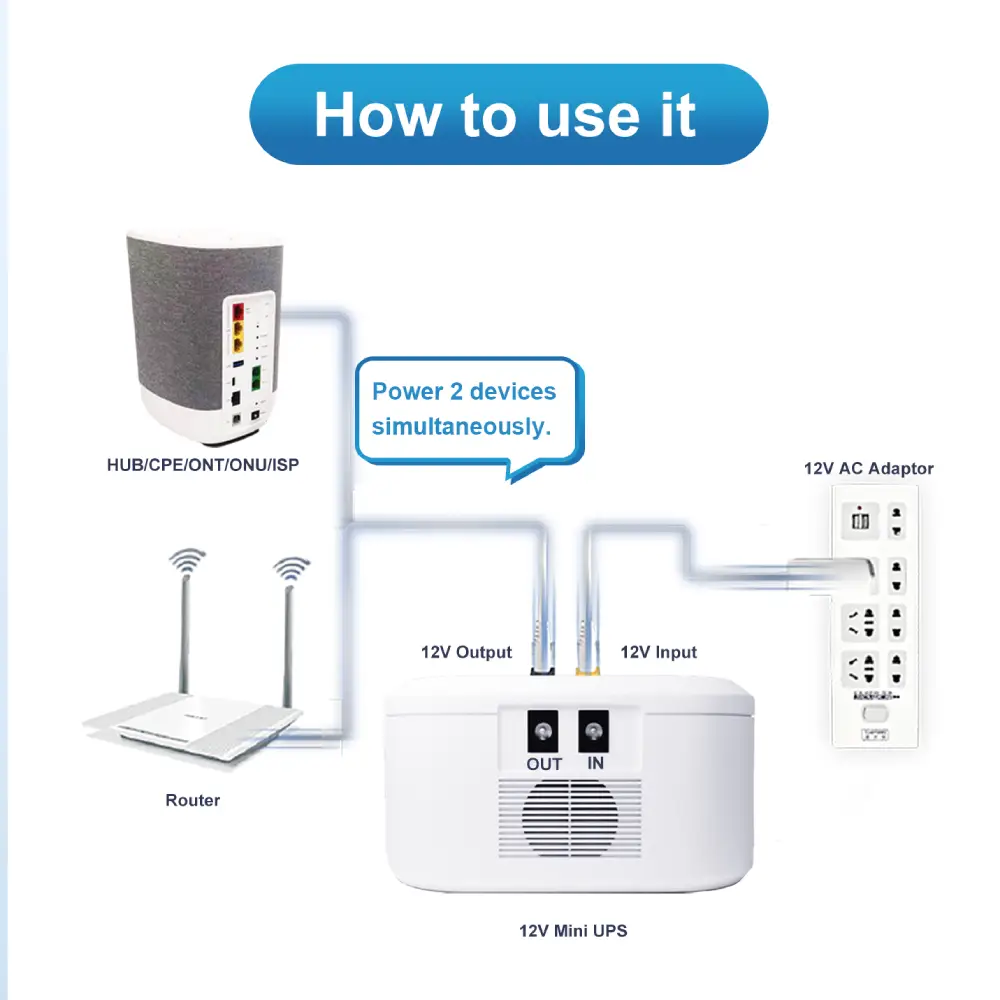
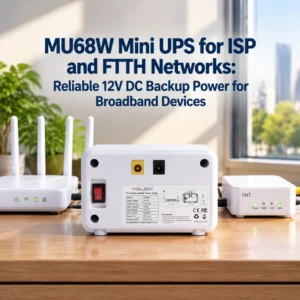
A mini UPS is a compact battery backup system specifically designed for low-power DC devices. Unlike traditional UPS, the mini UPS can be ingeniously placed between the router and its original power adapter.
When there is an available mains power supply, the micro uninterruptible power supply will transfer the electricity to the router and charge its internal battery at the same time. Once a power outage occurs, this device will switch to battery mode within milliseconds – usually so quickly that the router will not restart. This achieves a seamless transition, ensuring that your network connection remains uninterrupted during short power outages and provides you with several hours of operation time during long power outages.
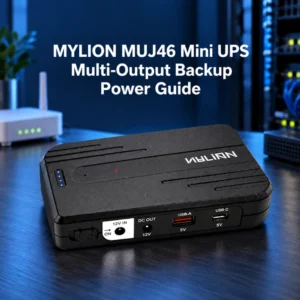
Router backup power solution: Mylion MU35 Mini UPS
For users seeking reliable solutions, the Mylion MU35 Mini UPS is an ideal choice for router backup. This product is specifically designed for high-demand telecommunications environments, combining the key functions of a DC uninterruptible power supply with the ease of use of plug-and-play devices.
The MU35 Mini UPS offers a powerful 12V 5A DC output, making it compatible with almost any home router, wired modem, fiber ONT or VoIP adapter. Its built-in large-capacity lithium-ion battery can provide several hours of operation for standard broadband settings, ensuring that power outages do not interrupt critical work, streaming media playback or security monitoring.
The main features of Mylion MU35 include:
- 12V voltage output: 12V 5A DC output to meet the requirements of various network devices.
- Seamless switching: Switching time within milliseconds ensures that the router remains online without the need for a restart.
- Compact design:Highly compact design for easy deployment.
- Plug-and-play installation:No configuration required.
For home broadband users, remote workers, and small-scale telecommunications deployments, the MU35 offers an economical and efficient dedicated backup power solution for them, without incurring the additional costs associated with traditional AC uninterruptible power supplies (AC UPS).
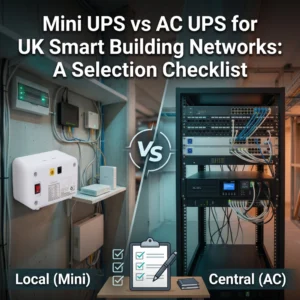
Mini UPS vs traditional UPS for router applications
Traditional AC UPS units are designed to power desktop computers, monitors, and multiple peripherals. They are heavy, noisy, and inefficient when used solely for a router. Converting DC battery power to AC (inverter) and then back to DC (via the router’s power adapter) results in significant energy loss.
A mini UPS eliminates this inefficiency by operating entirely in the DC domain. The table below summarizes the key differences:
| Feature | Mini DC UPS | Traditional AC UPS |
| Power Conversion | High Efficiency (DC-DC) | Low Efficiency (AC-DC-AC-DC) |
| Energy Loss | Minimal (<5% loss) | High (20-30% loss) |
| Form Factor | Compact, lightweight; often mounts near the router Large | heavy; requires floor or desk space |
| Switching Time | Immediate Switching (0ms) | 2ms to 12ms |
| TCO | Low TCO. | High TCO |
| Best Use | Routers, modems, ONTs, IP cameras, small network gear | Desktop PCs, servers, whole-office equipment |
How to check router voltage and power requirements
For the purchasing director, standardizing thousands of terminal devices requires accurately matching mini UPS with router equipment. You need to understand the power specifications of the router.
Verify the DC input parameters
Each router or ONT provided by ISP is labeled with specifications that clearly state its exact input requirements. The procurement team must verify the input voltage (V) and current (amps/A).
- Voltage matching is of vital importance:If the router requires 12V voltage, the mini UPS must precisely output 12V voltage. Providing 9V voltage will not be able to power the device, while providing 15V voltage will cause the components to be severely damaged.
- Adequate current margin is crucial: The rated current of the router (such as 2.5A, 3A, or 5A) represents the maximum current consumption of the device under peak network load. The power of the mini UPS must reach or exceed this value.
The 12V 5A DC output of Mylion MU35 Mini UPS is compatible with most router devices. It offers a power limit of 60W, which can easily meet the requirements of high-performance routers and ensure that the ISP’s deployment can handle future hardware upgrades.
Interface and connector standardization
To ensure that on-site engineers can easily achieve plug-and-play installation, the size of the DC power socket must be compatible. Selecting a mini UPS with multiple output ports can enable ISPs to use a single high-capacity UPS to power both ONTs (fiber modems) and Wi-Fi routers simultaneously.
What buyers should expect during operation
Runtime—the duration the UPS can sustain the router during a blackout—is the primary metric determining SLA compliance during severe utility failures. CTOs must model expected grid downtime in their specific operational regions against battery capacity.
Calculating Battery Capacity vs. Load
Runtime is a function of the battery’s Watt-hour (Wh) capacity divided by the router’s active power draw (Watts). For example, a standard fiber ONT and Wi-Fi 5 router combined may draw approximately 15W of continuous power.
- A localized grid micro-outage typically lasts under 30 minutes.
- A severe weather event may cause regional blackouts lasting 4 to 8 hours.
By utilizing high-density lithium-ion or LiFePO4 battery cores, premium mini UPS systems can deliver extended runtimes tailored to ISP requirements. Depending on the chosen capacity configuration, buyers can expect anywhere from 4 hours to over 12 hours of uninterrupted backup power.
This extended runtime is critical for ensuring that remote diagnostic telemetry remains online, allowing the ISP’s Network Operations Center (NOC) to monitor the edge device even when the local power grid is entirely dark.
Why choose Mylion to meet your needs for a Mini UPS?
In providing reliable power support for critical network devices such as routers, Mylion combines engineering expertise with a customer-centric approach.
Here are the distinctive features of Mylion:
- Professional DC uninterruptible power supply solutions
- Strict quality standards
- OEM and customization capabilities
- Global compliance certification and responsive support

FAQ
Q1: Will a Mini DC UPS degrade the lifespan of my ISP’s deployed routers?
No. In fact, it protects them. Premium units like the Mylion series provide stable, regulated DC voltage and incorporate over-charge, over-discharge, and short-circuit protection, shielding the router’s sensitive internal components from grid voltage spikes and sags.
Q2: Can a single mini UPS power both a fiber optic modem (ONT) and a Wi-Fi router
Yes, provided that the total power consumption of the two devices does not exceed the maximum output power of the UPS. A 12V 5A DC output (60W) large-capacity UPS can easily supply power to both the ONT and the high-end router simultaneously.
Q3: How is the scalability of this solution for large-scale Internet service providers (ISPs) deployment?
Extremely scalable. Due to the plug-and-play design, no configuration is required. On-site technicians can complete the installation of the mini UPS in just a few seconds. Moreover, using maintenance-free lithium batteries also avoids the high cost of battery replacement in the future.
Q4: Is a mini UPS safe to leave powered on 24/7?
Yes. High-quality mini UPS units are designed for continuous operation. The Mylion MU35, for instance, is engineered for always-on deployment, automatically maintaining battery status while safely powering connected equipment.
Q5: How long does the battery last before it needs replacement?
Most of the uninterruptible power supply devices you use are equipped with lithium-ion or lithium iron phosphate (LiFePO₄) batteries. Under normal usage conditions, these batteries typically last for 2 to 3 years. The lifespan depends on various factors.
Conclusion
Ensuring the normal operation of the network during a power outage is no longer a technical challenge – it depends on the quality of the infrastructure. By choosing a high-quality Mini UPS, you can ensure that your router remains connected to the network and that your network maintains visibility.
 English
  简体中文
简体中文  Deutsch
  Français
  Italiano
  Español