
Introduction
In ISP backup power projects, field failure is rarely caused by one problem alone.
Most deployment issues come from a chain of small mismatches: wrong connector, underestimated load, mixed device families, unclear installation logic, inconsistent incoming parts, or unrealistic runtime assumptions. Each issue may look minor by itself. Together, they create complaints, replacements, and operational frustration.
That is why field-failure reduction for ISP backup power should begin long before mass ordering. A successful Mini UPS rollout is not simply a purchasing decision. It is a deployment-control process that starts with the right pre-shipment strategy.
Why ISP Backup Power Failures Start Before Shipment
Many teams treat field failures as after-sales events. In reality, they often begin during early project definition.
Typical early mistakes include:
- No complete device list before model selection
- One sample approved for many device variants
- Runtime expectations not clearly defined
- Connector family not standardized
- No clear rule for ONT-only versus ONT plus router deployment
- No pre-shipment validation logic
If the project enters rollout with these gaps unresolved, the field team becomes the last test stage. That is expensive and unnecessary.
Before selecting any Mini UPS for an ISP rollout, the team should build a basic compatibility map.
This map should include:
- Device model
- Voltage
- Normal current
- Peak current if known
- Connector type
- Single-device or dual-device setup
- Priority runtime target
This does two things. First, it prevents the project from choosing an Mini UPS output class that is too narrow. Second, it shows where one standard Mini UPS model is realistic and where multiple models are safer.
Without this map, rollout risk remains hidden until installation begins.
Step 2: Use a Sample Matrix, Not a Single Sample Decision
A single successful Mini UPS sample is not sufficient for ISP-scale rollout validation. A sample that works perfectly with one router model may fail completely when connected to a different ONT or a combination of devices.
The better approach is a sample matrix, where the ISP backup power solution is validated against representative device types, not just one device that happens to work. For example:
- Standard ONT
- Higher-load router
- ONT plus router combination
- Gateway variant if relevant
This approach is especially useful when the ISP or distributor supports multiple broadband hardware families. It helps the team catch current-margin issues, connector problems, and runtime mismatch before deployment scale increases.
Step 3: Standardize Connector and Adapter Logic for Your Mini UPS Deployment
Connector and adapter mismatch is one of the most underestimated field risks in Mini UPS deployment for broadband networks.
The team should define early:
- Which DC plug sizes are in scope
- Polarity standard
- Whether the original adapter is retained
- Whether the backup kit includes cables, adapters, or split outputs
- Whether installers need different kits for different device families
Good connector discipline in Mini UPS deployment reduces wrong installations, confusion in spare parts handling, and preventable service tickets. This is not a minor detail. It is part of rollout stability.
Step 4: Validate Runtime Under Real Load With Your Mini UPS Selection
Runtime claims should be validated against actual use conditions, not only against battery size or theoretical light-load calculations.
The team should confirm:
- Real device load where possible
- Runtime target by scenario
- Single-device versus dual-device runtime difference
- Whether runtime labeling matches realistic expectation
If runtime claims are too optimistic, the backup unit may not technically fail but the project will still be judged as a field disappointment. Clear and realistic runtime validation protects both customer trust and internal rollout quality.
Step 5: Build Inspection Logic Before Mass Shipment of Mini UPS Units
A rollout-ready Mini UPS product must have pre-shipment control, not just final quality hope.
Useful pre-shipment control points for Mini UPS batches include:
- Incoming material verification
- Electrical and functional check
- Output voltage and current validation
- Charging and discharging spot logic (or full inspection depending on product type)
- Labeling confirmation (model, polarity, voltage)
- Packaging and accessory confirmation
For ISP projects, inspection is not only about quality. It is also about rollout predictability. Stable pre-shipment validation helps reduce the risk that installation teams become the first people to discover product mismatch.
Step 6: Prepare Installer-Facing Simplicity for Mini UPS Rollout
Many technically acceptable Mini UPS products still create field problems because the installer experience is unclear.
Useful rollout support includes:
- Clear model and application labeling
- Basic installation guide
- Defined cable usage
- Visible connector and polarity guidance
- Runtime tier labeling where relevant
- Simple support path for exceptional cases
A backup rollout should be easy to install correctly at the first attempt. Simplicity in the installer layer can reduce avoidable errors more effectively than adding more technical claims to a brochure.
Field Failure Reduction Is Also a Commercial Advantage
A well-designed ISP backup power rollout with the right Mini UPS strategy can help:
- Reduce subscriber complaints about internet dropouts during power events
- Lower truck-roll frequency for preventable power-related service calls
- Improve distributor and partner confidence in your ISP backup power solution
- Shorten approval cycles for future Mini UPS orders
- Reduce replacement cost and operational friction in the field
- Support stronger trust in the operator‘s service promise
That is why field reliability for ISP backup power should be built into the procurement framework, not treated as a separate afterthought. A reliable Mini UPS strategy becomes a competitive differentiator, not just a cost center.
The Right Mini UPS Strategy: Mylion Product Line for ISP Deployment
Not all Mini UPS units are the same—and for ISP backup power rollout, the wrong product line can create field failures before installation begins.
Unlike generic battery suppliers, MYLION‘s product line is structured by power level, runtime tier, deployment style, output architecture, battery chemistry (including LiFePO4), and voltage system. This structured approach helps reduce model mismatch in real-world ISP backup power projects.
MYLION Mini UPS Product Line Overview
Model | Output | Battery Type | Battery Capacity | Ideal Application |
MU68 | 12V / 3A | Lithium-ion | 44.4 Wh | Standard 12V router, ONT, ONU backup |
MU35 | 12V / 5A | Lithium-ion | 77.7 Wh | Higher-load routers, gateways, and CPEs |
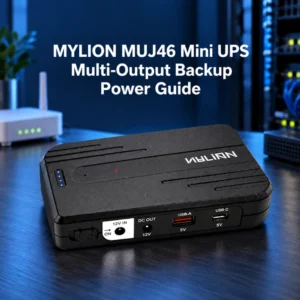
MUJ46 | 12V / 2A + USB 5V / 3A | Lithium-ion | 38.48 Wh | Inline FTTH deployment |
MUC85 | USB-C PD (20V / 3.25A) | Lithium-ion | 92 Wh | Modern USB-C/PD-powered routers |
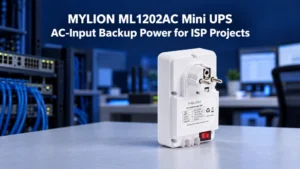
ML1202AC | 12V / 2A | LiFePO₄ | 25.6 Wh | Dual-device backup with AC input |
MU248 | 24V / 48V DC | LiFePO₄ | 102.4 Wh | Telecom and wireless devices requiring non-standard voltage |
Why a Structured Mini UPS Product Line Matters for ISP Rollout
A structured Mini UPS product line helps ISPs right-size backup power to each device type, avoiding the common trap of over-specifying on runtime while under-specifying on output current capacity.
For example, a standard ONT requiring 0.5A is well served by the MU68 Mini UPS; but a high-power Wi-Fi 7 gateway drawing 5A needs the MU35 Mini UPS to avoid field failure under peak load.
Similarly, inline FTTH deployment inside a compact subscriber box requires a different form factor—MUJ46 Mini UPS—than a desktop Mini UPS like MU68.
MYLION also supports OEM / ODM customization for projects that need specific output voltage, connector type, battery capacity, enclosure design, or application-specific protection logic. This capability helps ISPs align the Mini UPS precisely with existing device portfolios, further reducing field failure risk.

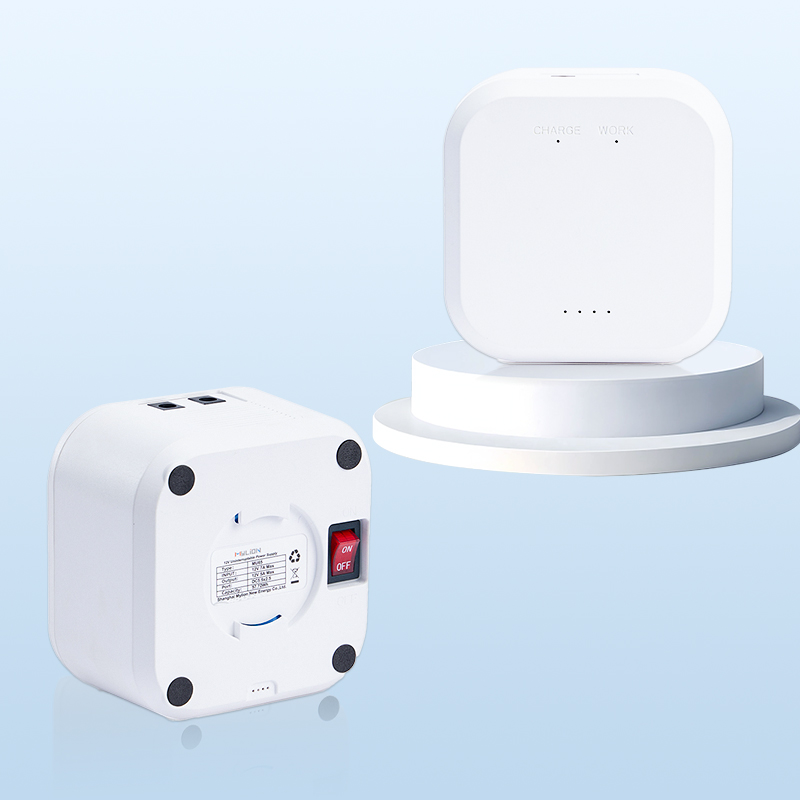
MUJ46 Mini UPS
MU35 Mini UPS

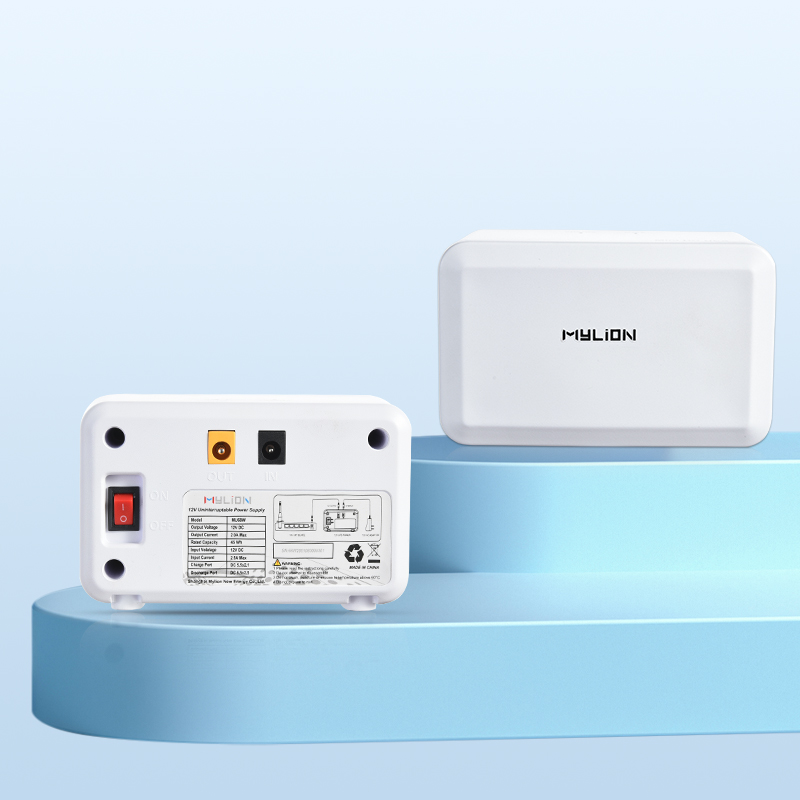
MU48 Mini UPS
MU68 Mini UPS
How MYLION Supports Lower-Risk ISP Backup Power Rollout
MYLION supports backup power rollout by focusing on practical device matching, structured model selection, connector-aware discussion, and pre-shipment validation logic. For telecom, ISP, and broadband customers, the goal is not only to ship Mini UPS products, but to reduce mismatch risk before deployment begins.
MYLION can support:
- Device-based model recommendation
- Discussion of ONT-only, router-only, and dual-device backup
- Connector and cable option review
- Sample support for realistic evaluation
- Support for inspection and shipment preparation
- Selected OEM / ODM cooperation where project fit needs improvement
For customers requiring safer battery chemistry and longer cycle life, MYLION also offers LiFePO4 Mini UPS solutions, engineered for stable long-term performance in demanding ISP deployment environments.
FAQ
Q1: Why do field failures often appear after a “successful” Mini UPS sample?
Q2: What is a compatibility map for ISP backup power?
Q3: Why is connector control so important for Mini UPS deployment?
Q4: How should ISPs validate Mini UPS runtime for their projects?
Q5: What helps reduce field confusion in ISP backup power deployment?
Conclusion
Field failure in ISP backup power rollout is not inevitable. It is the predictable outcome of a fragmented deployment process that treats Mini UPS selection as an afterthought rather than a core engineering decision.
By integrating the six steps above into your ISP backup power workflow, you transition from reactive troubleshooting to proactive risk reduction. The result is fewer complaints, lower operational costs, and a more reliable broadband experience for subscribers.

 English
  简体中文
简体中文  Deutsch
  Français
  Italiano
  Español