
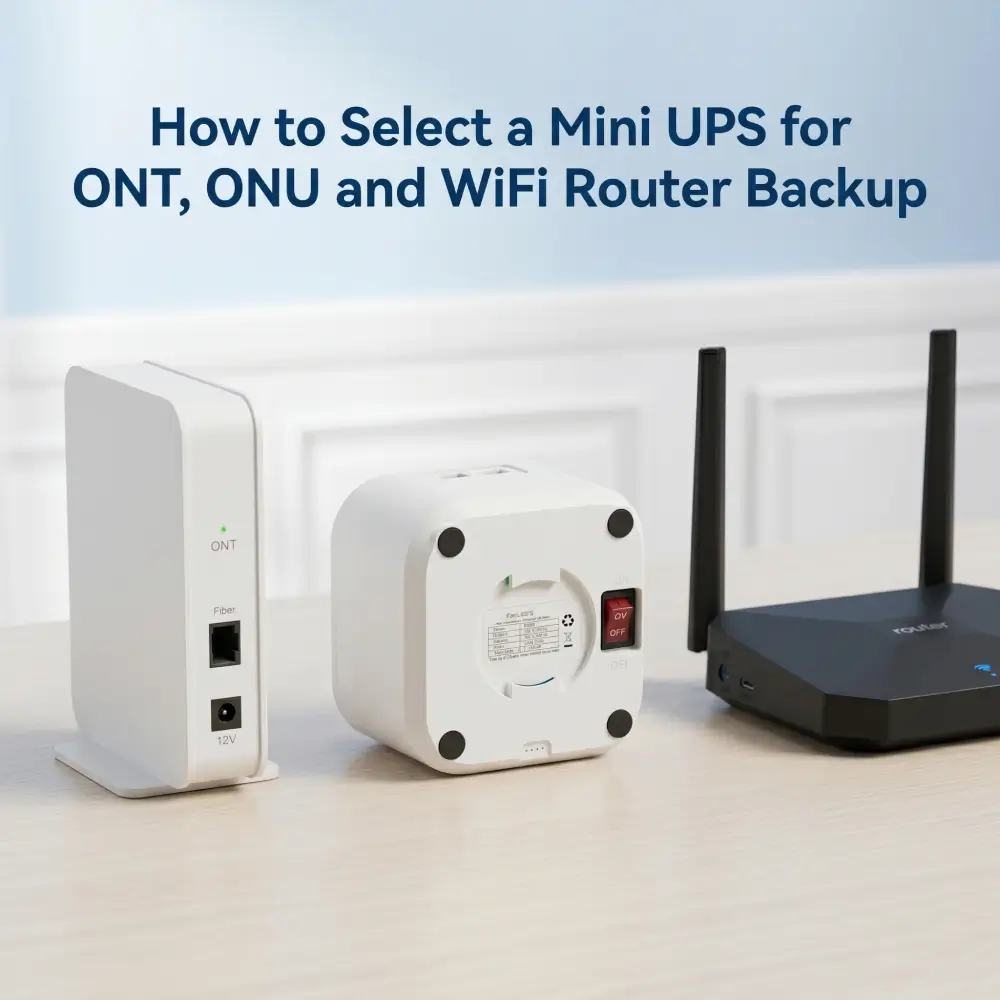
Choosing a Mini UPS for ONT/ONU, WiFi routers, modems, or CPE devices goes far beyond matching a DC plug and voltage. For telecom operators, ISPs, and system integrators, a well-chosen backup power solution ensures reliable broadband continuity, reduces field failures, and lowers long-term maintenance costs.
This guide walks you through the essential technical and project-based criteria for choosing a Mini DC UPS for residential, office, or FTTH deployments.
Start with the Device Application
First, identify exactly which devices the Mini UPS will support:
- ONT, ONU, router, modem, gateway, CPE, or CCTV cameras – or a combination.
- Residential broadband, office networks, FTTH, outdoor equipment, or industrial backup.
Different applications demand different battery capacities, current ratings, protection levels, and cable configurations. For example, an outdoor CPE may require wider temperature tolerance and surge protection, while a home router only needs basic backup.
Confirm Voltage and Connector
Most telecom devices run on 5V, 9V, 12V, or 24V DC. Check the original power adapter label or device specification.
- Voltage mismatch can damage equipment.
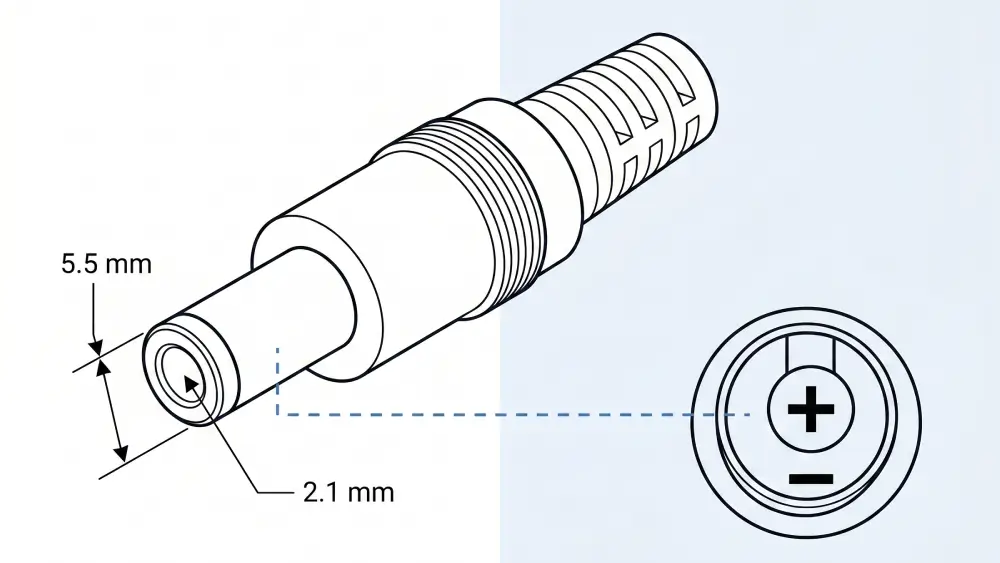
- Connector size and polarity must match exactly. Even with correct voltage, a wrong barrel plug (e.g., 5.5×2.1mm vs 5.5×2.5mm) or reversed center-positive/negative polarity will cause failure.
For project orders, also define cable length, plug angle (straight or right-angle), label requirements, and packaging before mass production.
Real Working Current vs. Adapter Rating
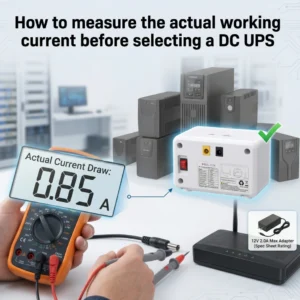
A common mistake is assuming a device draws the rated adapter current.
Example: A “12V/2A” adapter does not mean the device always consumes 2A. In reality, many routers and ONTs draw 0.3A–0.8A during normal operation, but may need higher peak current during startup, firmware updates, or heavy data traffic.
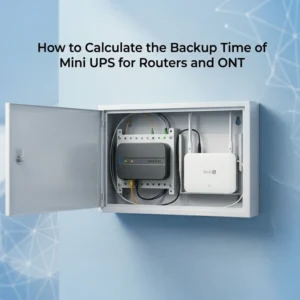
Best practice: Measure the actual current with your device under typical and peak load. Then calculate the required battery capacity (in Ah or Wh) based on your backup time target.
Define Backup Time Target
Backup requirements vary widely by project:
Application | Typical Backup Time | Battery Capacity Implication |
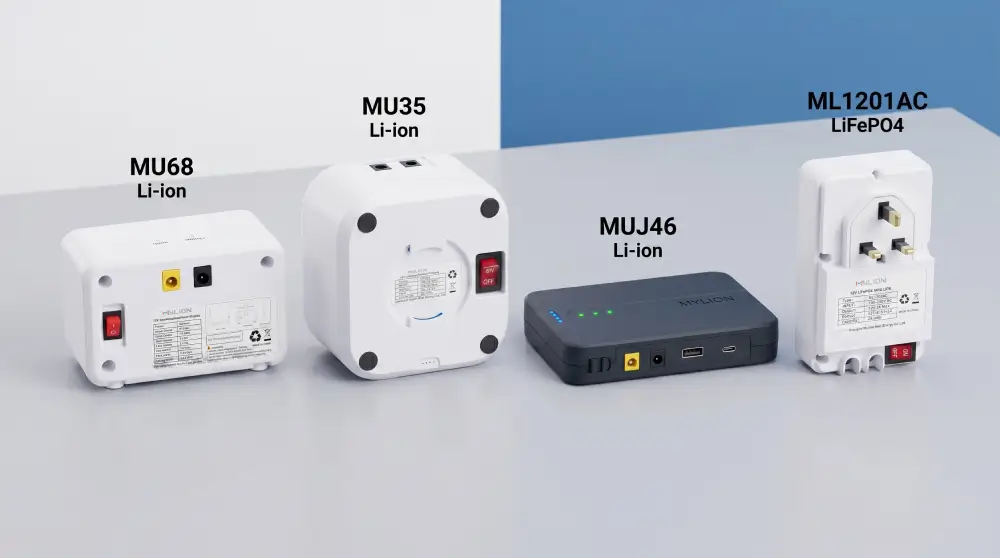
Home broadband (short outage) | 1–2 hours | Small Li-ion Mini UPS (e.g.,MU26) |
Office / SME continuity | 4–6 hours | Medium Capacity Mini UPS (e.g., MU68) |
FTTH / ISP service level | 8+ hours | High Capacity Mini UPS (e.g., MU35) |
Longer backup time increases battery capacity, physical size, weight, and shipping costs (often moving from air to sea freight). Define a realistic target based on actual grid stability and project budget.
Safety, Certification, and Environmental Factors
- Battery type: Lithium iron phosphate (LiFePO4) offers longer cycle life and better thermal stability than standard Li-ion or lead-acid.
- Protection: Overcharge, over-discharge, short-circuit, and reverse polarity protection are essential.
- Certifications: CE, FCC, RoHS, UL (for North America), or other local marks may be required. Certification depends on battery configuration, power adapter, and target market.
Installation and Cable Management
For outdoor or industrial installations, the Mini UPS should have a rugged enclosure, wide operating temperature (-10°C to 50°C or better), and secure mounting options.
Cable length and type (e.g., 18 AWG vs 22 AWG) affect voltage drop over distance – keep output cables as short as practical.
FAQ
Q1: Can one Mini UPS support two devices?
Q2: What information should I provide before requesting a quotation?
Q3: Should I test samples with my own router or ONT?
Q4: What is the difference between Li-ion and LiFePO4 for Mini UPS?
How MYLION Supports Buyers
MYLION specializes in B2B Mini DC UPS and lithium battery backup solutions for telecom, ISP, and industrial applications. We help customers with:
- Product selection and sample validation
- Custom cable, label, and packaging design
- Certification documentation (CE, FCC, RoHS, UL, etc.)
- Production inspection and shipment documentation
Whether you need a compact 5V/9V UPS for home routers or a high-capacity 12V/24V system for FTTH cabinets, MYLION delivers consistent quality and project support.
Need a Mini UPS or lithium battery backup solution for ONT, ONU, router, CPE or telecom equipment? Contact MYLION!
Compliance Note
Certification requirements depend on product configuration, target market, power adapter, battery capacity, and final application. Buyers should confirm the applicable requirements before mass production.
 English
  简体中文
简体中文  Deutsch
  Français
  Italiano
  Español