
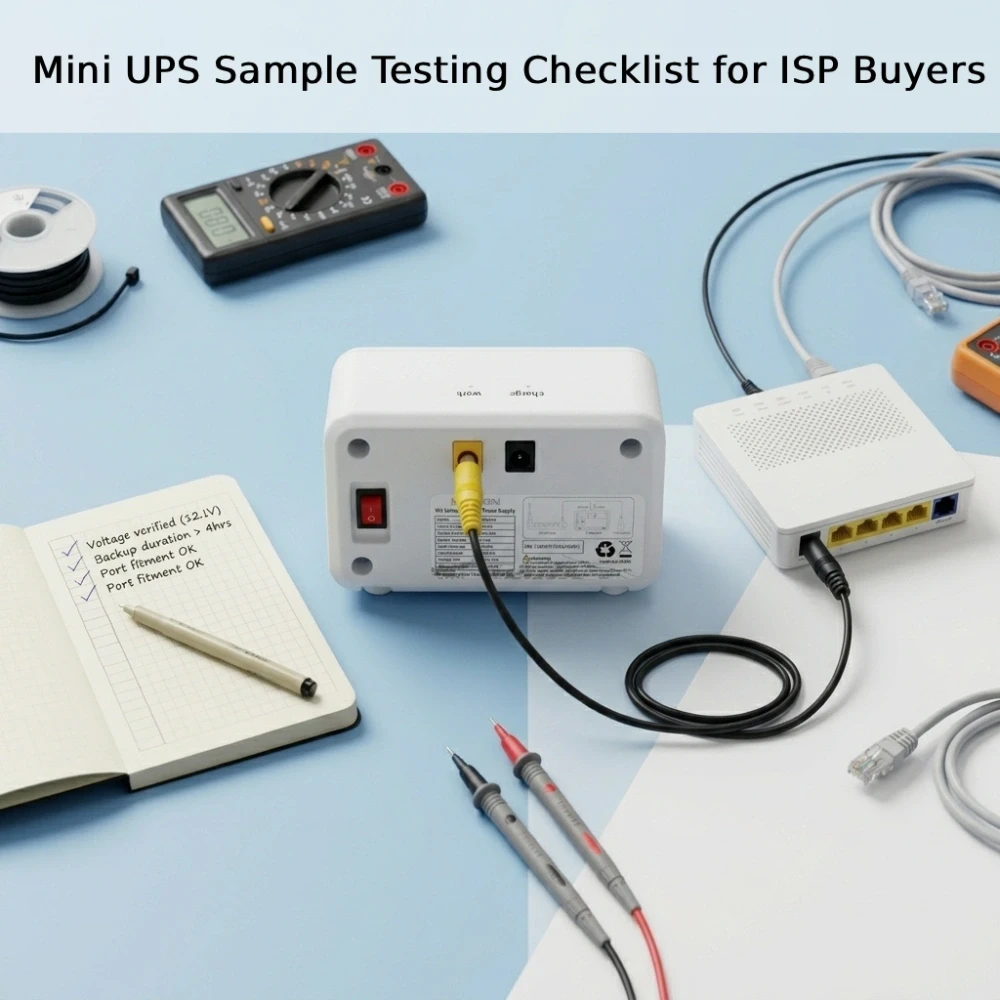
Sample testing is the critical bridge between product recommendation and mass production approval. Without a structured checklist, buyers risk misunderstandings, inconsistent results, and repeated test cycles. This guide provides a practical, repeatable framework for evaluating Mini UPS samples — helping you make confident, data-driven decisions before project sign-off.
Pre-Test Checklist
Use the table below to verify all prerequisites before powering up any Mini UPS sample.
Check Item | Typical Values / Notes |
Target device model (ONT, ONU, router, CPE, etc.) | Record exact brand and model number |
Input voltage of target device | 5V, 9V, 12V, 24V, 48V DC (common) |
Connector type and polarity | Barrel jack (5.5×2.1mm / 5.5×2.5mm), USB-C, screw terminal |
Real working current (measured or estimated) | mA or A under normal operation |
Target backup time | e.g., 2 hours, 4 hours, 8 hours |
Number of devices to be backed up | Single or multiple (total load current) |
Final system adapter model | Confirm voltage, current rating, and connector |
During Testing – Step by Step
Follow these steps closely to obtain repeatable, meaningful results.
- Record environment conditions– ambient temperature, ventilation, and test bench setup.
- Fully charge the Mini UPSbefore any backup time test (use the intended adapter).
- Connect the actual target device(s) in real working mode (not dummy loads).
- Start timingfrom the moment input power is disconnected. Record:
- Start time and end time (when device shuts down)
- Load voltage at regular intervals (e.g., every 30 minutes)
- Any abnormal behavior (flashing LEDs, reboots, noise, etc.)
- Test power–failure switching behavior– disconnect AC/DC input and observe whether the connected device:
- Stays online without restart
- Briefly resets (unacceptable for many ISP applications)
- Shows voltage drop or instability during transfer (use an oscilloscope if available)
- Repeat key testsat least three times – if results vary significantly, investigate the cause.
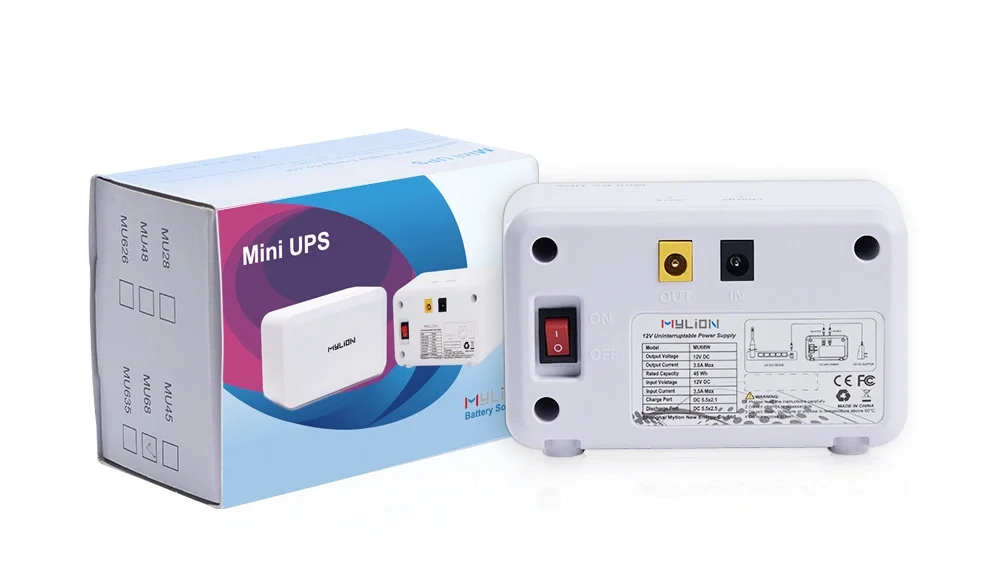
Safety and Protection Checks
Check | Acceptable Criteria |
Temperature rise under normal load | Warm but not painfully hot to touch (≤50°C surface) |
Output voltage stability | Within ±5% of rated voltage under varying load |
Over-current protection (if specified) | Shuts down or limits current when exceeding rated max |
Short-circuit protection (if specified) | Automatic recovery or latch-off (per project requirement) |
After Testing – Documentation & Approval
Once testing is complete, do not skip these final steps:
- Share all data– test reports, photos, and videos (especially if any issue occurred).
- Root-cause analysis– determine whether the issue is related to:
- The Mini UPS itself
- The adapter or charging source
- Test conditions (temperature, ventilation, load)
- Load mismatch (e.g., current exceeds UPS rating)
- Freeze the approved sample version – record firmware, battery cell batch, and PCB revision. Use this as the baseline for mass production.
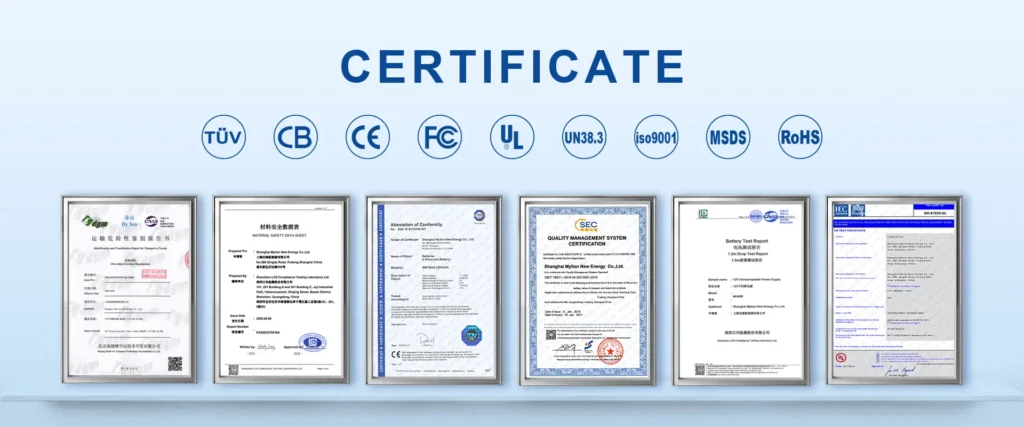
- Confirm non-technical items– cable length and type, label artwork, packaging, and certification documents (CE, FCC, RoHS, UN38.3, etc.).
FAQ
Q1: Why should abnormal tests be agreed in advance?
Q2: Should backup time be tested only once?
Q3: What should I do if sample result is not as expected?
Q4: How many Mini UPS samples should I request for testing?
How MYLION Supports Buyers
MYLION specializes in B2B Mini DC UPS and lithium battery backup solutions for telecom, ISP, and industrial applications. We support customers throughout the entire journey:
- Product selection based on device voltage and backup time
- Sample validation guidance (including custom checklists)
- Custom cables, labels, and packaging
- Certification document preparation (CE, FCC, RoHS, UN38.3, etc.)
- Production inspections and shipment documentation
We don’t just sell components – we help you test, validate, and deploy with confidence.
Need a Mini UPS or lithium battery backup solution for ONT, ONU, router, CPE or telecom equipment? Contact MYLION!
Compliance Note
Certification requirements depend on product configuration, target market, power adapter, battery capacity, and final application. Buyers should confirm the applicable requirements before mass production.
 English
  简体中文
简体中文  Deutsch
  Français
  Italiano
  Español