
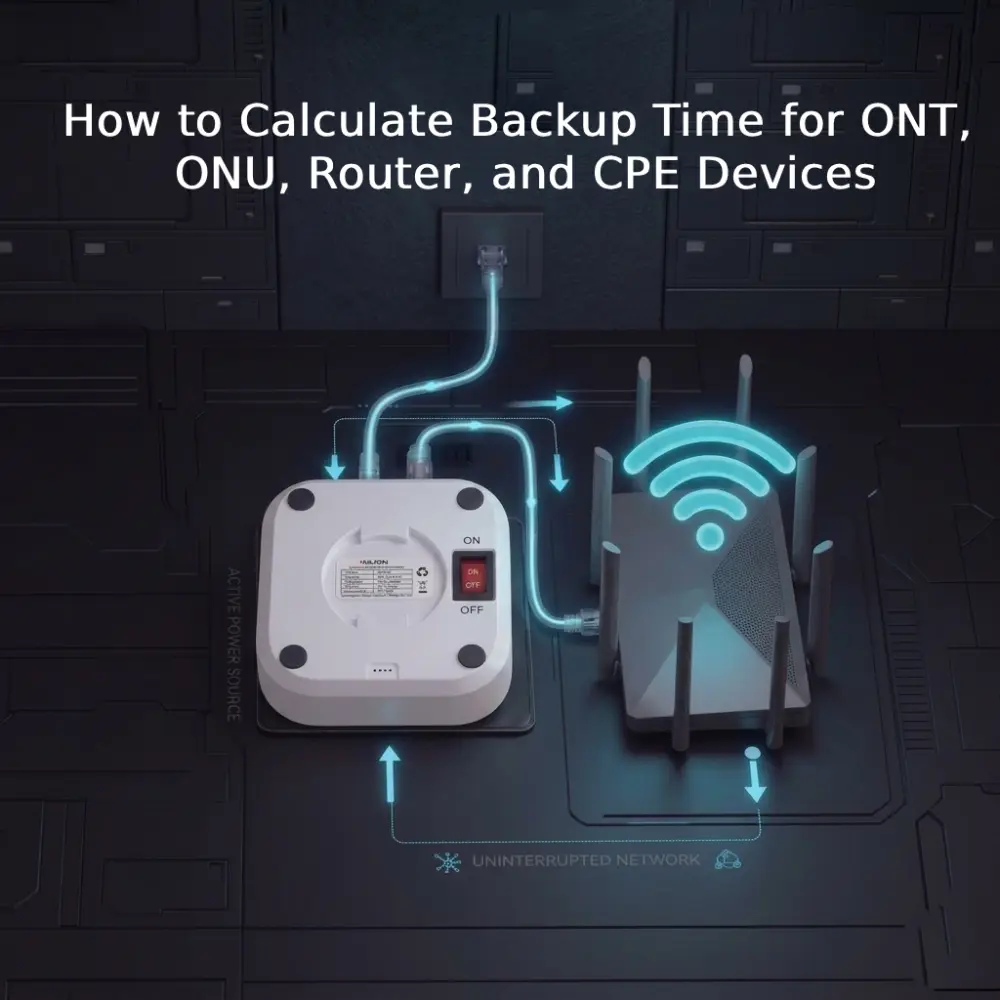
One of the most common questions in broadband backup projects is: How long will the Mini UPS support my device? Many buyers estimate backup time based only on battery size or adapter label. In real telecom and ISP applications, that is not enough.
Precise calculation of the backup time is necessary to match the appropriate Mini UPS products for different scenarios, avoiding “insufficient backup power” or “excessive investment”.
This technical guide details the methodology for calculating precise backup times for edge telecom devices, helping telecom service providers and ISPs select the appropriate Mini DC UPS solution.
How to Accurately Estimate Mini UPS Backup Time?
Calculate the backup time required for ONT, ONU, routers and CPE devices, and focus on the actual energy consumption indicators: watt-hours (Wh).
To determine how long a Mini UPS will power a specific device, a more appropriate method is to use:
T = E × η ÷ P
Where:
T = Backup time (hours)
E = Total Battery Energy Capacity ( Wh)
η = UPS efficiency (typically 90%-95% for DC MINI UPS)
P = Total load power (W)
A more intuitive simplified formula is: Backup Time = Total Battery Energy (Wh) ÷ Load Power (W)
Example: A 12V 3A MINI UPS with 45Wh capacity powering a 12W ONT device → theoretical backup time = 45 ÷ 12 = 3.75 hours.
Step 1: Profiling the Load (Device Power Consumption)
To calculate accurate runtime, you must identify the maximum operating wattage of the edge devices. While peak draw occurs during boot-up or heavy data transmission, using the rated maximum ensures a safe operational buffer.
- Standard Fiber ONT/ONU:5W to 10W (Typical 12V/0.5A or 12V/1A)
- Basic Wi-Fi Router/CPE:10W to 15W (Typical 12V/1A or 12V/1.5A)
- Advanced Tri-Band / Wi-Fi 6E Router:18W to 24W (Typical 12V/2A)
Step 2: Determining Battery Capacity (Wh)
If a Mini UPS lists its capacity in milliampere-hours (mAh) alongside voltage (V), you must convert it to Watt-hours to perform an accurate cross-device calculation:
E (Wh) = Capacity (mAh)×Voltage (V)÷1000
For example, a telecom-grade Mini UPS featuring a high-density lithium array of 10000mAh at 3.7V possesses an internal capacity of 37Wh.
Calculation Example:
If an ISP deploys an ONU and a standard router with a combined draw of 12W, and utilizes a 37Wh Mini UPS with a conversion efficiency of 90% (0.90):
T= 37 × 0.9 ÷ 12 ≈ 2.77 Hours
This guarantees nearly 3 hours of flawless network continuity during an outage.
Four Key Variables Affecting Backup Time
1. Battery Capacity: The Fundamental Determinant
Battery capacity is usually expressed in mAh or Wh. Note that Wh is the true measure of energy – a 12V 10Ah battery stores 120Wh, while a 5V 10Ah battery stores only 50Wh. Therefore, always unify to Wh when comparing across voltages.
2. Device Load Power: Typical Power Consumption of ONT/ONU/Router/CPE
Power consumption varies significantly across devices, directly impacting backup duration:
Device Type | Typical Power Range | Reference Value |
Basic GPON ONU/ONT | 2W – 7W | 2W |
ONT with Wi-Fi | 7W – 12.5W | 12.5W |
Home/Small Router | 5W – 10W | 6W |
Enterprise/High-Performance Router | 12W – 25W | 15W – 25W |
CPE (Wi-Fi + Multi-Port) | 10W – 18W | 15W |
Router + ONT Combo | 12W – 30W | 20W |
Practical tip: Check the device power adapter label “Output: V × A” and multiply voltage by current to get maximum power. Actual operating power is typically 60%-80% of this value.
3. UPS Efficiency: The Advantage of DC MINI UPS
Traditional AC UPS inverts battery DC to AC, then the device’s adapter converts back to DC – double conversion causes 20%-30% energy loss. In contrast, DC MINI UPS directly outputs 12V/5V DC, eliminating the need for the device’s adapter, achieving 90%-95% efficiency and extending backup time by more than 30%.
4. Real-World Operating Conditions
- Battery aging: After approximately 600 charge-discharge cycles, lithium battery capacity typically drops to 80% of initial.
- Ambient temperature: High temperatures accelerate battery degradation; low temperatures reduce instantaneous discharge capability.
- Discharge rate: Higher loads reduce effective usable battery capacity.
Full Mylion Mini UPS Series Comparison: Parameters & Backup Time Analysis
As a professional Mini UPS supplier, Mylion’s product line covers full-scenario needs from 2A basic backup to 5A high-current backup, widely used in telecom, ISP, FTTH, smart security, and other fields.
Model | Output Current | Battery Capacity (Wh) | Typical Backup Time | Core Positioning | Target Scenario |
MU26 | 2A | 19.24Wh | ~2h at 12W | Compact Economy | Single ONT/Small Router |
MU48 | 3A | 29.6Wh | ~3h at 12W | Long Endurance | ISP Network Equipment, Single ONT+Router |
MU68 | 3A | 44.4Wh | ~4h at 12W | High Reliability | Enterprise Network Equipment, FTTH Deployment |
MU35 | 5A | 77.7Wh | ~7h at 12W | High Current, High Load | High-Performance Routers, Multi-Device Central Backup |
MU65 | 5A | 57.72Wh | ~5h at 12W | Multi-Device Compatibility | High-power router backup, Multi-Device Combinations |
MUJ46 | 2A (12V) + 3A (USB) | 38.48Wh | ~4h at 12W | Multi-Port Output | Low-power CPE backup, 12V /5V USB Broadband devices Backup |
Mini UPS Selection Guide – How to Match Appropriate Backup Time for Different Applications?
Scenario 1: Home User/Small Office – Single ONT or Router Backup
Characteristics: Single device (ONT or router), 6W-12W power consumption, low outage frequency, budget-sensitive.
Backup Duration Requirement | Recommended Model | Theoretical Backup Time (12W Load) |
2-3 hours | MU26 | ~2 hours |
3-5 hours | MU48 | ~2.5 hours |
5-8 hours | MU68 | ~4-5 hours |
Selection advice: MU26 Mini UPS meets basic needs on a tight budget; for overnight outages or longer durations, recommend MU68 Mini UPS.
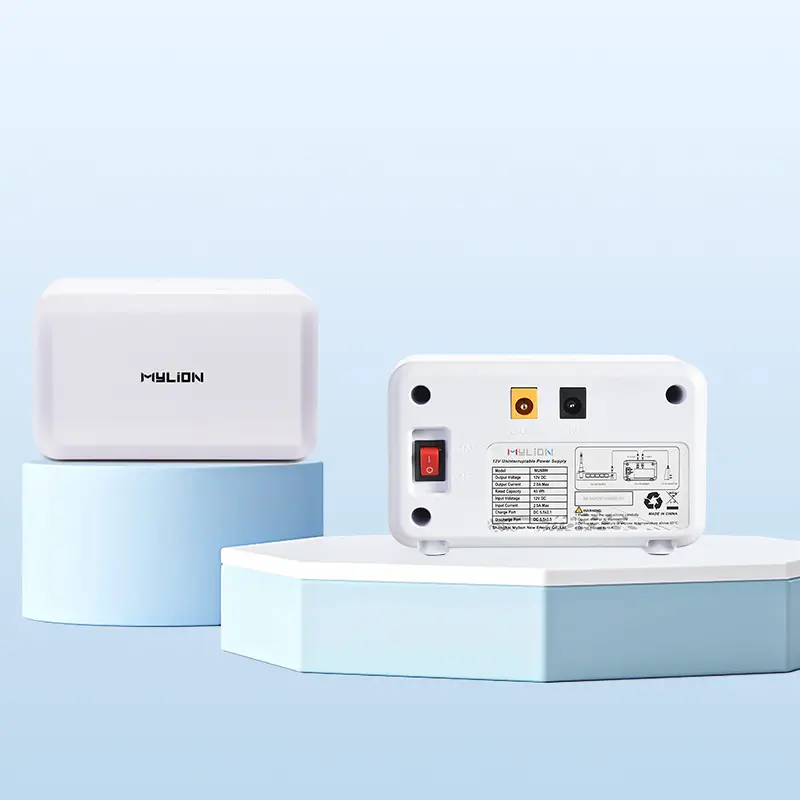
12V 2A MU26 Mini UPS
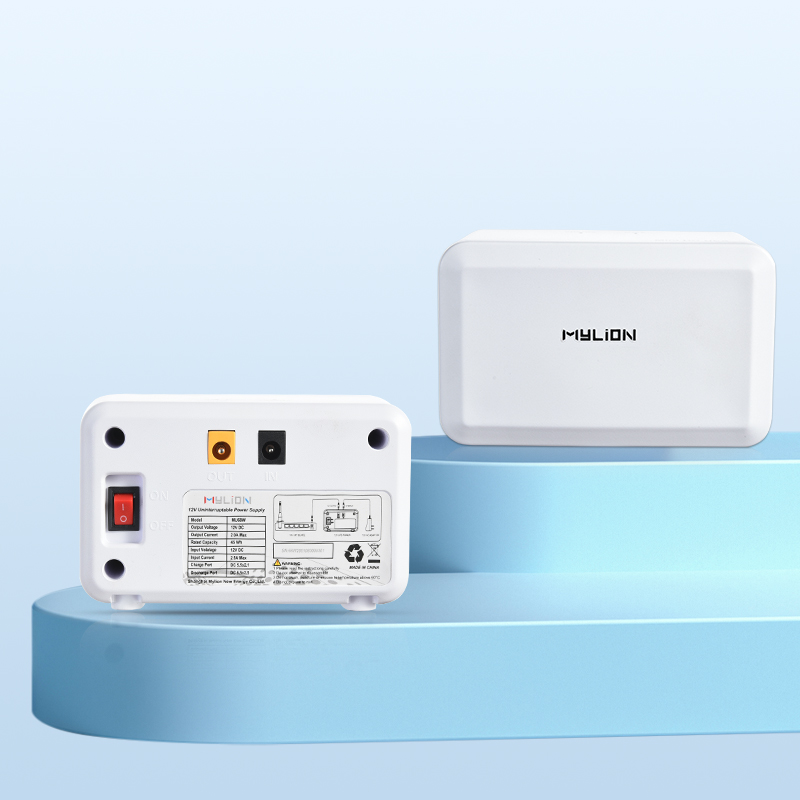
12V 3A MU48 Mini UPS
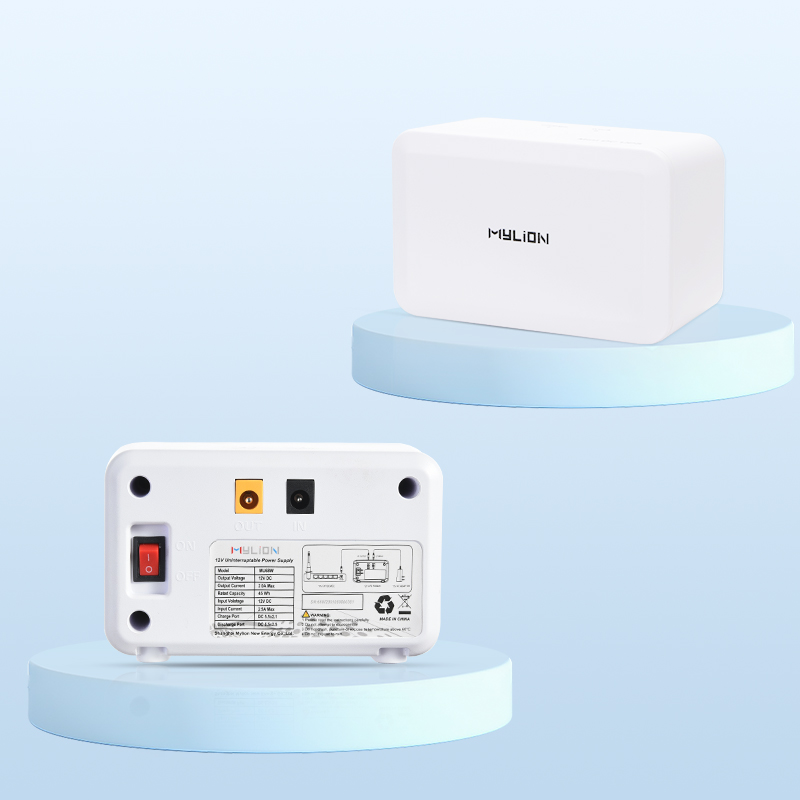
12V 3A MU68 Mini UPS
Scenario 2: ISP Centralized Deployment/FTTH Subscriber End – ONT + Router Combo Backup
Characteristics: Simultaneous power for ONT (~6W) and router (~6W-10W), total load 12W-16W, zero transfer time required, large deployment volume.
Backup Duration Requirement | Recommended Model | Theoretical Backup Time (14W Load) |
3-4 hours | MU68 | ~3.5 hours |
2-3 hours | MU48 | ~2 hours |
Selection advice: MU68 Mini UPS is a cost-effective choice, providing 4-5 hours backup at 12W load, far exceeding the 1-hour minimum required by UK regulator OFCOM.
Scenario 3: Enterprise Gateway/High-Performance Router – High-Power Device Dedicated Backup
Characteristics: Enterprise router 18W-25W, or simultaneous power for multiple devices, total load 20W-36W.
Backup Duration Requirement | Recommended Model | Theoretical Backup Time |
2-3 hours (20W load) | MU35 | ~3.5 hours |
1.5-2 hours (30W load) | MU35 | ~2 hours |
1 hour (60W load) | MU35 | ~1 hour |
Selection advice: High-load scenarios must use 5A high-current models (MU35 Mini UPS or MU65 Mini UPS); standard 2A/3A products cannot reliably start high-power devices. The MU35’s 77.7Wh capacity is currently the ceiling in the series.
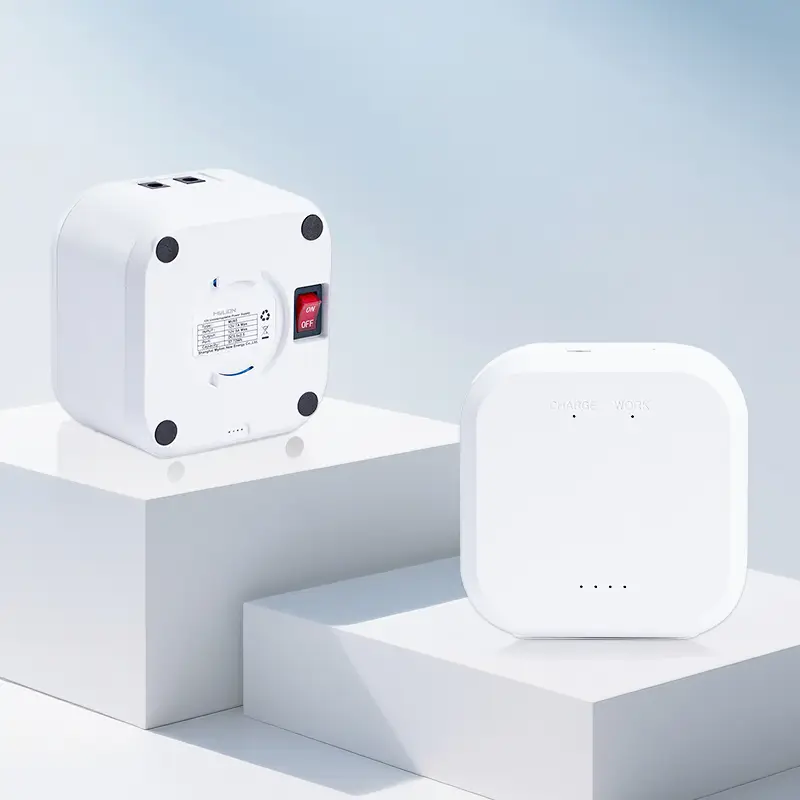
12V 5A MU35 Mini UPS
12V 5A MU65 Mini UPS
12V 5A MU05 Mini UPS
Scenario 4: FTTH Subscriber End + USB Device – 12V Terminal + 5V Device Combo Backup
Characteristics: Simultaneous power for ONT/router (12V) and 5V USB terminal devices, total power 8W-15W.
Backup Duration Requirement | Recommended Model | Configuration |
4-6 hours | MUJ46 | 12V + USB dual-port simultaneous output |
Selection advice: The MUJ46 Mini UPS is the only model natively supporting dual 12V and 5V output, particularly suitable for FTTH subscriber end installations, ensuring power for both network equipment and USB devices.
Scenario 5: Outdoor/Remote Monitoring – CPE and Security Device Backup
Characteristics: Devices located outdoors or in remote areas, high outage frequency, requiring long runtime and high reliability.
Selection advice: The MU65’s 55.72Wh capacity and MU35’s 77.7Wh large capacity are both suitable. If ambient temperature varies greatly, consider models with LiFePO₄ batteries (e.g., ML1202 Mini UPS series), which offer cycle life exceeding 2000 cycles and superior thermal stability.
Scenario 6: 24V/48V Telecom Equipment – Non-Standard Voltage Dedicated Backup
Characteristics: Wireless CPEs, bridges, telecom radio equipment requiring 24V or 48V power.
Selection advice: Mylion MU248 Mini UPS is specifically designed for 24V/48V non-standard voltage applications, supporting professional backup needs for telecom projects and wireless communication equipment.
Why Choose Mylion Mini UPS?
- Zero transfer time: 0ms seamless switching, network stays up during power failure
- DC high-efficiency architecture: 90%-95% conversion efficiency, extends backup time by 30%+ compared to AC UPS
- Complete product line: Full scenario coverage from 2A to 5A, single output to multi-port, 12V to 48V
- Professional protection: Built-in BMS intelligent protection, flame-retardant ABS enclosure, CE/FCC/UN38.3/IEC62133 and other international certifications
- Verified performance: Third-party tested continuous operation exceeding 7 hours, far above industry baseline requirements
Quick Backup Time Calculation Methods
Step 1: Check the device power adapter label, record output voltage (V) and output current (A), multiply to get maximum power (W).
Step 2: Confirm the MINI UPS battery capacity (Wh) using: Wh = V_battery × Ah_battery.
Step 3: Estimate backup time: Theoretical backup hours = UPS battery capacity (Wh) ÷ Total device power (W).
Note: Theoretical calculations typically run 10%-20% higher than actual runtime; it’s advisable to leave a safety margin.
FAQ
Q1: How to calculate backup time for a Mini UPS?
Use this formula:Backup Time = Battery Energy (Wh) × Efficiency ÷ Actual Load Power (W)
Q2: Why is actual backup time often shorter than theoretical runtime?
Because real conditions include efficiency loss, battery aging, load fluctuation, temperature effects, and protection margins.
Q3: Can one Mini UPS support both ONT and router?
Yes, if the total load and required runtime are within the output and battery capability of the Mini UPS.
Q4: Why should I use Wh instead of mAh?
Because Wh directly reflects energy storage and is more useful for runtime calculation across different voltage systems.
Q5: Does a bigger battery always mean longer backup time?
Usually yes under the same load, but runtime still depends on actual power consumption and system efficiency.
Q6: What should ISPs focus on when estimating backup time?
They should focus on the real device load, runtime target, and whether the Mini UPS can support stable operation in actual deployment.
Conclusion
The cost of a Mini DC UPS is a fraction of the cost associated with churned subscribers, voided SLAs, and emergency technician deployments. By accurately calculating the required backup time for your ONTs, ONUs, and CPEs, you can engineer an infrastructure that refuses to fail.
For telecom, ISPs, and broadband projects, choosing the right Mini UPS can ensure the continuity of services, reduce operating costs, and enhance customer satisfaction. Mylion Mini UPS full series provides a complete backup power solution covering all application scenarios for telecom operators and ISPs.

 English
  简体中文
简体中文  Deutsch
  Français
  Italiano
  Español