
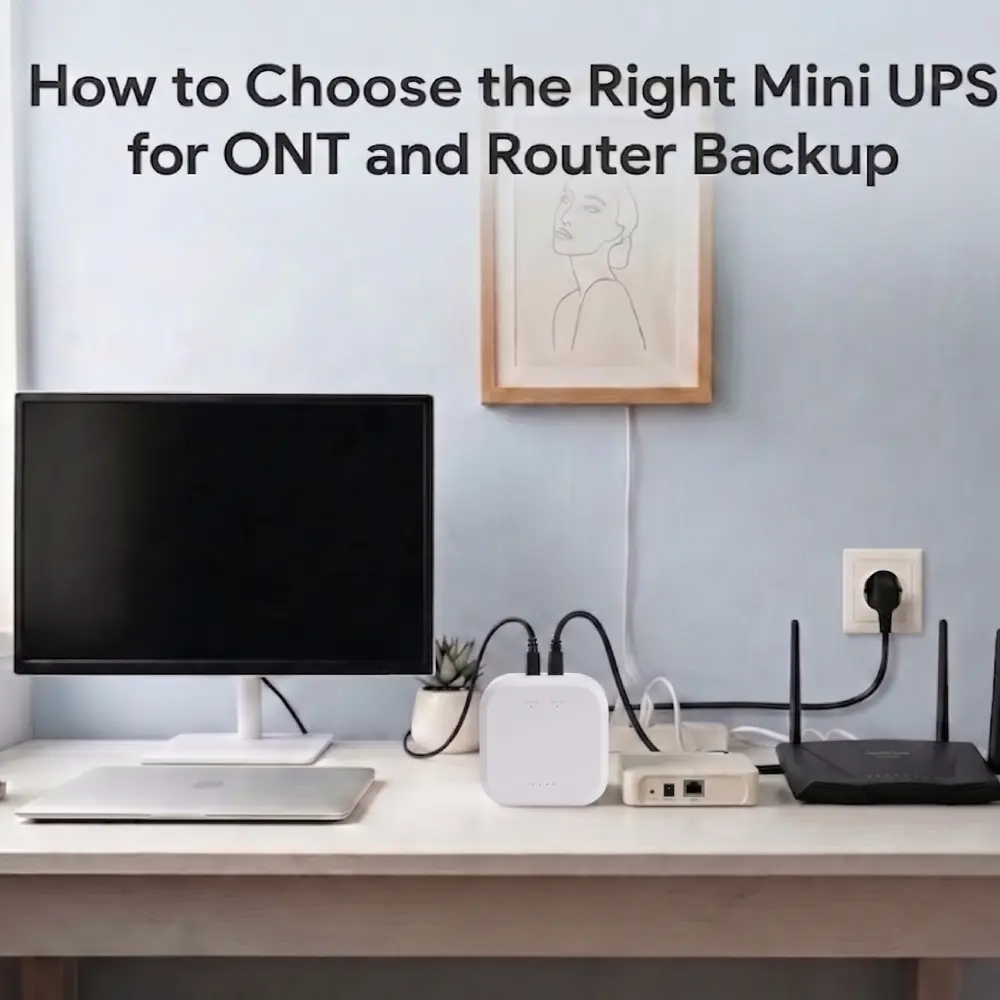
How to Choose the Right Mini UPS for ONT and Router Backup
Power outages are unavoidable.Service interruption does not have to be. For telecom operators, ISPs, and broadband service providers, the real problem during a power failure is not simply losing electricity. The bigger problem is losing subscriber connectivity, increasing support calls, and creating unnecessary field service pressure.
That is why choosing the right Mini UPS for ONT and router backup is not just a product decision. It is part of service continuity design.
Many buyers focus only on battery capacity or advertised backup hours. In real deployment, however, backup reliability depends on much more than watt-hours alone. A Mini UPS must match the actual device voltage, current, load profile, and backup target. Otherwise, even a larger battery may fail to deliver the expected result.
Why the Wrong Mini UPS Causes Problems?
In many projects, backup failure is not caused by poor battery quality alone. It often comes from selecting the wrong model for the application.
Common issues include:
- using a 12V 3A Mini UPSfor a device with higher startup or peak current
- estimating backup time based only on adapter label instead of real power consumption
- trying to support both ONT and router with a model designed for single-device backup
- ignoring adapter compatibility and charging margin
- choosing a consumer-style product for a project that requires stable long-term deployment
As a result, the device may reboot during outage, the backup time may be much shorter than expected, or the system may become unstable in real field conditions.
What Buyers Should Confirm Before Choosing a Mini UPS?
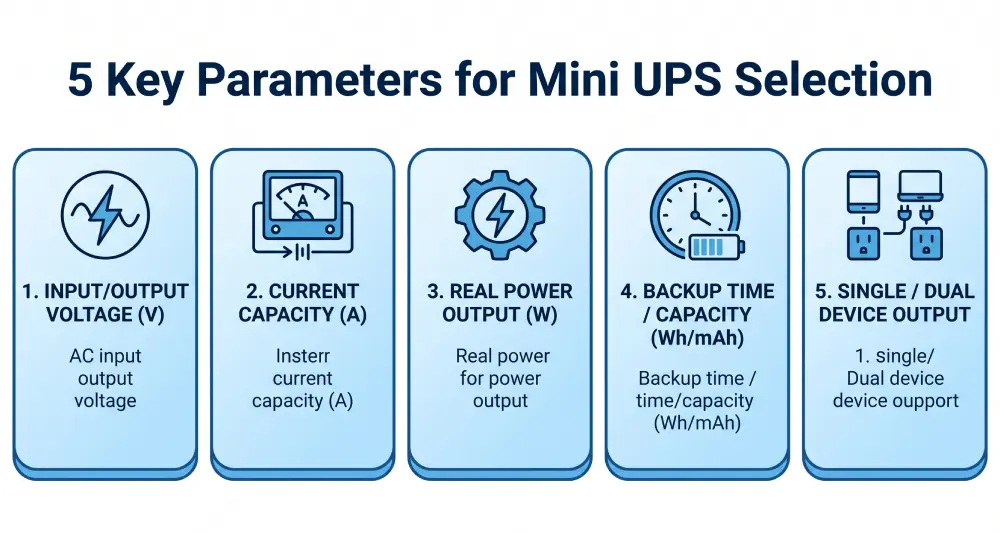
Before selecting a Mini UPS for ONT or router backup, buyers should confirm five key points.
1. Device Voltage
Most ONT, ONU, routers, and gateways use 12V DC input, but some projects may involve 9V, 24V, or even 48V devices. Voltage mismatch is a basic but critical error.
Therefore,the Mini UPS must match the device voltage requirement. A reliable backup solution always starts with correct voltage matching.
2. Maximum Current Requirement
Many ONT devices work within a relatively low current range, while some routers, gateways, or WiFi devices require higher current, especially during startup or peak load. A 12V 3A Mini UPS may be suitable for standard ONT backup, but it may not be enough for higher-power router or dual-device applications.
This is why buyers should check not only the rated current, but also the real operating and peak current of the device.
3. Actual Power Consumption
Do not rely only on the power adapter label. For example, a device may come with a 12V 3A adapter, but the actual operating power may be much lower. On the other hand, some devices may have load fluctuations that affect real backup time.
A better approach is to estimate backup needs based on actual watt consumption in working conditions. This gives a more realistic basis for Mini UPS selection.
4. Required Backup Time
Backup time should be defined clearly. Do you need 30 minutes, 1 hour, 2 hours, or 4 hours of support during a grid failure? Is the goal to maintain a short communication window, or to keep broadband service running for a longer period?
The required backup duration directly affects the battery capacity and model selection. Without a clear backup target, buyers often choose either an oversized product that adds cost or an undersized product that fails in the field.
5. Single Device or Dual Device Backup
Some users only need backup for the ONT. Others want one Mini UPS to support both ONT and router at the same time. These two applications are very different in real power demand.
If one Mini UPS is expected to support two devices, buyers must calculate the combined load, connector configuration, and expected runtime carefully. Otherwise, the result may look acceptable on paper but fail in real deployment.
What Makes a Good Mini UPS for ONT and Router Backup
For telecom and ISP use, a good Mini UPS should offer more than battery capacity.
Key factors include:
- stable voltage output
- sufficient current margin
- reliable switchover during outage
- good battery quality and protection design
- compatible connectors and adapter matching
- consistent production quality for project deployment
For B2B projects, product consistency matters as much as product specification. A sample that works well is not enough. The solution must also remain stable across repeated batches and real deployment environments.
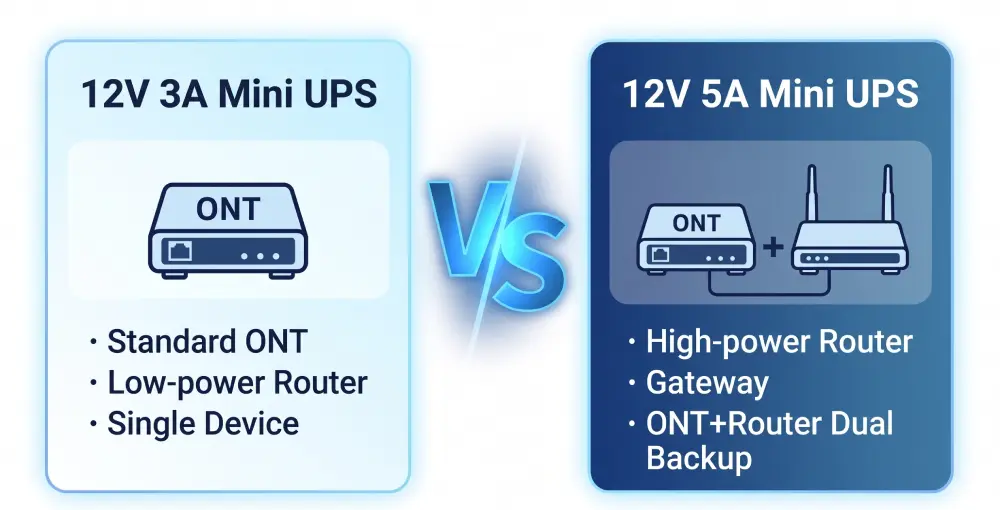
12V 3A or 12V 5A: Which One Should You Choose
In many broadband backup projects, the choice often comes down to 12V 3A or 12V 5A Mini UPS models.
A 12V 3A Mini UPS is usually suitable for:
- standard ONT or ONU backup
- lower-power router backup
- single-device deployment with moderate load
A 12V 5A Mini UPS is more suitable for:
- higher-power routers or gateways
- devices with higher startup current
- dual-device backup such as ONT plus router
- projects requiring more current margin and stronger load support
12V 3A Mini UPS vs 12V 5A Mini UPS
Specification Overview | 12V 3A Mini UPS | 12V 5A Mini UPS |
Primary Application | Standard ONT or ONU backup; lower-power routers | Higher-power routers, gateways, or demanding applications |
Deployment Scale | Single-device deployment with moderate load | Dual-device backup (e.g., ONT plus router) |
Current Margin & Load | Sufficient for lighter broadband equipment | Safely handles devices with higher startup current; provides more current margin |
In simple terms, 12V 3A models are often enough for lighter broadband equipment, while 12V 5A models are safer for higher-power or more demanding applications.
How ISPs and Integrators Should Think About Mini UPS Selection
For ISPs and system integrators, the right question is not:
Which Mini UPS has the biggest battery?
The better question is:
Which Mini UPS matches the actual device, power demand, deployment target, and service continuity requirement?
A proper backup solution helps reduce service interruption during power failure, lower complaint rates, and reduce avoidable support costs. That is where the real value is.
Mini UPS is not just a battery product. It is part of network continuity design.
Common Deployment Scenarios
When selecting the ONT and Router backup solution, aligning the Mini UPS model with the exact field deployment scenario is critical to preventing subscriber downtime and mitigating avoidable field service costs:
- Scenario A: Single-Node FTTH Continuity:Supplying dedicated backup solely to a standard ONT. This scenario operates within a relatively low current range, making a 12V 3A Mini UPS unit sufficient to maintain the communication window.
- Scenario B: Dual-Device Gateway Systems:Powering both the ONT and a local Wi-Fi router simultaneously. Because these applications demand higher operating and peak currents, calculating the combined load and utilizing a 12V 5A Mini UPS device is strictly required to maintain stability and prevent device reboots during a grid failure.
- Scenario C: High-demand Enterprise Routing:Supports high-power routers or gateways in business environments. These environments require strong load support and sufficient current margin. Adopting the 12V 5A Mini UPS solution ensures reliable switching and stable long-term deployment.
MYLION Mini UPS Options for ONT and Router Backup
At MYLION, we provide Mini UPS and DC backup solutions designed for telecom and broadband device applications.
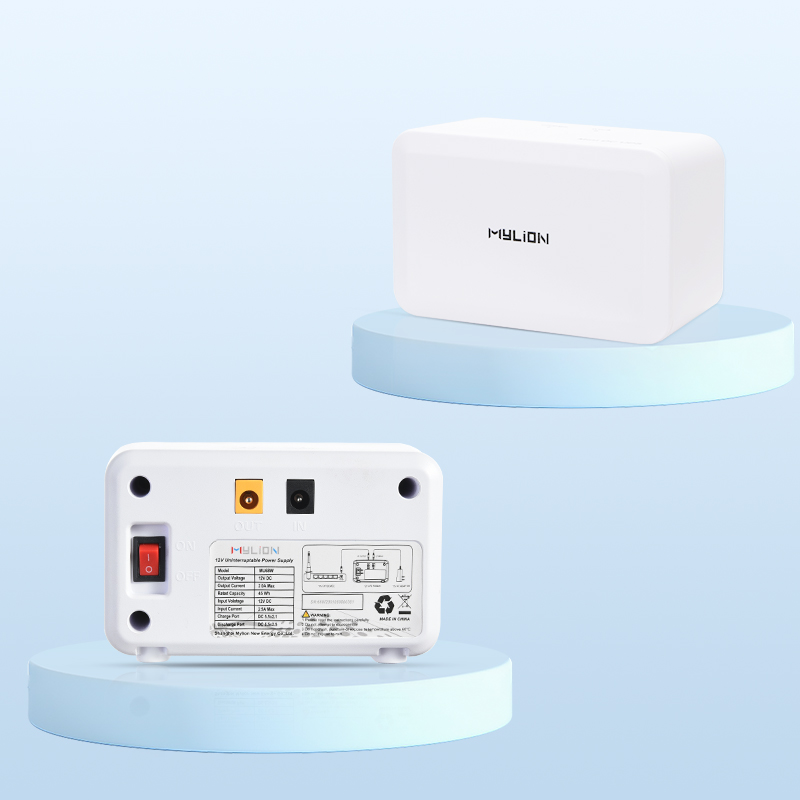
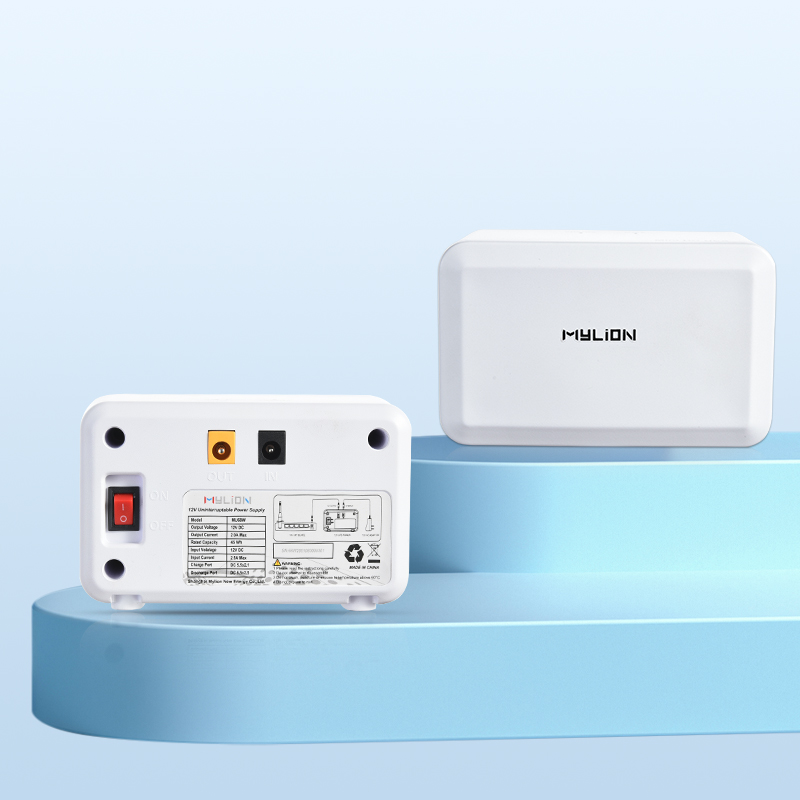
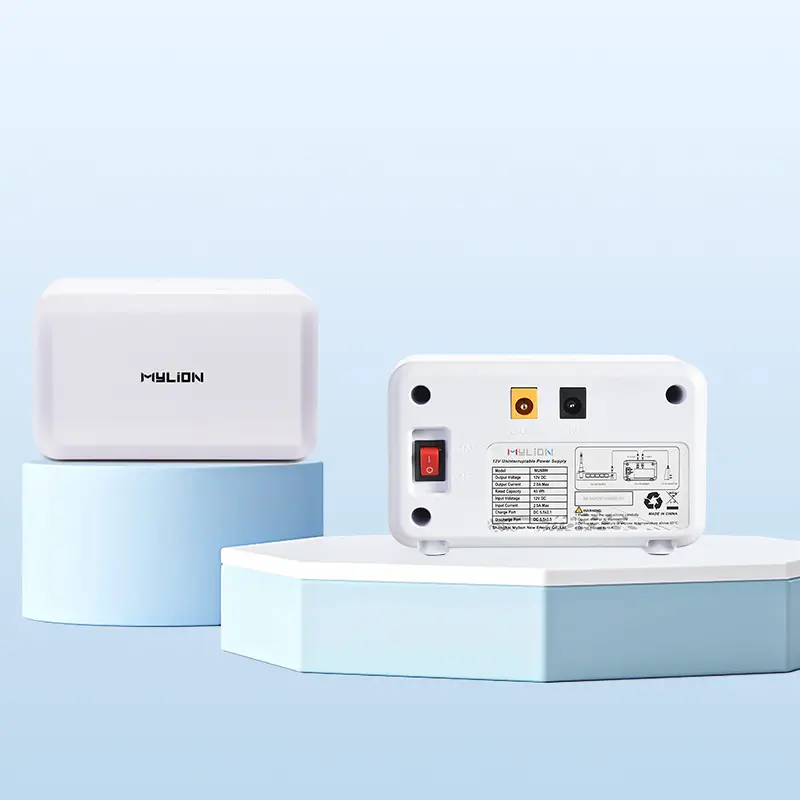
- For standard ONT and lower-power router backup, 12V 3A models such as MU26Mini UPS, MU48 Mini UPS, and MU68 Mini UPS are suitable options depending on the required backup time.
- For higher-power router, gateway, or dual-device backup, 12V 5A models such asMU35 Mini UPS are more suitable where higher current support and longer runtime are needed.
- For projects with higher voltage requirements, such as 24V or 48V telecom applications, industrial DC UPS solutionsshould be evaluated separately.
The right model should always be selected based on actual voltage, load, backup target, and project requirements rather than battery size alone.
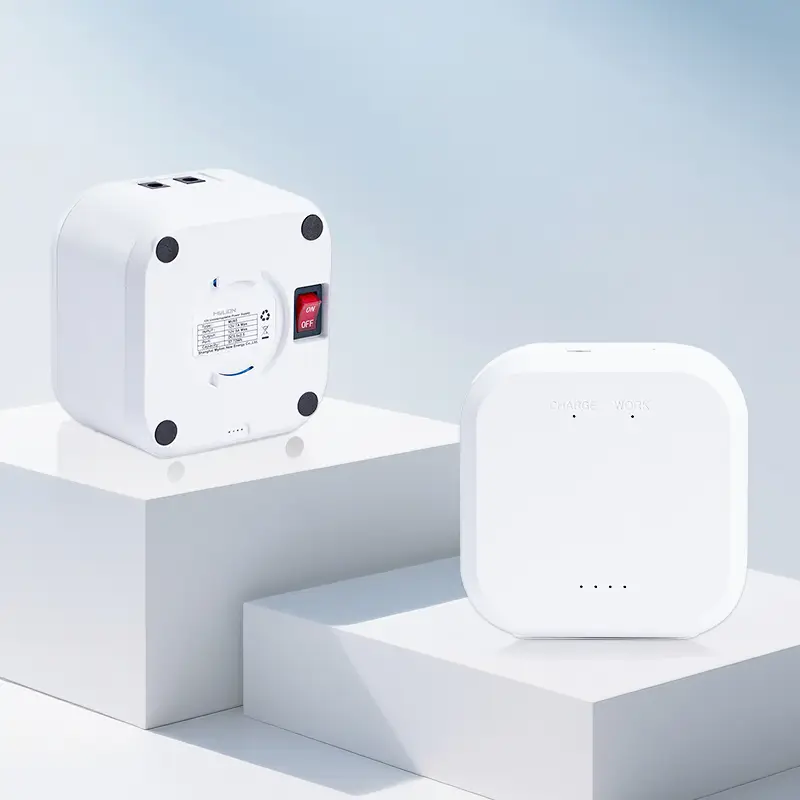
12V 5A MU35 Mini UPS
12V 3A MU68 Mini UPS
12V 5A MU48 Mini UPS
12V 3A MU26 Mini UPS
FAQ
Q1: What devices can a Mini UPS support?
A Mini UPS can support ONT, ONU, router, modem, gateway, CPE, and other DC-powered network devices, depending on voltage, current, and connector compatibility.
Q2: Can one Mini UPS support both ONT and router?
Yes, but only if the total load is within the Mini UPS output capability and the runtime target is still achievable. Dual-device backup requires careful load calculation.
Q3: How do I calculate backup time?
Backup time depends on battery energy, conversion efficiency, and actual device power consumption. A realistic estimate should be based on real load, not just adapter label rating.
Q4: What is the difference between 12V 3A and 12V 5A Mini UPS?
The main difference is output current capability and load support. A 12V 5A model can support higher-power devices or more demanding applications with more margin.
Q5: Why is Mini UPS selection important for ISPs?
The right Mini UPS helps maintain subscriber connectivity during outages, reduce service complaints, and lower field support pressure.
Conclusion
Choosing the right Mini UPS for ONT and router backup is not only about capacity. It is about matching voltage, current, real load, backup time, and deployment needs.
For telecom operators, ISPs, and system integrators, a suitable Mini UPS helps improve service continuity and reduce avoidable downtime during power outages.
If you are evaluating Mini UPS solutions for ONT, router, or broadband backup projects, MYLION can help recommend a suitable model based on your actual device requirements and backup targets.

 English
  简体中文
简体中文  Deutsch
  Français
  Italiano
  Español