
Introduction
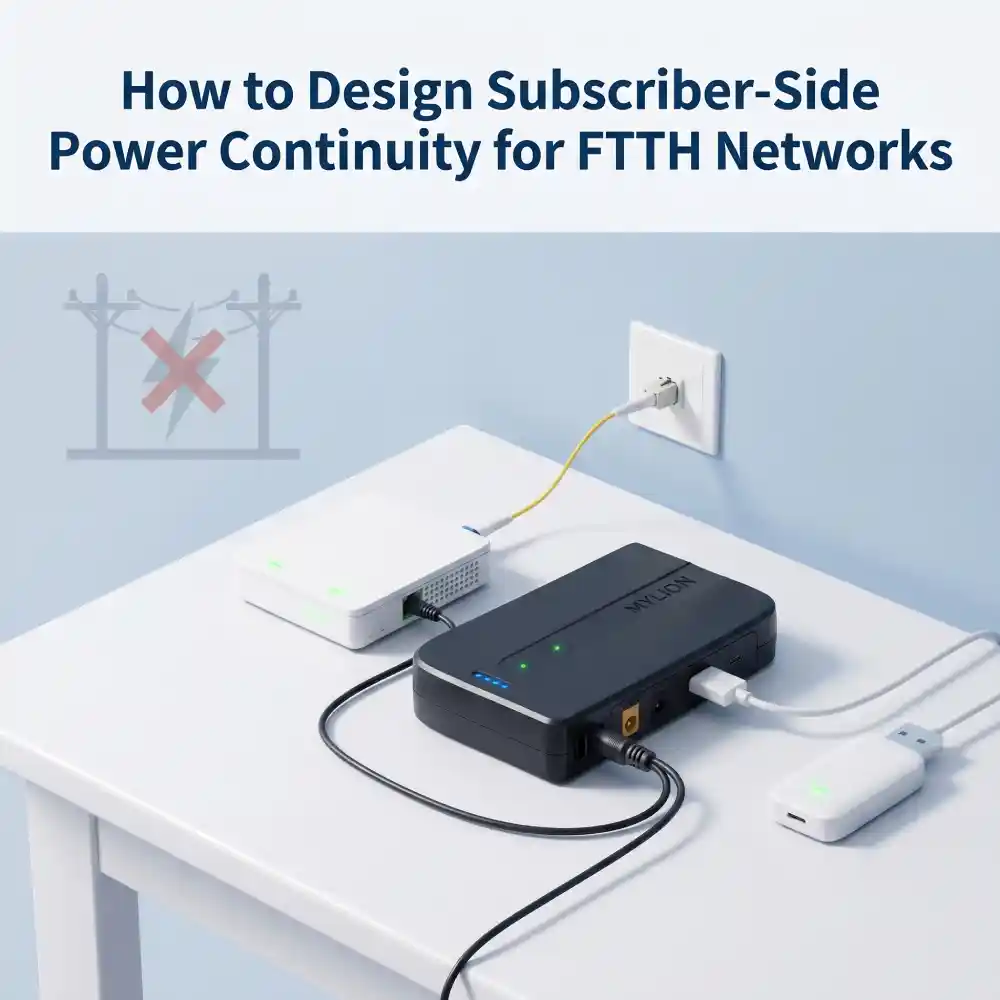
Power outages do not always take the fiber network down. But they often take the subscriber offline.
In FTTH projects, the most common interruption point during a grid failure is not the upstream optical line. It is the customer-side equipment: ONT, ONU, router, or gateway. Once those devices lose power, the service disappears at the user end, no matter how stable the access network may still be.
That is why subscriber-side power continuity is not a minor accessory topic. It is part of service continuity design. For ISPs and telecom operators, the more important question is “How do we design a practical and scalable backup strategy at the subscriber edge?” The answer increasingly points toward Mini UPS for FTTH networks—compact DC backup systems purpose-built for fiber edge devices.
Start from the Service Goal, Not the Battery
A useful FTTH backup design starts from the service goal. Different operators may define continuity differently:
- Keep only the optical terminal online during short outages
- Keep ONT and router online together so Wi-Fi still works
- Maintain gateway operation for a defined emergency window
- Offer a backup tier as a value-added service in unstable-grid markets
These are different service goals, so they should not be forced into one device choice. A good design begins by deciding what “stay online” should mean for the subscriber. Only then does product selection become meaningful.
This approach prevents a common mistake: choosing a Mini UPS for FTTH Networks first, then trying to make the project fit around it.
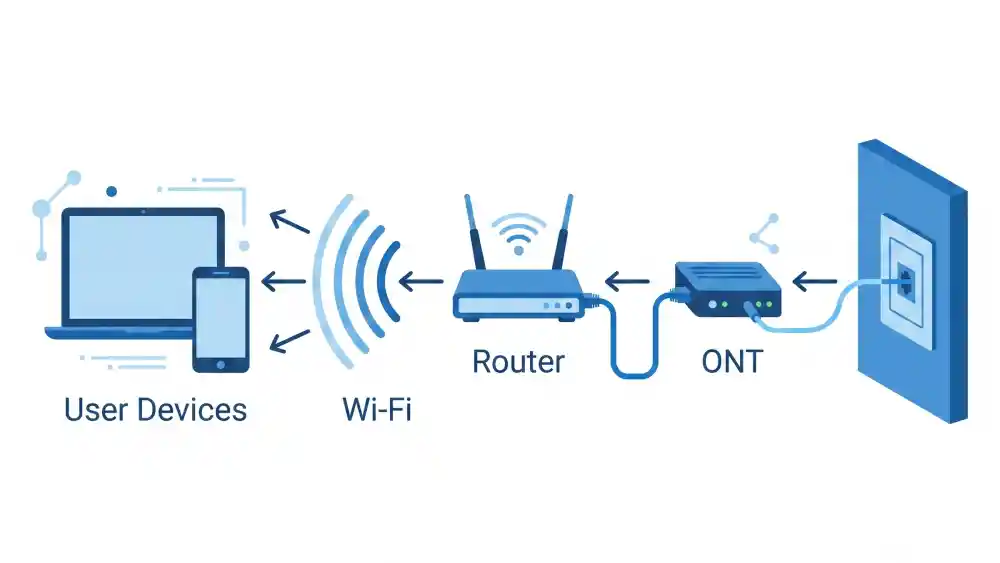
Subscriber-side continuity design should begin with device mapping. In a typical FTTH setup, the customer-side chain may include:
- ONT or ONU
- Router
- Wi-Fi gateway
- CPE or special access device
- Shared or separate adapters
- Installation environment and cable routing
The key is to identify what must stay powered for the service to remain usable. In some projects, ONT-only backup is enough. In others, ONT-only backup still results in complaints because users lose Wi-Fi when the router shuts down. The operator must decide whether continuity means “optical access preserved” or “subscriber experience preserved.” Those are not always the same thing.
For operators looking to deploy a Mini UPS for FTTH Networks, this mapping stage is critical—it directly determines voltage, current, and connector requirements.
Choose Between ONT-Only and ONT Plus Router Logic
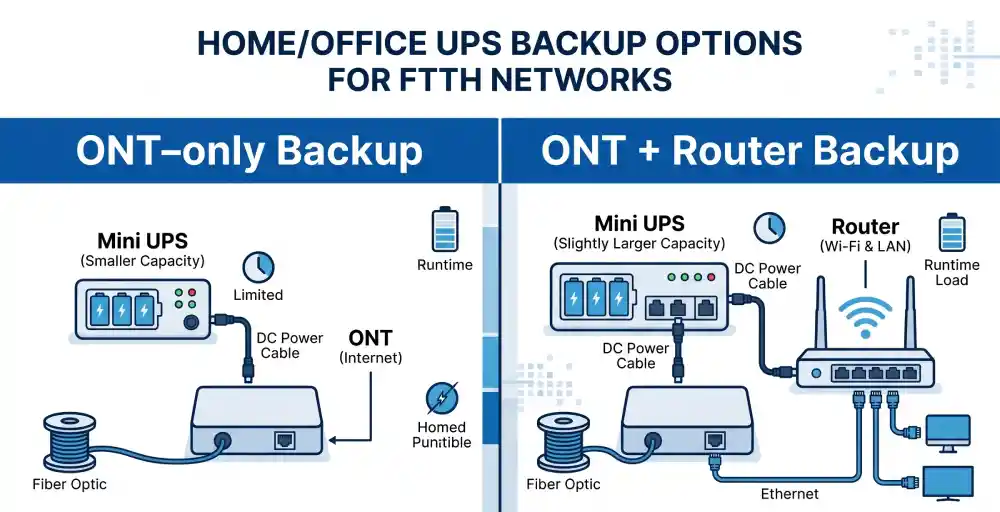
One of the most important design choices in FTTH backup is whether to support one device or two.
ONT–only backup usually offers:
- Lower unit cost
- Simpler connector logic
- Longer runtime under the same battery energy
- Easier standardized rollout
MYLION MU26 is a compact, low-cost Mini UPS for FTTH networks, specifically engineered for low-load devices such as standard ONTs and ONUs.
ONT plus router backup usually offers:
- Better user experience during outage
- Continued Wi-Fi access
- More complete service continuity
- Stronger customer-perceived value
But it also requires:
- Higher output current
- More careful combined-load planning
- Shorter runtime under the same battery size
- Better cable and connector management
This is why subscriber-side power continuity should not be reduced to a generic “battery backup” category. Device architecture changes the design.
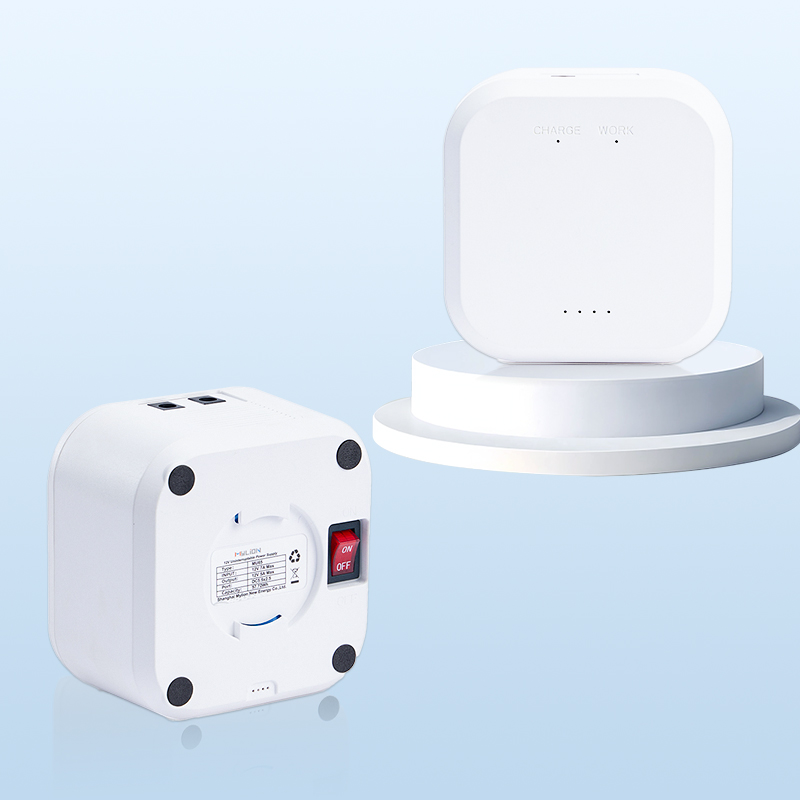
For dual-device backup scenarios, a higher-output Mini UPS for FTTH Networks—such as MYLION MU35 with 5A output—may be the appropriate choice for higher-load applications.
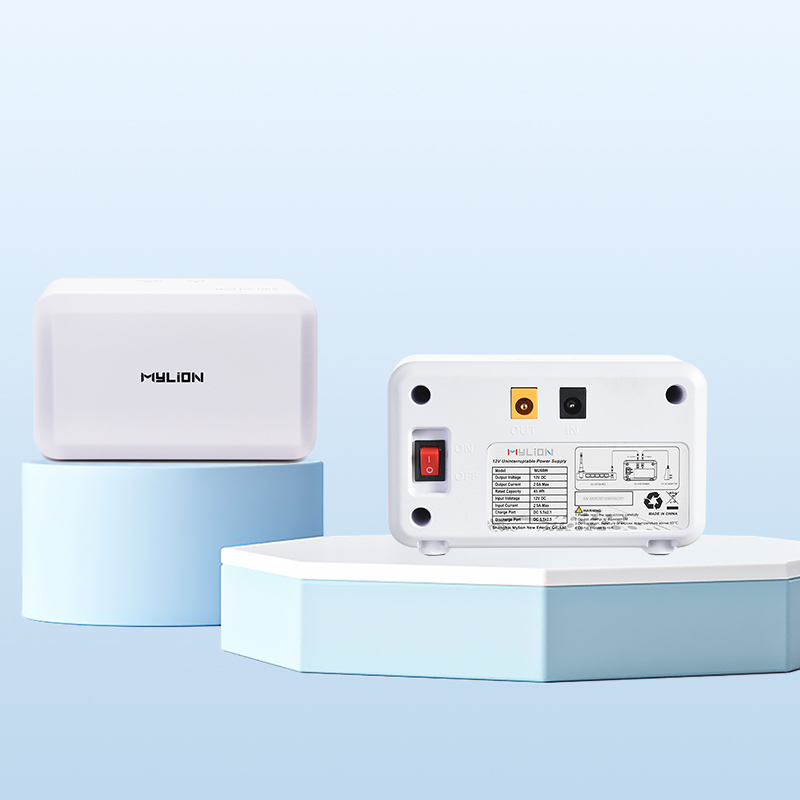
MU26 Mini UPS
MU35 Mini UPS
Define Runtime by Project Tier
Not every FTTH deployment needs the same backup duration. A practical design often classifies runtime by project tier:
- Short continuity tier for brief utility interruptions
- Standard continuity tier for common outage coverage
- Extended continuity tier for higher-value service or unstable-grid areas
This is more useful than asking for “the longest possible battery.” Runtime targets affect enclosure size, cost, charging behavior, and SKU complexity. Operators should define what runtime is necessary for the business case, then match products accordingly.
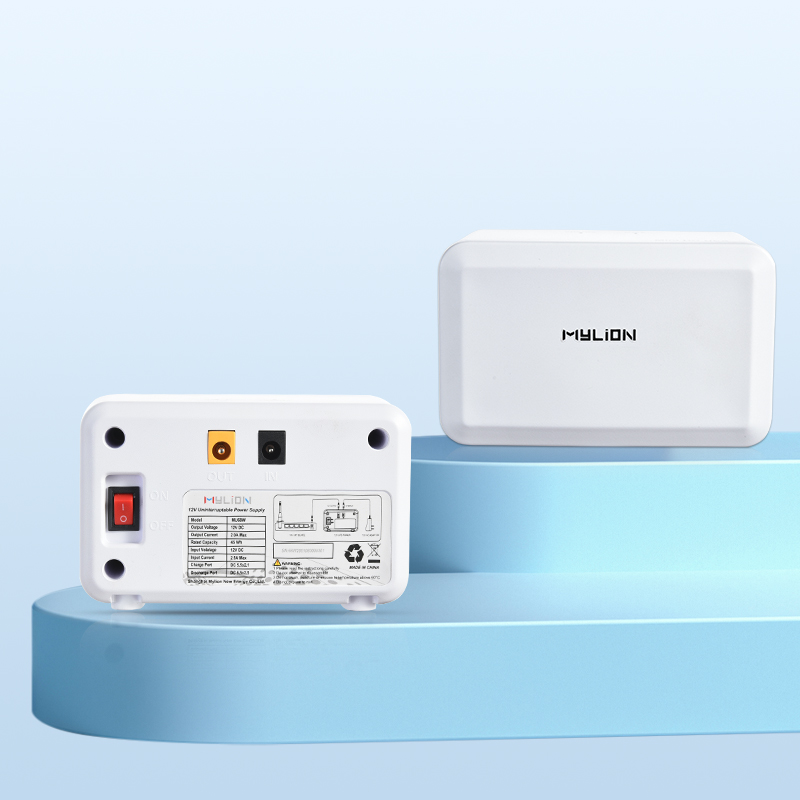
For standard runtime requirements, a compact Mini UPS for FTTH Networks like the MYLION MU48 (29.6Wh, about 3 hours at 12W load) offers balanced performance without oversized costs.
For extended runtime, the MYLION MU68 (68Wh, about 4 to 5 hours at 12W load) provides greater endurance in a similar compact footprint.

MU48 Mini UPS
MU68 Mini UPS
Standardization Across Multiple Device Models
Many ISPs use more than one ONT, router, or gateway model. That makes standardization more complex. Before rolling out a subscriber-side backup program, the operator should review:
- Device voltage map
- Current range across device families
- Connector type spread
- Peak-load behavior on different models
- Whether one backup class can cover all units or whether multiple SKUs are needed
Trying to standardize too aggressively can create mismatch risk. On the other hand, too many SKUs make rollout harder. The right answer is usually a structured model strategy: enough simplicity for operations, enough flexibility for technical fit.
MYLION supports this structured approach with a dedicated Mini UPS for FTTH Networks product line covering multiple deployment scenarios:
Model | Output | Best-fit Use Case | Key Specs |
12V 3A, 68Wh | Standard router/ONT/ONU backup | about 4 to 5 hours at 12W, 112×70×60mm | |
12V 3A, 29.6Wh | Entry-level to standard backup | about 3 hours at 12W, lighter weight | |
12V 5A, 77.7Wh | High-load routers, gateways, Wi-Fi 7 ONT | about 4 to 5 hours at 12W, supports 5A peak | |
Inline 12V backup | FTTH hidden wiring, structured media boxes | Compact inline design | |
USB-C / PD | Modern USB-C powered routers/devices | Flexible for evolving power architectures |
This model matrix enables operators to select the right Mini UPS for FTTH Networks for each use case without over-engineering or under-delivering.
Field Deployment Design Matters
Subscriber-side continuity does not succeed on technical matching alone. It must also survive real installation conditions. Good FTTH backup design should consider:
- Clear product labeling
- Defined cable and connector sets
- Guidance for installers and service teams
- Packaging that reduces confusion
- Spare strategy for channel or field replacement
- Whether the backup unit is wall-friendly, shelf-friendly, or compact enough for real subscriber spaces
These details are often treated as secondary. In rollout reality, they affect complaint rate, installation quality, and service cost.
A well-designed Mini UPS for FTTH Networks should support both desktop and inline deployment methods, giving field teams flexibility without adding complexity.
How MYLION Supports FTTH Continuity Design
MYLION supports subscriber-side FTTH backup projects by mapping Mini UPS solutions to real application roles, including ONT / ONU backup, router backup, ONT plus router backup, higher-load gateway support, and selected 24V / 48V telecom backup requirements.
For FTTH projects, MYLION can support:
- Model selection by voltage, current, and device setup
- Single-device and dual-device backup evaluation
- Runtime matching by target deployment tier
- Connector and cable option discussion
- Standard-model recommendation or selected project-based adjustment
- Support for evaluation and shipment preparation
The goal is not only to provide a battery box. It is to help build a subscriber-side continuity solution that fits real broadband service needs.
FAQ
Q1: What is subscriber-side power continuity in FTTH?
Q2: What is a Mini UPS for FTTH Networks?
Q3: Why is ONT-only backup sometimes not enough?
Q4: How should ISPs define backup runtime?
Q5: What is the main difference between single-device and dual-device backup?
Q6: Can one model cover every FTTH device?
Conclusion
For FTTH projects, subscriber-side power continuity is not a technical footnote. It is the difference between a service that stays online and a subscriber who goes offline. Choosing the right Mini UPS for FTTH Networks means choosing continuity by design, not by accident.
MYLION builds Mini UPS solutions that are designed for exactly this purpose. Each model in the MYLION product line is engineered to address a specific FTTH backup scenario.
 English
  简体中文
简体中文  Deutsch
  Français
  Italiano
  Español