
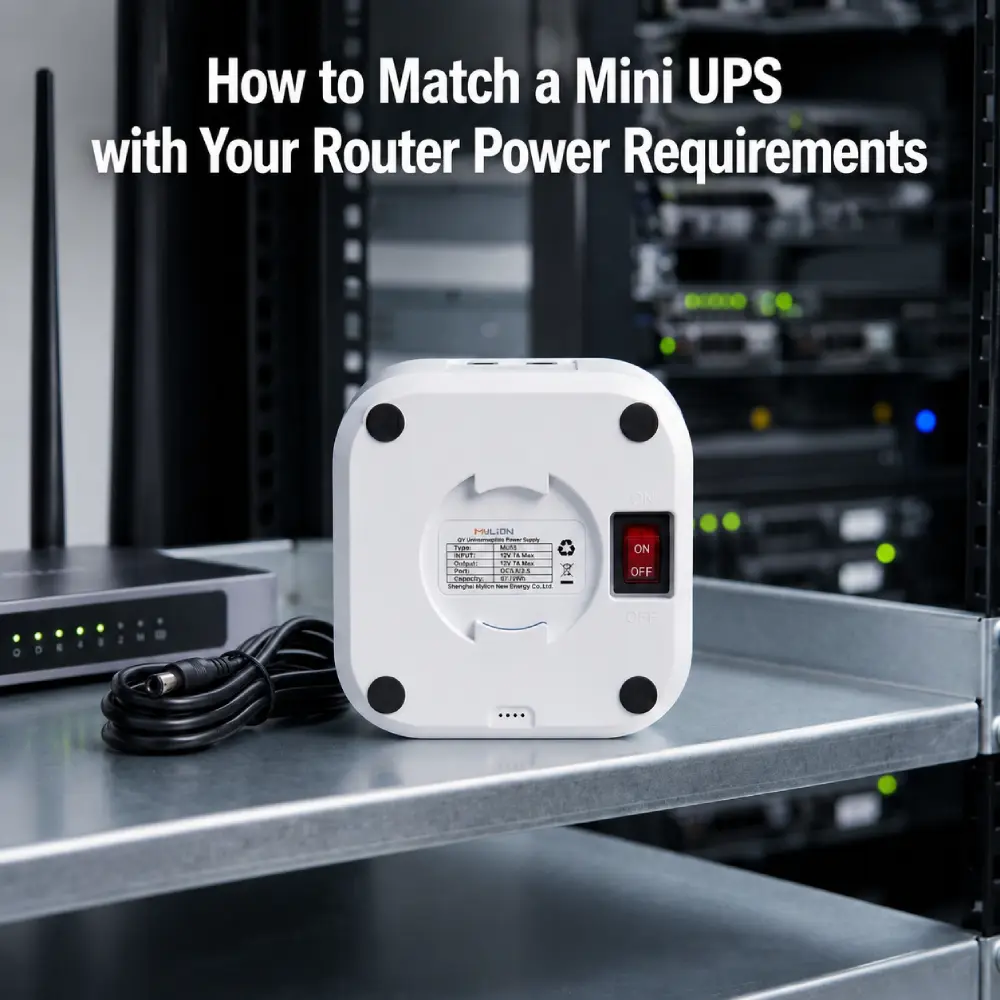
For Telecom providers and ISPs, the definition of network reliability has shifted from the core data center directly to the CPE. Sudden router power loss triggers immediate SLA penalties, escalates helpdesk ticket volumes, drives up truck-roll costs, and ultimately accelerates enterprise client churn.
A mini DC UPS specifically designed for low-voltage network equipment can effectively reduce these risks. However, choosing the wrong model can lead to a mismatch: devices with insufficient power cannot provide sufficient operating time during a prolonged power outage, while devices with excessive power will increase the inventory costs for distributors and integrators.
This guide provides a technical framework for ISPs, telecom distributors, and facility operators to match the Mini UPS with the power configuration of any router. We will take the Mylion Mini UPS series as an example to elaborate on the core parameters and suggestions for specific applications.
The Technical Imperative: Decoding Router Power Demands
Before selecting a Mini UPS, network engineers must establish a baseline understanding of the CPE’s electrical requirements. Mismatched power supplies are the leading cause of premature router failure, erratic data packet drops, and localized thermal events.
Voltage (V): The Non-Negotiable Parameter
Voltage is the electrical pressure required to operate the router’s internal circuitry. Most enterprise and prosumer routers deployed by European ISPs operate on 9V or 12V Direct Current (DC).
The Overvoltage Risk: Supplying 12V to a 9V router will overload the internal voltage regulators, leading to immediate thermal damage and complete hardware failure.
The Undervoltage Risk: Supplying 9V to a 12V router will result in “brownouts.” The router may power on, but high-drain components will fail under load, causing continuous reboot loops and fatal network drops.
Current (A) and Wattage (W): Sizing for Peak Load
Amperage (A) represents the volume of electrical current the router draws. A router’s power adapter might be rated for 1.5A, 2A, or 3A.
- The golden rule of current matching is that the Mini UPS must be able to supply equal or greateramperage than the router demands.
- The router will only pull the current it needs; excess capacity in the UPS output protects against sudden power spikes during heavy data transmission.
Wattage is the total power consumption, calculated as Voltage × Amperage = Wattage (W). For example, a 12V / 2A enterprise router has a maximum power draw of 24W. To ensure zero downtime, the chosen Mini DC UPS must feature a maximum output wattage that exceeds this baseline.
Battery Capacity (Wh / mAh) and Uptime SLA
While V and A dictate compatibility, Watt-hours (Wh) or Milliampere-hours (mAh) dictate the duration of SLA compliance during a grid failure. ISPs typically target 4 to 6 hours of edge backup power to bridge the gap between failure and grid restoration. Calculating required capacity is straightforward: Target Backup Time (Hours) = UPS Capacity (Wh) / Router Average Draw (W)
Why Mini UPS must be Precisely Matched with Routers
For telecom operators and ISPs, stocking the wrong Mini UPS models for router leads to:
- Insufficient runtime – Customers complain when a 5-hour backup turns into 90 minutes because the router draws more than expected.
- Over-provisioning – You waste budget on oversized units, making your solutions uncompetitive against alternative suppliers.
- Compatibility issues – A 12V UPS connected to a 5V router will damage the device; voltage mismatch is a serious liability.
Therefore, for any B2B partner, it is of utmost importance to adopt a scientific matching method based on actual power measurement data and recorded equipment specifications.
Why Choose Mini UPS for Router Backup
A Mini DC UPS is a compact battery backup system that provides uninterrupted DC power directly to routers, ONTs, and other low-voltage network gear. It eliminates the inefficiencies of traditional AC UPS units (which convert AC to DC, then back to AC, then back to DC again).
For B2B users, the critical features are:
- Zero–delay switching– When mains power fails, the Mini UPS switches to battery in <1ms. The router does not reboot.
- Lithium–ion battery management – Built-in BMS protects against over-charge, over-discharge, short circuits, and thermal runaway. CE, UKCA, and RoHS certifications are mandatory for European deployment.
- Direct DC output – No external adapters or power bricks required. The unit connects inline between the router’s original power supply and the router itself.
- Multiple output options– There are 5V, 9V, and 12V Mini UPS models available in the market, which can cover dozens of router types and are highly suitable for distributors and telecom project deployments.
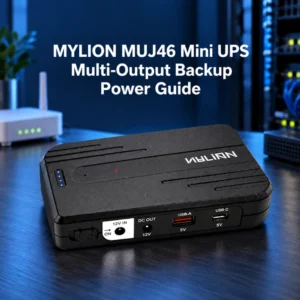
Mylion MiNi UPS Series: Engineered for ISP Infrastructure
Mylion’s premium Mini UPS solution are engineered to eliminate power-related churn. We offers three main series of mini UPS products. They use custom lithium battery cells and can provide pure, safe and stable power backup for telecomm infrastructure.
Each product is designed for a specific commercial load capacity and covers various scenarios such as protection of a single router to power supply for the entire network stack.
1.The Standard Edge Deployment Series (12V)
Engineered for mass deployment across standard single-device endpoints, such as Fiber Network Terminals (ONT) or dual-band gigabit routers.
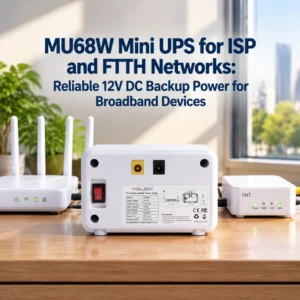
Core models: MU26 2A Mini UPS (entry-level product) and MU48 3A Mini UPS, and MU68 3A Mini UPS for most commercial routers (all-round main equipment).
Matching Profile: Suitable for routers with power consumption ranging from 12W to 24W (for example, 12V/1A or 12V/1.5A).
Applicable scenarios:
- A single SOHO router (6–10W) → runtime 3 – 5 hours
- Remote monitoring equipment → ideal for short-duration backup in non-critical sites
- Standard business router (8–15W) → runtime 3- 6 hours
- Small branch offices or retail stores → Equipped with one router and one ONT is sufficient
The prices for these Mini UPS models in bulk orders are the lowest. Extremely compact — fits inside existing network cabinets. Good for high-volume deployments where outage durations are typically under two hours (e.g., urban areas with reliable grids).
2.Multi-device and High-Energy Consumption Deployment Series
Enterprise deployments usually require power supply for multiple edge devices or high-performance router equipment, such as a 12W enterprise router and a 15W VoIP gateway.
Core models: MU35 Mini UPS, MU65 Mini UPS, and MU05 Mini UPS, all specially designed for high-load devices. Their 5A output can provide stable power to multiple devices simultaneously.
Matching Profile: Specifically designed for complex router devices. It can handle massive 60W to 65W peak loads without voltage sag.
Applicable scenarios:
- High-performance enterprise router (20–30W) → runtime3 – 4 hours
- Multiple devices on one UPS → For a small site, a router and an ONT need to be equipped.
- Rural areas or areas with unstable power grids → Requires long-term operation (for example, agricultural monitoring stations, remote warehouses)
The 5A current capability is unmatched in the compact Mini UPS category. It can drive almost any router on the market and can be used with Y–splitter cables to power two or three low-wattage devices simultaneously.
3.Intelligent Type-C Deployment Series
As Tier-1 Telcos accelerate the transition to Wi-Fi 6 and Wi-Fi 7 architectures, USB-C Power Delivery (PD) is now a critical infrastructure requirement.
Core model: MUC66 3.5A Type-C Mini UPS is specifically designed for the new generation of WiFi 6/7 routers. MUC85 65W USB-C PD Mini UPS is the long-lasting intelligent Type-C PD flagship choice.
Matching features: Adopting the intelligent USB-C PD standard can eliminate “power outage” losses. Ensures compatibility with various Wi-Fi 6 and Wi-Fi 7 router devices.
Applicable scenarios:
- 12V / 1A device (~ 12W) → runtime: 5-6 hours
- 12V / 2A device (~ 24W) → runtime: 3-4 hours
- Enterprise WiFi 6 router deployment (18-25W) → runtime: approximately 3-5 hours
- WiFi 7 multi-device networking scenario → WiFi 7 commercial router + ONT hybrid power supply, approximately 3 hours
Type-C Mini UPS models are gaining traction with next-gen devices. Featuring bidirectional USB-C PD and smart power management, they ensure zero-interruption switching for CPE, ONT, IP cameras, and routers during outages. Ideal for remote areas in Central/Eastern, Southern, and Northern Europe with weak grid stability.
Mylion Mini UPS for router Comparison Table
Edge Infrastructure Profile | Router/CPE Power Requirements | Maximum Load (W) | Recommended Mylion MINI UPS Series |
Standard Fiber ONT / Basic Router | 12V / 2.0A | 24W | MU26W/MU48W/MU68W (12V 3A) |
High-Drain ONT (Legacy DC) | 12V / 5.0A | 60W | MU35W (12V 5A) |
Enterprise ONU (Fixed USB-C) | 20V / 3.25A | 65W | MUC66 (20V 3.25A Type C) |
Flagship Wi-Fi 7 Router | Intelligent PD | 65W | MUC85 (65W USB-C PD) |
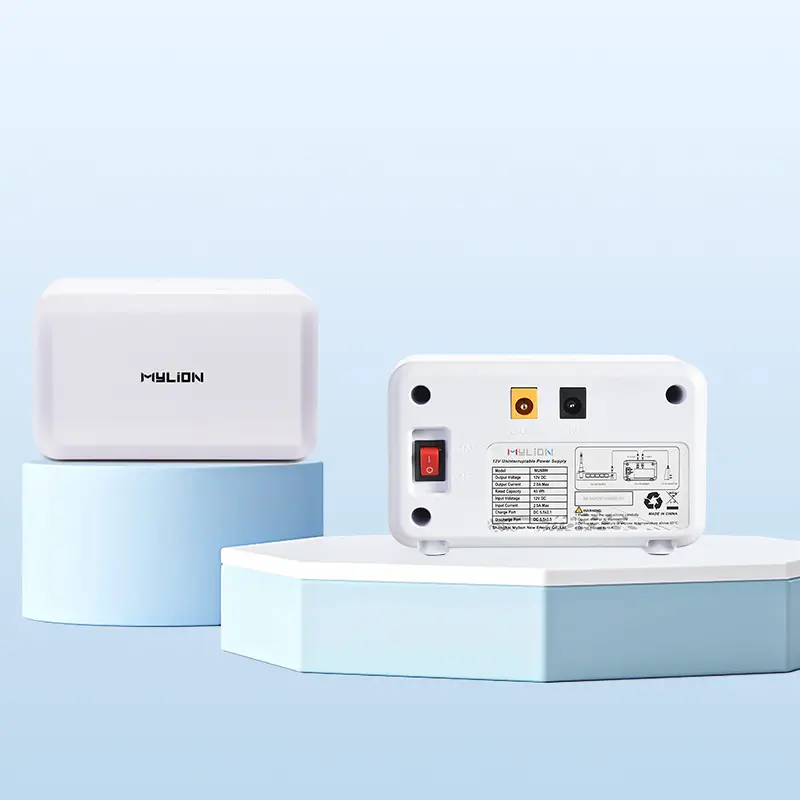
12V 3A MU26 Mini UPS
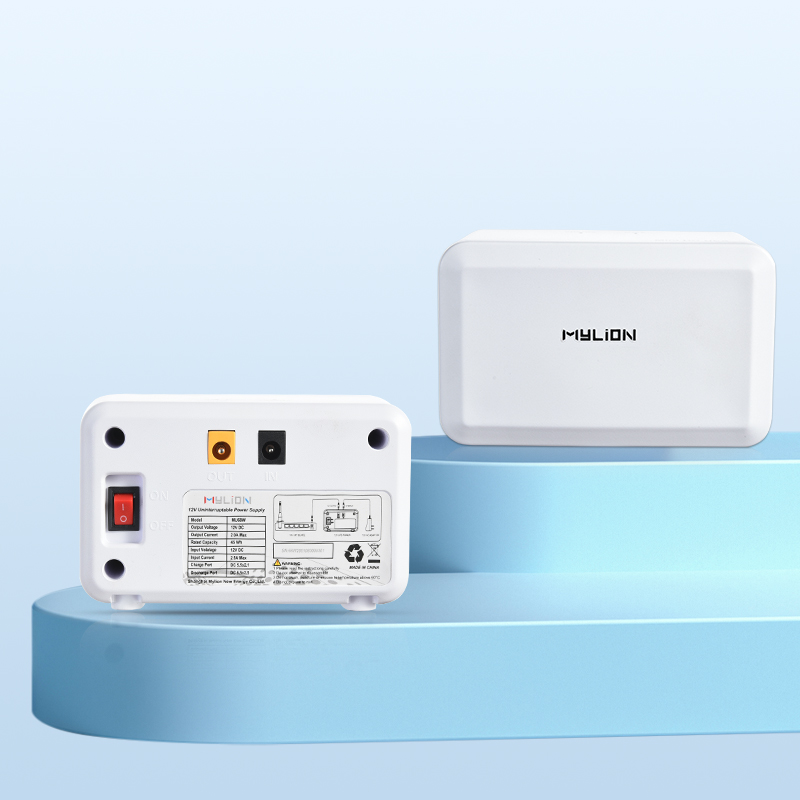
12V 3A MU48 Mini UPS
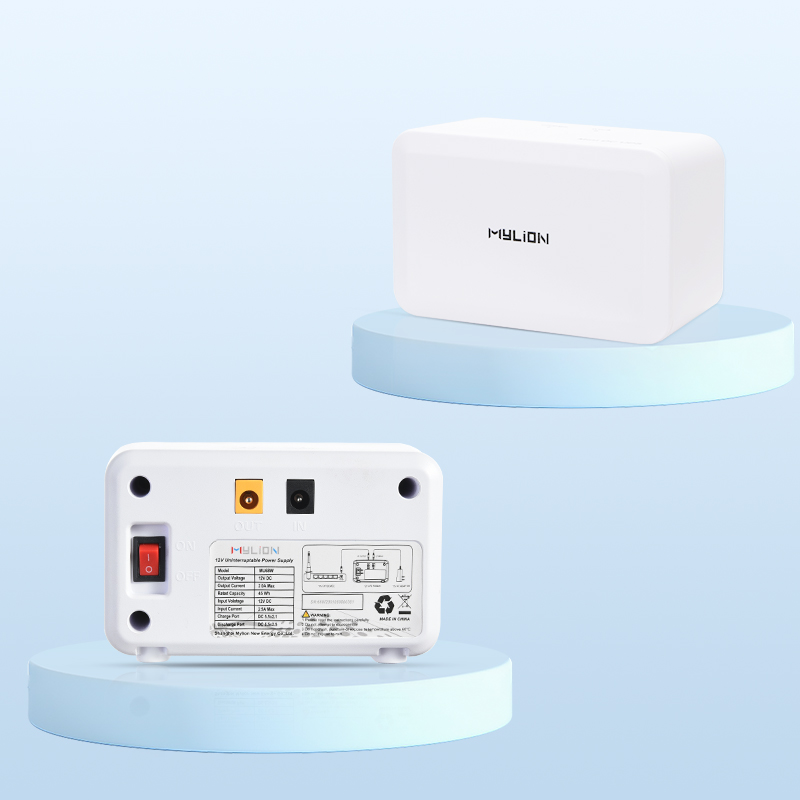
12V 3A MU68 Mini UPS
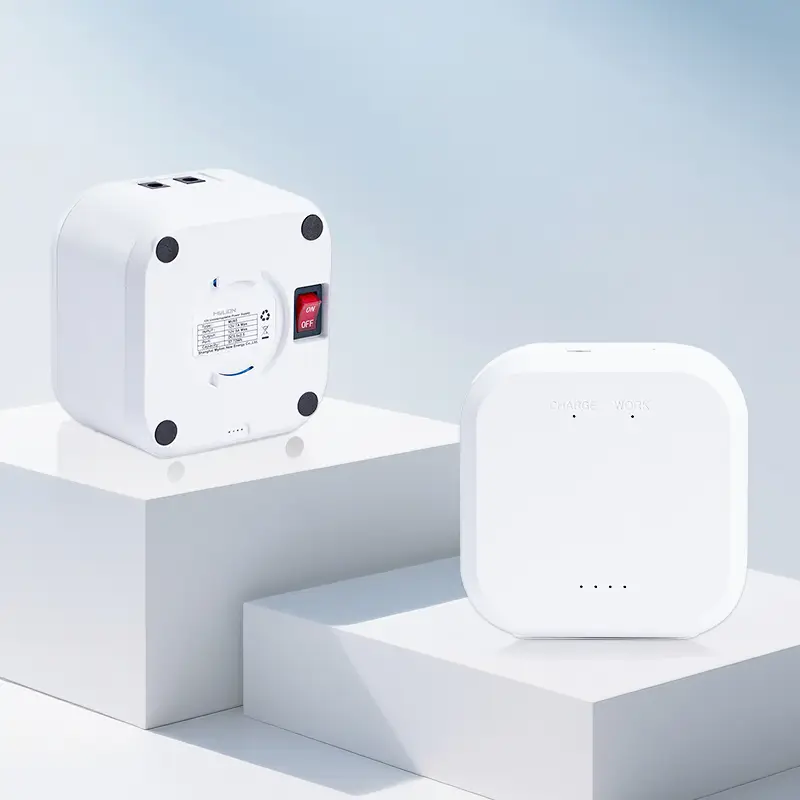
12V 5A MU35 Mini UPS
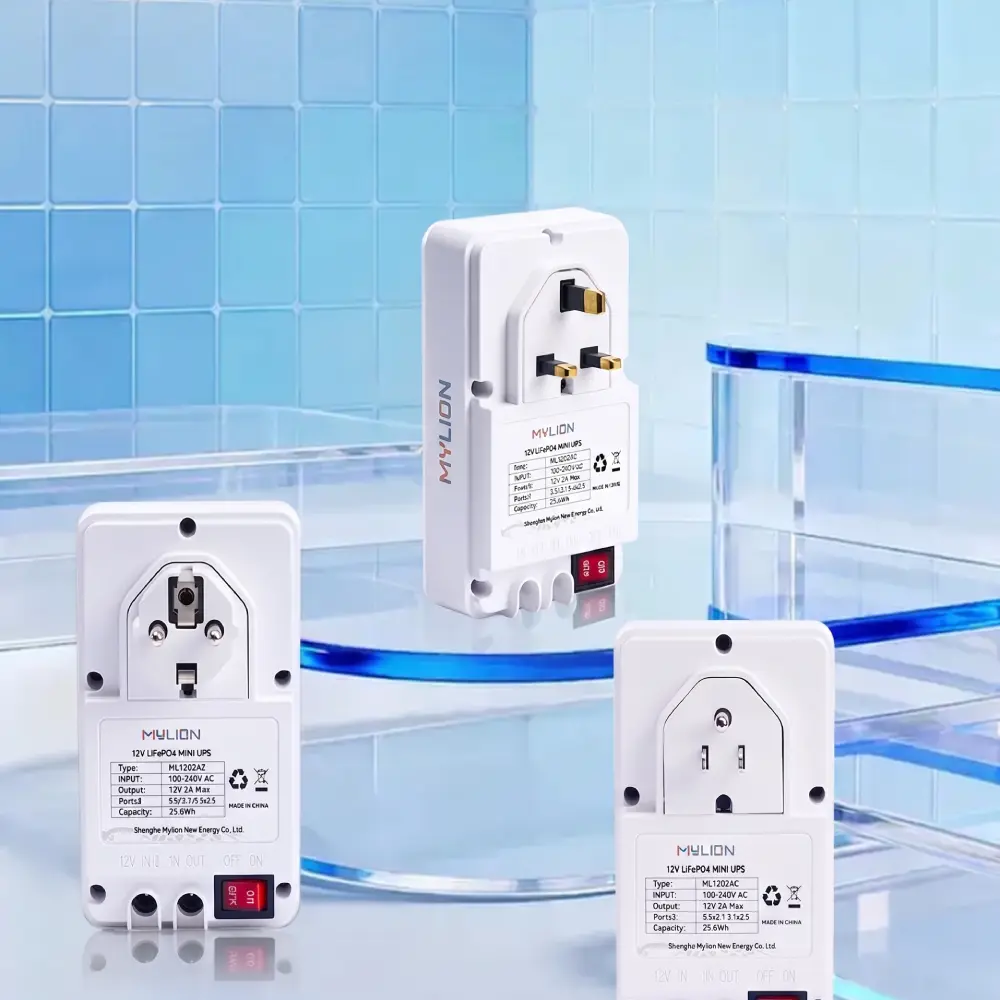
12V 2A ML1202AC Mini UPS
12V 3A MU65 Mini UPS
Why Choose Mylion as Your Mini DC UPS Supplier?
Mylion provides professional Mini DC UPS solutions for routers and CPE devices, helping ISPs and enterprise customers maintain network uptime and reduce service interruptions.
Key advantages include:
- Designed for B2B & ISP deployment– Built for telecom operators, system integrators, distributors, and project procurement — not for individual consumers.
- Wide DC voltage output support– Supports 5V / 9V / 12V / 24V, compatible with most routers, CPEs, ONTs, CCTV, and small network switches.
- Reliable CPE backup power– Provides 2–24 hours backup time depending on model and load, ensuring continuous network connectivity during power outages.
- Safe lithium battery technology– Uses Li ion or LiFePO₄ batteries with long cycle life and stable performance for 24/7 operation.
- Multiple safety protections– Includes over charge, over discharge, short circuit, and temperature protection.
- Proven ISP power solution– Deployed in large scale ISP and enterprise network projects across Europe.
FAQ
Q1: Can a single Mini UPS power more than one router or network device at the same time?
Q2: What certifications do Mylion Mini UPS units hold?
Q3: How do I correctly calculate the required battery capacity (Wh) for a given router?
Q4: How do I verify if our routers are compatible with MINI UPS units?
Q5: Why are standard DC battery backups failing on our new Wi-Fi 7 ONTs?
Q6: Do Mylion UPS units provide absolute 0ms transfer times during grid failures?
Conclusion
For network installers and telecom service providers, being able to correctly match a Mini UPS to a router’s power demand is a competitive advantage. Stocking the right Mini UPS models reduces customer complaints, lowers inventory complexity, and ensures SLAs are met.
The Mylion MINI UPS solution delivers exactly what commercial users require: zero-delay switching, full safety certifications, three distinct capacity tiers (30/45/77.7 Wh), and smart voltage compatibility — all in compact form factors suitable for any network cabinet.
Do not leave your B2B customers vulnerable to a 30-second power flicker that takes their entire network offline. Provide them with a precise, cost-effective backup
 English
  简体中文
简体中文  Deutsch
  Français
  Italiano
  Español