
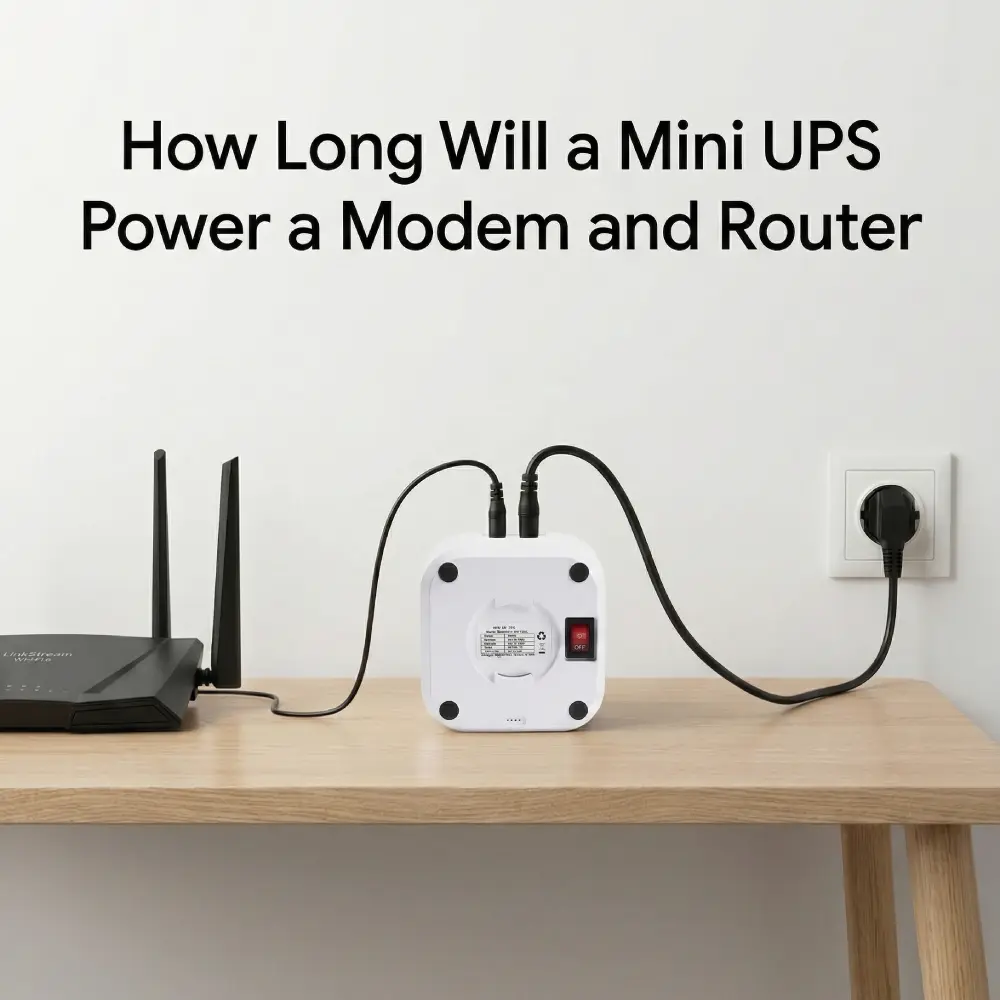
For ISPs, network availability is a core business metric. When customers lose power, their modems, routers, or ONTs stop working immediately. And when the network goes down, customers don’t distinguish between a power outage and a network fault – they only experience downtime that can lead to support requests, SLA violations, and customer churn.
This is where mini UPS solutions come into play. But before deploying at scale, ISPs need exact answers: How long can a mini UPS actually power a modem and router? And what factors affect its runtime under real-world field conditions?
This guide answers those questions and helps ISPs select the right micro UPS device.
What Is a Mini UPS and Why Use It for Modems/Routers?
Definition of a Mini UPS
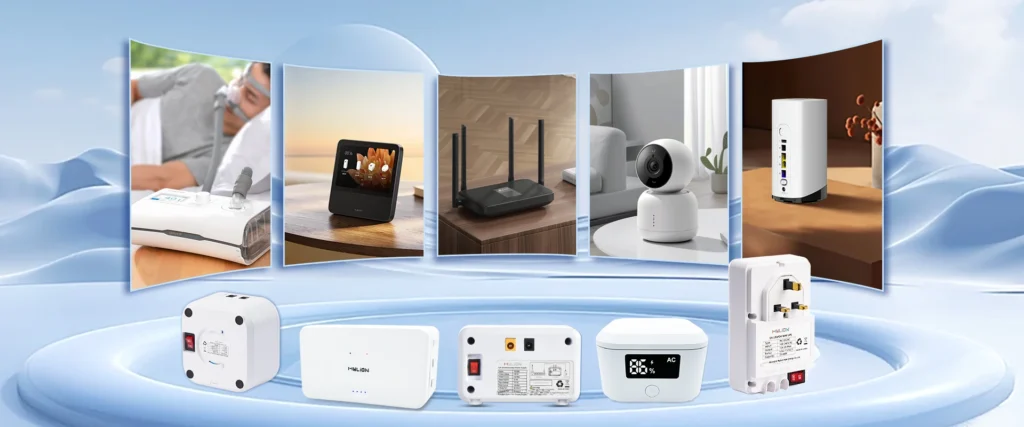
A mini UPS is a small, low-capacity backup power source. Most such devices are designed to power low-power equipment such as modems, routers, ONTs, and security cameras.
They typically output 12V DC. Unlike large traditional UPS systems, the focus of a mini UPS is to keep network edge devices running for several hours during a power outage.
Benefits of a Small UPS for Network Equipment
For ISPs, deploying mini UPS units at customer premises offers three major advantages:
- Stay online during power outages– A mini UPS keeps the network alive during short interruptions, avoiding disconnection for remote workers.
- Protection against power surges– Mini UPS devices include built-in surge suppression, guarding against voltage fluctuations and grid anomalies that can damage router hardware over time.
- Avoid modem/router restart delays – A mini UPS provides 0ms switchover, eliminating the delay caused by rebooting modems/routers and ensuring immediate connectivity when grid power returns – improving the customer experience.
Direct Factors Affecting Mini UPS Runtime for Modems and Routers
Runtime is not a fixed number. It depends on four key variables. Understanding each helps ISPs choose the right battery capacity for different deployment areas.
- Battery Capacity (Wh or mAh/VA)
Capacity is the fundamental measure of runtime. It is expressed in several ways:
- Wh – The most practical unit because it directly represents energy. Formula: Wh = V × Ah.
- Ah – Common for lead-acid batteries. Example: a 12V 7Ah battery stores 84 Wh (12×7).
- mAh – Often used for small lithium-based mini UPS units. Divide by 1000 to get Ah, then multiply by voltage.
Although consumer products are often advertised in mAh, Wh is the true measure of total energy after accounting for battery voltage.
- Total Power Consumption of Modem + Router
Most ISP-provided modems, ONTs, and routers have very low power draw. Typical total consumption ranges from 5W to 15W. However, high-performance routers or multi-port ONTs can consume 18–25W.
- To determine actual consumption: Check the label on each device’s power adapter. Look for “Output: V and A”. Multiply voltage by current to get maximum power.
- Example: 12V 1.0A = 12W maximum. Actual operating power is usually 60–80% of that value.
- Efficiency Losses and Inverter Type
The UPS architecture determines how much of the battery capacity actually reaches the router. The efficiency of the mini UPS itself reduces available energy.
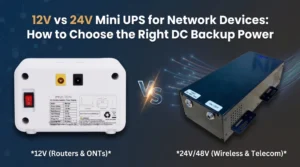
- DC Mini UPS (direct 12V)– Because modems and routers already run on low-voltage DC, no AC-to-DC conversion is needed. Operating efficiency is 90–95%.
- AC Mini UPS (120V/230V output) – Battery DC must be inverted to AC, then the device’s own adapter converts AC back to DC. This double conversion loses 15–30% of energy.
Whenever possible, choose a DC mini UPS that matches your equipment’s native voltage (usually 12V). This gives you 10–20% longer runtime for the same battery capacity.
- Battery Lifespan and Temperature
Battery chemistry and environmental conditions significantly affect runtime.
- Lead-acid batteries – Traditional lead-acid degrades quickly under deep discharge cycles. Capacity drops noticeably after 1–2 years. High temperatures accelerate aging.
- Lithium-ion or LiFePO₄ batteries – Lithium and LiFePO₄ batteries offer long life and high safety. They retain capacity over thousands of cycles.
- Low temperatures – In extreme cold, all battery chemistries suffer reduced capacity. Internal resistance increases, temporarily shortening runtime.
For ISPs deploying equipment in outdoor or uninsulated enclosures, LiFePO₄ is the better choice despite higher initial cost.
Expected Runtime Ranges – Mini UPS Powering Modems and Routers
For standard network deployments, a 12V compact DC UPS with a moderately high-density battery (approximately 25Wh to 37Wh) can sustain a typical 10W combined load for about 3 to 6 hours, effectively covering most rolling blackouts and local grid faults.
Real-World Runtime Examples – Common Modem + Router Combinations
To give ISPs realistic expectations, the three deployment scenarios below reflect actual field conditions. Each uses a DC Mini UPS (direct 12V output) for maximum efficiency.
Deployment Scenario | CPE Configuration | Total Load | Mini UPS Capacity / Type | Estimated Runtime |
Standard ISP Home User | Cable modem (6W) + Wi-Fi 5 router (6W) | 12W | 48Wh MU68W Mini UPS | ~4 hours |
High-Performance Home / SOHO | Fiber ONT (8W) + high-end router (10W) | 18W | 77.7Wh MU35 Mini UPS | ~7.5 hours |
Low-Power Deployment | Basic router (3W) + basic modem (4W) | 7W | 24Wh MU26W Mini UPS | ~3 hours |
Combo A – Standard ISP Residential Package: Cable modem (6W) + Wi-Fi 5 router (6W)
- Equipment: Standard DOCSIS 3.0 cable modem + basic dual-band router.
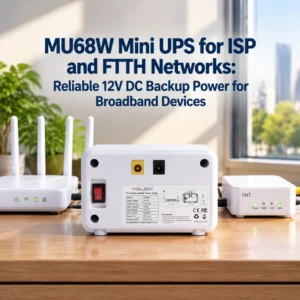
- Mini UPS: Mylion MU68W– 12V 3A DC output, balanced capacity (approx. 48 Wh usable).
- Estimated runtime: 3.8 to 4.2 hours at 12W load.
- ISP use case: Typical suburban or urban broadband where most grid outages last 1–2 hours. The MU68W provides enough safety margin to cover >95% of outages without customer complaints.
Combo B – High-Performance Home/Office: Fiber ONT (8W) + Wi-Fi 6 gaming router (10W)
- Equipment: GPON ONT with voice interface + high-performance Wi-Fi 6 gaming router.
- Mini UPS: Mylion MU35– 12V 6A output for high-load devices.
- Estimated runtime: 7–8 hours at 18W load.
- ISP use case: High-end residential or SOHO. 6+ hours of runtime handles most evening outages.
Combo C – Low-Power / Temporary Deployment: Basic modem (4W) + travel router (3W)
- Equipment: Small router + very basic DSL or cable modem.
- Mini UPS: Mylion MU26W– compact 12V 3A DC unit.
- Estimated runtime: 2.8–3.2 hours at 7W load.
- ISP use case: Temporary installations (e.g., construction sites, seasonal homes), guest network backup, or low-priority service tiers.
Recommended Mini UPS Products for Modems and Routers (Suitable for ISP Selection)
For ISPs deploying backup power at scale, consumer retail products often lack the stability, customization options, and long-term support that network operators need.
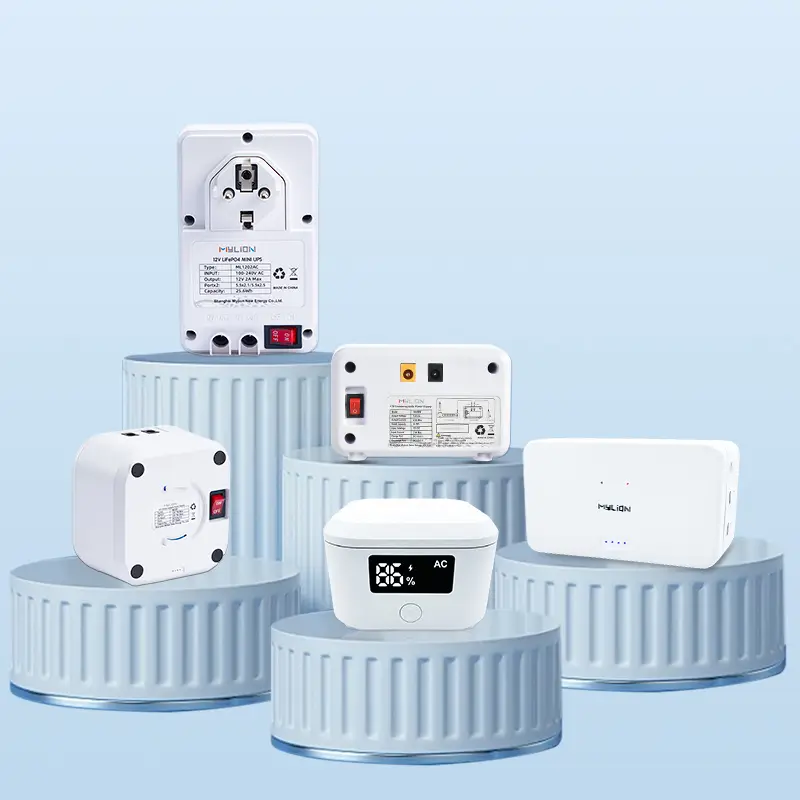
Mylion offers a range of dedicated DC mini UPS devices designed specifically for ONT, ONU, router, and modem applications. These models feature direct 12V output, robust battery management, and deployment flexibility – from single-unit residential installations to project-scale rollouts.
Model | Output | Battery Capacity | Runtime @12W | Best Use Case |
MU26W | 12V 3A | approx. 24 Wh usable | ~2 hours | Short outage protection for urban/suburban deployments |
MU48W | 12V 3A | approx. 36 Wh usable | ~3 hours | Standard broadband & communication devices |
MU68W | 12V 3A | approx. 48 Wh usable | ~4 hours | The “sweet spot” for telecom, ISP, and broadband backup projects |
MU35 | 12V 5A | approx. 77.7 Wh usable | ~6 hours | High-power device backup, perfect for project-based deployments requiring extended runtime |
Why Choose Mylion for ISP-Scale Deployment?
- DC-optimized design– All models output native 12V DC, eliminating the 15–25% efficiency loss of AC inverters. Your modems and routers run directly from the battery with minimal loss.
- Multiple capacity tiers– Exactly match your runtime SLAs: 2 hours, 3 hours, 4 hours, or 13 hours. No over-provisioning or under-delivering.
- Dual output flexibility– Power two devices from a single UPS, reducing hardware count and installation complexity.
- OEM customization available– Mylion works with ISPs to adjust output voltage (9V/12V), connector types (barrel sizes, USB-C), branding, and battery chemistry (LiFePO₄ for longer life).
- Proven in telecom– Mylion’s mini UPS units are already used by ISPs in Asia, Europe, and Latin America for standard broadband backup projects.
FAQ
Q1: How long can a mini UPS power a modem and router?
Typically 2 to 13 hours depending on battery capacity and load; for example, the Mylion MU68W provides about 4 hours at 12W load.
Q2: Can a mini UPS power a modem and router for 24 hours continuously?
Only with an oversized external battery pack (e.g., 200–300 Wh). Standard mini UPS units are designed for practical runtimes of 2–8 hours.
Q3: Is a 12V mini UPS compatible with my 9V modem?
Not directly. Connecting 12V to a 9V device can damage it. Use a mini UPS with adjustable voltage (some models offer 5V/9V/12V switching).
Q4: Is it safe to leave a modem and router connected to a mini UPS all the time?
Yes. Quality mini UPS devices are designed for continuous operation. They feature advanced BMS for constant pass-through operation and safe trickle charging, preventing overcharging.
Q5: How do I know when my mini UPS battery needs replacement?
Generally, a battery is considered end-of-life when its runtime drops below 50% of original capacity under the same hardware load. Some advanced mini UPS units have LED indicators or software to report battery health.
Conclusion
Determining how long a mini UPS can power a modem and router involves several factors: battery capacity, load power, efficiency, and battery chemistry. For most standard network deployments, engineers should plan for 3 to 6 hours of reliable backup. For large-scale deployments, choose an OEM DC mini UPS with LiFePO₄ batteries and custom interfaces.
By following this guide, you can deploy a mini UPS solution that keeps your users online, reduces maintenance costs, and protects your ISP’s reputation – one outage at a time.
 English
  简体中文
简体中文  Deutsch
  Français
  Italiano
  Español