
Introduction
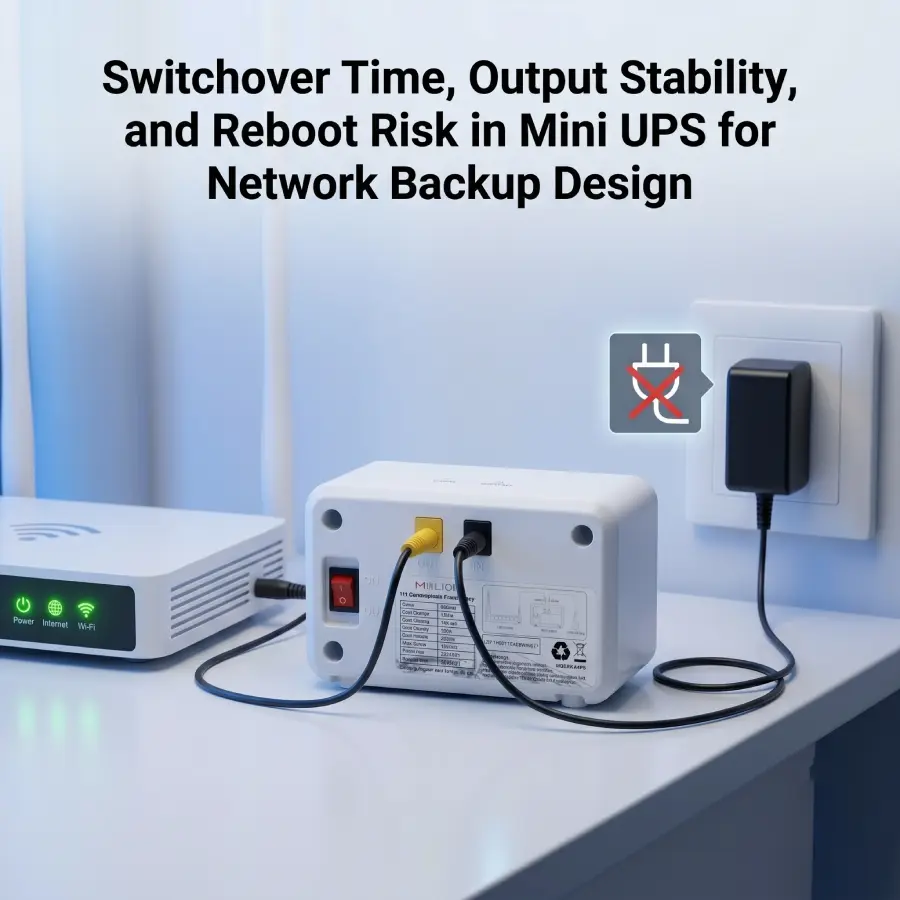
Many buyers focus on battery energy and runtime when choosing a Mini UPS for network backup. Fewer pay enough attention to what happens in the moment power fails.
In network backup design, that moment matters. If the Mini UPS does not switch cleanly from utility power to battery support, the connected device may reboot even when enough battery energy is available. For ONT, router, gateway, and CPE applications, a reboot can mean temporary service loss, customer dissatisfaction, and a weaker continuity outcome than the specification sheet suggests.
That is why switchover behavior and output stability should be part of Mini UPS evaluation, not an afterthought. A well-designed Mini UPS ensures seamless transition and keeps your network alive
Why Reboot Risk Matters More Than Many Buyers Expect
From the customer’s perspective, the difference between “device stayed online” and “device rebooted for a minute” is important.
A short reboot can still create:
- Session interruption
- Perceived service outage
- Customer frustration
- Higher support contact volume
- Reduced trust in the backup promise
In some subscriber-side applications, maintaining the service link through the transition is more valuable than simply having battery energy after the transition. This is why backup design must consider not just runtime, but continuity quality — and why a reliable Mini UPS is essential.
What Switchover Behavior Really Means in a Mini UPS
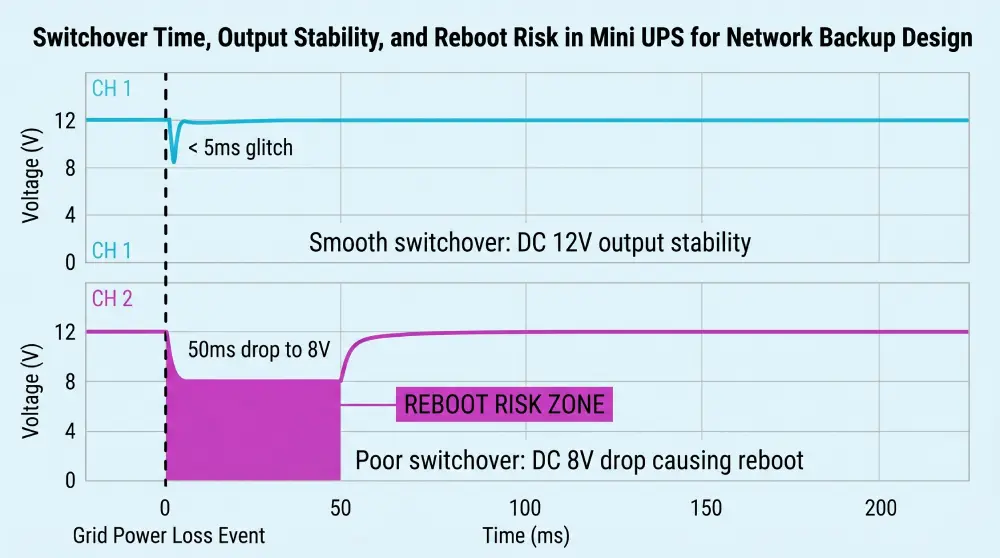
Switchover behavior is the way the Mini UPS transfers the load from utility input to battery output when power is lost.
A stronger Mini UPS design should aim for:
- Stable output during the transition
- Low risk of voltage drop beyond device tolerance
- Controlled response when the main input disappears
- Practical compatibility with real network devices
This is not only a theoretical engineering issue. It directly affects whether the connected router, ONT, or gateway stays operational or resets. MYLION Mini UPS products are engineered with optimized switchover circuits to minimize reboot risk.
Why Some Devices Are More Sensitive
Different network devices respond differently to output instability.
Some standard ONT devices may tolerate brief disturbance better than:
- Higher-power routers
- Integrated gateways
- CPE devices with more complex startup behavior
- Dual-device backup setups operating closer to current limits
This is why buyers should avoid assuming that one successful test on one device proves equal performance across all models. Device sensitivity can vary, especially when current demand or startup logic differs. A high-quality Mini UPS should be validated across multiple device types.
Output Stability Is About More Than Voltage Label
A Mini UPS can be labeled 12V and still perform very differently under real transition conditions.
Output stability is influenced by:
- Internal power-path design
- Load level during transition
- Current margin
- Battery condition
- Cable and connector quality
- Whether the setup is single-device or dual-device
In other words, the output label alone does not tell the whole continuity story. Real-world behavior depends on the full system context. MYLION Mini UPS series is designed for robust output stability in real-world telecom and broadband scenarios.
Why Tight Current Margin Increases Transition Risk
A Mini UPS operating too close to its current limit may be more vulnerable to reboot risk.
For example, a Mini UPS that works under normal steady load may become less stable during the moment of transfer if:
- Startup or transient load rises
- Two devices are connected
- Cable conditions add resistance
- The current margin is already narrow
This is why proper output-class selection matters. A stronger current margin can improve not only load support, but also practical transition robustness. When selecting a Mini UPS for router or gateway backup, always check the current margin.
How Buyers Should Evaluate Reboot Risk in a Mini UPS
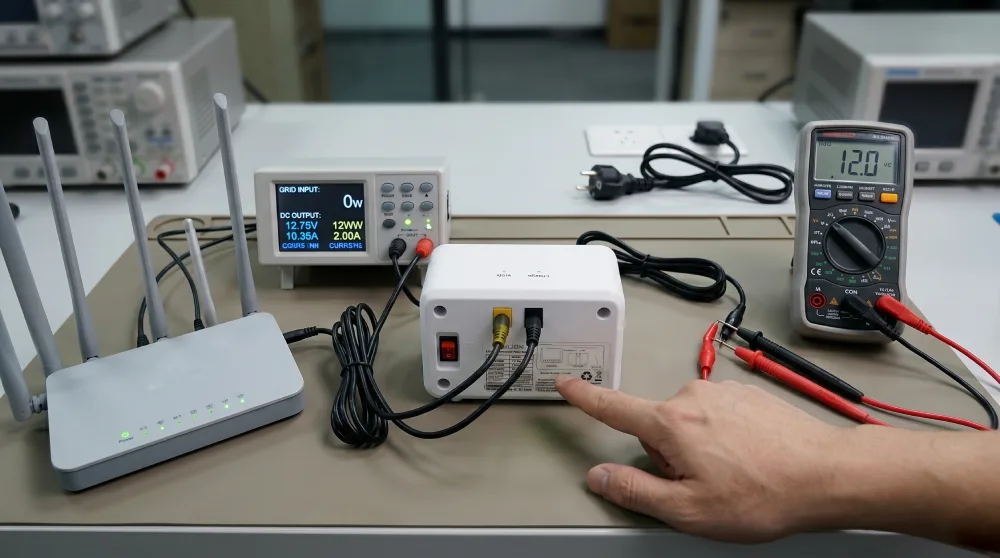
A more mature evaluation process asks:
- Does the device stay online through input loss?
- Does the backup remain stable under realistic load?
- Is the setup single-device or dual-device?
- Is the device type known to be sensitive during transition?
- Is the chosen output class comfortably matched or too tight?
- Are test conditions representative of deployment use?
This is a more useful approach than comparing battery capacity alone. It shifts the decision toward real continuity performance — exactly what MYLION Mini UPS delivers.
Design Implications for ONT, Router, and Gateway Backup Using Mini UPS
Switchover and stability evaluation should vary by scenario.
For ONT-only backup with a Mini UPS:
The load may be simpler, but continuity still matters where voice or access uptime is important.
For router or gateway backup using a Mini UPS:
Higher load and more complex behavior often make current margin and output stability more important.
For ONT plus router backup powered by a single Mini UPS:
The system should be evaluated as a combined-load architecture, not as two separate assumptions added together later.
These differences are why backup design should always start from the application role — and why choosing the right Mini UPS model matters.
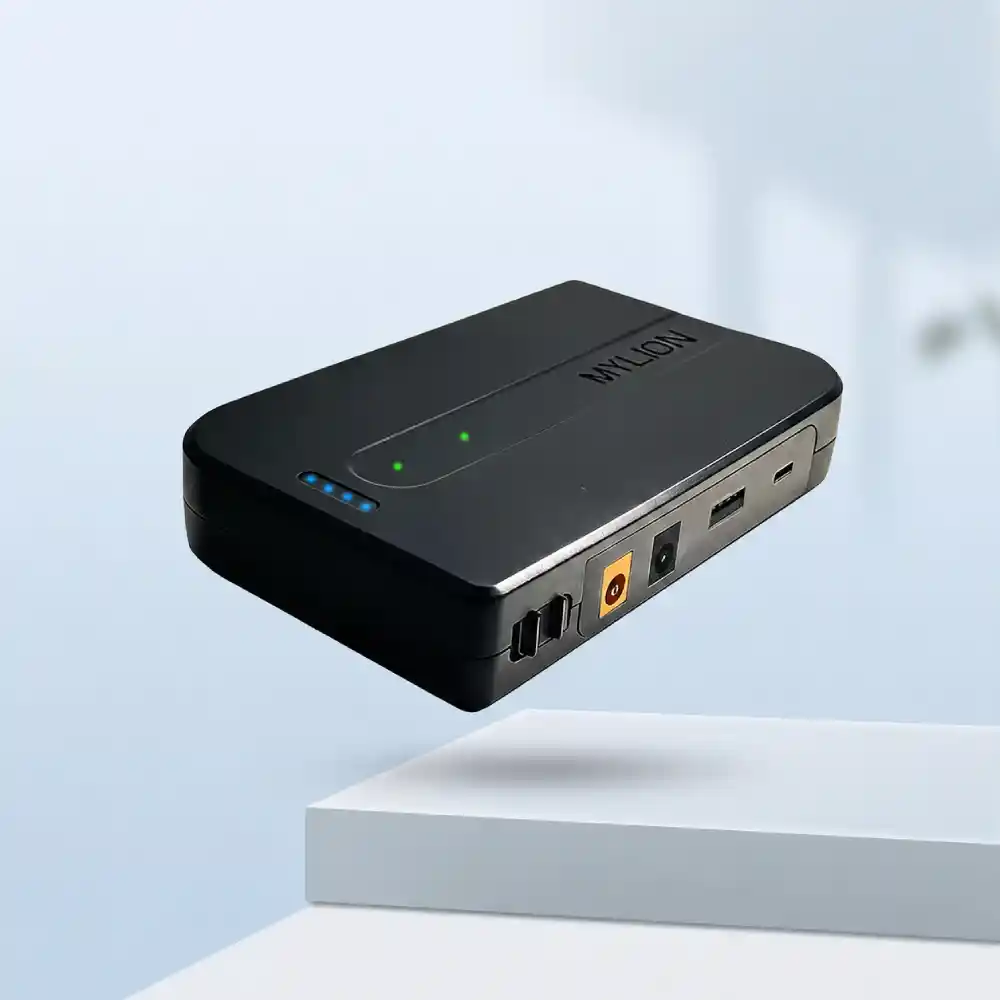
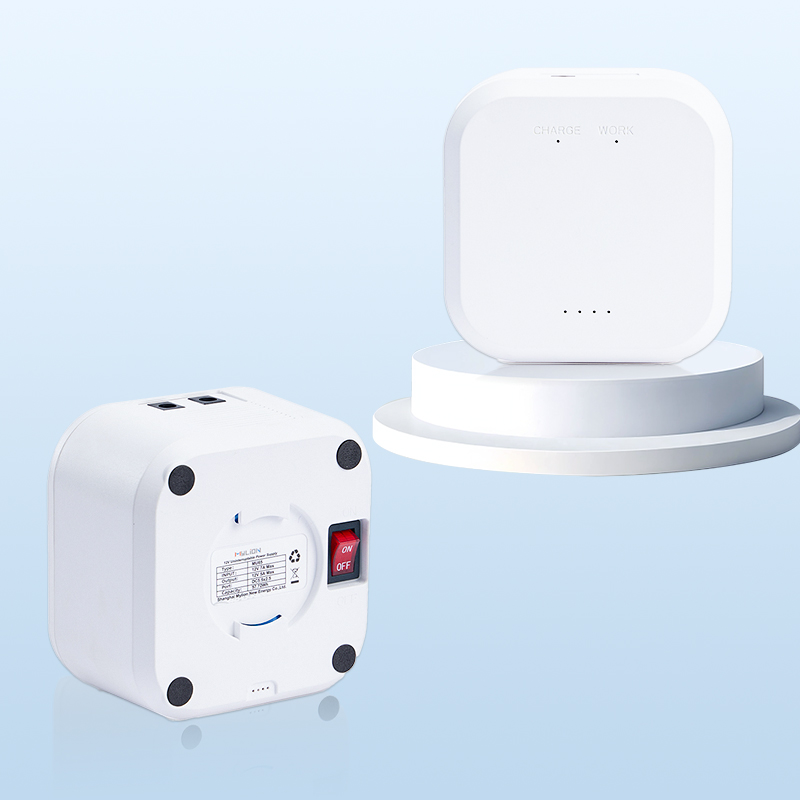
MYLION Mini UPS Model Comparison for Network Backup
The table below summarizes key MYLION Mini UPS models and their suitability for different network backup scenarios.
Model | Output (V/A) | Battery Capacity | Best-Fit Application |
12V DC (3A) | 19.24Wh | Low-power routers, ONUs, CPEs | |
12V DC (3A) | 29.6Wh | Small networking equipment | |
12V DC (3A) | 68Wh | Standard routers, ONT, ONU, modem | |
12V DC (5A) | 77.7Wh | High-power routers, gateways | |
12V DC (2A) | 25.6Wh | Routers, CPE/ONT/ONU, VoIP, IP cameras | |
USB-C PD 65W 5V / 9V / 12V / 15V (3A) 20V (3.25A) | 92Wh | USB-C / PD powered modern routers | |
12V/2A, USB 5V/3A | 38.48Wh | FTTH inline deployment |
Backup time varies by load. Contact MYLION for runtime estimation based on your specific device.
For ISP and telecom operators, MU68 serves as the classic volume model, MU35 as the higher-power upgrade, and MUJ46 as the FTTH-focused choice. Each MYLION Mini UPS supports OEM/ODM customization, including custom labels, cables, connectors, and regional plug options.

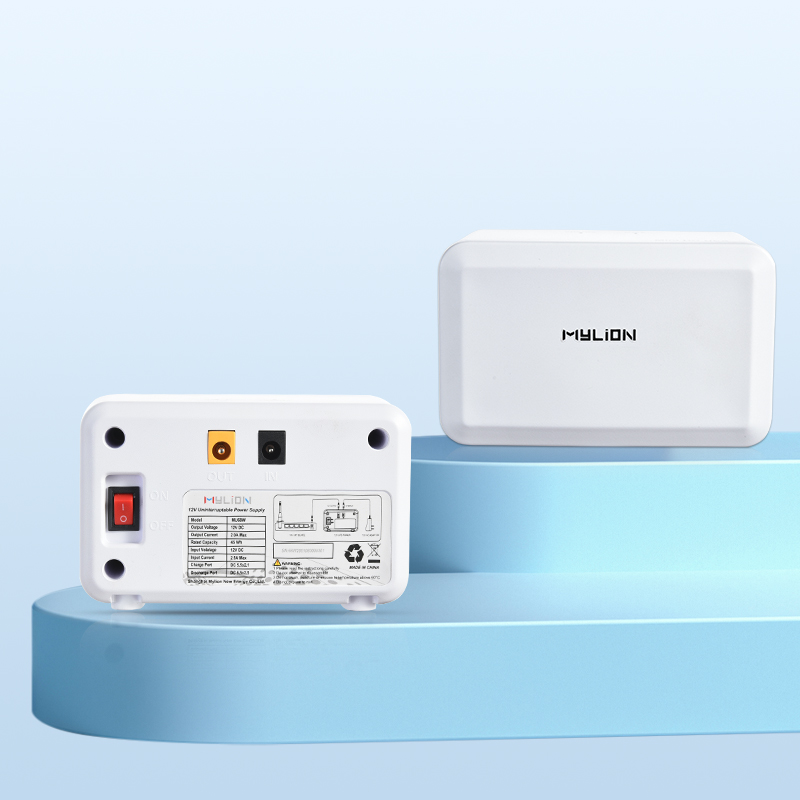
MUC85 Mini UPS
MU68 Mini UPS
MUJ46 Mini UPS
MU35 Mini UPS
How MYLION Approaches Stable Mini UPS Support
MYLION positions its Mini UPS products for telecom and broadband device applications by matching them to practical power roles, not only by battery size. For project discussion, this includes attention to output class, runtime target, single-device versus dual-device use, and real application fit.
For customers evaluating continuity-sensitive scenarios, MYLION Mini UPS can support:
- Model recommendation by device and load type
- Discussion of current margin for router and gateway backup
- Standard-model selection for ONT, router, and dual-device applications
- Sample support for practical evaluation
Explore the full MYLION Mini UPS product lineup here.
FAQ
Q1: Why can a device reboot even when the battery is large enough?
Q2: What kind of devices are most sensitive to poor switchover behavior?
Q3: Does output current of a Mini UPS affect reboot risk?
Q4: Is ONT plus router backup more demanding?
Q5: What should buyers ask during testing of a Mini UPS?
Conclusion
Selecting the right Mini UPS for network backup goes beyond battery runtime. Switchover time, output stability, and reboot risk are critical factors that directly determine whether your ONT, router, or gateway stays online during a power failure. A poorly designed Mini UPS can cause unexpected reboots, service interruptions, and customer dissatisfaction — even with a fully charged battery.
MYLION Mini UPS products are purpose-built for telecom and broadband applications, offering optimized switchover performance, stable output under load, and flexible current margins for single- or dual-device setups. Whether you need backup for a basic ONT or a power-hungry gateway, MYLION provides reliable Mini UPS solutions tailored to your deployment.




 English
  简体中文
简体中文  Deutsch
  Français
  Italiano
  Español