
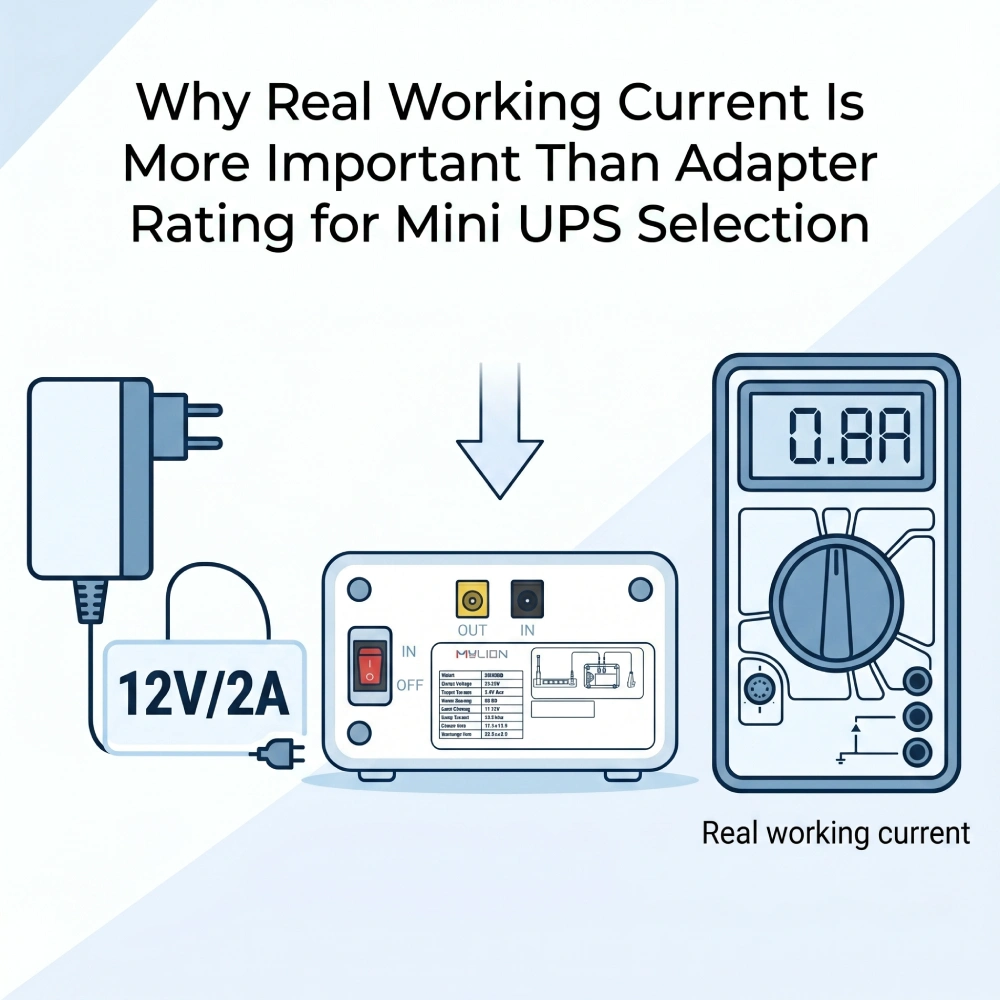
One of the most common mistakes when selecting a Mini UPS for routers, ONTs, or telecom devices is relying solely on the power adapter’s label. The label may state “12V/2A” or “12V/3A”, but this number represents the maximum output capability of the adapter — not the actual current the device draws during normal operation.
Misunderstanding this difference can lead to oversized batteries, unnecessary costs, or failed backup time expectations. This article explains why real working current is the key metric for reliable backup power design.
Adapter Rating vs. Real Working Current: Key Differences
The table below summarizes the critical distinctions between adapter ratings and actual device current:
Aspect | Adapter Rating | Real Working Current |
What it indicates | Maximum current the adapter can supply | Current the device actually consumes |
Measured from | Adapter label or specification sheet | Live device under real operating conditions |
Typical value for a router with 12V/2A adapter | 2A (peak capability) | 0.5A – 1.2A (normal operation) |
Impact on backup time calculation | Overestimates load → oversized battery | Accurate load → correct battery sizing |
Startup / peak behavior | Not reflected | Includes startup, traffic spikes, special modes |
A router using a 12V/2A adapter may only draw 0.5A on average. Using the 2A rating would quadruple the required battery capacity — a costly and unnecessary mistake.
Why This Affects Backup Time and Project Success
Backup time is calculated as:
Backup time (hours) = Battery energy (Wh) × Depth of discharge ÷ Real load power (W)
For a step-by-step explanation and real-world examples, see how to calculate backup time for ONT, router, and CPE devices.
If you overestimate the real load, you will overspecify battery capacity, pay more, and still get the same backup time. If you underestimate the real load, your actual backup time will be shorter than promised — leading to failed sample validation and unhappy end users.
How to Measure Real Working Current Correctly
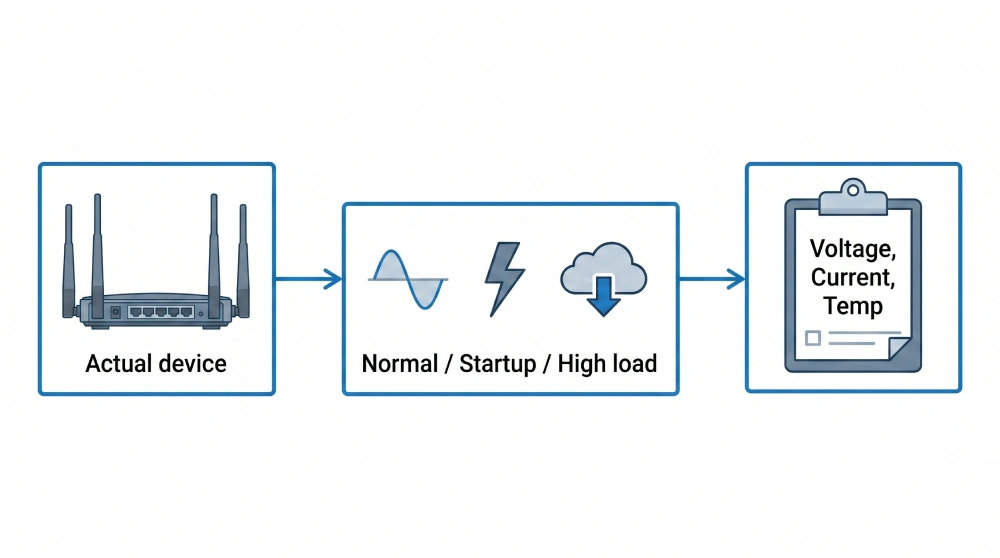
Follow these steps to obtain reliable data:
- Use the actual device — not the adapter label.
- Measure under multiple scenarios:normal operation, startup, heavy traffic (e.g., large file download), and any special modes (e.g., Wi-Fi on/off, USB load).
- Record key parameters:voltage (V), current (A), test duration, ambient temperature, and connected accessories (e.g., external HDD, LTE dongle).
- For ISP projects: test the exact configuration that end users will deploy, including all connected peripherals.
What MYLION Asks Before Recommending a Mini UPS
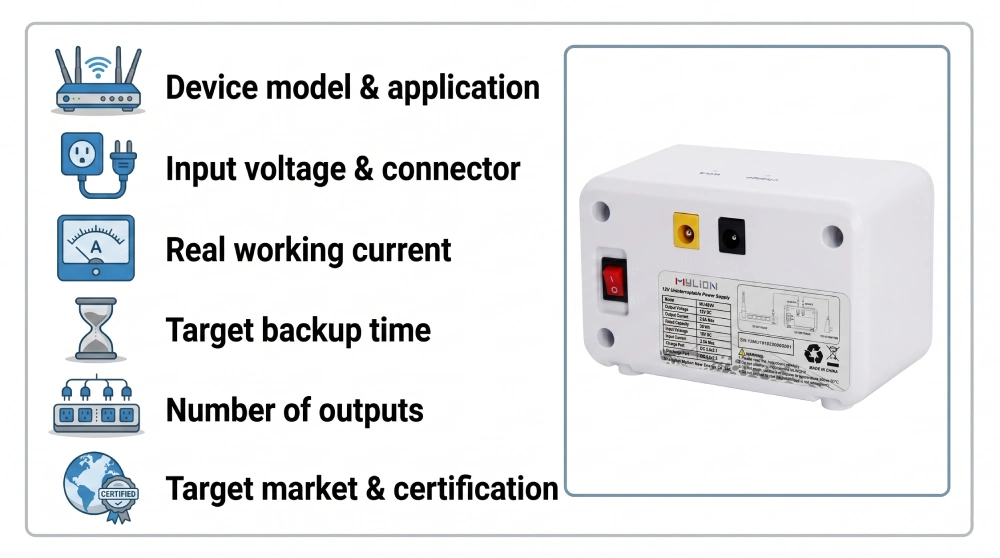
To ensure the right fit, we typically request the following information. For a complete overview, see our Mini UPS product series for 12V routers.
- Device model and application (e.g., ONT, router, CPE, security camera)
- Input voltage and connector type (e.g., 12V DC jack, 5.5×2.1mm)
- Real working current or power consumption (measured, not label value)
- Target backup time (e.g., 4 hours, 8 hours, 12 hours)
- Number of outputs required (single or multiple devices)
- Target market and any certification needs (CE, FCC, UL, etc.)
FAQ
Q1: Why does my device use less current than the adapter label?
Q2: Can MYLION recommend a Mini UPS without real current data?
Q3: Does peak current really matter for Mini UPS selection?
Q4: What happens if I provide the wrong working current value?
How MYLION Supports B2B Buyers
MYLION specializes in Mini DC UPS and lithium battery backup solutions for telecom, ISP, industrial, and security applications. We go beyond component supply — offering:
- Pre-sales consultation with real-current validation
- Custom cable lengths, connector types, and label designs
- Certification documentation (CE, FCC, RoHS, UN38.3)
- Sample testing support and production inspection
- Full shipment documentation for hassle-free logistics
Need a Mini UPS or lithium battery backup solution for ONT, ONU, router, CPE or telecom equipment? Contact MYLION!
Compliance Note
Certification requirements depend on product configuration, target market, power adapter, battery capacity, and final application. Buyers should confirm the applicable requirements before mass production.


 English
  简体中文
简体中文  Deutsch
  Français
  Italiano
  Español