
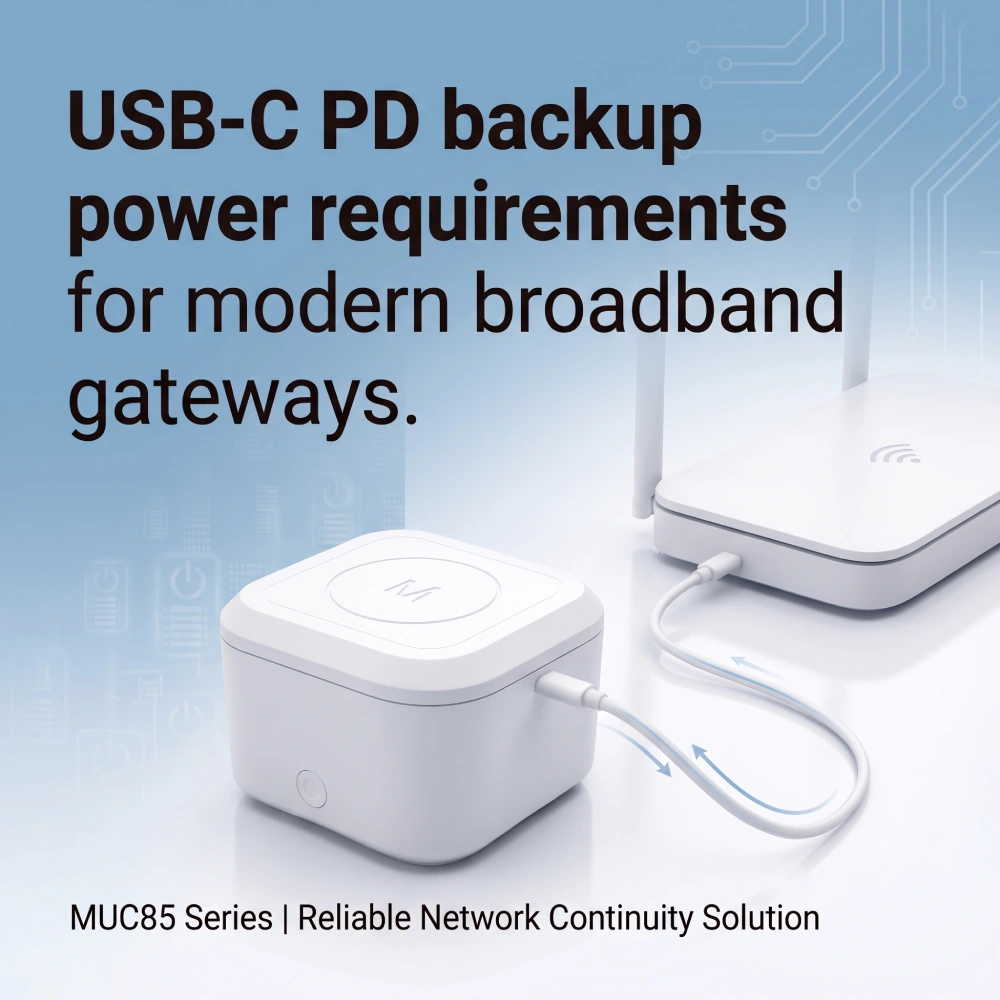
The telecommunications landscape is shifting rapidly. ISPs are rolling out multi-gigabit fiber networks, and telecom operators are aggressively deploying 5G fixed wireless access (FWA).
Beyond the obvious evolution from cable modems to fiber ONTs and from Wi-Fi 5 to Wi-Fi 7, this leap in bandwidth brings a massive change in power requirements: a rapid transition from traditional DC barrel jacks to USB-C Power Delivery (PD).
For ISPs, telecom operators, and system integrators, this introduces a critical challenge. When the grid fails, keeping these high-draw gateways online requires more than a standard battery bank.
This guide breaks down the technical requirements for USB-C PD backup power. We will also explore how purpose-built solutions, like the Mylion MUC85 Mini UPS, deliver the reliable, high-wattage intelligence modern networks demand.
The Shift Toward USB-C PD in Broadband Infrastructure
For decades, broadband hardware power was incredibly standardized. A standard optical network terminal (ONT) or a basic Wi-Fi router relied on a simple 12V DC power supply using a 5.5mm barrel jack.
Today, hardware architecture has evolved to keep pace with soaring data consumption.
- The Interface Evolution:Devices like the latest 5G cellular gateways, FTTH ONTs, and premium Wi-Fi 7 mesh routers are abandoning legacy barrel jacks. USB-C provides a universal, adaptable power standard that reduces global e-waste.
- Massive Power Demands:Modern gateways act like micro-servers. They house multi-gigabit ports, active cooling fans, and power-hungry radio arrays broadcasting on 2.4GHz, 5GHz, and 6GHz simultaneously.
- The Wattage Spike:Static 12V power bricks cannot keep up. A modern gateway may require 15W at idle, but spike to 45W or 65W during heavy localized transmission or boot sequences.
Legacy Power vs. Modern USB-C PD Gateways
Feature | Legacy Broadband Hardware | Modern 5G / Wi-Fi 7 Gateways |
Connection Type | 5.5mm / 2.1mm DC Barrel Jack | USB-C |
Power Protocol | Static / Fixed (Usually 12V) | Actively Negotiated (USB-C PD) |
Average Wattage | 10W – 18W | 15W – 65W |
Power Management | Basic continuous draw | Dynamic scaling based on load |
Understanding USB-C PD Specs for Gateways
To properly back up a modern gateway, procurement teams must understand how USB-C Power Delivery actually works. Unlike static DC outputs that push a constant voltage blindly, USB-C PD is an intelligent, actively negotiated standard.
Voltage and Wattage Negotiation
When a gateway plugs into a USB-C PD power source, a digital handshake occurs instantly over the cable. The router tells the power supply its exact requirements.
The PD standard supports multiple voltage steps: 5V, 9V, 12V, 15V, and 20V.
If a backup power supply cannot successfully negotiate the correct profile (e.g., defaulting to 9V when the router requires 20V), the gateway will fail to boot, throttle its performance, or trigger a protective shutdown.
Bi-Directional Efficiency
Advanced USB-C PD backups use bi-directional ports. A single Type-C port handles both the input charging current from the wall and the output discharging current to the gateway. This minimizes discrete circuits, lowers internal heat, and dramatically improves 24/7 efficiency.
Key Requirements for a Reliable USB-C PD Mini UPS
To guarantee uninterruptible connectivity for high-power devices, hardware distributors must source Mini UPS units engineered for modern demands.
Here is what you need to look for:
- High-Wattage Headroom:Natively support high-wattage USB-C PD output, peaking between 45W and 65W. This handles sudden power spikes during modem initialization without tripping electronic fuses.
- Smart IC Protections:Network environments run 24/365. A reliable Mini UPS needs smart charge management to govern power. This ensures strict overcharge, over-discharge, short-circuit, and thermal protection.
- High-Density Lithium Capacity:Backup runtime relies on Watt-hours (Wh). A modern gateway drawing 12W requires a substantial battery capacity to survive a grid outage. Aim for 60Wh or higher in a compact, desk-friendly form factor.
- Zero transfer time:Perhaps the most critical requirement for gateway backup power is switching speed. For true uninterrupted operation, backup power must deliver zero transfer time (0ms).
- PD protocol negotiation: A USB-C PD backup solutionmust support the full range of voltage profiles that the gateway may request. This means supporting 5V, 9V, 12V, and 15V profiles at appropriate current levels.
How Mylion Mini UPS Solutions Meet High-Power Gateway Demands
Recognizing the shift in telecom power, MYLION developed a line of Mini UPS devices engineered explicitly for B2B broadband and network continuity.
Product Spotlight: The Mylion MUC85 USB-C PD Mini UPS
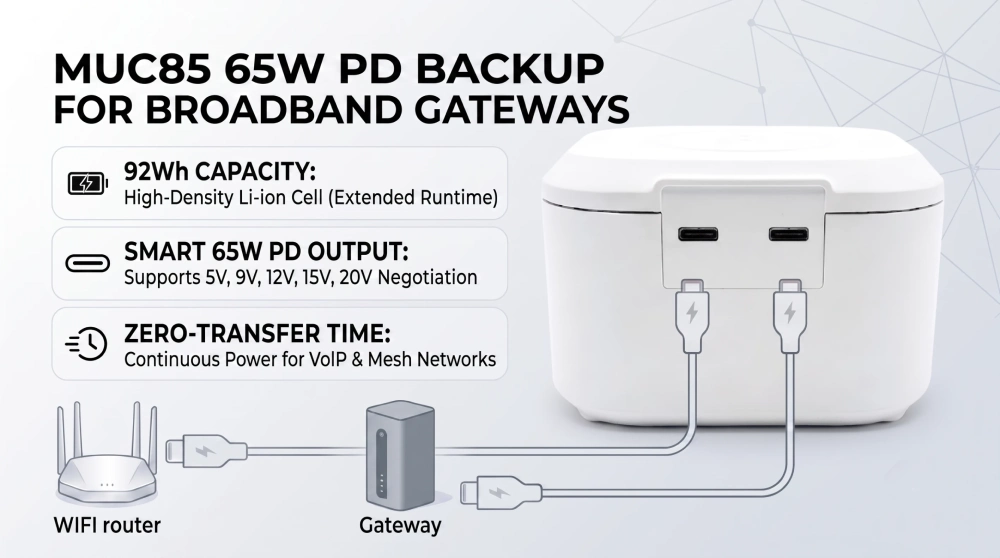
The Mylion MUC85 is a 92Wh USB-C PD Mini UPS specifically designed for modern network devices.
Here is why it stands out for ISP deployment:
- Massive Battery Capacity:It features a robust 92Wh high-density lithium-ion battery. This ensures extended uptime during severe weather or rolling blackouts.
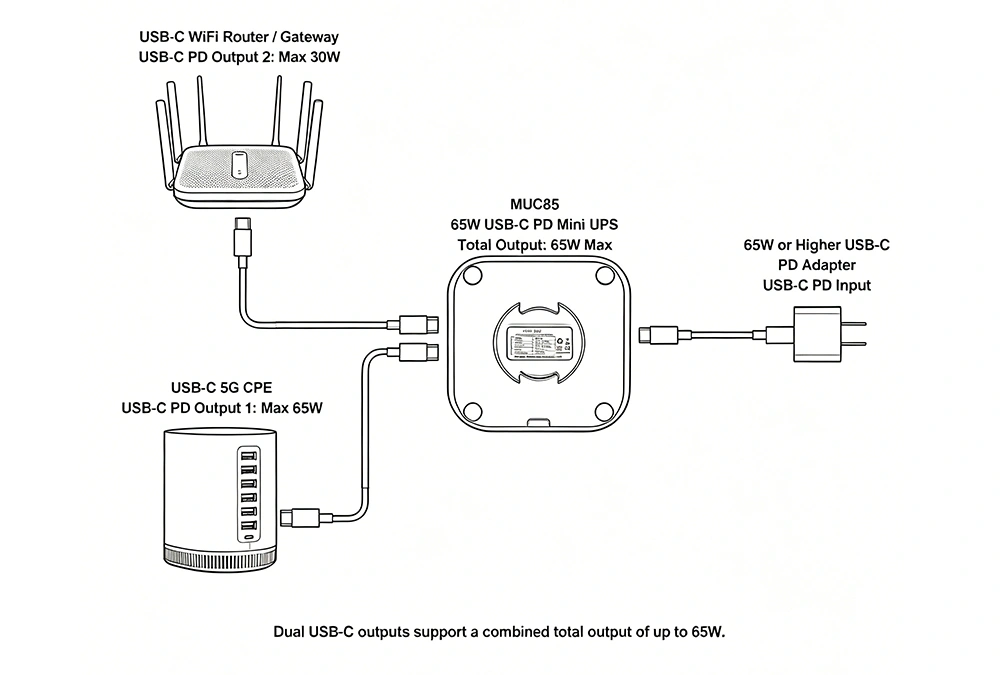
- 65W Bi-Directional PD Port:The primary port (20V / 3.25A) guarantees seamless voltage negotiation (5V, 9V, 12V, 15V, 20V). It easily powers the most demanding 5G CPE devices and Wi-Fi 7 meshes.
- Dual Type-C Outputs: The MUC85 offers a 65W bidirectional port for primary devices and a secondary 30W unidirectional Type-C PD port for secondary applications, like an ONT or VoIP phone.
- B2B Reliability: Every unit undergoes full inspection prior to shipment. Manufactured to meet global procurement standards, it is ready for wide-scale OEM/ODM projects.
Mylion MUC85 Quick Specs
Specification | Detail |
Battery Capacity | 92Wh (High-Density Lithium-Ion) |
USB-C PD Output | Output 1 at 65W max, Output 2 at 30W max |
Max Output | 5V / 9V / 12V / 15V 3A 20V 3.25A |
Safety Features | Smart IC (Overcharge, Thermal, Short-Circuit protection) |
Ideal Application | 5G Gateways, Wi-Fi 7 Mesh, FTTH ONTs, Small Servers |
Certifications | CE / FCC / UN38.3 / IEC 62368 |
Case Material | Fire-resistant ABS |
The MUC85 is suitable for USB-C powered routers, gateways, mesh Wi-Fi systems, mobile hotspots, VoIP devices, and selected CPE equipment. Its compact form factor makes it deployable in space-constrained environments where traditional UPS units cannot fit.
Deploying USB-C PD Backup Power: Considerations for ISPs
For ISPs, every minute of unplanned CPE downtime translates into SLA penalties, support calls, and subscriber churn. The root cause is often not the network itself but the power supply: voltage sags, micro-outages, or complete blackouts at the customer premises.
When deploying USB-C PD backup power at scale, several factors warrant attention:
- Voltage and connector compatibility: Mismatched voltages result in immediate hardware failure. Confirm that the backup solution supports the exact voltage profile your gateway requires.
- Output current rating:Inadequate amperage leads to thermal throttling and hardware dropouts. Select a backup solution rated for peak demand, not just average consumption.
- Runtime requirements:Calculate required battery capacity based on your backup time target. The Mylion MUC85 can provide approximately 12–15 hours of backup runtime.
- OEM and ODM support: For project-based deployments, Mylion offers branding and packaging customization, cable and accessory options, project-based product matching, and sample support for evaluation.
FAQ
Q1: Can I use a standard USB-C power bank as backup power for my broadband gateway?
Q2: Can a single Mini UPS power both my ONT and my router?
Q3: Do I need a special cable to connect the Mini UPS to my gateway?
Q4: Will a USB-C PD Mini UPS power older 12V barrel-jack routers?
Q5: What happens to the Mini UPS when grid power is automatically restored?
Q6: Can the MUC85 power other devices like laptops during an outage?
Conclusion
The transition from standard 12V DC power to intelligent, negotiated USB-C PD is fundamentally reshaping the network edge. As multi-gigabit fiber ONTs, 5G cellular routers, and Wi-Fi 7 meshes demand dynamic power loads, the telecom industry must adopt smart, high-density power solutions.
By leveraging advanced lithium technology and dual 65W/30W PD output capabilities, Mylion MUC85 USB-C PD solutions provide the exact performance metrics mission-critical infrastructure requires.

 English
  简体中文
简体中文  Deutsch
  Français
  Italiano
  Español