Mini UPS for ONT, ONU, Router & ISP Backup Projects

How to Reduce Field Failure Risk in ISP Backup Power Rollout

How to Reduce Field Failure Risk in ISP Backup Power Rollout with the Right Mini UPS Strategy

Introduction In ISP backup power projects, field failure is rarely caused by one problem alone. Most deployment issues come from a chain of small mismatches: wrong connector, underestimated load, mixed device families, unclear installation logic, inconsistent incoming parts, or unrealistic runtime assumptions. Each issue may look minor by itself. Together, they create complaints, replacements, and operational […]

How to Reduce Field Failure Risk in ISP Backup Power Rollout with the Right Mini UPS Strategy Read More »

IEC 62368-1 safety standard for Mini DC UPS connected to ONT and router

IEC 62368-1 for Mini UPS: What Telecom and ISP Buyers Should Know

IEC 62368-1 is a crucial safety standard for audio/video, information, and communication technology equipment. For Mini DC UPS products used with ONT, ONU, routers, gateways, or CPE devices, buyers increasingly ask whether the backup power system has been evaluated under a suitable safety framework. This guide explains what IEC 62368-1 means for your procurement decisions and

IEC 62368-1 for Mini UPS: What Telecom and ISP Buyers Should Know Read More »

Mini DC UPS Certifications Required for Telecom & ISP Applications

What Certifications Are Required for Mini DC UPS Used in Telecom and ISP Applications?

For telecom operators, ISPs, and system integrators, a Mini DC UPS is more than a small backup battery. It is an integral part of a power system connected to communication equipment that may operate 24/7 in homes, offices, telecom cabinets, or network access points. That is why certification and compliance checks should be addressed before

What Certifications Are Required for Mini DC UPS Used in Telecom and ISP Applications? Read More »

How to Design Subscriber-Side Power Continuity for FTTH Networks

How to Design Subscriber-Side Power Continuity for FTTH Networks

Introduction Power outages do not always take the fiber network down. But they often take the subscriber offline. In FTTH projects, the most common interruption point during a grid failure is not the upstream optical line. It is the customer-side equipment: ONT, ONU, router, or gateway. Once those devices lose power, the service disappears at

How to Design Subscriber-Side Power Continuity for FTTH Networks Read More »

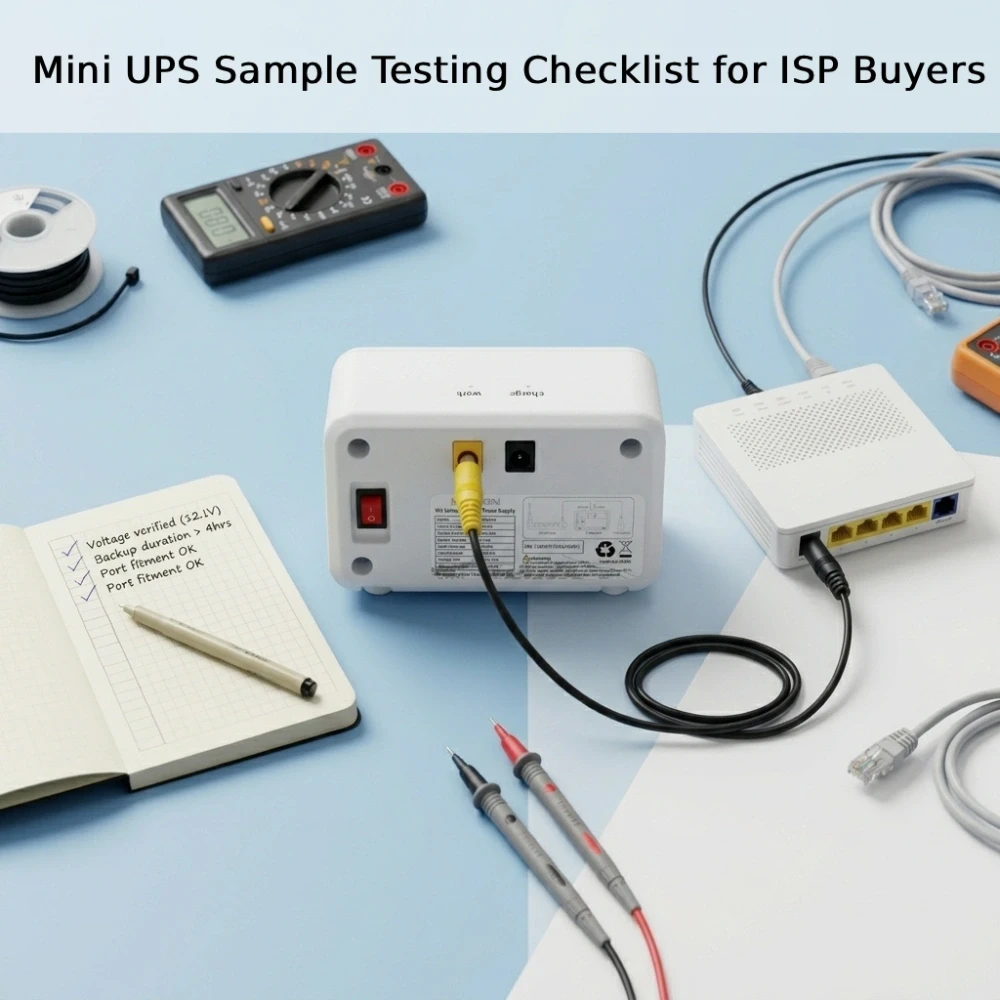
What Makes a Mini UPS “Project-Ready” for Telecom and Broadband Customers

What Makes a Mini UPS “Project-Ready” for Telecom and Broadband Customers

Introduction A Mini UPS that works in a sample test is not automatically project-ready. For telecom operators, ISPs, distributors, and system integrators, a reliable Mini UPS for Telecom and Broadband must go beyond a battery pack and a successful bench demo. A project-ready backup solution must be easy to evaluate, standardize, deploy, and maintain across batches. Many

What Makes a Mini UPS “Project-Ready” for Telecom and Broadband Customers Read More »

USB-C Mini UPS for Modern Network Devices

USB-C Mini UPS for Modern Network Devices: Opportunities and Design Challenges

For ISPs, every minute of unplanned CPE downtime translates into SLA penalties, support calls, and churn. The root cause is often not the network itself but the power supply: voltage sags, micro-outages, or complete blackouts at the customer premises. Traditional UPS units are too large, expensive, and inefficient for low-power 12V devices like ONTs, ONUs, and

USB-C Mini UPS for Modern Network Devices: Opportunities and Design Challenges Read More »

What Causes Service Interruptions During Power Outages in FTTH Networks

Why ISPs Need More Than Backup Time in a Mini UPS Solution

Most ISPs evaluate a mini UPS solution by one metric: backup time. Longer runtime appears better. But in real FTTH, outdoor, or CPE deployments, backup time alone is a misleading metric. Space is limited. Maintenance costs dominate. Lead-acid batteries fail quickly. ISPs need a mini UPS that fits physically, operates safely, and minimizes truck rolls. This

Why ISPs Need More Than Backup Time in a Mini UPS Solution Read More »

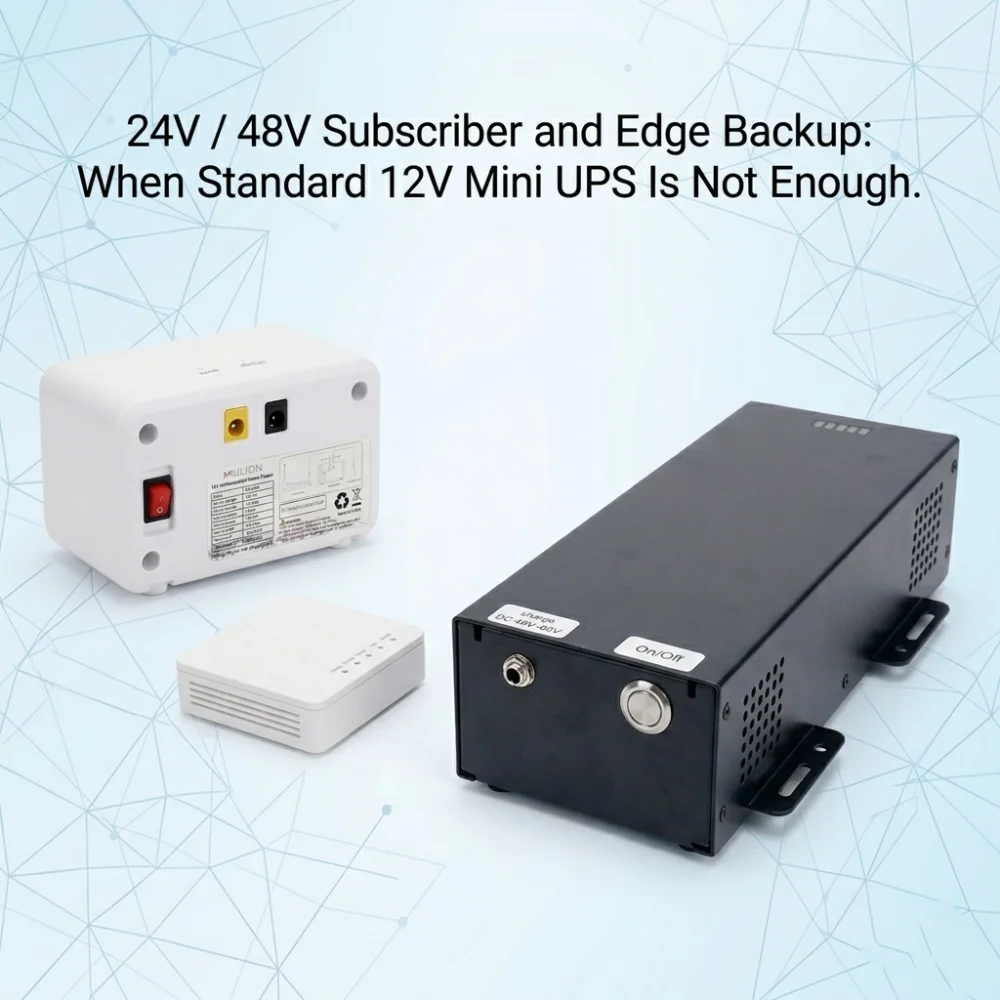
24V and 48V DC UPS for Telecom and Wireless Network Applications

24V and 48V DC UPS for Telecom and Wireless Network Applications

Introduction – The 24V/48V DC Backup Gap in Modern Telecom Deployments Most outdoor wireless CPEs, point-to-point radios, FTTH ONUs, and 4G/5G small cells run on 24V or 48V DC. Standard 12V Mini UPS units cannot power them. Mismatched voltage leads to boot failures, inefficient operation, or permanent damage. Telecom operators and ISPs need a dedicated DC backup

24V and 48V DC UPS for Telecom and Wireless Network Applications Read More »

Mini UPS for Modem and Router Backup Single Device vs Dual Device Setup

Mini UPS for Modem and Router Backup: Single Device vs Dual Device Setup

Introduction Modern business operations—remote work, VoIP, POS systems, and cloud services—depend entirely on uninterrupted network connectivity. A common blind spot: even with server-rack UPS, the last-mile access devices (modem/router) are often left unprotected. A brief power flicker or brownout takes down the modem or router, and the entire site goes offline. Mini UPS has emerged as

Mini UPS for Modem and Router Backup: Single Device vs Dual Device Setup Read More »

Is Bigger Battery Always Better for Router and ONT Backup

Is Bigger Battery Always Better for Router and ONT Backup?

Telecom companies and ISPs often default to large backup batteries for customer-premise ONTs, routers, and outdoor network nodes. The logic seems sound: longer runtime prevents customer churn during extended outages. But for a typical last-mile deployment, oversized batteries create more problems than they solve – higher CAPEX, bulky enclosures, safety risks, and unnecessary battery swaps

Is Bigger Battery Always Better for Router and ONT Backup? Read More »

en_USEnglish
滚动至顶部

Get A Quotation